Why Emergency Roof Repair Leads Are Different From Every Other Lead You've Ever Handled
At 2:47am, Mrs. Johnson wakes up to water dripping on her forehead. She runs upstairs and finds water pouring through her bedroom ceiling. Her hardwood floors are already warping. Her first thought isn't "I need to compare three quotes." It's "I need this fixed RIGHT NOW."
This is the mindset of every emergency roofing customer. They're not shopping. They're not comparing your Better Business Bureau rating to the guy down the street. They're panicking.
Emergency roof repair lead generation works completely differently than regular roofing leads because the customer psychology is totally different. When someone calls you at midnight because a tree just punched through their roof, they don't care that you're 20% more expensive than your competitor. They care that you answered the phone and the other guy didn't.
I've seen contractors miss this completely. They treat emergency calls like regular estimates - "I'll swing by tomorrow morning and take a look." By tomorrow morning, three other contractors have already been there with tarps.
What Actually Happens During a Roofing Emergency
Let me walk you through what your customer is experiencing when they call you with an emergency. Understanding this changes everything about how you handle these leads.
First, there's the initial damage. Maybe it's a storm that just ripped shingles off half their roof. Maybe it's a tree limb that created a hole the size of a washing machine. Maybe it's that slow leak that finally gave way and is now dumping water into their living room.
Within the first hour, they're dealing with immediate damage control. Moving furniture, putting out buckets, trying to protect belongings. They're stressed and overwhelmed.
By hour two, they realize this isn't something they can handle themselves. They start making calls. Here's the key: they're not calling one contractor. They're calling everyone they can find online until someone answers and says they can help today.
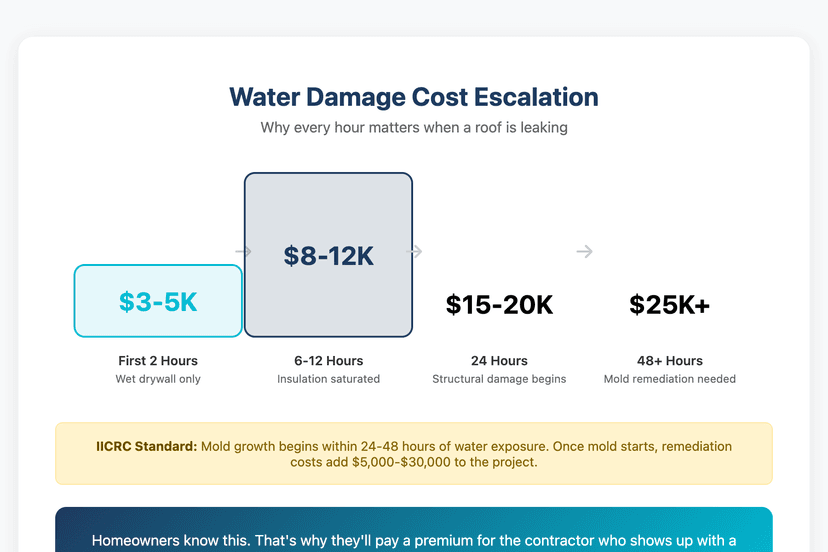
According to the Institute of Inspection Cleaning and Restoration Certification (IICRC), water damage doubles in cost every 24 hours it's left untreated. What starts as a $5,000 roof repair becomes a $25,000 restoration job if water sits for just one day. Your customer knows this, even if they don't know the exact numbers.
Why Speed Beats Everything Else in Emergency Situations
When someone has water pouring into their house, their decision-making process is completely different from normal home improvement projects. Price becomes secondary to availability and response time.
Think about it from their perspective. They have:
- Water damage that's getting worse every hour
- Potential mold growth starting within 24-48 hours
- Insurance claim deadlines they need to meet
- Family members who can't sleep in their bedrooms
- Neighbors asking if they need help
In this situation, the contractor who shows up first with solutions wins. Not the cheapest. Not the one with the best website. The one who's there.
I know contractors who charge 50% more for emergency calls and customers thank them for it. Why? Because they showed up at 11pm on a Sunday with tarps and stopped the water damage from getting worse.
| Response Time | Customer Mindset | Your Success Rate |
|---|---|---|
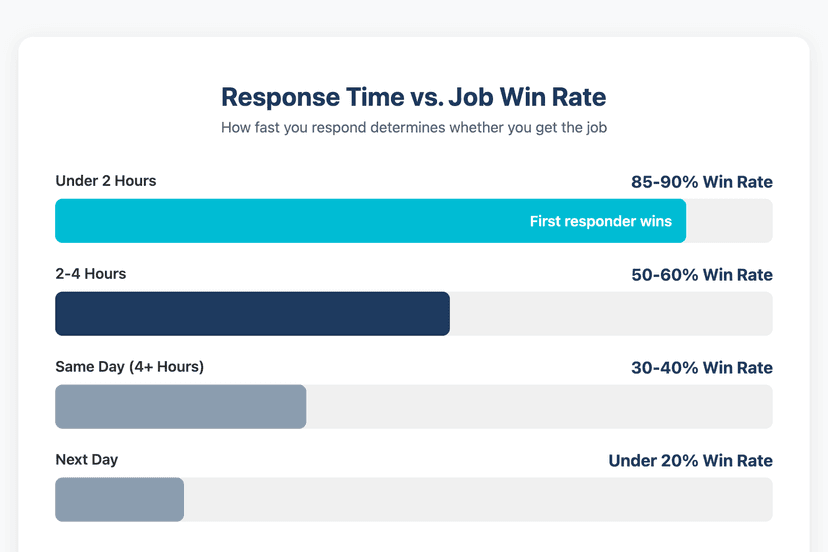
| Within 2 hours | "Thank God, someone who can help" | 85-90% |
| Same day (4-8 hours) | "Finally, a callback" | 60-70% |
| Next day | "Too late, already hired someone" | 20-30% |
What Fast Emergency Response Actually Looks Like
Here's what separates contractors who win emergency jobs from those who miss them completely:
Answer your damn phone. Not tomorrow. Not when you get around to checking messages. Right now. Emergency customers are calling 3-4 contractors. The first one who picks up and says "I can be there in two hours" gets the job.
Set up a system where emergency calls get through. Forward your business line to your cell phone after hours. Use a service that screens calls and forwards real emergencies. Whatever it takes.
Show up with immediate solutions. Your truck should always have tarps, plastic sheeting, and basic materials for temporary repairs. When you arrive, your first priority is stopping additional damage. Fix it properly later - protect it right now.
Communicate constantly. Emergency customers need reassurance. Text them when you're on your way. Call when you arrive. Explain what you're doing and what happens next. They're panicked - your job is to calm them down.
One contractor I know keeps emergency kits in his truck year-round: tarps, nails, plastic sheeting, and basic tools. When he gets an emergency call, he doesn't need to stop at the supply house. He goes straight to the customer.
The Real Cost of Slow Response Times
Missing emergency calls doesn't just mean losing one job. It means losing the most profitable jobs in your business.
Emergency repairs typically pay 40-60% more than regular jobs. Customers understand they're paying for immediate service and they're willing to do it. But only if you're actually providing immediate service.
Here's what happens when you're slow to respond:
By the time you call back, another contractor has already assessed the damage and provided a temporary fix. Your potential customer isn't panicking anymore - they're comparing quotes. You've lost your advantage.
Even worse, that fast-responding contractor now has the inside track on the full repair job. They've built trust by solving the immediate problem. Why would the customer hire someone else for the permanent fix?
According to the National Association of the Remodeling Industry, contractors who respond to emergency calls within two hours win 85% of those jobs. Contractors who take more than four hours win less than 30%.
How to Set Up Your Business for Emergency Response Success
Winning emergency leads isn't about having the biggest marketing budget. It's about having systems that let you respond faster than your competition.
Create an emergency phone system. Use call forwarding or a service like Answering Service Care that specializes in contractor calls. Make sure someone knowledgeable answers, not just anyone who picks up the phone.
Keep emergency supplies stocked. You need tarps, plastic sheeting, roofing cement, nails, and basic repair materials ready to go. Don't wait until you get a call to figure out what you need.
Establish clear pricing for emergency work. Customers expect to pay more for immediate service. Have your emergency rates figured out in advance so you can quote quickly and confidently.
Train your team on emergency protocols. Everyone who might take an emergency call needs to know: get contact information, assess urgency, provide realistic timeframes, and dispatch immediately if needed.
Map out your response area and know your average travel times. When someone calls with an emergency, you need to give them an accurate arrival time and stick to it.
"The contractor who showed up at 10pm with tarps and stopped the leak got our $15,000 insurance job. The other three contractors who called back the next morning never had a chance." - Homeowner review from Angie's List
Why Premium Pricing Works for Emergency Jobs
Emergency customers don't resent paying more - they expect it. They understand they're asking you to drop everything and help them right now. What they resent is paying emergency prices for slow service.
Your emergency pricing should reflect the value you're providing:
- Immediate response preventing additional damage
- After-hours availability
- Temporary repairs that protect their property
- Peace of mind during a stressful situation
Most contractors I know charge 1.5x to 2x their normal rates for true emergencies. Customers pay it without complaint when you deliver on your promise of immediate help.
The key is being upfront about pricing. When they call, explain that emergency service includes a premium but prevents much larger damage costs. Frame it as saving them money in the long run.
| Damage Type | Immediate Repair Cost | Cost if Left for 24 Hours | Cost if Left for Week |
|---|---|---|---|
| Small roof leak | $500-1,000 | $2,000-5,000 | $10,000-20,000 |
| Storm damage | $1,500-3,000 | $5,000-10,000 | $15,000-30,000 |
| Tree damage | $2,000-4,000 | $8,000-15,000 | $20,000-40,000 |
Frequently Asked Questions
How quickly should I respond to emergency roof repair calls?
Answer emergency calls within 15 minutes maximum. If you can't take the call immediately, use an answering service that can dispatch you right away. Customers calling with emergencies are contacting multiple contractors, and the first one who responds usually gets the job. Aim to be on-site within 2-4 hours for true emergencies.
What supplies should I keep in my truck for emergency calls?
Always carry tarps in multiple sizes, plastic sheeting, roofing cement, galvanized nails, basic hand tools, and a cordless drill. Include rope or bungee cords for securing tarps and a flashlight or headlamp for night work. Having these materials ready means you can provide immediate temporary repairs without stopping at a supply store first.
How much more should I charge for emergency roof repairs?
Most successful contractors charge 1.5 to 2 times their normal rates for true emergencies that require immediate response outside normal business hours. Be transparent about emergency pricing upfront. Customers understand they're paying for immediate service and availability, especially when you explain how quick response prevents much costlier damage.
What constitutes a true roofing emergency versus a regular repair?
True emergencies involve active water intrusion, structural damage that threatens safety, or storm damage that leaves the home exposed to elements. Regular repairs can wait for normal business hours without causing additional damage. Emergency calls typically come outside business hours and require immediate temporary protection while planning permanent repairs.
How do I handle emergency calls when I'm already booked with other jobs?
Build emergency response into your business model by keeping some capacity available or having trusted subcontractors you can call. Consider partnering with other contractors for emergency coverage during your busiest periods. Emergency jobs are typically more profitable than regular work, so it often makes financial sense to reschedule non-urgent work when possible.
Next step: once your emergency response speed is tight, route the revenue side through the ROI calculator, lock your follow-up into the homeowner text generator, and connect the whole process to GhostRep's roofing workflow so fast response also turns into booked jobs.
If your issue is call handling after hours, Echo is the product page to review next.
Related Reading
Free lead-generation resources
Turn traffic strategy into pipeline actions
Use free marketing and field tools to turn website, referral, and follow-up ideas into lead flow your reps can actually work.
Marketing tools
Generate ad copy, email sequences, company bios, and lead-conversion messaging for your market.
Browse marketing tools →Field sales tools
Create follow-up assets, texts, and homeowner-facing copy once a lead is already in motion.
Browse field sales tools →Job Intel
Give reps better customer context before the follow-up so lead quality is easier to convert.
See Job Intel →About the Author
Tim Nussbeck
Founder & CEO of GhostRep
Two decades in roofing—knocking doors, running teams, training 1,000+ reps. Built GhostRep to give every rep access to the coaching top teams get.
Lead-gen next step
Turn traffic into pipeline math before you buy more leads
Start with the ROI calculator or lead-generation tools if you are still diagnosing the economics. Book a walkthrough if you want GhostRep tied to lead handling, follow-up, and close-rate lift.
- ✓Best fit if traffic is arriving but too little of it turns into revenue.
- ✓Useful for modeling conversion lift before you increase spend.
- ✓Demo shows how field execution and coaching change lead economics after the click.
Start Here
Model your conversion lift
Estimate what more leads, better close rates, and faster rep ramp are worth in revenue.
Model your conversion liftNeed it mapped to your team?
Talk through your current workflow, traffic mix, and where GhostRep fits before you change anything.
Book a 15-minute walkthroughYou Might Also Like
Compare Angi, HomeAdvisor, LSA, PPC, SEO, referrals, and canvassing by cost per lead, close-rate risk, and real booked-job cost.
Read article →Compare Angi vs HomeAdvisor cost for roofing contractors in 2026: 8-18% shared-lead close rates, booked-job math, and when each platform fits.
Read article →Compare how to get roofing leads from storm leads, door-to-door, Google Ads, SEO, referrals, Facebook, and lead aggregators by real cost.
Read article →