Short answer: Roofers scale past referrals by keeping the referral system, then adding one owned demand channel and one measurable paid or outbound channel. For most established roofing companies, that means local SEO and Google Business Profile work paired with Local Services Ads, tightly managed paid search, partnerships, or territory-based canvassing. The right mix depends on your market, review profile, crew capacity, and response speed.
The number that matters: not cost per lead, but cost per sold job and gross profit per sold job. A $30 lead you never reach is more expensive than a $300 lead you close.
Before you buy more leads: make sure reps can answer fast, qualify, follow up, and handle price and insurance objections. Practice that in Role Play, keep field visibility with Echo, and run your own numbers in the ROI calculator.
Referrals are usually the best first source of roofing work, but they cannot produce on demand. Their ceiling is set by the size of the completed-customer base, the timing of replacement cycles, and whether customers remember to make an introduction. Scaling past that ceiling does not mean abandoning referrals. It means building a lead mix that creates demand between referral events.
Most "how to get roofing leads" advice hands you the same list — SEO, ads, referrals — and walks away. That list is useless without the part nobody writes down: which channel fits a company at your stage, and what breaks its economics.
More leads also do not fix a weak response process. If reps are slow to call, thin on qualifying, or fold on the first price objection, buying more leads just raises the cost of the same leaks. Fix the sales side first, then add one channel at a time and compare it with referrals using the same funnel math.
Next Step
Turn lead strategy into the first field action
If the goal is more roofing leads, the next click should help the team create conversations, not just compare channels.
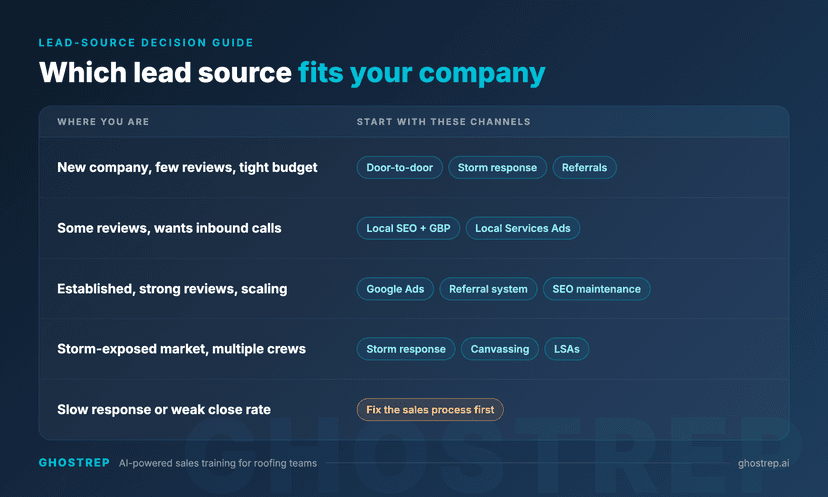
Best fit by situation
Use this as a starting point, not a rule. Your review profile, crew capacity, and response speed will move these around.
| Where you are | Channels that usually fit first | Why |
|---|---|---|
| Brand new, few reviews, tight budget | Door-to-door, storm response, referrals from every job | Cheap to start, no ad history needed, and it builds the reviews everything else depends on |
| Some reviews, wants inbound calls | Local SEO and Google Business Profile, Local Services Ads | Reviews and proximity drive both; LSAs are pay-per-lead through a Google Verified profile |
| Established, strong reviews, wants scale | Google Ads, a real referral system, SEO maintenance | Brand and reviews make paid search efficient; referrals compound as your customer base grows |
| Storm-exposed market, multiple crews | Storm response, canvassing, LSAs | Speed and capacity win when damage is fresh and homeowners need it done now |
| Slow response or weak close rate right now | None yet — fix the sales process first | More leads only multiply an existing leak |
The math that decides every channel
Cost per lead is a vanity number. The one that pays your crew is cost per sold job:
Cost per sold job = channel spend ÷ sold jobs.
Sold jobs are not a fixed share of leads. They come out the far end of a funnel:
Sold jobs = leads × contact rate × appointment rate × show rate × close rate.
Here is why that matters, as an example — not a benchmark. Say a channel gives you 50 leads for $5,000. Reach 60% of them, set appointments with 60% of those, get an 80% show rate, and close 20%. The expected result is 2.88 jobs, or roughly 3, at about $1,700 per sold job — not the "$100 cost per lead" the report shows.
Now change nothing about the spend and move contact rate to 80% and close rate to 30%. The same formula produces 5.76 jobs, or roughly 6, at about $870 each. Same leads, stronger sales execution, roughly half the acquisition cost.
That is why generic cost-per-lead benchmarks are dangerous. A "$45 roofing lead" and a "$300 roofing lead" can land at the same cost per sold job — or trade places — depending on your contact and close rates. Plug your own funnel into the roofing lead cost calculator before you trust any published figure.
Referrals and reviews
Good for: any company that does solid work and actually asks. Reviews also support local visibility and LSA profile quality, so this channel quietly powers the others.
When it fails: you are brand new with no past customers, your quality is inconsistent, or you never ask. A passive "hope they remember us" approach is not a system.
How to check fit: track the percentage of completed jobs where your team asks, the referrals created, and the referrals that become sold work. Build the workflow with a referral program for roofing, and turn jobs into reviews that generate leads.
How Roofers Can Scale Past Referrals
Referrals are a strong trust channel, but they are constrained by the size and timing of the completed-customer base. To scale past referrals, keep the referral system and add one owned demand channel plus one measurable paid or outbound channel. For many established roofers, that means local SEO and Google Business Profile work paired with Local Services Ads, tightly managed Google Ads, or a territory-based canvassing program.
Do not spread budget across every source at once. Choose the next channel from the constraint: add paid search when demand speed is the problem, SEO when auction dependence is the problem, canvassing when territory control is the problem, and partnerships when trust transfer is the advantage. Preserve source, owner, contact, appointment, signed-job, completed-job, and gross-profit data in the CRM so the new channel can be compared with referrals on the same basis.
Use the roofing lead cost benchmark when you need channel-by-channel cost context, or compare roofing SEO with Google Ads when that is the immediate budget decision.
Three Roofing Companies, Three Executable Channel Tests
These are illustrative company scenarios, not customer results or recommended market prices. The budgets are operating caps chosen for the examples. Replace every rate, labor cost and margin allowance with your own records. A test is complete when its records support a decision, not when a calendar says it should.
1. New Roofer: One Dense Route and a Referral Process
Situation: one owner, one crew, few reviews and $750 available for acquisition. Start with a permitted, compact canvassing route and ask completed customers for introductions. Keep an accurate Google Business Profile, but do not count future rankings as jobs already won.
Set up: choose one service area and job type, prepare the truthful doorstep demonstration, assign a route ID, and reserve inspection capacity. Example cap: $150 for route materials and travel plus 20 hours valued at $30 ($600). Owner time remains a cost even when it is not a cash wage.
Record: answered doors, permission to continue, fit, held inspections, collected jobs and actual hours. Keep referrals in a separate source group. Stop or repair if the route is impractical, contact restrictions prevent the activity, or appointments exceed available capacity. Scale only after completed route cohorts clear the company's acquisition allowance without deteriorating held appointments or increasing complaints.
2. Established Roofer: One Search Campaign With an Answer Owner
Situation: two sales reps, an office that answers inquiries, established reviews, and room for three additional replacement jobs. Choose one local high-intent search campaign, or evaluate LSA eligibility and its separate economics. Do not merge their results.
Set up: limit the example to one replacement service area, a relevant landing page, call/form attribution, and an office owner. Example acquisition cap: $2,400 advertising + $300 setup/tracking + $600 response labor = $3,300. A company allowance of $1,100 per collected job would require three collected jobs to meet the cap. These inputs are hypothetical, not a forecast of search performance.
Stop or repair when calls are missed, wrong-area inquiries dominate, tracking cannot connect to jobs, or the spending cap is reached. Fix the first failed stage. Scale after more than one mature cohort meets the allowance and production still has capacity. A platform conversion alone is not a collected job.
3. Busy Roofer With Unworked Inquiries: Recover the Existing Queue
Situation: four crews, forty existing inquiries without a documented outcome, and inconsistent callback ownership. The next test is the handoff. Assign each inquiry, verify its source and current contact permission, remove closed or opted-out records, and separate genuine opportunities from duplicates.
Set up: allow ten office hours at an illustrative $35 plus two manager hours at $50: $450. Reconcile original acquisition spend separately; $450 measures this incremental recovery activity, not the all-in cost of the original leads. Use the routing and appointment handoff guide and the call branches below.
Stop or repair when no valid contact path exists, the homeowner declines, or no job capacity remains. Resume new acquisition when every active inquiry has an owner and next action and the business can absorb more work. Do not credit the recovery activity with all historical revenue or assume all forty inquiries are qualified.
Build your own channel test from these examples. The two-page worksheet captures the company constraint, budget, response owner, source definitions and stop-or-scale decision, with the $3,300 example worked through.
Download the printable PDF · Free, no email required.
Local SEO and your Google Business Profile
Good for: building an owned source of inbound demand around the services and locations you actually serve. Google's own local-ranking guidance centers on relevance, distance, and prominence; complete business information, reviews, responses, and photos all support that work.
When it fails: you need jobs immediately, the profile is incomplete, or the website has no useful service-area content. Treat any exact "months to rank" or "cost per lead" timeline as a market-specific estimate, not a promise.
How to check fit: can you keep the profile accurate, earn reviews consistently, and publish useful local pages without needing an immediate payback? If so, follow this guide to ranking in the Google Maps pack for roofing.
Google Local Services Ads (LSAs)
Good for: high-intent, pay-per-lead demand from a Google Verified profile. You pay for valid leads instead of clicks, and Google automatically reassesses charged leads for quality. Google's ad-ranking guidance lists responsiveness, reviews, relevance, and profile quality alongside the bid.
When it fails: the team misses calls, responds slowly, or accepts job types and service areas it cannot profitably serve. Those gaps hurt both conversion and profile performance.
How to check fit: run the pay-per-lead economics for your market in the LSA ROI calculator before you commit a budget.
Google Ads (paid search)
Good for: capturing active search demand quickly when the landing page, offer, reviews, and response process are already strong.
When it fails: broad targeting, weak landing pages, slow response, or a sales process that cannot convert expensive clicks into profitable jobs. Your agency may report cost per click or per lead; you should track cost per sold job after the full funnel takes its cut.
How to check fit: before you scale spend, compare paid search against organic for your market in this SEO vs Google Ads cost comparison.
Next Step
Compare lead volume against true economics
More leads only help when the cost per booked job, close rate, and follow-up system make sense together.
Facebook and Instagram lead ads
Good for: creating demand with a specific local offer when homeowners are not actively searching yet. Creative, qualification, and follow-up matter more than keyword coverage.
When it fails: the offer is generic, the team judges success by cheap form fills, or inquiries wait in a shared inbox. Compare instant and website forms using qualified appointments and sold jobs.
How to check fit: use the roofing Facebook ads playbook to plan the offer, campaign setup, follow-up process, and cost-per-sold-job math.
Door-to-door and canvassing
Good for: dense neighborhoods, storm-affected areas, and newer companies that need volume without ad history. It gives the company direct control over territory, activity, and the opening conversation.
When it fails: spread-out routes where drive time destroys the math, gated or no-soliciting areas, or a team without the recruiting and coaching capacity to support field reps. Measure doors, conversations, inspections, and sold jobs by route instead of assuming every neighborhood has the same value.
How to check fit: run your territory through the door-knocking ROI calculator, then tighten the approach at the door with a canvassing script. If the same neighborhood should receive a trackable offer without adding field labor, compare the audience, print, postage, response, and completed-job economics in the roofing direct mail guide.
Storm response
Good for: companies that can deploy quickly after a hail or wind event, with crews staged and reps who understand inspections, insurance conversations, and homeowner follow-up. Fresh damage creates urgent demand, but execution still decides the job.
When it fails: operators who cannot scale a surge, teams without the working capital to carry insurance timelines, or anyone who needs steady monthly revenue. Do not model a fresh inbound storm inquiry and an aged, repeatedly sold lead as the same opportunity.
How to check fit: model a season, including capacity and cash flow, in the storm season revenue calculator.
Lead marketplaces and partnerships
Good for: filling gaps fast. Shared and aged marketplace leads can work when the team responds quickly, qualifies consistently, and follows up after the first attempt.
When it fails: slow response or a soft close, where shared leads can become expensive jobs to chase. Read the real per-job math before you sign: is Angi worth it, and what does HomeAdvisor actually cost per job?
Partnerships — insurance agents, property managers, general contractors, real estate agents — belong in the same planning bucket, but their economics depend on relationship quality and consistent follow-through.
What to fix before you buy more leads
Leads amplify whatever process you already run. Fix these first, roughly in this order.
Speed to lead. Harvard Business Review's study of online sales leads found that faster contact was associated with much higher odds of qualifying a lead. Route each lead to a specific rep, not a shared inbox, and make the response standard measurable — see winning on speed instead of budget.
Script and qualification. Reps who cannot qualify burn good leads on poor-fit conversations and talk past real buyers. Have them practice the actual objections before those objections cost you a live lead — that is what Role Play is for.
Follow-up. Many roofing opportunities take more than one touch; one call and a shrug wastes the spend. Set a real cadence with a follow-up sequence and a follow-up generator.
Price and insurance objections. If reps fold on "that's too expensive" or cannot walk a homeowner through financing or a supplement, no channel will save the close rate. Sharpen the conversation with these price-objection approaches.
Reviews. Local visibility, LSA profile quality, and referrals all benefit from a consistent review process. Make the ask part of closing out every job.
First Roofing Inquiry Call: Three Branches to Rehearse
Scripted training demonstration, not a customer transcript. The homeowner submitted an inquiry. For an unsolicited call, use the separate cold-call script builder and your company's approved contact process; do not imply a request that never happened.
Opening: “Hi Jordan, this is Alex with [company], following up on your roof inquiry through [actual source]. Is now a good time for two questions?” Pause for an answer.
- “I only want a price.” “Are you considering a repair or replacement, and what prompted the request?” If the answer fits your service, explain what an estimate needs and offer a scheduled review. If they demand an unseen fixed price, explain the missing information and offer written process details; do not invent a quote.
- “I already have two estimates.” “What would help you compare them?” If they identify a scope question, explain how your inspection or proposal addresses it. If they only want a lower number, offer a like-for-like scope comparison using the price-objection drill. If they decline, close the inquiry under their stated preference.
- “I didn't ask you to call.” “Thanks for telling me. I'll stop here and have our office check the source record.” End the call, record the contact preference, and send the source discrepancy to the account owner. Do not debate their memory or count the conversation as qualified.
Record before moving on: actual source, homeowner's stated need, service-area fit, permission or contact preference, appointment status, owner and next action. A successful rehearsal can end in an accurate disqualification. With an appropriately authorized recording in Echo, the manager can compare the summary against what was actually said before choosing the next practice drill.
What to track every week
Use the sales KPI scorecard to keep definitions and owners consistent. Pick a channel and watch it move week over week. For each source, track:
- Spend
- Leads and contacts made
- Booked appointments
- Inspections or demos actually run
- Signed jobs
- Gross margin per job
- No-show rate
- Refund and credit rate (for marketplace and LSA leads)
Two numbers tell you almost everything: cost per sold job and gross profit per sold job. If acquisition cost climbs while margin holds, the channel may be getting less efficient. If margin slips, job mix, lead quality, pricing, or sales execution may have moved — check those before blaming the channel. Roll it up in the roofing marketing ROI calculator.
The bottom line
There is no universally best roofing lead source — only the one that fits your stage, market, reviews, capacity, and response speed today. Match the channel to where you actually are, measure cost per sold job, and change the mix as you grow.
And before you spend another dollar on lead flow, make sure the sales side can carry it.
Fix the sales side first. Have reps drill price, insurance, and stall objections in Role Play before they touch a live lead. Keep field visibility and cleaner follow-up with Echo. Then pressure-test the economics in the ROI calculator before you scale spend. See prepaid pricing.
Next Step
Build the channels you control
Referral and review systems compound faster than rented lead marketplaces when reps know when to ask and what to say.
Frequently Asked Questions
How can roofers scale past referrals?
Keep the referral process, then add one owned channel such as local SEO and one measurable paid or outbound channel such as LSAs, paid search, canvassing, or partnerships. Launch one channel at a time and compare it with referrals using contact rate, booked appointments, sold jobs, acquisition cost, and gross profit.
How should roofers compare lead sources?
Track spend, contacts, appointments, completed inspections, sold jobs, and gross profit by source. Cost per sold job equals channel spend divided by jobs won. That number exposes whether a cheap-looking lead source is actually profitable.
Should a new roofing company buy leads?
Only after it can answer quickly, qualify consistently, follow up, and handle common price and insurance objections. Buying leads before those basics are working pays to expose the same process gap more often.
How many lead sources should a roofer use?
Start with the smallest mix the team can measure and operate well. One owned channel, one direct outbound channel, and one paid test is often easier to diagnose than launching every source at once. Add channels after the existing funnel has reliable source-level data.
Free lead-generation resources
Turn traffic strategy into pipeline actions
Use free marketing and field tools to turn website, referral, and follow-up ideas into lead flow your reps can actually work.
Marketing tools
Generate ad copy, email sequences, company bios, and lead-conversion messaging for your market.
Browse marketing tools →Field sales tools
Create follow-up assets, texts, and homeowner-facing copy once a lead is already in motion.
Browse field sales tools →Job Intel
Give reps better customer context before the follow-up so lead quality is easier to convert.
See Job Intel →About the Author
Tim Nussbeck
Founder & CEO of GhostRep
20+ years in roofing and home improvement sales—knocking doors, running teams, and building practical coaching systems. Built GhostRep to give every rep access to the coaching top teams get.
Lead-gen next step
Find the leak before you buy more roofing leads
Use the calculator to compare every source by cost per sold job and gross profit. Book a walkthrough if the math points to response speed, follow-up, or rep execution as the bottleneck.
- ✓Best fit if you are adding lead sources but still do not know which one creates profitable jobs.
- ✓Useful for separating channel fit from sales-process leakage.
- ✓Demo shows how Role Play and Echo improve the conversations after the lead arrives.
Start Here
Run the lead-cost math
Compare sources by cost per sold job, not cost per lead or raw volume.
Run the lead-cost mathNeed it mapped to your team?
Estimate what better contact, booking, and close rates do to revenue.
Model close-rate liftYou Might Also Like
See sourced roofing lead prices, minimum orders, and a $228.15 paid-search benchmark. Compare contact lists, exclusive leads, and live transfers fairly.
Read article →Angi and HomeAdvisor share a parent. Compare published lead-sharing and credit terms, account fees, renewal risks, and a free contractor offer worksheet.
Read article →Plan roofing direct mail marketing with targeted lists, compliant offers, unique tracking, holdout tests, and cost-per-booked-job math.
Read article →