The homeowner opens the door and says, “We already have a roofer.” A memorized rep keeps reciting. A trained rep recognizes that the conversation has changed, asks one clarifying question if permission remains, and leaves when it does not. That moment—not recital accuracy—is the job this guide trains.
Keep identity, reason for contact, required disclosures, safety rules, and exit language fixed. Let the rep adapt the question and next step to what the homeowner actually says. “I rent,” “My claim was denied,” and “Please leave” are not three objections to overcome; they are three different decisions. Good door-to-door training teaches recognition before response.
This page owns the training method. The door-knocking psychology guide explains homeowner context, the canvassing script generator creates an approved language draft, and the canvassing-app comparison covers route and field-activity software.
Teach two layers: fixed truth and flexible conversation
| Conversation element | Training rule | Roofing example |
|---|---|---|
| Identity | Fixed and accurate | Name the rep and company; show required identification |
| Reason for contact | Fixed to verified facts | Scheduled neighborhood work, a documented weather event, or a service-area introduction |
| Disclosure and consent | Fixed to approved language | State the purpose, ask permission to continue, and respect the answer |
| Discovery question | Flexible within role | Ask about an observed or homeowner-stated concern without diagnosing damage |
| Explanation | Flexible, source-bound | Explain the company’s inspection process without predicting coverage or claim outcome |
| Next step | Flexible among approved options | Leave information, schedule an inspection, confirm later contact, or close the conversation |
| Exit | Immediate when required | Leave after a decline, safety concern, no-soliciting direction, or company stop condition |
Local solicitation, identification, permit, contract, and cancellation requirements vary. For covered transactions, the FTC’s Cooling-Off Rule addresses disclosures concerning cancellation rights for certain sales made at a consumer’s home or another covered location. Company counsel should determine what applies to the actual market and transaction. A canvasser should never guess at the door.
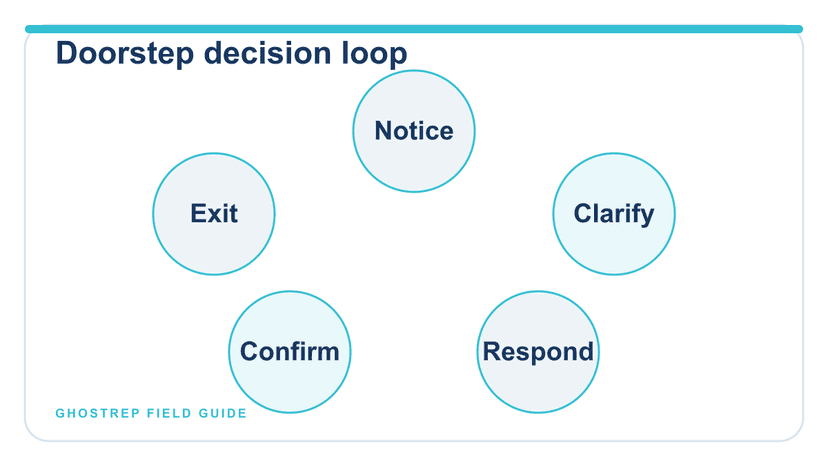
Use a five-decision doorstep loop
1. Do I have permission to continue?
State identity and purpose, then ask for a brief moment. Avoid false familiarity, implying the homeowner requested contact, or using a neighbor’s name without permission.
Approved shape: “Hi, I’m Maya with Northside Roofing. We’re speaking with homeowners on this block today about [verified reason]. Is now a bad time for one quick question?”
If the homeowner declines, the correct training outcome is a courteous exit and accurate disposition—not a rebuttal.
2. What context did the homeowner provide?
Listen for the job state: renter, existing contractor, active leak, prior inspection, insurance question, general curiosity, or no interest. Reflect the statement before adding information: “It sounds like you already have someone handling it. Is that right?”
3. Am I authorized to answer?
A canvasser may explain the company’s process and schedule an approved next step. The role may not include diagnosing storm damage, interpreting coverage, promising approval, changing a price, giving a code opinion, entering restricted property, or making a structural conclusion. Train the escalation sentence as carefully as the opener: “I don’t want to guess. Our [qualified role] can review that after [approved next step].”
4. What is the smallest useful next step?
Do not force every door toward an inspection. The proportionate next step may be verified company information, an inspection request, a later contact selected by the homeowner, or no further contact. When an appointment is agreed, the appointment-confirmation tool can carry the verified logistics into a factual message.
5. What must the record say?
Record the actual outcome, customer-stated concern, permission for the next channel where required, assigned owner, and dated action. “Hot lead” is not evidence. “Homeowner requested inspection options for Tuesday after 4 p.m.; no insurance discussion” is.
Practice drill: the lower-price brush-off
One decision-based canvassing drill
Scenario
- Approved drill: Homeowner says, “We already got a cheaper quote, so we’re good.”
Known to rep
- Approved drill: No written proposal is visible; no permission to criticize the other contractor
Target behavior
- Approved drill: Acknowledge the decision, ask whether the homeowner wants a scope-comparison checklist, and accept no
Permitted fact
- Approved drill: The company can compare written scope items during an approved appointment
Critical misses
- Approved drill: Claims the competitor omitted work; predicts failure; pressures after decline; invents storm damage
Variation A
- Approved drill: Homeowner has both proposals and asks what to compare
Variation B
- Approved drill: Homeowner says the decision is final and asks the rep to leave
Pass evidence
- Approved drill: Correct behavior across both variations, followed by accurate disposition
Run a baseline, identify one gap, give specific feedback, and require a retry. Research on structured feedback has described an actionable pattern of task, performance gap, and action plan; the primary study record supports that feedback design without establishing a roofing-sales performance claim.
Use the role-play scenario generator for controlled variants and the objection-practice guide for the full attempt-feedback-retry loop.
Build a practice ladder before live doors
- Explain the decision map: the rep describes why each stage exists without reciting an opener.
- Fixed-fact drill: the rep delivers identity, purpose, disclosure, and exit language accurately.
- Single-variable role play: change one homeowner response while keeping the same objective.
- Mixed-door circuit: run renter, existing roofer, curiosity, decline, and qualified-interest scenarios in random order.
- Observed field transfer: a manager watches approved live work and compares it with the same rubric.
Do not grant field access because a rep completed a set number of repetitions. Define what the rep must demonstrate, across what variations, and who must observe it. Safety, driving, property access, roof access, and technical inspection need separate company gates.
Notes from one supervised block
Notes from one supervised canvassing block
Identity and purpose:
Evidence: Accurate at six observed doors
Decision: Meets current gatePermission:
Evidence: Asked before continuing; one opener ran long
Decision: Coach brevityResponse to decline:
Evidence: Exited immediately at two doors
Decision: Meets current gateTechnical boundary:
Evidence: Routed ventilation question to inspector without guessing
Decision: Meets current gateRecord quality:
Evidence: One follow-up record lacked the homeowner-selected time
Decision: Retry requiredField release:
Evidence: Conversation behavior passed; documentation incomplete
Decision: Continue supervised work until record gate passes
The remote sales-management guide shows how to calibrate field observations across managers. Keep the evidence job-related. Do not score likability, accent, personality, or a manager’s impression of “closer energy.”
Publish safety and stop rules
A written canvassing policy should address identification, working hours, weather, driving, buddy or check-in procedures, dogs, hostile encounters, vacant properties, no-soliciting signs, local permits, emergency escalation, and data handling. The field rule is simple: no appointment is worth overriding a safety concern or a request to leave.
Managers should audit a balanced sample, not only conversations that produced appointments. Otherwise the program rewards persistence without observing respectful exits, accurate dispositions, and safe escalation.
Frequently asked questions
Should new canvassers memorize an opener?
They should know required facts and practice an approved short opening. They should also understand the purpose of each part and deliver it naturally without changing the truth.
Does “without scripts” mean reps can say anything?
No. Identity, disclosures, consent, company facts, safety boundaries, prohibited claims, and exit rules should be tightly controlled. Questions and explanations may vary inside those boundaries.
What should a rep do when asked about insurance coverage?
Explain the contractor’s inspection and documentation process, then direct policy and coverage questions to the insurer or another appropriately qualified professional.
How should managers measure improvement?
Use the same observable rubric across varied simulations and supervised field work. Preserve the evidence, record coaching, and evaluate accurate exits and documentation—not only appointment count.
Train the decision, not the recital
Door-to-door training without rigid scripts is not anti-structure. It is better structure: standardize truth, permission, safety, and escalation; teach reps to recognize the situation; practice one decision at a time; and require observed evidence before autonomy expands.
Free tools for door-to-door reps
Give canvassers something they can use today
Pair the strategy in this article with free tools for scripts, door hangers, homeowner texts, and field follow-up.
Field sales tools
Generate homeowner texts, canvassing assets, inspection summaries, and follow-up language.
Browse field sales tools →Training tools
Build knock tracks, objection handlers, and practice scenarios before reps burn live doors.
Browse training tools →Echo
Support reps live in the field with in-ear coaching during real conversations.
See Echo →About the Author
Tim Nussbeck
Founder & CEO of GhostRep
20+ years in roofing and home improvement sales—knocking doors, running teams, and building practical coaching systems. Built GhostRep to give every rep access to the coaching top teams get.
Field next step
Give your reps something they can use before the next knock
Start with field and training tools if you need talk tracks, follow-up language, or canvassing assets now. Book a walkthrough if you want GhostRep mapped to live field coaching.
- ✓Best fit if reps need sharper first knocks and second visits.
- ✓Useful for follow-up language, inspection texts, and canvassing flow.
- ✓Demo shows how Echo and Role Play support real field conversations.
Start Here
Browse field sales tools
Create homeowner texts, canvassing assets, inspection summaries, and follow-up copy.
Browse field sales toolsNeed it mapped to your team?
Talk through your current workflow, traffic mix, and where GhostRep fits before you change anything.
Book a 15-minute walkthroughYou Might Also Like
Compare Map My Customers and GhostRep by routing, territory execution, CRM sync, conversation practice, coaching, pricing, and roofing-team fit.
Read article →D2D CRM shows you exactly which rep is failing. GhostRep gives you the tools to fix it. Measuring the gap and closing it require two different platforms.
Read article →Compare RepCard's field-sales and digital-card workflows with GhostRep's AI conversation practice. See feature overlap, differences, and pilot criteria.
Read article →