Before anyone claims “one extra job per rep,” calculate the improvement the coaching system must produce just to pay for itself. That break-even number is knowable. The promised lift is not.
This calculator uses collected gross profit, adoption, attribution, manager time, devices, integration, training, and administration—not only the subscription. It also separates a prompt during a homeowner conversation from guidance between doors, live manager help, and rapid post-call review. Those are different interventions with different costs and exposure.
This page owns the real-time coaching model. Use the roofing training ROI calculator to compare live coaching with role play, manager-led training, virtual training, and other formats. Use the roofing sales call scorecard when managers need consistent behavior evidence.
The formula
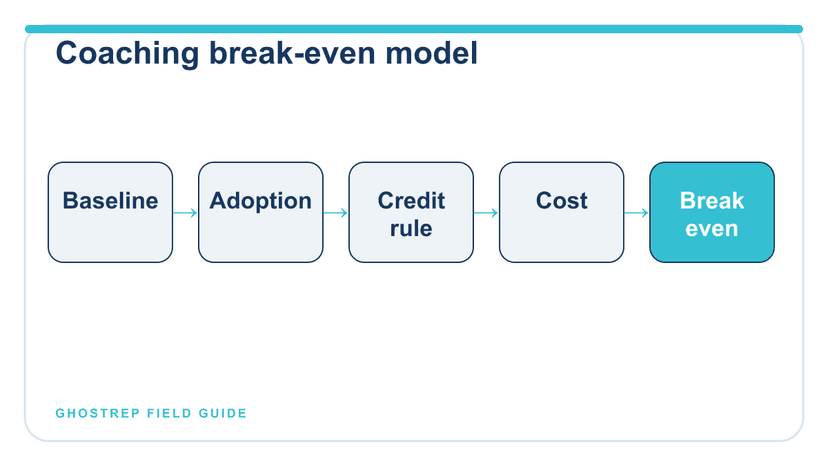
ROI = (attributable collected gross profit + documented cash cost avoided − total coaching cost) ÷ total coaching cost × 100
Attributable collected gross profit = observed incremental collected gross profit × attribution factor
Total coaching cost = software and usage + setup and integration + devices + rep training + manager review + administration and compliance
Use collected gross profit, not signed contract revenue. Do not call manager hours a cash saving unless payroll, contractor spend, overtime, or another cash expense actually falls. Otherwise report those hours as recovered capacity and show whether the team used that capacity for documented work.
Define every input before the test
Inputs that can break the model
- Eligible opportunities
- Required definition: Comparable lead source, stage, market, and time window where coaching could operate
- Common distortion: Counting every lead, including events the tool never touched
- Adoption
- Required definition: Eligible opportunities where the assigned workflow actually ran
- Common distortion: Using purchased seats as usage
- Completed jobs
- Required definition: Jobs meeting the company’s final completion and collection rule
- Common distortion: Using signed or approved work that never collected
- Gross profit
- Required definition: Collected revenue minus agreed direct job costs under the same accounting rule
- Common distortion: Using top-line contract value
- Incremental result
- Required definition: Test difference after matching or adjustment for known business factors
- Common distortion: Treating raw before/after change as causal
- Attribution factor
- Required definition: Explicit share of the adjusted difference credited to coaching
- Common distortion: Using 100% without evidence
- Cash cost avoided
- Required definition: Expense that demonstrably did not occur
- Common distortion: Monetizing every saved minute as cash
- Full cost
- Required definition: All incremental cash and labor required to operate safely
- Common distortion: Counting only the vendor invoice
Worked scenario: a 12-rep roofing test
The following numbers are synthetic. They demonstrate the model; they do not predict GhostRep or any other product’s results.
Eight-week accounting example
Eligible held appointments:
Value: 180
Evidence rule: CRM stage and held-event definition frozen before testWorkflow adoption:
Value: 72% (130 appointments)
Evidence rule: System event confirms the assigned workflow ranMatched baseline collected gross profit:
Value: $112,000
Evidence rule: Comparable reps, source, territory, job type, and periodTest collected gross profit:
Value: $126,000
Evidence rule: Same accounting definition and maturity cutoffObserved incremental gross profit:
Value: $14,000
Evidence rule: $126,000 minus $112,000 before attributionDocumented cash cost avoided:
Value: $0
Evidence rule: No payroll or contractor expense actually removedTotal test cost:
Value: $8,400
Evidence rule: Detailed cost table belowBase attribution assumption:
Value: 50%
Evidence rule: Reported as an assumption, not a causal finding
At 50% attribution, modeled benefit is $14,000 × 0.50 = $7,000. Modeled ROI is ($7,000 − $8,400) ÷ $8,400 = −16.7%. The test does not clear the financial gate under that assumption.
Show the full cost
| Cost category | Calculation | Cost |
|---|---|---|
| Software and usage | Vendor test invoice and measured usage | $3,600 |
| Setup and integration | 20 internal hours × $60 loaded cost | $1,200 |
| Devices and accessories | Approved incremental equipment | $600 |
| Rep training | 12 reps × 2 hours × $40 loaded cost | $960 |
| Manager review | 24 hours × $65 loaded cost | $1,560 |
| Administration and compliance | 8 hours × $60 loaded cost | $480 |
| Total | Sum of incremental test costs | $8,400 |
If an existing employee would be paid anyway, loaded labor cost is still useful for comparing capacity demands. Keep it labeled as allocated operating cost rather than pretending the same amount left the bank because of the test.
Run attribution sensitivity instead of hiding uncertainty
| Attribution | Attributed benefit | Modeled ROI | Interpretation |
|---|---|---|---|
| 25% | $3,500 | −58.3% | Clearly below the financial gate |
| 50% | $7,000 | −16.7% | Below the gate |
| 60% | $8,400 | 0% | Break-even |
| 75% | $10,500 | 25.0% | Positive only under stronger attribution |
| 100% | $14,000 | 66.7% | Upper bound, not a credible default |
The break-even attribution factor is $8,400 ÷ $14,000 = 60%. The decision therefore depends on whether the evaluation design can credibly attribute at least 60% of the adjusted result to coaching. If not, extend, redesign, or stop the test.
Separate product efficacy from adoption
Only 130 of 180 eligible appointments used the workflow. If value is concentrated among adopted events, the manager needs to understand why 28% did not use it. Low adoption can reflect weak connectivity, poor timing, unclear consent, device friction, rep resistance, manager instructions, or a workflow that simply does not fit the moment.
How to read adoption and behavior results
High
- Behavior improvement: High
- Next action: Continue financial evaluation and test durability
High
- Behavior improvement: Low
- Next action: Revisit guidance quality, source material, and coaching objective
Low
- Behavior improvement: High among users
- Next action: Diagnose workflow friction before forecasting scale
Low
- Behavior improvement: Low
- Next action: Stop or redesign; do not use hypothetical full adoption to rescue ROI
Require behavior and safety gates before financial credit
A positive spreadsheet does not justify a workflow that produces unsafe guidance, distracts reps, mishandles recordings, or creates unreviewable claims. Track:
- manager-verified prompt accuracy and relevance;
- unsupported or prohibited guidance rate;
- latency, failure, recovery, and device performance in field conditions;
- rep acceptance, overrides, and distraction incidents;
- manager review minutes by output category;
- repeat rubric misses and successful retries;
- observed transfer of the target behavior into supervised work; and
- consent, recording, privacy, access, retention, and support incidents.
The sales KPI scorecard helps freeze metric definitions. The remote management guide shows how to route exceptions without turning every interaction into surveillance.
Define roofing guidance boundaries
Real-time guidance should not tell a rep to diagnose damage, infer storm causation, interpret a policy, predict claim approval, waive a deductible, calculate financing outside approved tools, or promise scope, price, schedule, workmanship, or manufacturer coverage beyond authority.
Appropriate shape: “Acknowledge the coverage question. Explain that the company can document observed conditions and prepare its construction scope. Direct policy and coverage questions to the insurer or another authorized adviser; do not predict the decision.”
Recording and employee-monitoring requirements vary by jurisdiction. Define notice and consent, disabled contexts, minimum necessary capture, retention, access, deletion, model providers, devices, and the non-recorded alternative. Obtain qualified guidance for the actual markets and workforce.
A seven-step test
- Choose one moment: for example, rapid post-appointment feedback on price explanations—not “all sales coaching.”
- Freeze approved content: name sources, version, prohibited guidance, and escalation owners.
- Define cohorts and maturity: match lead source, territory, role, tenure, manager, season, job mix, and collection cutoff.
- Capture the baseline: use the same behavior, adoption, cost, and accounting definitions.
- Test failure states: weak network, device denial, incorrect prompt, customer opt-out, recording disabled, and manager disagreement.
- Review evidence: sample successes, misses, overrides, and non-use—not only favorable sessions.
- Report ranges: publish raw difference, adjustments, attribution sensitivity, break-even point, full cost, behavior gates, and unresolved risks.
GhostRep publishes Echo as a live field-support and intelligence product. This article does not independently validate product outcomes. Confirm current behavior, data handling, usage, implementation, and pricing directly, then apply the same test controls.
Frequently asked questions
How much ROI does real-time coaching produce?
There is no universal figure. Use comparable operating data, collected gross profit, full cost, actual adoption, and an explicit attribution range.
Should close rate be the main metric?
It is a useful lagging outcome, but it changes with lead source, season, price, territory, rep tenure, and job mix. Start with accuracy, safety, adoption, manager effort, and observed behavior.
Can manager time count as savings?
Count it as recovered capacity unless payroll, contractor spend, overtime, or another expense actually decreases. If capacity produces additional value, document that separately.
What is the minimum useful test?
A bounded workflow with enough comparable events to inspect accuracy, adoption, behavior, operating cost, and failure states. A small test may support an operating decision without supporting a causal revenue claim.
Calculate the break-even requirement first
A credible real-time coaching ROI model is intentionally conservative. It uses collected gross profit, exposes attribution, includes full cost, separates cash from capacity, and refuses to buy financial upside with unsafe guidance. If the decision changes when attribution moves from 50% to 60%, that uncertainty—not the headline percentage—is the finding managers need.
Free tools for roofing sales training
Turn this article into rep practice
Use the training library to turn ideas into drills, scripts, and coaching reps can actually use in the field.
Training tools
Browse objection, role-play, and scripting tools built for home improvement sales teams.
Browse training tools →All free tools
See the full tools hub across hiring, management, field sales, operations, and marketing.
Browse all tools →Role Play
Turn training concepts into live practice with AI homeowner scenarios that build muscle memory.
See Role Play →About the Author
Tim Nussbeck
Founder & CEO of GhostRep
20+ years in roofing and home improvement sales—knocking doors, running teams, and building practical coaching systems. Built GhostRep to give every rep access to the coaching top teams get.
Training next step
Turn training ideas into drills your reps will actually run
Start with the free training tools if you need scripts, practice reps, or coaching prompts today. Book a walkthrough if you want GhostRep mapped to your onboarding process.
- ✓Best fit if reps need more repetition, not more theory.
- ✓Useful for onboarding, objection practice, and weekly coaching.
- ✓Demo shows how Role Play plugs into your current training process.
Start Here
Browse training tools
Free objection builders, role-play prompts, scripts, and rep-practice templates.
Browse training toolsNeed it mapped to your team?
Talk through your current workflow, traffic mix, and where GhostRep fits before you change anything.
Book a 15-minute walkthroughYou Might Also Like
Learn the roofing sales competencies reps need from first contact through signed contract, with observable behaviors managers can coach and verify.
Read article →Calculate a training investment from actual program costs and attributed job contribution, with transparent examples and a link to the interactive ROI tool.
Read article →Prepare for a roofing sales appointment by reviewing approved context, setting one goal, planning questions, organizing materials, and defining next steps.
Read article →