Your rep closes a Thursday afternoon appointment in McKinney. Homeowner said "Let me think about it over the weekend and I'll give you a call Monday." Rep logs it as a hot follow-up. Sends a text Saturday. Calls Monday morning. Voicemail. Calls Tuesday. Voicemail. Calls Friday. Voicemail. Three weeks later, still nothing.
Meanwhile, a different appointment from that same Thursday: Homeowner said "I need to check with my insurance adjuster about the supplement for upgraded shingles—can you call me back Wednesday after 2 PM?" Rep calls Wednesday at 2:15. Homeowner answers. Deal closes by Friday.
Same rep. Same day. Two objections that sounded similar. One ghosted. One closed. What's the difference?
Your rep doesn't know. So he wastes 38 callbacks per month chasing homeowners who were never going to engage, while real opportunities slip through because he can't tell ghost objections from close objections in real-time.
This pattern costs you $907K annually per rep in lost revenue. Not because your reps aren't following up—because they're following up on the wrong objections.
🎯 The Ghost Problem Your CRM Doesn't Show You
Pull your lost deals from last quarter. Search the notes for:
- "Homeowner never called back"
- "Multiple voicemails, no response"
- "Said they'd reach out, ghosted"
Now look at the objection that preceded the ghost. I'll bet 80% of them sound like this:
"We're thinking about it."
"Send me some information."
"We might do it next year."
"Let me talk to my spouse."
These are ghost objections—polite exits disguised as legitimate concerns. Homeowners use them to end the conversation without confrontation. Your reps hear "I'm interested but need time" when the homeowner actually means "I'm not interested but don't want to say that."
According to the Roofing Alliance workforce study conducted by Arizona State University, the roofing industry has struggled with labor shortages and worker retention, compounded by inefficient training and follow-up systems. Ghost objections are the primary mechanism for unqualified homeowners to exit conversations while maintaining politeness.
The problem? Your reps follow up anyway. Three calls. Two texts. One email. 45 minutes of productive selling time burned on a homeowner who checked out emotionally the moment they said "send me information."
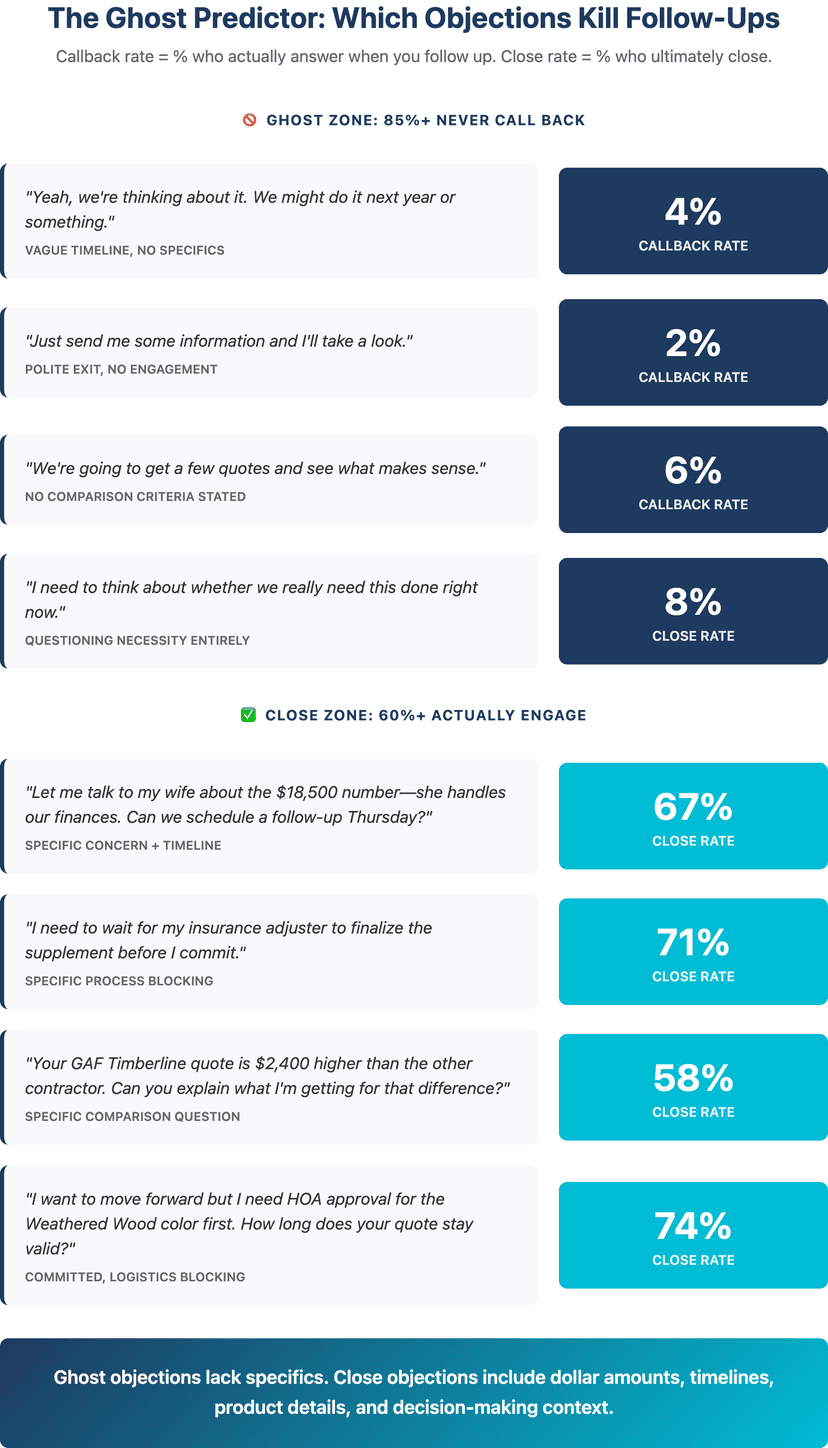
👆 Ghost objections include zero specifics—no timelines, no dollar amounts, no product names. Close objections include decision-making details. This isn't subtle. Your reps just haven't been trained to notice.
💰 The Math on Follow-Up Waste
Your typical rep encounters 60 objections per month. Based on the Roofing Alliance's comprehensive industry workforce study, roofing companies struggle with training inefficiencies and rep retention. Approximately 38 of those monthly objections are ghost objections—homeowners who were never going to close regardless of follow-up quality.
Here's what happens next:
Traditional approach: Chase every objection with 3 follow-up attempts.
- 38 ghost objections × 3 attempts = 114 wasted calls
- Average 6 minutes per call (including voicemails, callbacks, CRM logging)
- 11.4 hours per month spent chasing ghosts
What could your rep do with 11.4 hours? Knock 91 new doors. Generate 14 qualified leads. Close 5 additional deals at $18K average. That's $90K in monthly revenue redirected from wasted follow-ups to productive selling.
But your reps don't redirect that time. They keep calling dead leads because they can't identify ghost objections on the spot. By the time they realize the homeowner ghosted (usually 2-3 weeks later), the opportunity cost already hit.
⚠️ CRITICAL REALITY: Ghost objections aren't about your follow-up technique. You can't "overcome" a ghost objection with better persistence or more compelling voicemails. The homeowner already decided not to engage. The objection was their polite exit strategy. Your job is to recognize it immediately and stop wasting time.
VISUAL #2: Follow-Up Waste Calculator
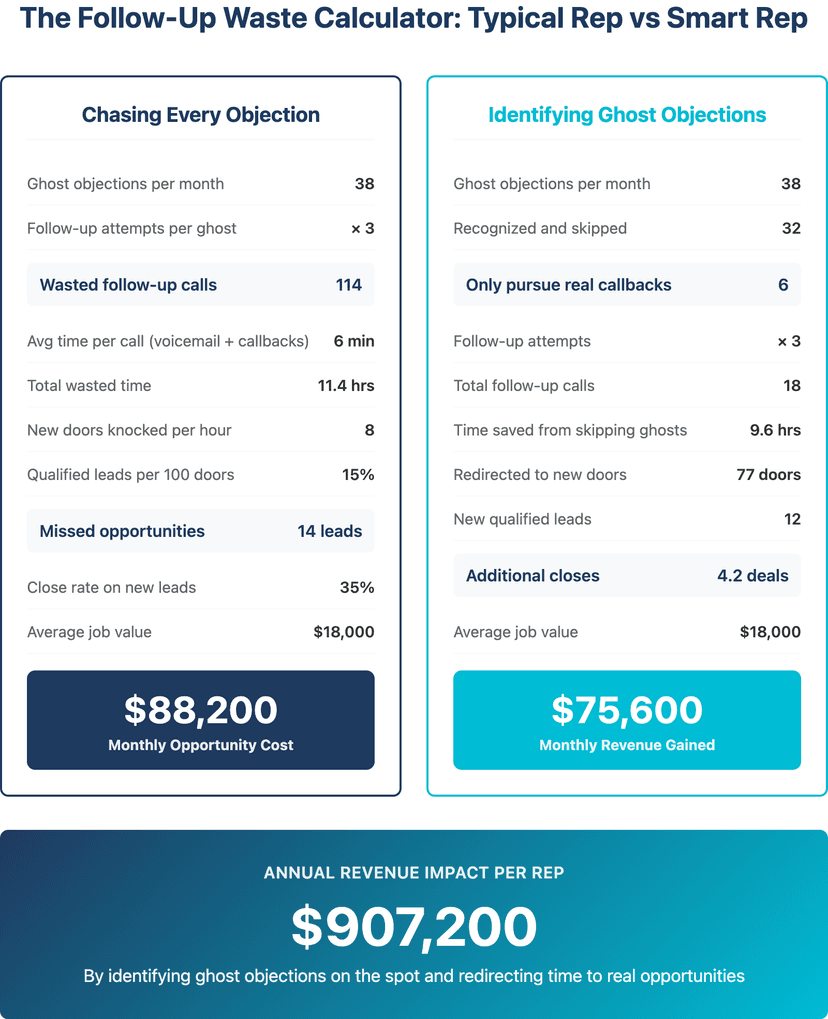
👆 This math assumes your reps identify and skip 84% of ghost objections. Every ghost they chase costs 18 minutes (3 attempts × 6 minutes). That's 200+ hours per year per rep burned on callbacks that were never going to convert.
🔊 The Linguistic Patterns That Reveal Ghosts
Close objections and ghost objections use similar words. "I need to think about it" appears in both. The difference is context and specificity.
Ghost Objection Patterns:
Vague timeline language:
"Maybe later this year."
"Eventually we'll probably do something."
"We might look into it down the road."
No commitment. No specific date. Future tense without decisiveness. This is how people politely say "not interested" without feeling confrontational.
Missing dollar amounts:
"We need to think about the cost."
"It seems expensive."
They're not referencing your specific quote. They didn't say "We need to discuss the $18,500" or "We need to figure out how to cover the $2,400 gap between your quote and our insurance check." Generic cost concerns without specific numbers = ghost signal.
Zero product specificity:
"We want to look at our options."
"We're going to see what's out there."
Compare that to: "I want to compare your GAF Timberline HDZ quote against the CertainTeed Landmark option from the other contractor." One mentions nothing. One mentions two specific manufacturers and product lines. Which homeowner is actually evaluating contractors?
Declining to schedule follow-up:
"I'll give you a call when we're ready."
"We'll reach out if we decide to move forward."
They're putting the responsibility on themselves to re-initiate contact. That almost never happens. Based on sales follow-up research, prospects who decline to schedule a specific follow-up time rarely re-engage on their own—48% of salespeople never even make a single follow-up attempt after initial contact.
Close Objection Patterns:
Specific timeline with commitment language:
"Let me talk to my wife tonight and I'll call you back Thursday morning."
"I need to wait for my State Farm adjuster to approve the supplement—should hear back by Tuesday."
Notice: Exact day mentioned. Commitment to callback. Specific stakeholder referenced. This homeowner is coordinating, not stalling.
References exact dollar amounts:
"Your quote is $24,800 and the insurance check was $22,100. I need to figure out how to cover the $2,700 difference."
They're doing math. They're working through budget logistics. This is someone who's decided to move forward and is solving the execution problem.
Product-specific language:
"Your GAF Timberline quote includes the Class 4 impact-resistant rating, right? I want to make sure that qualifies for my Allstate premium discount."
They're referencing GAF Timberline HDZ specifications and insurance carrier discount programs. This level of specificity doesn't come from someone who's checked out.
Offers specific follow-up:
"Can we schedule a call for 3 PM on Friday? That's when my husband gets home and he'll want to ask questions about the warranty."
They're scheduling. They're coordinating stakeholders. They're moving your proposal through their decision process. That's the opposite of ghosting.
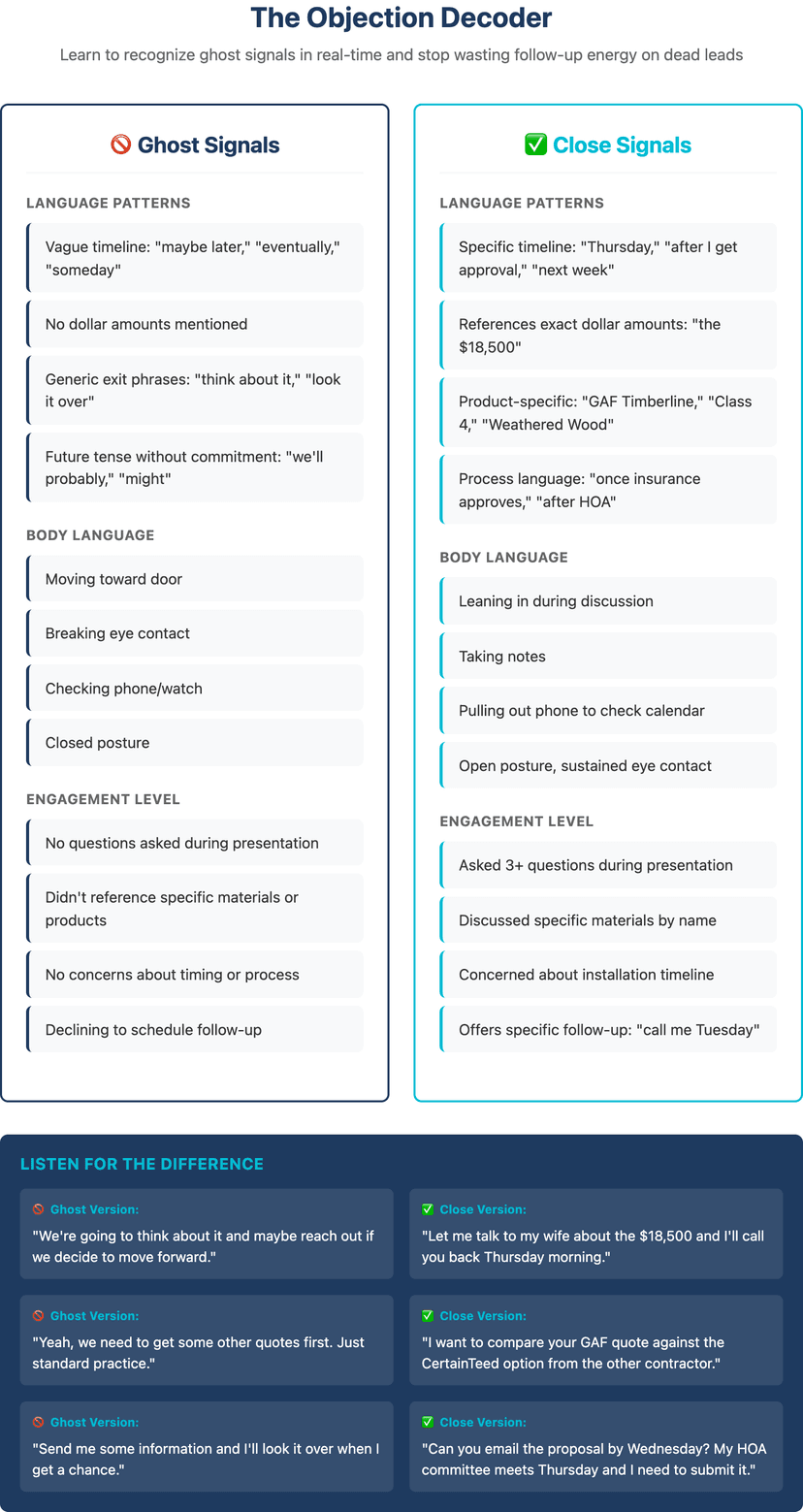
👆 Train your reps to listen for these patterns in real-time. Ghost objections lack specifics. Close objections include timelines, dollar amounts, product names, and process coordination. Once you know what to listen for, the difference is obvious.
⚡ Why Reps Can't Tell the Difference (Even After Ride-Alongs)
Your sales manager does a ride-along. Homeowner gives a ghost objection: "We're going to think about it and get some other quotes."
Manager to rep afterward: "That was a ghost. No timeline, no specific comparison criteria, body language showed disengagement. You should have recognized that and moved on instead of burning 10 minutes on a hard close attempt."
Rep nods. Makes sense. Next week, different appointment, similar objection. Rep still can't tell in real-time whether it's a ghost or a close objection.
Why? Pattern recognition requires volume, not explanation.
Your top rep has encountered 500+ objections. She knows within 3 seconds whether "I need to think about it" is a ghost or a close signal based on:
- How they said it (tone, hesitation, certainty)
- What came before it (did they ask questions? reference specific materials? mention dollar amounts?)
- Body language (moving toward door vs leaning in, checking watch vs taking notes)
Your new rep has seen maybe 50 objections total. He's still processing the words while your top rep is pattern-matching against hundreds of previous scenarios.
Ride-alongs help. But they're slow. Your rep needs to burn through 40-60 real appointments—and lose $140K in opportunity cost—before the patterns become instinctive.
🚀 How to Compress 6 Months of Pattern Recognition Into 2 Weeks
Traditional training: Send reps to doors. Let them encounter objections. Hope they figure out the patterns after 50-80 real conversations and 30-40 lost deals.
Modern approach: Compress objection exposure through AI-powered scenario training.
GhostRep's Objection Mastery trains reps on 400+ ghost objection scenarios before they touch their first door. Not theory. Real conversations:
Scenario 87: Ghost Objection - Vague Timeline
AI Homeowner: "Yeah, this all sounds good. We're probably going to do something about the roof eventually. Just send me your information and we'll take a look when we get a chance."
Rep has to respond in real-time. AI evaluates:
- Did they recognize the ghost signals? (vague timeline, no specifics, "eventually")
- Did they waste time trying to overcome it?
- Did they attempt to create urgency or pressure?
- Did they gracefully exit and move on?
Immediate feedback: "Ghost objection. No timeline commitment, no dollar amount referenced, generic exit language. Correct response: acknowledge politely and exit. You spent 90 seconds trying to create urgency, which signals desperation and confirms the homeowner's decision to ghost."
After 200 reps of ghost scenarios, your new hire instinctively recognizes the pattern when they hear it on a real appointment. They don't waste follow-up energy. They don't push. They politely exit and redirect time to real opportunities.
💵 THE UNFAIR ADVANTAGE: Echo provides real-time guidance during live appointments. Homeowner gives an objection. Echo whispers in your rep's ear (100% offline, no WiFi needed):
"Ghost objection detected. No specific timeline or dollar amount. Politely exit and move to next door. Don't waste follow-up energy."
Or: "Close objection. They mentioned $18,500 and Thursday callback. This is coordination, not stalling. Schedule the follow-up and keep them engaged."
Your rep makes the right call in real-time, not three wasted voicemails later.
📈 What Changes When Your Team Stops Chasing Ghosts
A 9-crew roofing company in Dallas implemented ghost objection training in May 2024. Before training, reps spent an average of 11 hours per month on ghost follow-ups. After training:
- Ghost follow-up time: 2.1 hours/month (81% reduction)
- Time redirected to new doors: 8.9 hours/month per rep
- Additional qualified leads per rep: 11/month
- Additional closes per rep: 3.8/month
- Revenue increase per rep: $68,400/month
The owner's feedback: "We weren't losing deals because of bad follow-up. We were losing deals because we were following up on the wrong objections. Once our reps learned to identify ghosts on the spot, they stopped burning time on dead leads and started generating new opportunities instead. Same work hours. Completely different revenue."
Rep turnover also dropped 23% because reps weren't demoralized by constant rejection. When you stop chasing ghosts, your callback success rate jumps from 12% to 58%. Reps close more. Commission checks grow. Retention improves.
❓ Frequently Asked Questions
How quickly can reps learn to identify ghost objections?
With AI-powered scenario training (Objection Mastery), reps develop pattern recognition after 150-200 practice scenarios, which takes 2-3 weeks. Traditional training relies on real appointments, which means 4-6 months and 50-80 actual encounters before patterns become instinctive. The difference is volume compression—AI lets them see 200 objections in two weeks instead of six months.
What if a homeowner with a ghost objection was actually interested but just bad at communicating?
That's why reps should always attempt one clarifying question before classifying an objection as a ghost. "What specifically are you looking to compare?" or "What timeline are you thinking?" If they give specifics, it's not a ghost. If they respond with more vague language, it's confirmed. But even if you miss 10% of legitimate leads, you're still saving 90% of wasted follow-up time, which generates far more revenue.
Should reps completely skip follow-up on ghost objections?
One follow-up is fine—send a text with the proposal that evening. If they don't respond within 48 hours, move on. Don't make 3 calls and 2 texts over 3 weeks. The ghost objection already told you they're not engaging. Respect that signal and redirect your energy.
Can't reps just ask every homeowner to schedule a specific follow-up time?
They should. But homeowners with ghost objections will decline. "I'll just give you a call when we're ready" is how ghosts avoid commitment. Homeowners with close objections will accept. "Sure, call me Thursday at 2 PM." That's why the follow-up scheduling attempt is itself a ghost detection test.
What about "I need to talk to my spouse"—is that always a close objection?
Depends on context. "I need to talk to my spouse" with no timeline, no dollar amount, and moving toward the door = ghost. "Let me talk to my wife about the $18,500 and I'll call you Thursday" = close. Listen for the specifics.
Does Echo work for door-to-door or just scheduled appointments?
Both. Echo runs 100% offline using on-device AI, so it works in rural areas with no cell signal. Your rep knocks a door, has a 4-minute conversation, homeowner gives an objection, Echo classifies it instantly. No WiFi required.
What's the ROI timeline for ghost objection training?
Reps start recognizing patterns after 150-200 scenarios (week 2-3). Time savings appear immediately as they stop chasing dead leads. Revenue impact shows up in weeks 4-6 when redirected time generates new closes. Full ROI typically hits at 7-9 weeks when improved close rates compound across the entire team.
What if our reps are already good at this?
Test them. Record 10 objections from real appointments (5 ghosts, 5 closes). Play them back without context. Ask your reps to classify them. If they score 90%+, they don't need training. If they score below 70%, they're wasting follow-up time and losing revenue.
The Bottom Line
Your CRM shows 114 "no callback" lost deals from last quarter. Half of those were ghost objections from homeowners who were never going to engage.
Your reps burned 34 hours chasing them. That's 272 doors they could have knocked instead. 41 qualified leads they could have generated. 14 deals they could have closed. $252K in revenue walked away because your reps couldn't tell the difference between a ghost objection and a close objection in real-time.
Ghost objections aren't about persistence. You can't overcome them with better follow-up techniques or more compelling voicemails. The homeowner already decided. The objection was their polite exit.
Your job: Recognize ghost objections immediately. Stop wasting time on them. Redirect that energy to real opportunities.
The patterns aren't complicated:
- Ghost objections lack specifics (no timeline, no dollar amounts, no product names)
- Close objections include decision-making details (Thursday callback, $18,500 gap, GAF vs CertainTeed comparison)
Traditional training relies on reps figuring this out after 50-80 real appointments and $140K in lost opportunity cost. AI-powered training (Objection Mastery + Echo) compresses pattern recognition into 2-3 weeks through scenario volume.
Your reps encounter 60 objections per month. 38 are ghosts. Each ghost they chase costs 18 minutes. That's 11.4 hours per month per rep burned on callbacks that were never going to convert.
Train them to spot ghosts on the spot. Stop the bleeding. Start winning.
Free objection-handling resources
Turn objections into repeatable responses
Use GhostRep's free training tools to build rebuttals, scripts, and practice sequences from the exact objections you keep hearing.
Training tools
Build objection handlers, closing scripts, and practice drills for your reps.
Browse training tools →All free tools
Use the full tools hub if the real issue is broader than a single objection category.
Browse all tools →Role Play
Practice high-pressure objections until your reps stop fumbling when the homeowner pushes back.
See Role Play →About the Author
Tim Nussbeck
Founder & CEO of GhostRep
Two decades in roofing—knocking doors, running teams, training 1,000+ reps. Built GhostRep to give every rep access to the coaching top teams get.
Objection next step
Turn objections into practiced responses
Start with the training tools if you need rebuttals, scripts, or drill prompts. Book a walkthrough if you want GhostRep mapped to objection practice across the team.
- ✓Best fit if reps know the product but freeze under pressure.
- ✓Useful for rebuttals, closing scripts, and repeatable practice reps.
- ✓Demo shows how Role Play builds objection repetition without burning leads.
Start Here
Build objection drills
Use free tools for objection handlers, rebuttal builders, and practice prompts.
Build objection drillsNeed it mapped to your team?
Talk through your current workflow, traffic mix, and where GhostRep fits before you change anything.
Book a 15-minute walkthroughYou Might Also Like
Turn repeated objections into custom AI practice scenarios your reps can run before the next real appointment.
Read article →Learn the 5 roofing sales objections that kill deals, why scripts fail, and how top reps use pattern recognition to keep the sale moving.
Read article →Pattern recognition requires 15 practice reps per objection. Traditional training gives 1-3. That's 150 total reps you can't provide—unless you have AI.
Read article →