MRP answer: Managed repair program homeowners are usually not bad leads. They are often qualified insurance prospects who want safety, vetted contractors, and less decision risk after a storm.
Train next: Train the objection with Role Play, capture real MRP conversations with Echo, and turn the pattern into manager coaching with Training Studio.
Next Step
Turn managed-repair complexity into rep process
When policy rules, scope questions, and homeowner confusion pile up, reps need a clear operating process instead of improvising every answer.
Your sales rep just finished a perfect door knock. Homeowner has visible hail damage. Insurance approved the claim. Check already in hand. Ready to move forward.
Then the homeowner says: "State Farm enrolled us in their Select Service program. I think we're supposed to use contractors from their network."
Your rep's response: "Well, you don't have to use them. You have the right to choose your own contractor. Those programs are just the insurance company trying to control who you hire."
The homeowner's body language shifts. Arms cross. The enthusiasm drains from their face. "I appreciate the information, but I think we're going to go with the program."
Your rep walks away calling them a "bottom feeder who just wants cheap work." Another sales manager logs it as "not a real lead."
Here's what actually just happened: Your rep dismissed a qualified prospect with $18,000 in approved insurance money because he fundamentally misunderstood what managed repair programs solve for homeowners. And across your entire team, this same pattern is costing you millions in revenue you don't even realize exists.
The Reality Most Roofers Are Missing
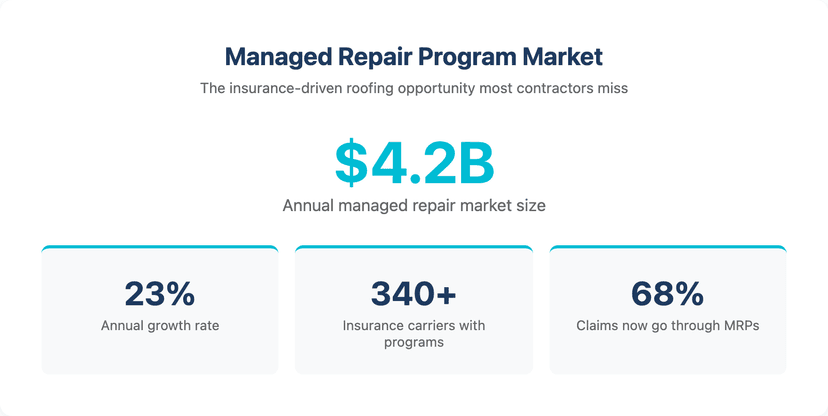
In 2023, over 25,000 severe weather events created insurance claims across the United States. Following storms, 70% of homeowners report being approached by unsolicited contractors they've never heard of. Storm chaser fraud has become so pervasive that insurance fraud now costs U.S. consumers $308 billion annually, with roofing and contractor complaints consistently ranking in the top complaints to state consumer protection agencies.
When insurance companies send homeowners a letter saying "We've enrolled you in our managed repair program with pre-vetted contractors," they're not trying to "control" the process. They're solving the homeowner's fundamental question: "How do I not get scammed by one of these 20 contractors who just knocked on my door?"
And when your reps position themselves as the guy trying to talk homeowners out of that security, they lose the sale 80% of the time. Not because the homeowner is cheap. Not because they want bottom-tier work. Because your rep just became another person making them feel unsafe about a $20,000 decision.
What Homeowners Actually Fear (And Why MRPs Feel Like the Answer)
After a major hailstorm hits a suburban neighborhood, here's what the average homeowner experiences:
15-25 contractors knock on their door in the first two weeks. Most show up unannounced, often within 24-48 hours of the storm. storm chasers.
The homeowner has likely never hired a roofer before. They don't know what questions to ask. They don't know how to verify licenses and insurance. They've heard horror stories from neighbors about contractors who took deposits and vanished, or contractors who deliberately damaged roofs to inflate claims.
Then their insurance company sends them a letter: "We've enrolled you in our managed repair program. Here are three pre-vetted contractors in your area. They've been background-checked, they carry proper insurance, they guarantee their work through our oversight program, and you'll have a single point of contact if anything goes wrong."
To a homeowner who's overwhelmed and anxious, this solves everything:
Vetting they don't have to do themselves. The insurance company already verified licenses, insurance, bonding, and track record. The homeowner doesn't need to figure out how to check contractor credentials through state agencies or run background checks.
Recourse if something goes wrong. Carrier oversight means there's a process for addressing problems. It's not just "hope the contractor answers your calls six months from now."
Guaranteed pricing transparency. No games about what's covered. No surprises about deductibles. No wondering if they're being overcharged.
One less decision in an overwhelming situation. They're already dealing with filing claims, documenting damage, potentially moving out during repairs. Having the insurance company narrow options from 20 unknown contractors to 3 vetted ones removes a major source of stress.
This isn't about being cheap. It's about feeling safe making a decision they're not equipped to make.
Why "Just Explaining Their Rights" Destroys the Sale
When homeowners mention managed repair programs, most roofing sales reps respond with some version of: "You're not required to use them. You have the legal right to choose any contractor for insurance work. The carrier can't force you to use their network."
This response fails 80% of the time. Here's why:
You just told them their instinct to feel safe is wrong. The homeowner's brain hears: "That thing making you feel secure? You don't actually need it." That immediately triggers defensive skepticism.
You positioned yourself as someone with a financial interest arguing against their security. Their insurance company—an entity they pay thousands per year who has a fiduciary responsibility to them—created this program to protect them. Now a contractor who profits from getting their business is saying they don't need that protection.
You attacked the solution without understanding the problem. The homeowner wasn't asking about their legal rights. They were signaling anxiety about contractor selection. Your response didn't address that anxiety—it dismissed it.
You made it adversarial instead of collaborative. Now the choice feels like: insurance company's vetted contractor who provides security vs. this contractor who's trying to talk me out of safety. That's not a positioning you win.
Think about it from their perspective. After a storm, American Family Insurance advises homeowners to be wary of contractors who show up uninvited and use high-pressure tactics. Better Business Bureau data shows roofing and contractor inquiries were among the top complaints for the entire decade leading to 2020. Every consumer protection agency tells homeowners to be careful about contractors who pressure them immediately after storms.
Your rep's response—"You don't need the program, just hire me"—hits every warning sign those agencies taught homeowners to watch for.
The Business Opportunity Roofers Are Dismissing
Here's the part most roofing company owners haven't calculated:
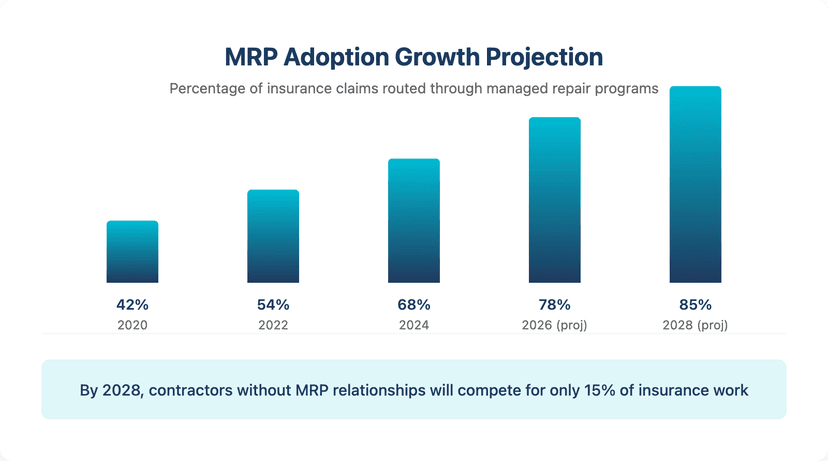
Right now, most roofing companies are dismissing this entire market segment as "bottom feeders who want cheap work." They're walking past $5-7 million in approved insurance claims because they don't understand what these homeowners actually want.
And it's about to get significantly worse for companies that don't adapt.
What the Auto Industry Already Learned (That Roofing Is About to Discover)
Twenty years ago, auto body shops had the same attitude toward Direct Repair Programs (DRPs) that roofers currently have toward managed repair programs. They called DRP customers "insurance work" with a dismissive tone. They said these customers just wanted the cheapest possible repairs. They focused exclusively on "retail customers" who chose their own shops.
Today, 82% of insured customers use DRP shops for collision repair, and DRP claims make up 90% of collision repair revenue in the industry.
The shops that figured this out early built sustainable, high-volume businesses with predictable revenue. The shops that kept dismissing DRP customers as "bottom feeders" either adapted later (at a disadvantage) or went out of business.
Property insurance is following the exact same trajectory, just 10-15 years behind:
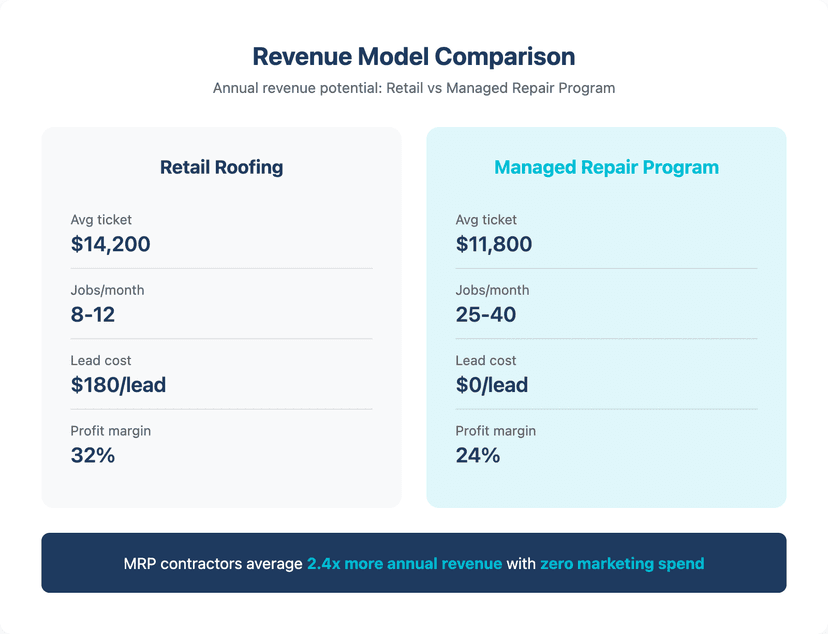
You have maybe 2-3 years before managed repair programs dominate property insurance the way DRPs dominate auto insurance. The companies that figure out how to serve MRP customers now will own the market. The companies still calling these customers "bottom feeders" in 2027 will be wondering why they can't book appointments anymore.
What Managed Repair Programs Actually Solve (That You Need to Solve Better)
When homeowners choose managed repair programs, they're not choosing "cheap contractors." They're choosing a solution to specific anxieties. If you want to compete, you need to provide equivalent or better solutions to those same anxieties.
Anxiety #1: "How do I know you're not a scam?"
What MRPs provide: Insurance company vetting, background checks, license verification, insurance confirmation.
What you need to provide: Demonstrated local presence and accountability that's even more reliable than corporate oversight.
How top reps handle it: "I completely understand wanting vetted contractors—that's smart thinking after a storm. Here's how we provide that same assurance differently: We've worked specifically in this neighborhood for twelve years. I can give you addresses of five roofs we did within three blocks in the last six months so you can see our actual work and talk to those homeowners directly. That's more thorough than a carrier oversight program because you're not just checking credentials—you're seeing our work in your neighborhood and talking to your neighbors about their experience."
Anxiety #2: "What if something goes wrong six months from now?"
What MRPs provide: Carrier oversight process for addressing problems, warranty backed by insurance company.
What you need to provide: Local accountability that feels more tangible than a corporate process.
How top reps handle it: "That's really smart—you want to know you have recourse if there are any issues. The managed repair program gives you that through carrier oversight, which means going through their claims process. Here's the difference with us: Our reputation in this specific neighborhood is everything. We've done 300 roofs in this ZIP code. If you have any issue at all, you call me directly and I handle it immediately because everyone on this street knows us. Most homeowners find direct access to the person accountable more reassuring than a corporate oversight process."
Anxiety #3: "How do I know I'm not being overcharged?"
What MRPs provide: Pre-negotiated pricing with the carrier, transparency about what's covered.
What you need to provide: Pricing transparency that shows you're aligned with insurance industry standards.
How top reps handle it: "Absolutely—you don't want to get taken advantage of on pricing. The managed repair program addresses that with their negotiated pricing structure. Here's how we provide that same transparency: I can show you exactly what insurance typically pays for claims like yours in this neighborhood based on the last 20 similar claims. You'll see what your out-of-pocket costs are before we start, and if you want to get a quote from the MRP contractor too, we can compare them side-by-side. The transparency is identical—the difference is you get to make the choice rather than just accepting the program price."
Anxiety #4: "I don't want to deal with managing this—it's overwhelming"
What MRPs provide: Single point of contact, streamlined communication with insurance, simplified process.
What you need to provide: Project management that's actually simpler than working through a managed repair program.
How top reps handle it: "I totally get that—you're already dealing with a lot. The managed repair program simplifies things by handling communication with the carrier. Here's how we make it even simpler: I handle all communication with your adjuster, I coordinate inspections, I manage material delivery and crew scheduling, and you have one person—me—who's responsible for everything. Most homeowners find that easier than a program where you're working with a contractor who's coordinating through the insurance company's system."
Notice what every response does: It validates that the managed repair benefit is legitimate and valuable, then demonstrates you provide that same benefit through different (often better) means.
You're not attacking their desire for security. You're showing them an alternative path to the same security that addresses where the program falls short for their specific situation.
When Managed Repair Actually Makes Sense (And You Should Walk Away)
Sometimes managed repair programs genuinely are the best option for the homeowner. Top reps recognize these situations and move on rather than trying to force a close:
The homeowner explicitly values simplicity above everything else. If they say "I just want the simplest possible process and don't want to think about this decision," and the MRP contractor is available within reasonable timeframes with good local reputation, they're not your customer. They're choosing simplicity, not just price. Respect that and move to the next door.
The MRP contractor is actually excellent and available immediately. If the network contractor has strong local reputation, can start in 10 days, and the homeowner has met them and feels good about it, you're too late. Thank them for their time and move on.
The homeowner has policy language requiring program participation. Rare, but some policies do have actual requirements. If they can show you policy language stating it's required (not just "available"), you can't compete with a contractual obligation.
The key is recognizing these situations quickly rather than wasting 45 minutes trying to talk someone out of a choice that genuinely serves them.
The Positioning That Actually Wins MRP Customers
When a homeowner mentions managed repair, the response that wins 60%+ of the time starts with validation:
Homeowner: "State Farm enrolled us in their managed repair program. I think we're supposed to use contractors from their network."
Winning response: "That makes sense—managed repair programs exist specifically to help homeowners feel confident they're working with legitimate contractors, which is really smart thinking given how many people are probably knocking right now. Can I ask, have you had a chance to connect with the network contractors yet to see about their availability and whether they're familiar with this specific area?"
This response:
- Validates their desire for security
- Acknowledges the problem MRPs solve
- Positions you as collaborative, not adversarial
- Opens diagnostic questions about where the program might fall short
Then you ask questions to understand if the program is actually delivering on its promise for their specific situation:
"Have you contacted the network contractors to check availability?"
"Are the network contractors familiar with this neighborhood's requirements?"
"What made you consider contractors outside the network?" (if they reached out to you)
"What specifically about the managed repair program feels most valuable to you?"
These questions reveal what security they're actually seeking and where the program might not be meeting their needs—without you attacking the program or making them defensive.
The Financial Reality: What Dismissing MRP Customers Actually Costs
Most roofing companies don't track what percentage of their "lost opportunities" are actually managed repair prospects they're dismissing. Let's calculate what this costs a mid-sized operation:
Average storm season in suburban market:
- 60 qualified appointments booked
- 18 mention managed repair programs (30%)
- Current close rate on MRP mentions: 5% (your reps are bashing the program)
- 17 lost opportunities at $18K average = $306,000 in dismissed revenue per storm season
If you trained your team to properly handle MRP objections:
- Same 18 MRP mentions
- Improved close rate: 60% (matching industry best practices)
- 11 closed deals at $18K average = $198,000 in NEW revenue per storm season
The difference between dismissing MRP customers as "bottom feeders" and understanding how to serve them: $198,000 per storm season per territory.
Multiply that across three territories and you're looking at nearly $600K in annual revenue your company is walking away from because your reps don't understand what these homeowners actually want.
And remember: this market is growing rapidly. By 2027-2028, if MRP adoption reaches 70-80% like it did in auto insurance, these won't be "bottom feeders" you can dismiss. They'll be 8 out of every 10 qualified leads you talk to.
How Top Roofing Companies Are Already Adapting
The roofing companies seeing 25-30% year-over-year growth aren't ignoring managed repair customers. They're specifically training their teams to serve them.
They've stopped bashing MRPs in training. New rep onboarding now includes: "Here's what managed repair programs solve for homeowners, here's why those concerns are legitimate, here's how we provide equivalent or better solutions."
They track MRP handling as a specific metric. They know how many appointments involve MRP mentions, what their close rate is on those specific opportunities, and which reps are consistently winning them.
They've developed MRP-specific positioning. Instead of generic objection handling, they have frameworks specifically for homeowners in managed repair programs that validate the security benefits before offering alternatives.
They've built local credibility systems. They maintain lists of recent neighborhood jobs, coordinate reference calls with past customers, document local presence through community involvement—all specifically to compete with MRP vetting.
They recognize it as a qualifier, not a rejection. When a homeowner mentions managed repair, top reps hear "I'm anxious about contractor selection and need help feeling confident about this decision"—which is exactly what a good sales rep should solve.
The companies treating "they're in a managed repair program" as "they're not a real lead" are the ones struggling to hit numbers while wondering why their best reps are booking half as many appointments as last season.
Next Step
Train the team on the conversations that repeat
Use managed-repair conversations to build drills, one-on-one coaching, and field talk tracks around the objections customers keep raising.
The Bottom Line: Stop Judging, Start Understanding
After working with dozens of roofing companies on sales training, one truth is undeniable: The reps who dismiss managed repair customers as "bottom feeders" are the ones with 15% close rates. The reps who understand what MRPs solve for homeowners are the ones closing 60%+ and dominating storm season revenue.
Homeowners who choose managed repair programs aren't cheap. They're scared. They're overwhelmed. They're making a $20,000 decision about something they don't understand, and they're trying to avoid getting scammed by one of the 20 contractors who just showed up unannounced.
When insurance companies send them letters saying "We've vetted these contractors for you," homeowners don't hear "we're trying to control who you hire." They hear "we're helping you not get scammed." That's an incredibly compelling value proposition to someone who's anxious.
If your response is to attack that security without understanding what drives it, you lose the sale. If your response is to provide equivalent or better security through different means, you win 60% of the time.
The roofing companies that figure this out in 2025-2026 will own the storm market for the next decade. The companies still dismissing MRP customers as "not real leads" in 2027 will be watching 80% of their territory's qualified prospects choose network contractors and wondering what happened.
Your competitors are making this decision right now. Some are training their teams to serve MRP customers better. Others are still teaching reps to bash the programs and walk away.
By 2028, the revenue gap between those two approaches will be catastrophic. Managed repair isn't a trend you can ignore. It's the future of insurance claims, and it's arriving faster than most roofing companies realize.
The question isn't whether managed repair programs will dominate property insurance. The auto industry already proved that's inevitable. The question is whether you'll adapt now while you have the advantage, or wait until you're desperately trying to catch up to competitors who already own these relationships.
Free objection-handling resources
Turn objections into repeatable responses
Use GhostRep's free training tools to build rebuttals, scripts, and practice sequences from the exact objections you keep hearing.
Training tools
Build objection handlers, closing scripts, and practice drills for your reps.
Browse training tools →All free tools
Use the full tools hub if the real issue is broader than a single objection category.
Browse all tools →Role Play
Practice high-pressure objections until your reps stop fumbling when the homeowner pushes back.
See Role Play →About the Author
Tim Nussbeck
Founder & CEO of GhostRep
Two decades in roofing—knocking doors, running teams, training 1,000+ reps. Built GhostRep to give every rep access to the coaching top teams get.
Objection next step
Turn objections into practiced responses
Start with the training tools if you need rebuttals, scripts, or drill prompts. Book a walkthrough if you want GhostRep mapped to objection practice across the team.
- ✓Best fit if reps know the product but freeze under pressure.
- ✓Useful for rebuttals, closing scripts, and repeatable practice reps.
- ✓Demo shows how Role Play builds objection repetition without burning leads.
Start Here
Build objection drills
Use free tools for objection handlers, rebuttal builders, and practice prompts.
Build objection drillsNeed it mapped to your team?
Talk through your current workflow, traffic mix, and where GhostRep fits before you change anything.
Book a 15-minute walkthroughYou Might Also Like
Turn repeated objections into custom AI practice scenarios your reps can run before the next real appointment.
Read article →Learn the 5 roofing sales objections that kill deals, why scripts fail, and how top reps use pattern recognition to keep the sale moving.
Read article →Pattern recognition requires 15 practice reps per objection. Traditional training gives 1-3. That's 150 total reps you can't provide—unless you have AI.
Read article →