Post-Bootcamp Training: Should You Choose Live Coaching or 24/7 AI Practice?
You already sent your team through a bootcamp. They came back fired up with frameworks and methodology. Three months later, they're fumbling objections and your close rates haven't moved.
The bootcamp wasn't the problem. The follow-up was.
Your newest rep spent 90 minutes at a kitchen table yesterday and walked out with "we'll think about it." Your experienced rep closed a $24K job in 35 minutes the same day. The difference isn't talent—it's practice volume.
Here's what actually works after bootcamp: keep the methodology training (one time), add unlimited practice scenarios (ongoing). The bootcamp teaches what to say. Daily AI practice drills it until it's automatic.
Most companies pick one or the other and wonder why results suck. The answer is both, but in different doses depending on your situation.
Why Bootcamp Training Disappears in 90 Days
Your rep leaves bootcamp knowing the "feel, felt, found" framework. Two weeks later, homeowner says: "Your competitor is $8,000 cheaper with a 50-year warranty—why should I pay more?"
Rep freezes. They know there's a good answer. They learned it at bootcamp. Under pressure, it's gone.
This isn't because bootcamps suck. It's because human memory needs repetition. The Ebbinghaus Forgetting Curve shows people lose 70% of new information within days without practice. By 90 days, you're down to 10-20% retention from that weekend training.
The bootcamp taught them what to say. They never drilled it enough to make it automatic.
Manager ride-alongs help but you can't scale them. Weekly roleplay sessions give reps maybe 5-10 practice scenarios per month. That's not enough repetitions to build automatic responses.
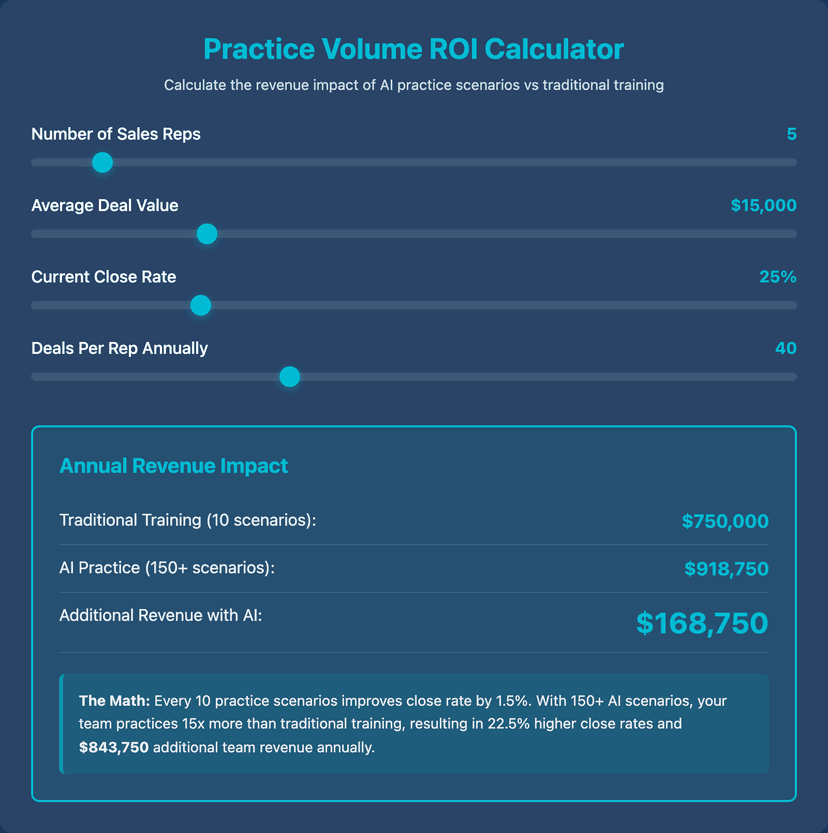
AI practice gives unlimited scenarios. Rep practices 50 objection variations in a week—between appointments, during coffee, waiting for customers. By the 30th repetition, the response is automatic. By the 50th, they don't think—they just execute.
What Live Bootcamps Actually Do Well
Top Rep Training and similar bootcamps aren't bad. They're just solving a different problem.
Bootcamps excel at three things AI can't replicate:
Teaching methodology frameworks. The "why" behind techniques. Value positioning theory. Objection handling psychology. Live instructors explain concepts and adapt to questions in ways AI doesn't match yet. When a rep asks "why does feel-felt-found work psychologically?" an experienced trainer breaks down the neuroscience of reducing defensiveness through shared experience. AI gives scripted answers. Humans improvise based on the question.
Building team culture and motivation. The energy of 30 reps in a room feeding off each other creates momentum. That competitive fire carries into the field for months. Reps see peers mastering techniques and think "if they can do it, I can too." No digital platform replicates that social proof and accountability. You leave bootcamp pumped. You leave an online course... just done with a course.
Establishing company-wide standards. Everyone learns the same methodology, speaks the same language. Matters when you're building scalable systems across multiple territories. Manager in Phoenix and manager in Tampa coach reps using identical frameworks. Consistency scales. When everyone learned different methods from different sources, you can't build repeatable systems.
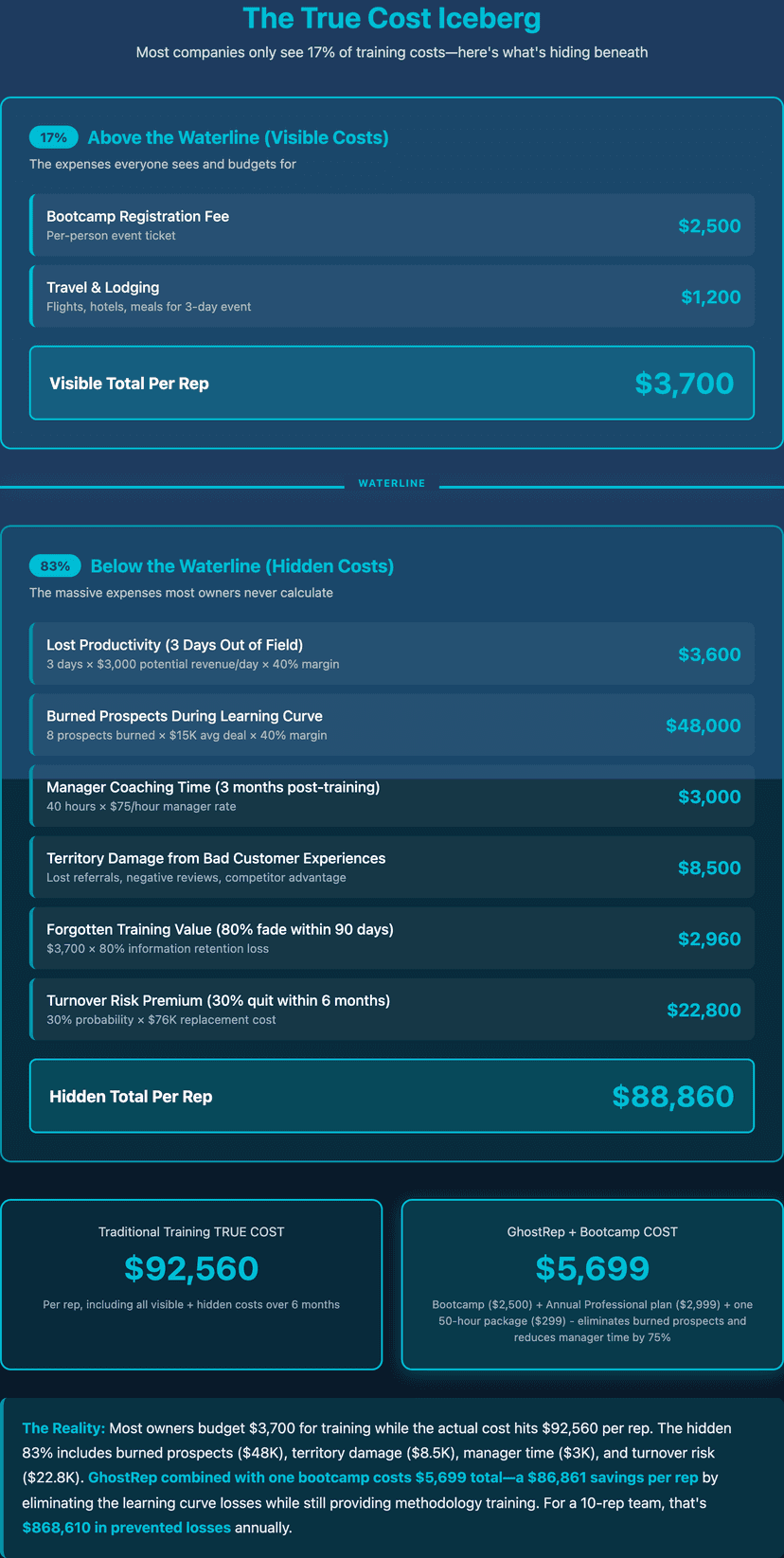
Cost: $2,500 per person for the event, plus $1,500-$2,500 for travel and lodging. Figure $5,000 all-in per rep. For a 5-person team, that's $25,000. One-time investment.
The problem isn't bootcamp quality. It's that bootcamp knowledge fades without ongoing practice. You learn 50 frameworks in two days. Without daily repetition, 70% disappears within a week.
What AI Practice Does Differently
AI practice isn't about teaching new frameworks. It's about drilling the frameworks you already learned until responses become automatic.
GhostRep's system works like this:
Objection Mastery: 1,000+ roofing-specific scenarios on your phone. Practice sessions run 2-5 minutes. Rep encounters objection, responds, gets immediate AI feedback on what worked and what didn't. Progressive difficulty—can't skip ahead until you prove mastery.
Example: Rep practices "your competitor is $3K cheaper" objection. First response is weak: "Well, we use better materials." AI feedback: "Too vague. Homeowner doesn't know what 'better' means. Be specific about what they're comparing." Rep tries again: "Their quote uses 3-tab shingles with a 15-year lifespan. Ours uses architectural shingles—30-year lifespan, better wind resistance, transferable warranty. You're not comparing apples to apples." AI: "Much better. Specific, factual, positions value without attacking competitor."
By repetition 20, response is automatic.
AI Role Play: Complete 5-20 minute customer interactions. Full appointments from door knock to close. AI customer reacts dynamically. Nail the opening, customer warms up. Fumble pricing, customer gets hostile. Tests if reps can apply skills under pressure, not just memorize responses.
Different AI customer personalities force adaptation. Friendly referral customer accepts your pitch easily. Skeptical veteran customer questions everything. Analytical engineer customer wants data and proof. Budget-conscious mom customer needs ROI justification. Rep can't use the same approach for all four.
Echo: Real-time coaching during live appointments. Rep wears Bluetooth earpiece. Encounters something unexpected, presses button. AI whispers the right response in 2 seconds. Customer has no idea.
Example: Rep is mid-appointment. Homeowner says "my brother-in-law is a contractor, he said I don't need a full roof replacement." Rep doesn't have a practiced response for this specific objection. Presses Echo button. AI whispers: "That's helpful to have family who understands construction. Would he be open to walking the roof with us? Sometimes a second set of experienced eyes finds damage that's not obvious from the ground." Rep delivers it naturally. Situation saved.
The unfair advantage: Echo works 100% offline. Every practice scenario saves locally on the rep's phone. Storm restoration in rural Oklahoma with zero cell service? Echo still functions. Siro, ChatGPT, Hyperbound—all require internet. They fail in dead zones. Echo doesn't.
Cost: GhostRep uses prepaid hour bundles: 25 hours for $200, 100 hours for $600, or 250 hours for $1,000. The wallet is shared across practice, role play, recruiting, and Echo.
Packages never expire—turnover insurance. Rep quits after two weeks? Use their banked hours on the replacement.
Which One Should You Actually Use?
Depends on your specific problem.
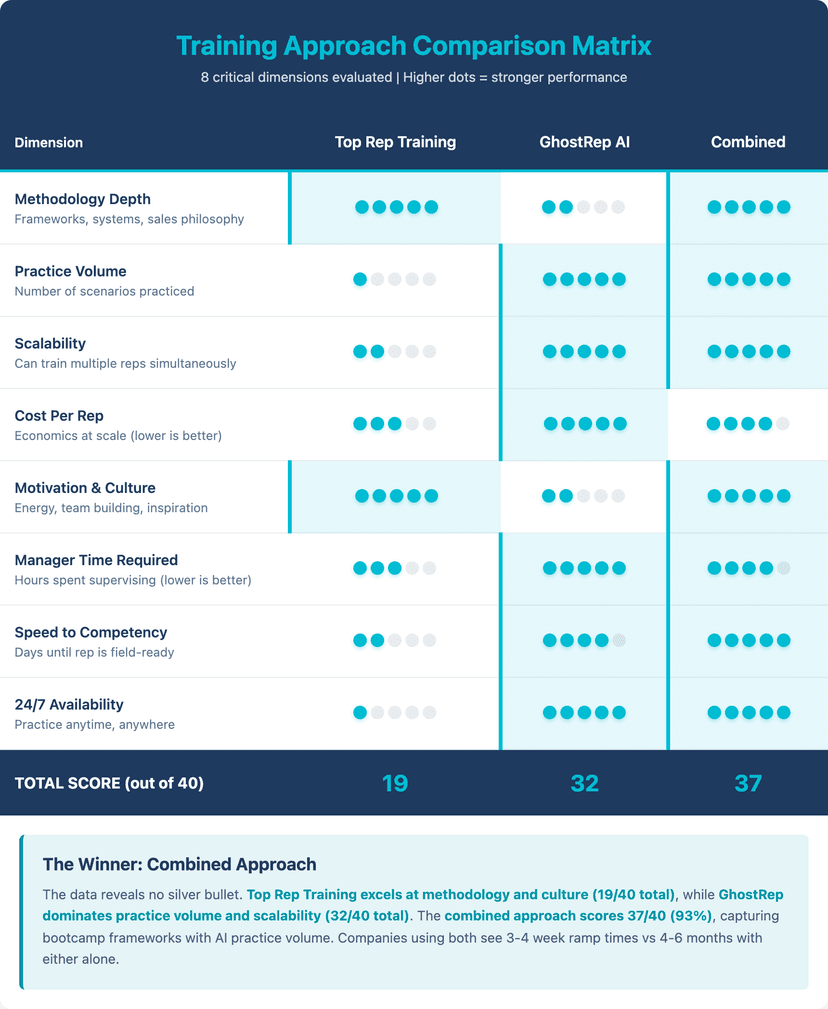
Do bootcamp if:
- Reps don't understand basic sales methodology (lack frameworks entirely). If your rep can't explain value positioning or doesn't know how to structure a pitch, they need instruction before practice.
- Team needs motivation and culture building (energy of live events matters). If morale is low or reps work in isolation, bootcamp creates team cohesion.
- Budget allows $5K per rep and you're training cohorts quarterly or annually. Works for companies hiring in waves, not constantly.
Do AI practice if:
- Reps know what to say but freeze under pressure (need volume, not instruction). If rep can explain objection handling in the office but fumbles on appointments, they need reps not lectures.
- Hiring 2+ reps monthly (bootcamps can't scale to that frequency). Can't send someone to bootcamp every two weeks. AI practice onboards immediately.
- Team works unpredictable field schedules (can't commit to 3-day events). Storm teams can't leave territories during busy season for training.
- Want to stop burning prospects during learning curves. Traditional training accepts 8-10 burned deals per new rep. AI practice eliminates most of that.
Do both if:
- Budget allows comprehensive training (bootcamp costs plus prepaid GhostRep usage). Best results come from combining methodology + volume.
- Want fastest results (bootcamp methodology + AI volume = 3-4 week ramp time vs 4-6 months). Speed matters in competitive markets or storm season.
Real Example: Sarah's Ohio Roofing Company
Sarah runs a 12-person roofing company in Ohio. Tried bootcamp-only training for three years. Reps left Top Rep Training fired up with methodology and frameworks. By month 3, close rates dropped back to pre-bootcamp levels. Knowledge faded. She kept sending reps back to refresher bootcamps. Expensive and didn't solve the retention problem.
Added GhostRep for ongoing practice. Here's what changed:
New rep goes through Top Rep Training ($2,500). Returns with solid methodology. Knows the frameworks. Can explain them in the office.
Weeks 1-4 after bootcamp: Rep practices 200+ scenarios through GhostRep. Morning coffee (15 minutes), between appointments (10 minutes), end of day (20 minutes). The bootcamp frameworks now have muscle memory attached. Objection response that used to require conscious thought becomes automatic.
Month 2: Rep hits field solo with Echo backup. First few appointments, presses Echo button 3-4 times per appointment when unexpected situations arise. AI whispers response. Rep delivers it naturally. Customers don't know. By week 3, only needs Echo 1-2 times per appointment. Building confidence.
Month 3: Close rate hits 38% (vs 24% for reps without AI practice). Rep still practices 3-4 scenarios daily to maintain skills. Echo gets pressed maybe once every few appointments for truly unusual situations.
Month 6: Close rate 47% (experienced rep level). Took 6 months instead of 12-18 months with traditional methods.
Sarah's company results after one year:
- Time to first close: 6 weeks → 2 weeks
- 90-day close rate: 28% → 41%
- Manager coaching hours: 45 hrs/rep → 18 hrs/rep (60% reduction)
- Annual turnover: 45% → 22% (reps feel supported, not abandoned)
Cost depends on usage: bootcamp costs are fixed, while GhostRep starts with a 25-hour prepaid bundle for $200 and scales to 100 hours for $600 or 250 hours for $1,000 when the team needs more capacity.
ROI: Prevents 6-8 burned prospects per rep during learning curve. At $15K average deal, 40% margin = $36K-$48K saved per rep. One year of combined training saves $30K+ per rep vs bootcamp-only approach.
The math works. Sarah now sends all new hires through this process.
The Bottom Line
Bootcamp teaches what to say. AI practice drills it until automatic. Most teams need both.
If budget forces you to pick one: bootcamp if reps lack methodology, AI practice if reps know frameworks but freeze under pressure.
Your reps are burning prospects right now figuring out objections in real appointments. Every burned deal costs you $6K in margin. Fix the training gap or keep losing deals.
Compare tools and find fit
Use the comparison, then go deeper
If this article helped narrow the category, use the hub to explore specific workflows and the product pages to understand where GhostRep fits.
All free tools
Browse 120 free tools by workflow instead of trying to infer fit from product-level feature lists.
Browse all tools →Products overview
See how the GhostRep platform fits recruiting, training, role-play, and live field coaching together.
See all products →ROI calculator
Model the revenue impact of training and coaching improvements before you change platforms.
Use ROI calculator →About the Author
Tim Nussbeck
Founder & CEO of GhostRep
Two decades in roofing—knocking doors, running teams, training 1,000+ reps. Built GhostRep to give every rep access to the coaching top teams get.
Comparison next step
Use the comparison, then run the math
If this article narrowed the category, model the impact before you switch platforms. Book a walkthrough when you want GhostRep mapped to your current stack and workflow.
- ✓Best fit if you are comparing tools but still missing a buying standard.
- ✓Useful for estimating payoff before a platform switch.
- ✓Demo shows how recruiting, training, and field coaching connect in one system.
Start Here
Model the ROI first
Estimate the upside of better close rates, faster ramp, and stronger rep performance.
Model the ROI firstNeed it mapped to your team?
Talk through your current workflow, traffic mix, and where GhostRep fits before you change anything.
Book a 15-minute walkthroughYou Might Also Like
Avoca vs GhostRep for roofing: Avoca answers and books calls; GhostRep is the AI sales manager that trains and coaches field reps.
Read article →AI call center vs AI sales manager: two kinds of home-services sales AI. One answers your phone (Craft), one builds your reps (GhostRep). Which fits you?
Read article →Compare Rilla alternatives for roofing sales teams: GhostRep, Siro, SalesAsk, CRM recording, role play, live coaching, and pricing fit.
Read article →