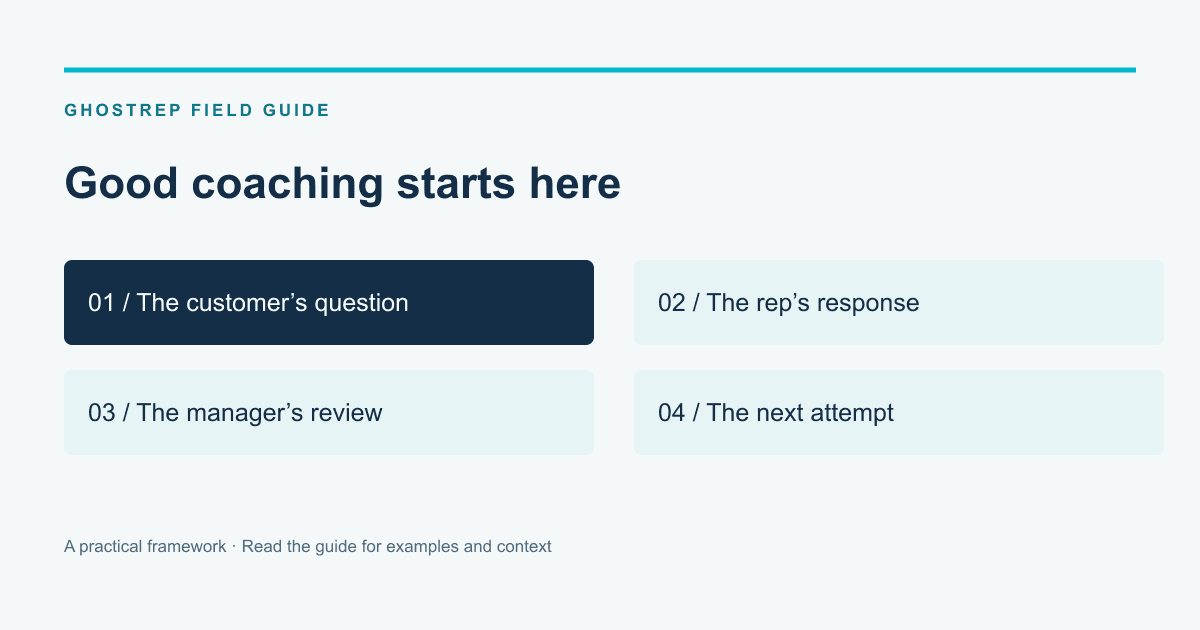
Good coaching starts with what happened. When a roofing rep leaves an appointment with an unanswered question, the manager needs more than the final outcome. They need the exchange that led there: what the homeowner asked, how the rep explained the work and what the two agreed to do next.
GhostRep connects field-conversation capture, live AI coaching, session review and practice. This guide follows one coaching problem through that sequence so you can see where each part fits and what your team needs to bring.
Start at the kitchen table
Consider this illustrative situation: a homeowner has two replacement proposals and asks why yours costs more. The rep begins describing the product before finding out which part of the proposals the homeowner is comparing. The appointment ends without a clear next step.
There are several possible explanations. The scope may differ. The customer may be asking about installation rather than materials. They may need another person involved. The coaching task is to identify the question that was missed, not to assume that a lower price or a stronger closing line would have solved it.
Capture the exchange with Echo
Echo records field conversations and provides a transcript and coaching action plan for review. A manager can return to the exchange behind the recap and discuss the specific moment with the rep.
Set up the supported recording workflow before relying on it in appointments. Confirm the device, recording process, session access and customer-consent requirements. Make sure the rep knows how to check session status and how the manager will find the recording afterward.
Recording availability and live AI availability are separate questions. Do not assume that a device’s ability to record without a connection means AI coaching also works offline. Confirm the current supported behavior for the app and workflow you plan to use.
Use live coaching while the question is still open
Live AI coaching supports the rep during the conversation. The useful test is whether a cue helps them listen or ask a better question without drawing attention away from the customer.
In the proposal example, the next useful question might be, “Which part of the two proposals would you like to compare?” The rep should then respond to the homeowner’s answer using the company’s actual scope and product information. A cue is support for that judgment, not a substitute for understanding the situation.
Test the experience with the audio setup and environment your team uses. Several speakers, noise and connectivity can affect the workflow. Evaluate the timing and relevance you observe rather than relying on a universal response-time promise.
Review one moment with the manager
After the appointment, ask the rep which exchange they want to discuss. Review that part of the recording together. Compare the rep’s interpretation with the customer’s actual words and identify one behavior to practice.
A useful review might conclude: “Before explaining the difference, ask what the customer is comparing.” That is more actionable than “build more value.” Use the call scorecard if the team needs a consistent way to describe the behavior.
Keep the feedback connected to the source. A summary can organize the discussion, but the recording helps resolve uncertainty about what was said. The manager remains responsible for the company standard and the next coaching decision.
Work through the response with AI Sales Coach
AI Sales Coach gives the rep a place to explore a question and prepare another approach. Bring the situation and relevant company context. Ask for help with the explanation that needs work, rather than a generic script for every appointment.
For the competing-proposal example, the rep could ask how to explain an installation difference in plain language. Check the response against the actual proposal. If information is missing, identify the question that needs an answer before the rep repeats the explanation to a homeowner.
Rehearse the next attempt
AI Role Play turns the coaching focus into another conversation. Vary the homeowner’s concern so the rep has to listen. One customer may care about the installation scope; another may be asking about payment timing or an unresolved detail.
Keep the objective the same long enough to assess it. Review whether the rep asked the clarifying question, understood the answer and explained the relevant information. A completed session is evidence of participation. A better response is evidence about the skill.
Bring a recurring lesson to the team
If several reps need help with the same explanation, use Training Studio to prepare a focused lesson. Supply current company material and the situation you want to address. Review the draft before adopting it as team training.
The lesson can be short and concrete: the homeowner’s question, a demonstration, a practice attempt and a discussion. Preserve useful variations so reps learn to handle the question rather than memorize one line.
Keep the job context available
Job Intel supports preparation and follow-up using available customer and job context. Before the next visit, the rep can identify what remains unresolved and prepare a question worth asking.
Keep the CRM and other source records accurate. Confirm any integration your company depends on using the actual supported workflow. A product description alone does not prove that your particular fields, permissions and handoff are connected.
Evaluate the complete coaching cycle
| Stage | What to look for |
|---|---|
| Capture | The relevant exchange is available for review. |
| Live support | The cue fits the question and arrives at a useful moment. |
| Review | Manager and rep agree on one specific change. |
| Practice | The rep attempts that change in a comparable scenario. |
| Next appointment | The manager checks whether the behavior transferred. |
Start with one team and one coaching priority. Measure usage, review time and the behavior you want to improve. Treat any revenue scenario as an assumption until the company has observed comparable outcomes.
Pricing and a practical starting point
GhostRep offers shared prepaid bundles: 25 hours for $200, 100 hours for $600 or 250 hours for $1,000. See current pricing for the purchase flow and how hours work. Include the manager’s review time and setup work when planning the rollout.
Bring a real appointment situation to contact sales: your trade, team, supported-device needs and the question reps struggle to explain. That gives the conversation a useful starting point without promising a particular close-rate lift or time to first sale.
Free tools for roofing sales training
Turn this article into rep practice
Use the training library to turn ideas into drills, scripts, and coaching reps can actually use in the field.
Training tools
Browse objection, role-play, and scripting tools built for home improvement sales teams.
Browse training tools →All free tools
See the full tools hub across hiring, management, field sales, operations, and marketing.
Browse all tools →Role Play
Turn training concepts into live practice with AI homeowner scenarios that build muscle memory.
See Role Play →About the Author
Tim Nussbeck
Founder & CEO of GhostRep
20+ years in roofing and home improvement sales—knocking doors, running teams, and building practical coaching systems. Built GhostRep to give every rep access to the coaching top teams get.
Training next step
Turn training ideas into drills your reps will actually run
Start with the free training tools if you need scripts, practice reps, or coaching prompts today. Book a walkthrough if you want GhostRep mapped to your onboarding process.
- ✓Best fit if reps need more repetition, not more theory.
- ✓Useful for onboarding, objection practice, and weekly coaching.
- ✓Demo shows how Role Play plugs into your current training process.
Start Here
Browse training tools
Free objection builders, role-play prompts, scripts, and rep-practice templates.
Browse training toolsNeed it mapped to your team?
Talk through your current workflow, traffic mix, and where GhostRep fits before you change anything.
Book a 15-minute walkthroughYou Might Also Like
Build a roofing sales training workflow around recorded appointments, live coaching, manager review and focused practice. Evaluate it with your own team.
Read article →A practical roofing sales rep training timeline: first appointment, first sale, consistent production, full ramp, and what speeds it up.
Read article →Build safe roofing objection practice with realistic scenarios, observable coaching criteria, and readiness gates—without using homeowners as practice targets.
Read article →