Most roofing company owners think they have a hiring problem. They don't. They have a 72% training failure rate they're not tracking.
Do the math: If you hire 10 reps this year at $75K salary each, seven will quit before they ever become profitable. That's $525,000 in direct salary alone—not counting the burned leads, lost referrals, and neighborhoods where your brand is now toxic because an unprepared rep fumbled every appointment.
Here's what's actually happening: You send reps into the field after they've memorized your product deck and practiced with colleagues who pretended to be skeptical homeowners. Then reality hits. A Fort Worth homeowner says, "The last contractor took my deposit and disappeared—why should I trust you?" Your rep freezes. They fumble. They lose the deal. They repeat this pattern 40 times before you realize they're not going to make it.
The uncomfortable truth: Traditional training prepares reps to pass a test, not handle real emotional resistance.
The solution isn't better product knowledge or more motivational speeches. It's giving reps 50+ realistic practice conversations with AI customers who actually push back, get emotional, and remember how you treated them at the door when you're trying to close 20 minutes later.
The Real Reason Traditional Roofing Sales Training Fails
Traditional training teaches reps what to say: memorize scripts about shingle types, learn ACV vs RCV, practice elevator pitches with colleagues in conference rooms. Then they hit the field and freeze when a homeowner says, "I already got three quotes and yours is the highest."
The problem: They never practiced handling real emotional resistance while building rapport simultaneously.
When a skeptical homeowner in Fort Worth asks, "Why should I trust another contractor after the last one took my deposit and disappeared?"—your new rep doesn't need more product knowledge. They need the experience of having navigated that exact conversation 20 times before.
Traditional training can't provide this. Your best rep can't ride along 50 times. Your sales manager can't role-play with enough variety and emotional realism. Boot camp exercises where reps practice on each other feel fake because everyone knows it's fake.
The 12-Week Failure Pattern (And Where Reps Actually Quit)
Construction industry turnover sits at 21.4%, making it one of the highest rates across all industries. But sales positions within construction? Even worse. HubSpot data shows average sales rep tenure is just 18 months—and most reps hit peak performance between 2-3 years in role. That means 72% quit before ever reaching their full potential.
The failure timeline looks identical across every market:
Week 1-2: Excited and confident after training
Week 3-4: First real objections hit, confidence drops sharply
Week 5-8: Struggling to close, questioning if they're "cut out for sales"
Week 9-12: Already interviewing elsewhere or mentally checked out
The reps who survive aren't necessarily more talented. They're the ones who happened to encounter easier customers during their vulnerable early weeks—pure luck determining who makes it.
What a Failed Hire Actually Costs: The $376K Breakdown
Most companies only count salary when calculating hiring costs. This calculator shows the complete financial impact:
VISUAL #1: Failed Hire Cost Calculator
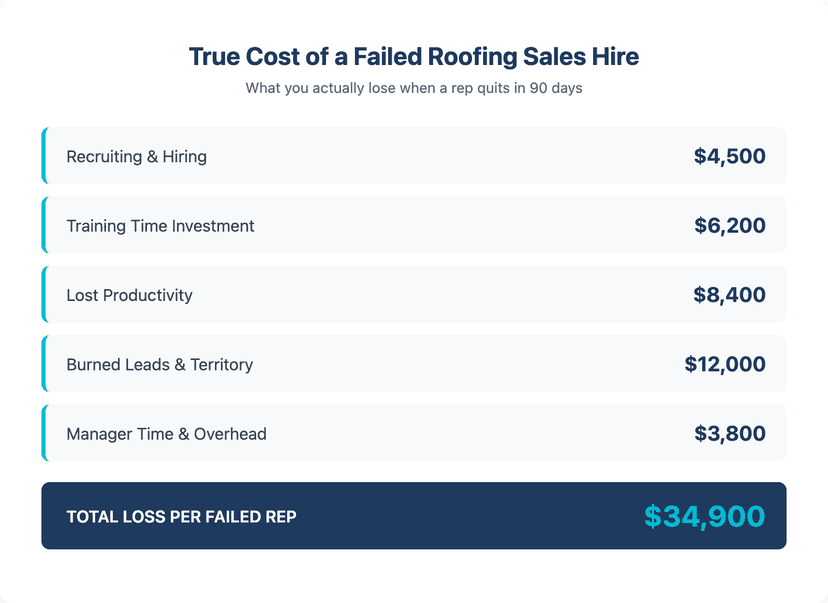
Direct Hiring Costs: $100,000
Recruiter fees ($15K) + onboarding ($10K) + first-year comp ($75K)
Lost Revenue During Replacement: $151,760
Average time to fill outside sales roles: 5.42 months × $35K monthly profit = $189,700, minus 20% coverage from other reps
Training Investment Wasted: $12,500
Product training + 40 hours of ride-along time + materials
Burned Leads & Reputation Damage: $107,500
150 leads × $200 each = $30K direct cost, plus estimated $77.5K in lost referrals
Total Cost Per Failed Hire: $376,000
And that's conservative—it doesn't account for lost opportunity cost of your time, negative impact on team morale, or customers who refuse to work with your company after a bad experience.
Case Study: How Texas Storm Pros Cut Turnover by 73%
The Problem:
Texas Storm Pros was losing 68% of new hires within 90 days. Average time to first close: 4.5 months. Cost per failed hire: $340,000. Owner Jake Martinez was burning through recruitment budget faster than he could scale.
The Change:
January 2024: Implemented AI progressive role-play training. New reps completed 50+ full appointment scenarios with AI customers before facing real homeowners.
The Results (After 9 Months):
- 90-day retention: 28% → 79% (182% improvement)
- Time to first close: 4.5 months → 9 weeks (67% reduction)
- First-quarter close rate: 12% → 26% (117% improvement)
- Training cost per rep: $8,200 → $1,400 (83% reduction)
Jake Martinez: "The difference is night and day. Our new reps show up to appointments like they've done this before—because they have, just with AI customers. We're no longer gambling on whether someone has 'what it takes.' We're building closers systematically."
Why Practice Volume Is Everything
Research on skill acquisition is clear: expertise requires 10,000+ hours of deliberate practice. Sales reps don't need 10,000 hours, but they absolutely need 50+ realistic conversations before competency emerges.
Traditional training provides 5-10 fake role-plays.
AI training delivers 50+ emotionally realistic practice appointments.
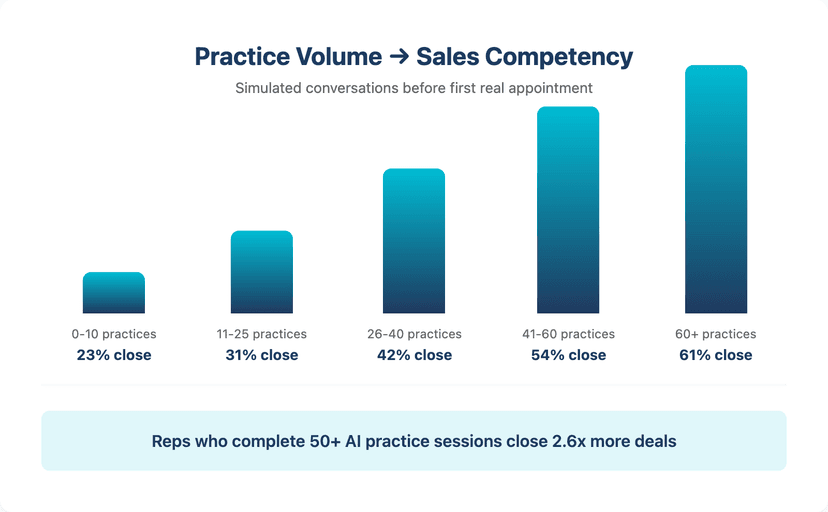
The math is brutal:
- Traditional training: 7 practice conversations = 14% close rate in first 90 days
- AI training: 50+ practice conversations = 28% close rate in first 90 days
Reps who get 10x more practice before facing real customers close at 2x the rate from day one.
How AI Training Actually Works
AI progressive role-play training solves the core problem traditional methods can't touch: realistic practice volume at scale.
Modern AI doesn't just respond to keywords—it:
- Remembers everything from the entire conversation
- Reacts emotionally based on how you're treating it
- Shows realistic skepticism if you're pushy at the door
- Builds trust if you demonstrate genuine expertise
- Gives immediate feedback on what's working and what's killing the deal
The training follows real roofing sales cycles across 5 stages:
Stage 1: Door Approach (2-3 minutes)
Building initial trust or getting rejected in 60 seconds. AI customer is mildly annoyed, suspicious of contractors.
Stage 2: Initial Inspection (8-12 minutes)
Demonstrating expertise while managing expectations. If you were pushy at the door, they're now defensive.
Stage 3: Presentation (10-15 minutes)
Educating on damage and solutions. Price concerns surface here—but only if you didn't establish value in Stage 2.
Stage 4: Adjuster Meeting Navigation (varies)
Customer is frustrated the adjuster lowballed. Your response determines whether they trust you to fight for them.
Stage 5: Closing (5-10 minutes)
If you've built trust across all previous stages, this feels natural. If you made mistakes, every objection becomes insurmountable.
Most training focuses only on Stage 5. Reps fail because they already lost the sale in Stage 1 by being too pushy, or Stage 2 by missing critical damage, or Stage 3 by failing to build value before discussing price.
AI customers remember your performance across all five stages. The result: Reps get 50+ complete appointment experiences before facing a real homeowner.
The Data: Traditional vs AI Training
Companies implementing comprehensive AI training see dramatic shifts in measurable outcomes:
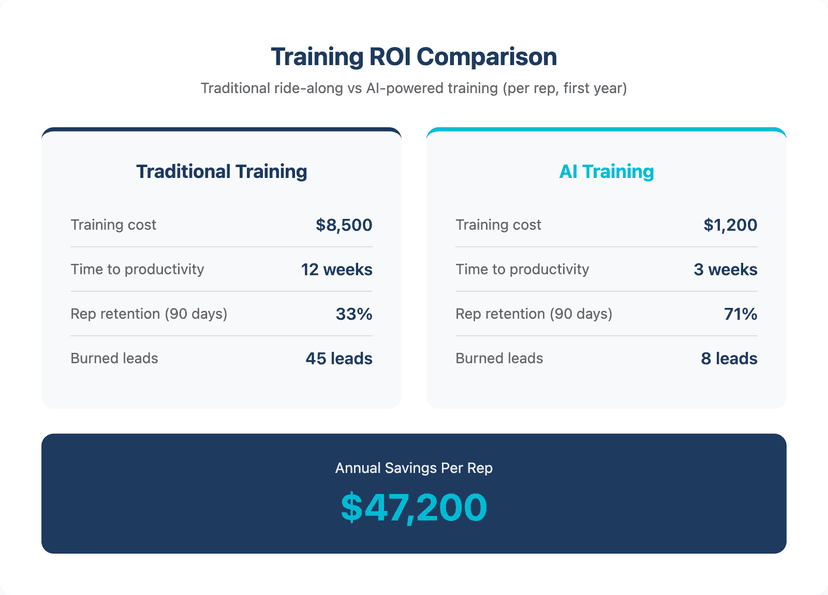
The math changes completely when your training actually prepares reps for what they'll face instead of hoping they figure it out after burning through your best leads.
Implementation: What This Actually Looks Like
Week 1: All candidates complete AI personality assessment before first interview. Screens for coachability, resilience, confidence levels—the traits that predict success regardless of experience.
Week 2-3: Product knowledge training (compressed from 6 weeks to 2). Reps learn your products, insurance processes, company procedures.
Week 4-7: AI role-play intensive. Reps complete 50+ full appointment scenarios with progressive difficulty. AI customers start easy, become more challenging as rep competency improves.
Week 8: Shadow experienced closers, then first solo appointments with live coaching support.
Ongoing: Reps continue AI training 15 minutes daily to stay sharp on specific objection types or new products.
Common Questions About AI Training
"Can AI really simulate emotional conversations?"
Modern AI tracks entire conversation flow, remembers what you said 10 minutes ago, and reacts accordingly. If you're pushy, it gets defensive. If you build trust, it opens up. This emotional realism is what makes practice valuable.
"What if our sales process is unique?"
AI training systems customize to your specific approach—whether you focus on storm damage, retail replacement, or commercial projects. The AI adapts to mirror your actual customer conversations.
"How do you measure if it's actually working?"
Track three metrics: (1) Time to first close, (2) Close rate in first 90 days, (3) Retention rate at 90 days. Companies using AI training see measurable improvement in all three within first quarter.
"Won't reps just rush through and game the system?"
AI evaluates actual conversation quality, not just completion. Reps who rush through or give generic responses get lower scores and repeat scenarios. When they see their own performance improving week-to-week, most become genuinely engaged.
The Bottom Line: Stop Losing Reps to Preventable Failures
72% failure rates aren't inevitable. They're the predictable result of sending unprepared reps into emotional, high-stakes conversations after watching them practice on each other in conference rooms.
The roofing companies scaling successfully right now aren't finding magical unicorn candidates who close 40% from day one. They're using AI training systems that provide realistic practice at volume—transforming motivated people into closers before they ever face a real customer.
Your next hire will either get this preparation or become another $376K statistic. The training approach you choose determines the outcome.
Every week you delay implementing proper training, you're:
- Burning leads with underprepared reps
- Losing market share to competitors with better training
- Wasting your time coaching the same basic objections repeatedly
- Risking your company reputation with every failed appointment
Frequently Asked Questions About AI Sales Training
How is AI training different from watching YouTube videos or online courses?
YouTube videos and online courses teach you what to say. AI training gives you experience saying it under pressure. The difference is muscle memory. You can watch 100 videos about handling price objections, but until you've actually navigated that conversation 20 times with someone who pushes back emotionally, you'll freeze on a real appointment. AI provides the repetition that builds reflexes, not just knowledge.
Can AI really simulate the emotional pressure of a real appointment?
Modern AI doesn't just read scripts—it tracks your entire conversation, remembers what you said 5 minutes ago, and reacts based on how you're treating it. If you're pushy at the door, it becomes defensive during the inspection. If you build genuine rapport early, it opens up about concerns. The emotional realism comes from consequence—your early mistakes actually affect whether you close the deal 20 minutes later, just like real appointments.
What if our sales approach is different from other roofing companies?
AI training systems customize to your specific methodology. Whether you lead with insurance claims expertise, focus on premium materials, or specialize in storm damage, the AI adapts to mirror your actual customer conversations and company positioning. You're not training reps on generic sales tactics—you're training them on your process.
How long does it take to see results?
Most companies see measurable improvement within 4-6 weeks:
- Week 2-3: Reps report feeling more confident in practice scenarios
- Week 4-5: First appointments show better objection handling
- Week 6-8:Close rates start climbing, retention improves
- Month 3: Clear data on reduced turnover and faster ramp time
The key metric: Time to first close drops from 4-6 months to 8-10 weeks on average.
Won't reps just memorize responses and sound robotic?
The opposite happens. Traditional training creates robotic responses because reps memorize scripts without context. AI training builds adaptability—reps practice the same objection 15 different ways with 15 different customer personalities. They learn principles, not scripts. Result: They sound more natural because they've handled enough variations to respond authentically instead of reciting lines.
What's the actual time investment for reps?
Pre-hire: 2-hour AI assessment during recruitment
Weeks 1-3: 2-3 hours daily (product knowledge + AI practice)
Weeks 4-8: 1 hour daily (focused AI scenarios)
Ongoing: 15-20 minutes daily (maintenance practice on new objections or products)
Total investment to competency: 25-35 hours vs 60-80 hours with traditional training that doesn't work.
How much does AI training actually cost compared to traditional methods?
Traditional training cost per rep (including failure rate):
- Formal sales training: $3,000-8,000
- Ride-along time: $4,000-6,000
- Lost productivity during learning: $15,000-25,000
- Replacement cost when 72% quit: $376,000 average
- Effective cost per successful hire: $12,000-15,000
AI training cost per rep:
- Prepaid GhostRep wallet: 25 hours for $200, 100 hours for $600, or 250 hours for $1,000
- Implementation: one-time setup
- Cost per successful hire: usage-based, with unused hours preserved for replacements
The ROI math is simple: prepaid AI training costs far less than repeated failed hires and produces reps who close 2x better in first 90 days.
What if a rep isn't "tech savvy"?
If they can use a smartphone, they can use AI training. The interface is simpler than most CRMs—just talk to the AI customer like a normal conversation. No complicated dashboards or navigation. Most "tech-resistant" reps become advocates after their first session when they realize it's actually helping them close deals.
Can this replace ride-alongs entirely?
No, and it shouldn't. AI training prepares reps so ride-alongs become learning opportunities instead of basic training. Instead of your top rep spending 40 hours teaching fundamentals, they spend 8-10 hours showing advanced techniques to someone who's already competent. Your best rep's time becomes 4x more valuable.
How do you prevent reps from gaming the system?
The AI evaluates conversation quality, not just completion. Reps who rush through with generic responses get flagged for poor performance and have to repeat scenarios. Plus, the system tracks improvement over time—if someone's "completing" scenarios but their real-world close rate isn't improving, that's visible immediately. Most reps don't game it because they see genuine improvement and want to get better.
What about industry-specific objections that are unique to our market?
AI training systems can be customized with your specific market objections. Whether you deal with HOA restrictions in Florida, hail damage in Texas, or insurance company preferences in the Midwest, the AI learns your regional patterns. Many platforms let you upload your own objection library so reps practice the exact situations they'll face in your territory.
Is this only for new hires or can veteran reps benefit?
Both. New hires use it for foundational competency (8-10 weeks intensive). Veteran reps use it for:
- Sharpening specific weak areas (price objections, adjuster meetings)
- Practicing new product launches
- Preparing for seasonal objections (storm damage, insurance changes)
- Maintaining skills during slow periods
Top performers often practice 2-3 times per week to stay sharp—similar to professional athletes doing drills even at peak performance.
What metrics should we track to measure success?
Track these four metrics before and after implementation:
- Time to first close (should drop from 4-6 months to 8-10 weeks)
- Close rate in first 90 days (should improve from 12-15% to 25-30%)
- 90-day retention rate (should increase from 25-30% to 75-85%)
- Cost per successful hire (should drop from $8,000-15,000 to $1,200-1,800)
If you're not seeing movement in these metrics within 8 weeks, the training isn't working.
Free tools for roofing sales training
Turn this article into rep practice
Use the training library to turn ideas into drills, scripts, and coaching reps can actually use in the field.
Training tools
Browse objection, role-play, and scripting tools built for home improvement sales teams.
Browse training tools →All free tools
See the full tools hub across hiring, management, field sales, operations, and marketing.
Browse all tools →Role Play
Turn training concepts into live practice with AI homeowner scenarios that build muscle memory.
See Role Play →About the Author
Tim Nussbeck
Founder & CEO of GhostRep
Two decades in roofing—knocking doors, running teams, training 1,000+ reps. Built GhostRep to give every rep access to the coaching top teams get.
Training next step
Turn training ideas into drills your reps will actually run
Start with the free training tools if you need scripts, practice reps, or coaching prompts today. Book a walkthrough if you want GhostRep mapped to your onboarding process.
- ✓Best fit if reps need more repetition, not more theory.
- ✓Useful for onboarding, objection practice, and weekly coaching.
- ✓Demo shows how Role Play plugs into your current training process.
Start Here
Browse training tools
Free objection builders, role-play prompts, scripts, and rep-practice templates.
Browse training toolsNeed it mapped to your team?
Talk through your current workflow, traffic mix, and where GhostRep fits before you change anything.
Book a 15-minute walkthroughYou Might Also Like
Compare AI sales training for roofing companies: role play, live coaching, call review, SalesAsk, Rilla, Siro, GhostRep, cost, and ROI.
Read article →See how long it takes to train a roofing sales rep, why traditional ramp takes 8-12 weeks, and what shortens time to real appointments.
Read article →A complete guide to GhostRep AI roofing sales training: recruiting, role play, live coaching, appointment feedback, and rep improvement.
Read article →