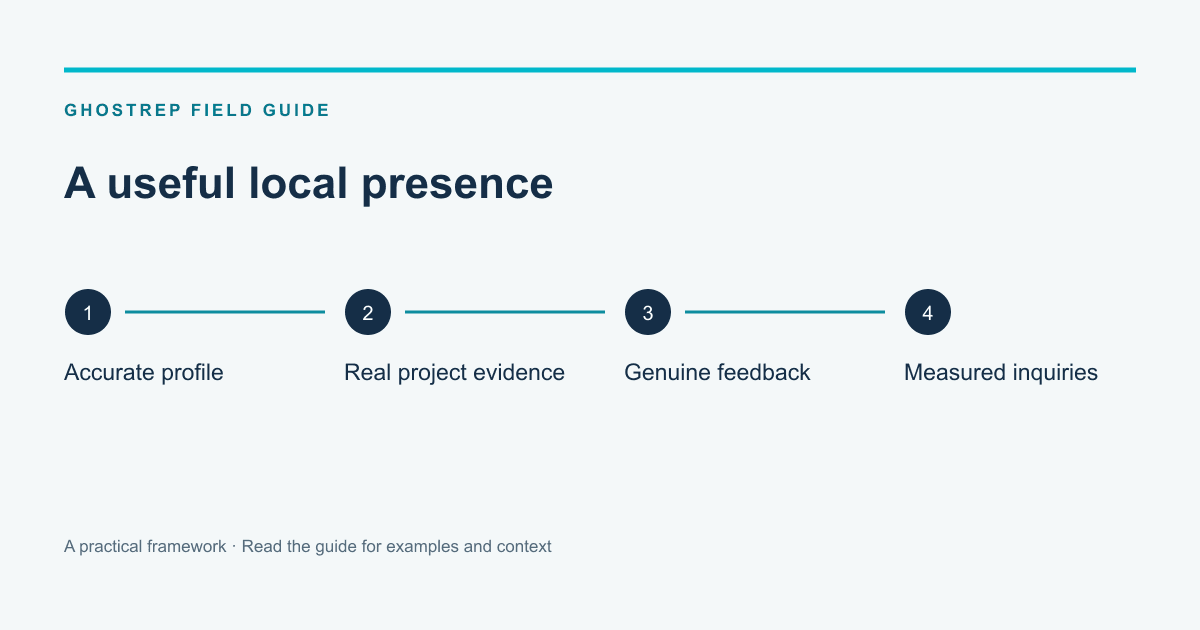
To improve Google Maps ranking for a roofing company, strengthen relevance and prominence while keeping the Business Profile eligible and accurate. Distance is determined by the searcher's location, so no tactic guarantees a Local 3-Pack position. Use the broader roofing lead-channel planning guide when deciding which acquisition channel to prioritize.
Google says local results are mainly based on relevance, distance, and prominence. Google also says there is no way to request or pay for a better local ranking. Start with Google’s own local ranking guidance and Business Profile guidelines.
Next Step
Turn Maps visibility into the local trust assets Google expects
Ranking in Maps is not just proximity. Contractors need clearer local copy, stronger review velocity, and a profile that matches the jobs they want.
Review your live profile before making changes
Use this evidence worksheet to identify the next concrete correction. Mark an item verified only after checking the actual profile, page, or lead record. Completing the review does not predict a ranking; compare the same reporting period and geography when evaluating later results.
Google Business Profile evidence review
Check the live evidence before changing the profile. This is a completion record, not a ranking score. Selections stay in this page until you leave or reload. Download to retain the review.
0 of 6 reviewed
Authorized profile access
Confirm the responsible owner can access the correct verified Business Profile and identify any duplicates for review.
Business details
Compare the live name, accurate category, phone, hours, website, and services with your actual operation. Follow Google’s service-area and address rules.
Local destination page
Open the profile’s website link on mobile. Verify the service, service area, contact details, and working inquiry path.
Review request process
Inspect the real review request. Invite honest feedback without incentives or selectively directing only happy customers to Google.
Current evidence
Review genuine project photos and service information. Remove outdated claims and ensure you have permission to publish the material.
Lead measurement
Record the reporting period and distinguish profile interactions from qualified inquiries and booked work. Check the actual handoff into your lead records.
For a specific correction, use the Google Business Profile description editor to describe the real business and the Google review request tool to prepare an honest feedback request. Check the final text against the actual service and customer interaction before using it.
1. Confirm eligibility and ownership
Verify the Business Profile through the business’s authorized owner. Use the real-world business name and an eligible location or service-area setup. Do not create virtual-office, mailbox, employee-home, or duplicate profiles to manufacture coverage.
A service-area business should follow Google’s rules about hiding an address when customers are not served there. Adding cities does not make a business locally prominent in every city.
2. Complete the profile accurately
Choose the most specific accurate primary category and only relevant secondary categories. Complete hours, phone, website, services, service area, business description, appointment links, and other available fields. Keep holiday and emergency hours current.
Do not add keywords, city lists, taglines, or license claims to the business name unless they are part of the real-world name. Do not list services the company cannot actually deliver.
The Google Business Profile description tool can help organize a draft from verified business facts without changing the real-world name or manufacturing location claims.
3. Build a useful local destination
The linked website should make the business and local relevance clear. Include consistent contact information, licensing or credential details where appropriate, service explanations, real project evidence, and a clear contact path. Avoid mass-producing thin city pages that merely swap place names.
Use the roofing SEO versus Google Ads guide to decide how local organic work fits paid acquisition. The roofing website conversion guide covers what happens after the click.
4. Earn and respond to genuine reviews
Ask real customers for honest feedback without telling them what rating to leave. Do not gate requests so only happy customers reach Google, buy reviews, trade incentives for positive sentiment, or have employees pose as customers.
Reply professionally without exposing private project, payment, claim, or customer details. The roofing review guide explains a compliant operating process. Google’s review restrictions apply to contributed content.
5. Publish real evidence
Use current, original photos and videos that help a customer understand the business: crews, vehicles, completed work, material details, and the real premises where eligible. Obtain permission and remove sensitive customer information. Accurate services, updates, and questions-and-answers can reduce uncertainty, but posting frequency is not a published ranking formula.
6. Strengthen real-world prominence
Prominence can reflect information Google finds across the web, including links and articles. Keep core business information consistent on important industry, licensing, chamber, manufacturer, supplier, and local sources. Correct high-value inaccuracies; do not buy a large package of low-quality directory listings.
Local sponsorships, associations, completed public work, and useful local resources may earn legitimate mentions. The goal is evidence of a real local business, not a citation count.
7. Measure without inventing a ranking score
Track Business Profile interactions, calls or forms with appropriate attribution, qualified appointments, jobs, and search visibility across representative locations. Distance means two searchers can see different results. A single rank check from the office is not a market-wide measurement.
Record the date of profile, site, review, and directory changes. Compare stable periods and account for storms, season, advertising, brand campaigns, and service-area changes before attributing an outcome.
A 30-day operating checklist
- resolve ownership, eligibility, duplicates, and guideline violations;
- correct name, category, hours, phone, website, and service area;
- update the linked service and contact pages;
- create a customer-consent review workflow;
- add a small set of useful original photos;
- correct the most visible business-information conflicts;
- implement call and form attribution; and
- document the baseline before evaluating change.
Bottom line
Google Maps visibility is built through an eligible, accurate profile and a credible local business—not secret ranking weights. Improve relevance, protect data accuracy, earn genuine reputation, and measure qualified outcomes over time.
Next Step
Measure whether local visibility is creating revenue
More Maps impressions only matter if they create appointments, reviews, and booked jobs the team can actually close.
Google Maps ranking for roofers FAQ
What determines Google Maps ranking for roofers?
Google says local results are mainly based on relevance, distance, and prominence. A complete and accurate profile can improve relevance, while genuine reviews, links, articles, and broader real-world reputation can support prominence. The searcher's distance remains outside the contractor's control.
Can a roofing company pay Google for a better local ranking?
No. Google's local-ranking guidance says there is no way to request or pay for a better local ranking. Advertising and organic local ranking are separate systems.
Do service areas make a roofer rank in every listed city?
No. A service area describes where the business serves customers; it does not create a ranking guarantee in each city. Follow Google's eligibility and address rules and build genuine local relevance.
What should a roofer measure after updating a Business Profile?
Record a baseline and track profile interactions, attributed calls and forms, qualified appointments, jobs, and representative location-based visibility. Annotate changes so storms, seasonality, advertising, and brand campaigns are not mistaken for ranking effects.
Free lead-generation resources
Turn traffic strategy into pipeline actions
Use free marketing and field tools to turn website, referral, and follow-up ideas into lead flow your reps can actually work.
Marketing tools
Generate ad copy, email sequences, company bios, and lead-conversion messaging for your market.
Browse marketing tools →Field sales tools
Create follow-up assets, texts, and homeowner-facing copy once a lead is already in motion.
Browse field sales tools →Job Intel
Give reps better customer context before the follow-up so lead quality is easier to convert.
See Job Intel →About the Author
Tim Nussbeck
Founder & CEO of GhostRep
20+ years in roofing and home improvement sales—knocking doors, running teams, and building practical coaching systems. Built GhostRep to give every rep access to the coaching top teams get.
Lead-gen next step
Turn traffic into pipeline math before you buy more leads
Start with the ROI calculator or lead-generation tools if you are still diagnosing the economics. Book a walkthrough if you want GhostRep tied to lead handling, follow-up, and close-rate lift.
- ✓Best fit if traffic is arriving but too little of it turns into revenue.
- ✓Useful for modeling conversion lift before you increase spend.
- ✓Demo shows how field execution and coaching change lead economics after the click.
Start Here
Model your conversion lift
Estimate what more leads, better close rates, and faster rep ramp are worth in revenue.
Model your conversion liftNeed it mapped to your team?
Talk through your current workflow, traffic mix, and where GhostRep fits before you change anything.
Book a 15-minute walkthroughYou Might Also Like
Angi and HomeAdvisor share a parent. Compare published lead-sharing and credit terms, account fees, renewal risks, and a free contractor offer worksheet.
Read article →Learn the 3-phase review system roofers use to turn happy customers into Google reviews, stronger local rankings, and more booked leads.
Read article →Use eight roofing email marketing templates for inquiries, appointments, estimates, project updates, service recovery, referrals, and re-engagement.
Read article →