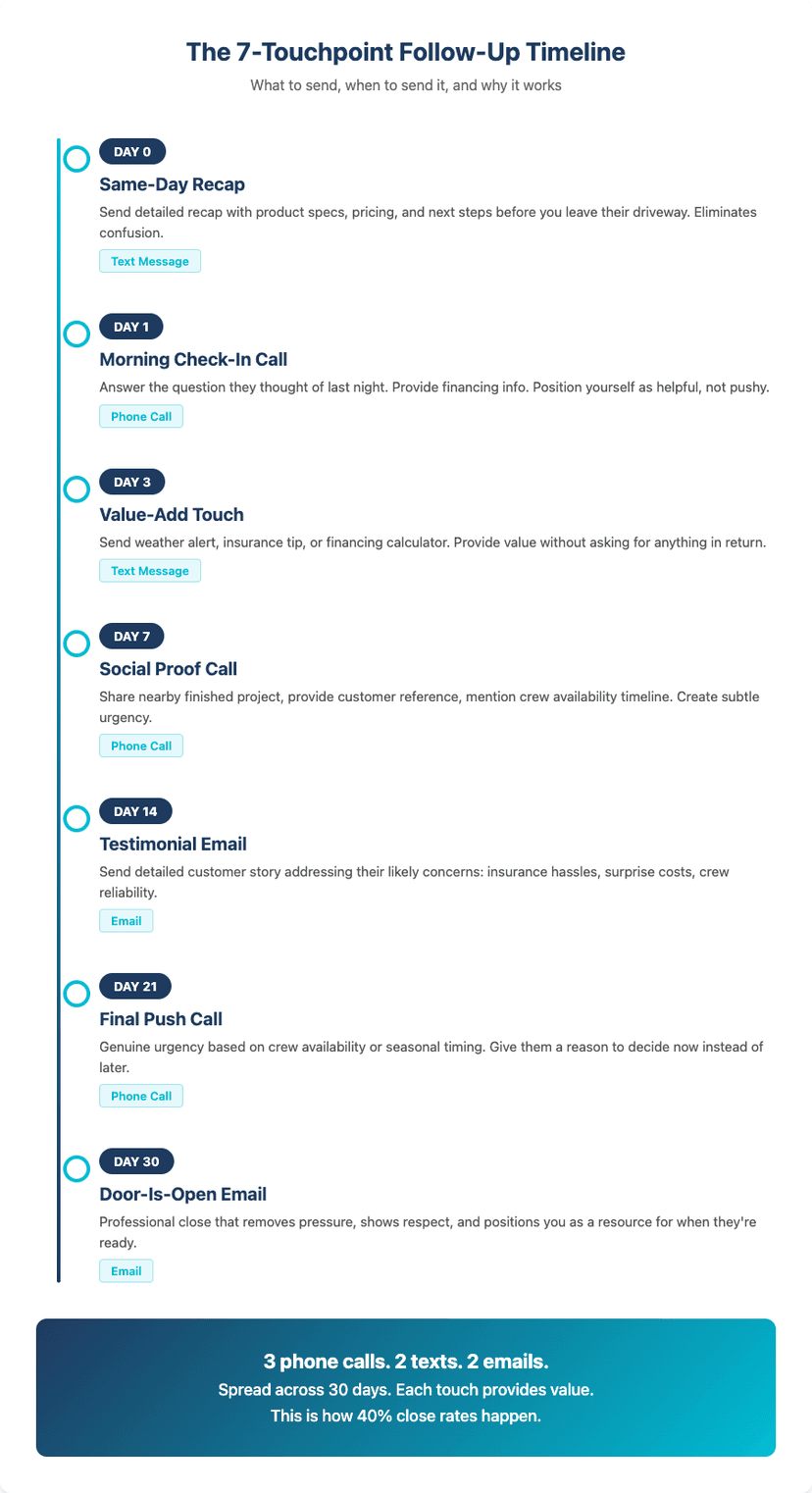
A practical roofing sales follow-up cadence uses seven documented, helpful touches over 30 days: a same-day recap, a next-day call, a day-three value message, a day-seven decision call, a day-14 proof email, a day-21 timeline call, and a day-30 close-the-loop email.
That schedule is a starting framework, not a reason to ignore what the homeowner tells you. If they give you a decision date, ask permission to follow up on that date. If they choose another contractor, decline the project, or opt out of a channel, stop the sequence and update the CRM. Every message should add information or clarify the next step—not repeat “just checking in.”
| Touch | Timing | Channel | Job to do |
|---|---|---|---|
| 1 | Day 0 | Text or email | Confirm the scope, price, documents, and next step |
| 2 | Day 1 | Call | Confirm receipt and uncover the decision process |
| 3 | Day 3 | Text | Answer one project-specific question or send one useful item |
| 4 | Day 7 | Call | Surface the real objection and agree on a next step |
| 5 | Day 14 | Provide relevant, verifiable proof | |
| 6 | Day 21 | Call | Give an accurate schedule or proposal-status update |
| 7 | Day 30 | Close the active sequence and leave a clean path back |
Use the table as the operating view. The templates below show what each touch should contain. Adapt every message to the signed scope, estimate, documented conversation, and communication permissions in your records. For stage-specific inquiry, appointment, estimate, project-update, recovery, and referral copy, use the roofing email marketing templates. If you need a first draft for a specific situation, the free roofing follow-up message generator can help, but a rep should verify every detail before sending.
Turn the cadence into a dated draft
The starting date is illustrative. Use a customer-agreed date when one exists. This plans your work; it sends nothing and creates no CRM tasks.
- 1
Text or email · Confirm scope and next step
- 2
Call · Confirm receipt and decision process
- 3
Text · Answer one project-specific question
- 4
Call · Review the unresolved decision
- 5
Email · Provide relevant verified evidence
- 6
Call · Give an accurate status update
- 7
Email · Close the active sequence
If the customer named a date, use that date instead of the default sequence. A request for space, no further contact, or a closed project removes all tasks from this draft. The CSV is a planning export; review channel permission and current customer status before creating any task in your own system.
For an HVAC proposal, use the HVAC unsold-estimate follow-up builder to prepare the actual call, email, or voicemail around the unresolved issue. Keep the roofing cadence here as an example process, not a universal prescription for other trades.
Next Step
Turn the cadence into usable follow-up assets
Use the exact field tools that help reps send the next message instead of letting the deal go cold.
Before You Start: Confirm the Next Step and Contact Rules
A follow-up sequence works only when the rep starts with a clean record. Before Touch 1, confirm:
- The proposal, scope, options, and expiration date are accurate.
- The decision-makers and the homeowner's stated decision timeline are recorded.
- The phone number and email belong to the intended recipient.
- The company has a documented basis for using each channel under its approved process.
- Any do-not-call, unsubscribe, or channel-specific opt-out is applied immediately.
- The rep knows which facts still require confirmation from production, financing, or insurance.
Do not assume that an estimate request authorizes unlimited automated marketing. The FTC's Telemarketing Sales Rule guidance and the FCC's telemarketing and robocall resources are useful starting points, but state law, message type, technology, and consent records can change the analysis. Have counsel approve the company's calling and texting policy. This article is an operating framework, not legal advice.
Touch 1 — Day 0: Send the Estimate Recap
Send the recap through a permitted channel after the appointment. Its job is to eliminate ambiguity: what was proposed, what the homeowner receives next, and when you will reconnect.
Hi [Name], thanks for meeting today. I sent the proposal for [project scope] at [proposal amount]. It includes [two or three verified scope items]. The next step we discussed is [inspection / decision / document] on [date]. Reply here if I missed anything, and I will follow up [agreed day]. — [Rep], [Company]
Do not paste warranty, financing, code, or insurance language from a generic template. Pull those details from the approved proposal and current company documents. Attach the proposal or link to the customer portal so the homeowner does not have to search for it.
Touch 2 — Day 1: Confirm Receipt and Map the Decision
The next-day call is not a disguised demand for a signature. Confirm that the proposal arrived, then ask one question that reveals how the decision will be made.
Hi [Name], this is [Rep] with [Company]. I wanted to confirm that the proposal came through and that the scope matches what we discussed. As you review it, what part do you expect to compare most closely: scope, timing, payment options, or something else?
If they do not answer, leave a short voicemail with your name, company, reason for calling, and callback number. Do not add unverified urgency. Record the outcome—connected, voicemail, wrong number, requested callback, or opt-out—in the CRM.
Touch 3 — Day 3: Add One Useful Detail
Choose one item that matches the conversation. Good options include an annotated inspection photo, a revised scope answer, a link to the exact manufacturer document cited in the proposal, or an approved financing disclosure. When financing becomes the open decision, use the lender's current materials and the boundaries in the roof financing comparison guide. A vague “Any thoughts?” message makes the homeowner do the work.
Hi [Name], you asked how the proposal handles [specific concern]. I marked the relevant section here: [link or attachment]. It includes [verified answer]. If you want, I can walk through that section with you by phone.
If the concern is price, do not immediately discount. Clarify whether the homeowner is comparing the same scope, materials, exclusions, and workmanship coverage. The guide to handling roofing price objections gives your rep a better structure than defending the total with a wall of text.
Touch 4 — Day 7: Surface the Real Objection
By the day-seven call, the rep should stop guessing. Ask where the decision stands, listen, and establish one concrete next step.
Hi [Name], when we met, you planned to review [scope or option] before deciding. Where does the project stand today? Is there a question about our scope, timing, or proposal that is keeping you from a decision?
Useful outcomes include a scheduled scope review, a request for a revised option, a specific decision date, a documented loss reason, or permission to close the opportunity. “Still thinking” is not a next step until the rep asks what information is missing and when the homeowner wants to reconnect.
Reps who hesitate on this call need practice, not a more aggressive script. Use the roofing sales closing scripts as coaching material, then role-play the likely answer before the rep calls.
Touch 5 — Day 14: Send Relevant, Verifiable Proof
Send evidence that addresses the homeowner's stated concern. That could be a completed project with the same system, a manufacturer specification, an approved customer testimonial, or a short explanation of the production handoff. Only use customer names, photos, addresses, or contact details when your company has permission.
Subject: Example related to your [roof type / scope / concern]
Hi [Name], you mentioned [specific concern] when we reviewed the proposal. Here is [approved project example or source] showing how we handled a similar situation: [link]. The detail most relevant to your roof is [verified point]. If it would help, I can review how that appears in your scope.
Do not invent a testimonial, claim that a nearby homeowner approved a reference call when they did not, or present a manufacturer warranty as your own workmanship guarantee. The proof must be real and relevant.
Touch 6 — Day 21: Give an Accurate Timeline Update
This call is the place for real operational information: current crew availability, an upcoming proposal expiration, a material lead-time change, or the date an approved financing offer ends. Confirm the information before using it.
Hi [Name], I am updating the open proposals on my schedule. Your proposal is currently valid through [date], and the installation window we discussed is [verified window]. Are you still considering the project, or should I close the active follow-up for now?
Never manufacture scarcity. “One slot left” should appear in a call only when scheduling has confirmed that statement. If the homeowner is waiting for an external event, record the event and agree on a better callback date instead of continuing a generic cadence.
Touch 7 — Day 30: Close the Active Sequence
The final email ends the active sequence without punishing the homeowner for silence. It should explain what happens to the proposal and make returning easy.
Subject: Closing the loop on your roofing proposal
Hi [Name], I am closing the active follow-up on the proposal for [project]. The proposal is [valid through date / now due for review]. If you are still considering the project, reply here and I will confirm the current scope, price, and schedule before you make a decision. If you selected another contractor or decided not to proceed, no reply is needed. Thank you for considering [Company]. — [Rep], [phone]
If the homeowner previously asked you not to contact them, do not send this email. The opt-out ends the sequence; it does not create an exception for a “final” message.
When to Change or Stop the Cadence
The cadence is for an open estimate with no agreed alternative timeline. Change it when the homeowner gives you better information.
- They set a decision date: confirm permission and follow up on that date.
- They are waiting on a documented event: schedule the next touch around that event.
- They ask a substantive question: answer it and set the next step; do not keep sending scheduled templates.
- They choose another contractor or decline: record the loss reason and stop selling.
- They opt out or revoke permission: apply the request immediately across the relevant channel and systems.
- The phone or email is wrong: suppress the bad contact data instead of retrying it.
A lead can move into a separate, company-approved nurture program only when the contact rules and the homeowner's stated interest support it. Do not quietly convert an unanswered estimate sequence into indefinite automated messaging.
Set Up the Cadence in Your CRM
Automation should create accountability without sending unreviewed claims. When an opportunity moves to “Proposal Sent,” create seven dated tasks with the purpose of each touch. Let approved automation prefill known fields, but require the rep to review the recipient, scope, amount, next step, permissions, and template before sending.
- Create the sequence only when the proposal status and contact record are complete.
- Assign every task to one owner; avoid duplicate calls from the rep and office.
- Require an outcome after each touch: connected, message left, replied, rescheduled, won, lost, or opted out.
- Cancel future tasks automatically when the opportunity is won, lost, invalid, or opted out.
- Route scope, production, financing, and insurance questions to the person authorized to answer them.
- Show overdue follow-up and missing outcomes on the manager dashboard.
If your process is inconsistent, use the roofing CRM rollout plan and the companion CRM rollout checklist before adding more automation.
Measure Your Own Roofing Follow-Up Results
Do not borrow an unsourced industry close-rate claim as your forecast. Measure the cadence against your own eligible proposals and keep lead source, job type, territory, and rep mix visible.
| Metric | Definition | Management question |
|---|---|---|
| Cadence completion | Required touches completed on time ÷ required touches due | Is the team running the process? |
| Response rate by touch | Homeowner responses ÷ delivered touches at that step | Which messages start useful conversations? |
| Decision captured | Won or lost proposals with a recorded decision ÷ eligible proposals | Are open estimates reaching a known outcome? |
| Proposal win rate | Won proposals ÷ eligible proposals | Did results change for a comparable cohort? |
| Days to decision | Decision date minus proposal date | Is follow-up clarifying decisions sooner? |
| Opt-out rate | Channel opt-outs ÷ delivered messages | Is the contact approach creating avoidable friction? |
Review results by cohort rather than celebrating raw wins. A referral-heavy month and a paid-lead-heavy month are not directly comparable. The roofing sales KPI scorecard helps managers keep activity, outcomes, and definitions in one place.
Coach the Message, Not Just the Task
A checked box does not prove that the rep helped the homeowner. Review a small sample of follow-up records each week and ask:
- Did the rep use a verified detail from the appointment?
- Did the message add information or define a next step?
- Were claims consistent with the proposal and approved documents?
- Did the rep record the homeowner's answer accurately?
- Did the sequence stop when the homeowner decided or opted out?
When a rep repeatedly avoids the decision call or folds at the first objection, rehearse the conversation before changing the cadence. GhostRep's AI role-play training lets managers practice the exact call while the customer record, proposal, and live follow-up remain in the systems authorized for customer communication.
Start With the Next Open Proposal
For the next eligible proposal, send an accurate recap, schedule the six remaining tasks, and write the homeowner's actual decision date into the CRM. The goal is not to contact someone seven times at any cost. The goal is to make every open proposal easy to understand, easy to act on, and impossible for your team to forget.
Ready to help reps handle follow-up conversations with more consistency? GhostRep gives roofing teams structured AI practice for the calls that happen after the estimate. Book a GhostRep demo to see how it fits your coaching process.
Free tools for roofing sales training
Turn this article into rep practice
Use the training library to turn ideas into drills, scripts, and coaching reps can actually use in the field.
Training tools
Browse objection, role-play, and scripting tools built for home improvement sales teams.
Browse training tools →All free tools
See the full tools hub across hiring, management, field sales, operations, and marketing.
Browse all tools →Role Play
Turn training concepts into live practice with AI homeowner scenarios that build muscle memory.
See Role Play →About the Author
Tim Nussbeck
Founder & CEO of GhostRep
20+ years in roofing and home improvement sales—knocking doors, running teams, and building practical coaching systems. Built GhostRep to give every rep access to the coaching top teams get.
Training next step
Turn training ideas into drills your reps will actually run
Start with the free training tools if you need scripts, practice reps, or coaching prompts today. Book a walkthrough if you want GhostRep mapped to your onboarding process.
- ✓Best fit if reps need more repetition, not more theory.
- ✓Useful for onboarding, objection practice, and weekly coaching.
- ✓Demo shows how Role Play plugs into your current training process.
Start Here
Browse training tools
Free objection builders, role-play prompts, scripts, and rep-practice templates.
Browse training toolsNeed it mapped to your team?
Talk through your current workflow, traffic mix, and where GhostRep fits before you change anything.
Book a 15-minute walkthroughYou Might Also Like
Use a safe seven-step process to verify, role-play, observe, version, and update a roofing sales script without testing claims on homeowners.
Read article →Learn the roofing sales competencies reps need from first contact through signed contract, with observable behaviors managers can coach and verify.
Read article →Run virtual roofing sales appointments with verified pre-call evidence, clear scope navigation, decision records, electronic-document controls, and follow-up.
Read article →