Short answer: plan in stages: a controlled first appointment, a first sale, consistent production, then full independence. For an initial staffing model, you might reserve 2–4 weeks for a supervised first appointment and 30–90 days for an initial sales review. These are planning assumptions, not measured roofing-industry averages or deadlines a rep is guaranteed to meet. Expand responsibility when the rep demonstrates readiness.
Build the ramp: use the sales onboarding plan tool, role play scenario generator, and 30-day roofing sales onboarding plan before handing a new rep expensive leads.
Roofing rep training timeline: a planning model
The dates below are example planning windows. This article does not present a measured GhostRep customer cohort or a study establishing a universal roofing-sales ramp. Prior experience, lead mix, available coaching, technical requirements, and the actual job change the schedule.
| Stage | Illustrative planning window | Readiness evidence |
|---|---|---|
| First controlled appointment | 2-4 weeks | observed appointment flow, honest answers, and a documented next step |
| First sale | 30-90 days | a real signed job; evaluate lead mix and supervised practice separately |
| Consistent production | 8-12+ weeks | repeatable performance against the team’s comparable lead-source baseline |
| Full independence | 6-12 months | scope, follow-up, margin, escalation, and production handoff handled reliably |
If you are asking how long it takes to train a roofing sales rep, you probably need to make a hiring or capacity decision. Can this person take storm leads next month? Can they run appointments without a manager in the truck? Can you count them in the forecast, or are they still learning on expensive opportunities?
The honest answer is staged. A new rep may learn an introduction and basic appointment flow in the early weeks. Roof access and technical inspection require their own training, safety process, and company authorization. That does not mean they can consistently close. Closing requires pattern recognition: hearing a homeowner's concern, knowing whether it is price, trust, insurance, timing, or spouse approval, and responding without sounding rehearsed.
That is why the best training plans separate readiness into four milestones:
- First appointment: can the rep represent the company without damaging trust?
- First sale: can the rep ask for a decision and handle the common objections?
- Consistent production: can the rep manage follow-up, estimates, and lead flow without daily rescue?
- Full productivity: can the rep generate referrals, protect margin, and hand work cleanly to production?
This article addresses the timeline question. If you need the day-by-day curriculum, use the 30-day onboarding plan. Here, the goal is to set the right expectation so you do not fire a trainable rep too early or leave an unready rep alone with your best leads.
The timeline moves fastest when the rep gets high-volume practice before the appointment, clear coaching after each miss, and enough lead flow to see the same objections repeatedly. The timeline drags when training is mostly shadowing, product dumping, and vague feedback like "sell value." Keep the sales-readiness review separate from technical and safety qualifications. OSHA’s residential fall-protection guidance addresses training for employees exposed to fall hazards; a passed sales role play is not a substitute.
Roofing sales rep readiness assessment
A calendar tells you when to review. An observed appointment tells you what to coach. Use the four demonstrations below before granting the next level of responsibility. The assessment covers sales readiness; it does not qualify a person for roof access, technical inspection, insurance advice, or work requiring separate training and authorization.
Open the printable roofing sales readiness assessment. Fill in the scenario, observations, decision, owner, and reassessment date, then Print or Save as PDF. There is no automatic pass score: a strong pitch cannot cancel out an inaccurate scope promise or a missing next step.
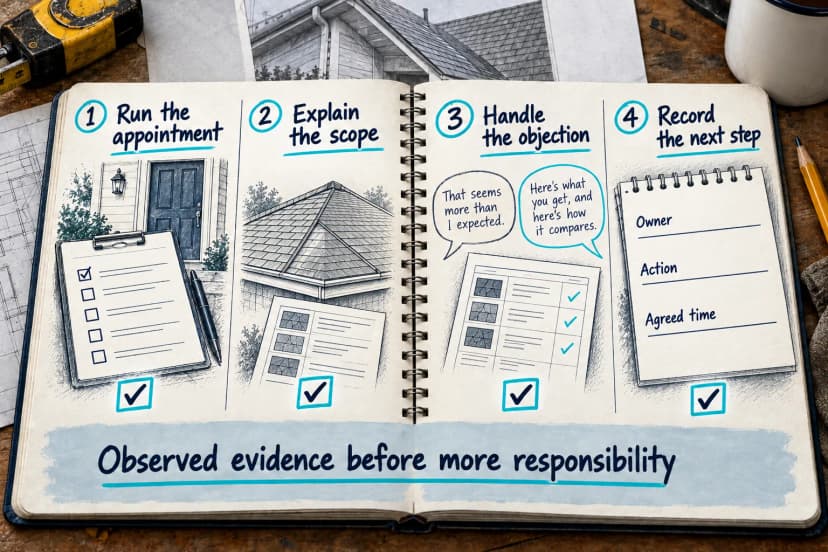
| Demonstration | Give the rep this task | Observe and retain |
|---|---|---|
| Run the appointment | Open an appointment, confirm the customer’s objective, explain the agenda, and ask who needs to participate in the decision. | The rep listens, confirms the requested service, and does not invent a diagnosis or force a decision. |
| Explain the scope | Use an approved sample estimate to explain included work, exclusions, price assumptions, and one unresolved site condition. | The rep can point to the supporting document, distinguish known from unknown, and identify who resolves an unanswered technical question. |
| Handle the objection | Respond when a customer says a competing quote is lower. Ask a clarifying question, compare documented scope, and check whether the concern was answered. | The response uses evidence without inventing competitor defects, guaranteeing coverage, or discounting beyond authority. |
| Record the next step | Finish the conversation and enter its outcome in a training CRM record. | Customer’s stated concern, next action, owner, due date, contact preference, and any required escalation are complete. |
Choose the next assignment from the evidence
- Not yet observed
- Assign the missing demonstration. A completed course or confident conversation does not fill an empty evidence field.
- Needs a prompt
- Keep the relevant task supervised. Coach the specific miss and rehearse a different version of the same situation.
- Independent in this scenario
- Record what the rep handled without help. A manager may authorize a limited assignment consistent with company policy, then verify the result in supervised field work before expanding further.
Pause advancement for a safety-boundary violation, fabricated answer, unauthorized coverage or financing promise, ignored customer contact restriction, or materially incorrect scope. Resolve that issue directly; do not average it away with stronger scores elsewhere.
Completed example: ready for a supervised scope review
Fictional example: Maya has completed product orientation and ride-alongs. In a practice appointment she opens clearly, explains the sample scope, and records a dated next step. When the homeowner says another roofer is cheaper, she needs the manager to prompt a comparison of exclusions.
Decision: supervised scope-review appointments only. Evidence gap: handling a lower-price comparison without a prompt. Practice assignment: a second quote that excludes a scope item, followed by a different example where the quotes are genuinely comparable. Reassessment: the manager observes a new scenario at the next scheduled coaching session.
Record the actual date and reviewer in the assessment. This is a worked example of a decision, not evidence of how quickly a typical rep becomes ready.
Turn the missing demonstration into a drill with the sales role-play scenario tool. Put the assigned activity and review owner into the sales onboarding plan. The separate 30-day roofing onboarding curriculum supplies the schedule; this assessment supplies the decision at each checkpoint.
Phase 1: basic competency (example: days 1–30)
The first phase is about representing the company accurately while learning the appointment, product, and documentation process.
What They're Actually Learning
Product Knowledge:
- The shingle types your company actually offers, including architectural or 3-tab where applicable; GAF still lists Royal Sovereign 3-tab shingles
- Manufacturer differences (GAF vs Owens Corning vs CertainTeed)
- The exact product and workmanship warranty terms you offer; use the current manufacturer documents, such as GAF’s residential warranty comparison, rather than treating “lifetime” as a complete explanation
- Basic terminology (ridge cap, starter strip, ice and water shield, valley flashing)
Sales Process:
- Your company's pitch structure
- Inspection checklist (what to look for, what photos to take)
- How to use your CRM (JobNimbus, AccuLynx, whatever you use)
- Pricing guidelines (when to quote, when to call manager)
Example assignment sequence, subject to readiness:
- Observe experienced reps and record the purpose of each appointment step
- Run selected parts of an appointment with the manager actively observing
- Move to a limited independent assignment only after the relevant demonstrations pass review
First review evidence: retain the observed appointment, the scope explanation, the rep’s CRM note, and the manager’s decision. A first sale is a useful milestone, but does not alone prove that the process is repeatable.
The Hidden Skill: Managing Anxiety
Early appointments can create anxiety. Prepare the rep to acknowledge an unknown, locate the approved answer, and call the right owner without pretending to know more than they do.
Practice the situations that create hesitation: introducing the company, discussing a large estimate, and answering a question that requires technical escalation. Do not tie confidence to taking an unsafe or unauthorized action.
What slows Phase 1 down:
- Information dumping (teaching them 47 shingle types when they need to know 3)
- No practice before real appointments (first time handling "insurance won't cover it" is at a kitchen table)
- Perfectionism ("you can't go solo until you know everything")
What speeds Phase 1 up:
- Focus on 3-5 most common scenarios only
- Repeated, reviewed practice before live appointments, using Role Play or a manager-led scenario
- A named backup and escalation route during early appointments; if using Echo, verify that its suggestions match approved company facts
Phase 2: consistent production (example: days 31–90)
The next phase checks whether the rep repeats the process across a comparable mix of appointments and follow-up situations.
What Changes in Phase 2
| Skill area | Early observation | Evidence for more responsibility |
|---|---|---|
| Objection handling | Needs a prompt to clarify the concern | Clarifies and answers accurately in varied scenarios |
| Pipeline management | Manager supplies owners and due dates | Rep records and completes the agreed follow-up |
| Referral asking | Knows the program terms | Recognizes an appropriate service moment and asks permission |
| Sales outcomes | Small or mixed appointment sample | Compare held appointments, outcomes, and margins by lead source and period |
The middle-ramp plateau
A rep may plateau when familiar product questions turn into less predictable customer concerns. Review the actual conversations before deciding whether the problem is knowledge, practice, lead fit, or follow-up.
Knowing a written response is different from recognizing when it is appropriate. Repeat a scenario with changed facts so the rep has to listen rather than recite.
Illustrative practice scenario:
Homeowner: "Your price is $4,000 higher than the other guy."
Rep's brain: I know there is a response to this. What did my manager say? Something about quality? Or was it about hidden costs? I am taking too long to respond. Now it looks like I do not have an answer. This deal is lost.
A clearer response to practice is: "Let me show you exactly what's included in our price that might not be in theirs—I'd rather you choose based on understanding the difference than just on the number."
The Close Rate Progression
Progress can change as objections and job complexity change. Review the work at each stage instead of expecting a straight-line close-rate curve.
Typical close-rate progression: do not use someone else's percentages as your standard. Use your team baseline by lead source. Start with an assignment suited to the skills already demonstrated, then review performance across the normal appointment mix before adding more complex work.
Middle-ramp review goal: assess whether the rep is managing a small pipeline, handling standard residential sales conversations independently, and needing manager backup only on complex deals. Judge them against your source-adjusted baseline, not a generic industry number.
What Actually Eats Time in Phase 2
The Practice Gap:
If each practice session covers a different objection, the manager may never see whether the rep corrected the first miss. Revisit a weak task, change the customer’s circumstances, and evaluate the response again.
Your rep encounters "I want to think about it" at a real appointment. They fumble it. Three days later, they get "I need to talk to my spouse." Different objection, new fumble. A week later, they face "Your price is too high."
Waiting for the same objection to appear in a paid appointment leaves the practice schedule to chance. Use a planned drill between appointments, then look for transfer into field behavior.
Using AI practice: it can make additional scenarios available between manager sessions. More attempts are activity, not proof of faster readiness; the manager still needs to verify accurate answers and field application.
Phase 3: full productivity (example: months 4–12)
Full productivity means the rep can handle the authorized sales process repeatedly, with a reliable handoff and sensible escalation on exceptions.
What Full Productivity Looks Like
- Runs standard appointments and follow-up without routine rescue.
- Explains scope, exclusions, and the basis of price without unauthorized promises.
- Protects the company’s pricing rules and documents approved exceptions.
- Hands production the information it needs to perform the sold work.
- Knows when an insurance, safety, technical, or contract question belongs with another qualified owner.
Independence review: use the rep’s observed work and source-adjusted outcomes. No month automatically produces a particular close rate, revenue band, or referral count.
The Skills That Separate Good from Great
For this roofing sales-readiness model, review three further capabilities as the rep takes on more responsibility:
1. Pattern Recognition at Scale
When a customer says “I need to think about it,” ask a clarifying question rather than assume the motive. It may be:
- A genuine request for time
- Uncertainty about the scope
- A price or affordability concern
- A comparison with other quotes
Retain the customer’s actual answer. A category is a coaching aid, not permission to dismiss what the customer said.
2. Complex Deal Navigation
When a homeowner mentions HOA approval or another decision-maker, the rep should identify the required step, the responsible person, and what information they need.
Practice these situations with both manager-led and software-assisted scenarios, then verify that the rep handles real approvals and documentation accurately.
3. Referral Generation Systems
A repeatable referral process recognizes appropriate service moments, explains the program, asks permission, and records the introduction.
Use the roofing referral-program guide and tracking worksheet to evaluate the process. A referral count alone does not show whether the customer was asked appropriately.
Factors That Speed Up Training
These variables are worth reviewing when the ramp is slower than the company’s plan. Their effect should be tested against your own hires rather than assumed.
Prior Sales Experience (Not Industry-Specific)
A rep who sold door-to-door for solar, pest control, or home security brings transferable skills:
- Rejection tolerance already calibrated
- Comfortable with cold prospecting
- Understands commission volatility
- Can read buying signals
Timeline impact: can reduce the need for basic sales-process orientation. They still need to learn your inspection process, pricing rules, CRM, and production handoff.
Quality of Training Program
Compare the relevance of the material, access to practice, quality of feedback, and how the rep applies a correction. Manager-led practice can surface company-specific judgment; AI scenarios can supply additional repetition. Neither format is effective merely because many sessions were completed.
Reviewed, deliberate practice gives the manager evidence before assigning greater responsibility. The rep gets more repetitions before a live appointment and the manager can coach from a cleaner sample of performance.
Timeline impact: practice volume can shorten the early ramp, but only if the rep gets feedback and the scenarios match the actual objections your team hears.
Lead Quality During Ramp
Assign a lead mix suited to the demonstrated task. A warm introduction may still involve complex scope or insurance questions; a storm claim is not automatically an easy training appointment.
- Begin with a manager-observed appointment whose purpose and scope are understood.
- Expand the mix after the relevant skills are demonstrated.
- Compare outcomes by source, assignment, and maturity instead of blending unlike opportunities.
Timeline impact: appropriate lead assignment during ramp builds confidence faster and protects the prospects you paid to acquire.
Manager Coaching Frequency
Choose a coaching cadence the manager can sustain and increase support when an observed gap needs attention.
Illustrative coaching cadence to adapt:
- Weeks 1-4: Daily 15-minute check-ins
- Weeks 5-8: 2-3x per week
- Weeks 9-12: Weekly
- Month 4+: Bi-weekly unless issues arise
Timeline impact: structured coaching keeps the rep from repeating the same mistake for weeks before anyone notices.
AI Practice Tools
The bottleneck in traditional training is practice availability. Your manager can only role-play so many hours per day. AI can add practice availability between manager reviews.
Use Role Play to practice selected conversations, then have the manager check the factual accuracy and relevance of the response. Assign the next scenario from the observed gap rather than treating session count as readiness.
Timeline impact: AI practice tools increase repetitions and make coaching easier to target. The improvement still depends on whether the rep completes the work and applies it in the field.
Factors That Slow Down Training
These patterns make the ramp harder to diagnose and manage.
Information Overload (Too Much Too Fast)
The Mistake: Teaching reps about 15 shingle types, 8 ventilation systems, 6 warranty options, 4 financing programs, and 12 objection responses in week 1.
The Result: The rep may struggle to distinguish the few facts needed in a first appointment from material that can be looked up or escalated.
The Fix:
- Week 1: Teach 3 shingle types, 2 warranty options, 3 objections
- Week 2: Add 2 more objections, introduce financing
- Week 3: Add complexity only after basics are solid
Practice heuristic: establish a small set of accurate responses before adding complexity. Use the next observed scenario to check whether the rep can apply the response rather than simply remember it.
Sink-or-Swim Mentality
"Figure it out" isn't training. It's laziness disguised as toughness.
Some managers pride themselves on throwing new reps into appointments immediately with minimal preparation: "I learned that way, they can too."
Track early exits and the conditions surrounding them in your own hiring cohort. Do not assign an industry attrition percentage to a training approach without supporting data.
Timeline impact: sink-or-swim makes the ramp unpredictable and burns confidence on real homeowners instead of practice reps.
Poor Lead Flow
A rep who runs only a couple of appointments per week will take much longer to reach competency than a rep seeing enough qualified opportunities to recognize patterns.
Look at the number and mix of observed attempts available for each skill. A rep may have plenty of appointments but very little practice explaining exclusions, asking for a decision, or completing a handoff.
Build additional scenarios around the missing task. There is no universal weekly appointment count that proves competence or guarantees progress.
Timeline impact: poor lead flow stretches every phase because the rep does not see the same objections often enough to improve.
No Feedback Loops
Activity without review can conceal a repeated mistake. Pair an observed appointment with one specific correction and verify that correction in the next relevant attempt.
What Good Feedback Looks Like:
- Specific: "You let the homeowner control minute 4-8 by answering questions instead of asking them"
- Actionable: "Next time, answer briefly then redirect: 'Great question. Let me show you. Speaking of which, when did you last have your roof inspected?'"
- Immediate: Given within 24 hours of the appointment
What Bad Feedback Looks Like:
- Vague: "You need to improve your objection handling"
- Judgmental: "That was terrible"
- Delayed: Discussed in monthly reviews 3 weeks later
Timeline impact: no feedback lets bad habits harden. The rep may stay busy, but the same appointment mistake keeps repeating.
The Cost of Rushing vs The Cost of Patience
Every contractor faces the same tension: you need field capacity fast, but every unready rep learns on real homeowners. The cost question should be built from your numbers, not a borrowed industry benchmark.
The Rush Approach
What it looks like: a few days of product training, one or two ride-alongs, then live appointments before the rep has handled common objections in practice.
Risks to observe: the rep burns trust on good leads, asks the manager for rescue on basic questions, discounts too early, and loses confidence before they have enough repetitions to improve.
The Patient Approach
What it looks like: a structured first 30 days with script practice, objection work, CRM habits, ride-alongs, and controlled solo appointments.
Improvements to check for: fewer wasted leads, clearer manager feedback, better rep confidence, and a cleaner handoff from sales to production.
The AI-Accelerated Approach
What it looks like: practice volume comes before live lead volume. The rep role-plays price, spouse approval, insurance scope, timing, financing, and follow-up before those objections happen at a kitchen table.
Improvements to check for: the manager spends less time repeating basics and more time coaching the exact issue the rep is stuck on.
The practical test: calculate your actual cost per successful ramp. Include draw or salary, manager hours, ride-along time, lead cost, lost opportunities, and replacement recruiting. Then compare that against the cost of giving the rep more practice before they touch your best prospects.
What This Means for Your Hiring Plan
Be honest about timelines. If you hire someone today:
Traditional training:
- Early weeks: they should learn the inspection, pitch, CRM, and appointment flow
- Middle ramp: they should handle common objections and follow-up without daily rescue
- Later ramp: they should protect margin, generate referrals, and hand off cleanly to production
AI-accelerated training:
- Early weeks: they get more practice repetitions before live appointments
- Middle ramp: coaching is tied to exact objection failures and follow-up misses
- Later ramp: manager time shifts from basics to pipeline quality, margin, and consistency
Key Takeaway: Use the planning window to schedule support, and use observed evidence to decide responsibility. Practice is valuable when the rep carries an accurate, repeatable behavior into the next appointment.
Setting Honest Expectations
With ownership:
"This hire will not be fully productive immediately. We should expect staged readiness: first controlled appointment, first sale, consistent production, then full independence."
With the rep:
"You will earn more responsibility as you prove the basics: inspection, pitch, objection handling, follow-up, and handoff. We are not going to judge week-two performance like month-six performance."
With Yourself:
"I need documented expectations, a scheduled review, and evidence of improvement. A calendar alone should not decide retention, and an unresolved material risk should not wait for a milestone date."
The Action Step
Calculate your actual timeline based on your current training approach:
- Do you provide 10 practice scenarios or 100?
- Do reps get real-time backup or sink-or-swim?
- Are they practicing on AI or on your prospects?
- How many manager hours does each hire use, and which observed gaps are those hours resolving?
Then decide where the ramp is weak: not enough practice, not enough feedback, poor lead flow, bad scorecard, or unclear manager ownership.
Record both elapsed time and demonstrated skill. That makes the next hiring forecast more useful than borrowing a universal ramp number.
Next step: build the first 30 days before the hire starts. Use the sales onboarding plan tool for structure, then assign daily role plays from the scenario generator around the exact objections your team hears most.
Questions about roofing sales ramp time
Does a first sale mean a roofing rep is ready?
It is one outcome. Review how the appointment was handled, whether the scope was explained correctly, what supervision was needed, and whether follow-up and handoff were complete. A favorable lead can produce a sale before the full process is repeatable.
When can a new roofing sales rep go solo?
When the company has observed the relevant skills, resolved material gaps, and authorized that assignment. Start with a defined type of appointment and a backup route. Technical inspection and roof access require separate qualifications and safety controls.
How do we measure our own time to productivity?
For each hire, record start date, first observed readiness, first independent assignment, first sale, comparable held appointments, outcomes, manager hours, and the date your declared productivity standard is met. Keep incomplete ramps visible and separate hires with different roles or lead sources.
Related Resources
Free tools for roofing sales training
Turn this article into rep practice
Use the training library to turn ideas into drills, scripts, and coaching reps can actually use in the field.
Training tools
Browse objection, role-play, and scripting tools built for home improvement sales teams.
Browse training tools →All free tools
See the full tools hub across hiring, management, field sales, operations, and marketing.
Browse all tools →Role Play
Turn training concepts into live practice with AI homeowner scenarios that build muscle memory.
See Role Play →About the Author
Tim Nussbeck
Founder & CEO of GhostRep
20+ years in roofing and home improvement sales—knocking doors, running teams, and building practical coaching systems. Built GhostRep to give every rep access to the coaching top teams get.
Training next step
Turn training ideas into drills your reps will actually run
Start with the free training tools if you need scripts, practice reps, or coaching prompts today. Book a walkthrough if you want GhostRep mapped to your onboarding process.
- ✓Best fit if reps need more repetition, not more theory.
- ✓Useful for onboarding, objection practice, and weekly coaching.
- ✓Demo shows how Role Play plugs into your current training process.
Start Here
Browse training tools
Free objection builders, role-play prompts, scripts, and rep-practice templates.
Browse training toolsNeed it mapped to your team?
Talk through your current workflow, traffic mix, and where GhostRep fits before you change anything.
Book a 15-minute walkthroughYou Might Also Like
Build a roofing sales training workflow around recorded appointments, live coaching, manager review and focused practice. Evaluate it with your own team.
Read article →A complete guide to GhostRep AI roofing sales training: role play, objection practice, live coaching, appointment feedback, and rep improvement.
Read article →Build safe roofing objection practice with realistic scenarios, observable coaching criteria, and readiness gates—without using homeowners as practice targets.
Read article →