Ask ChatGPT for “the best roofing objection script” and it can produce a confident answer that invents your warranty, ignores your financing rules, and teaches language no manager approved. The prose may sound excellent. That is precisely why the failure is hard to spot.
ChatGPT is useful for drafting questions, scenario variations, plain-language explanations, and review summaries when it is anchored to current company material. It is not the training program. A prompt produces an output; a training system changes and verifies job behavior.
This page owns that operating boundary. For a full program design, use the custom AI roofing training guide. For controlled simulations, use the sales role-play scenario generator. For the practice method itself, see the roofing objection-practice guide.
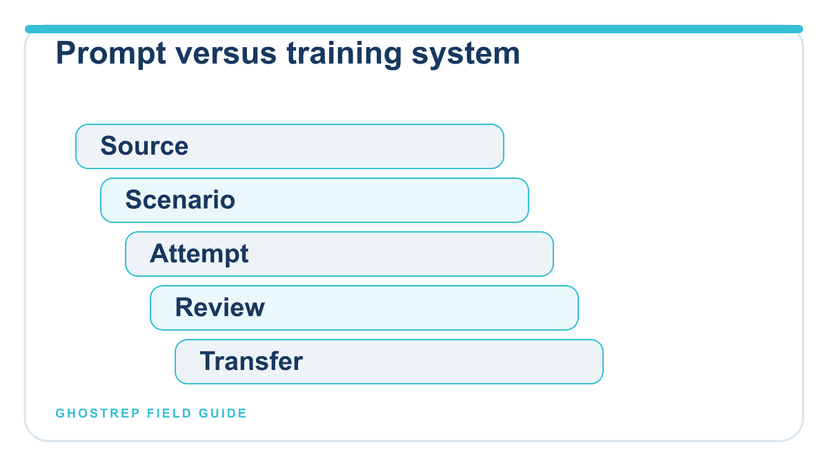
A prompt is not a control system
| Training requirement | Uncontrolled prompt | Governed workflow |
|---|---|---|
| Truth source | Model memory and the user’s wording | Named, current company policy or approved document |
| Scenario | Generic “price objection” | Specific homeowner context, known facts, unknowns, and role boundary |
| Rep evidence | AI writes the ideal response | Rep responds before coaching is shown |
| Scoring | Vague confidence or persuasiveness | Observable rubric with critical-error rules |
| Feedback | General advice | Quoted evidence, one priority gap, and a required retry |
| Release decision | Conversation completed | Manager verifies repeated performance and field transfer |
| Data control | Anything is pasted into the chat | Approved workspace, minimum necessary data, access, retention, and deletion rules |
That does not make ChatGPT useless. It makes its role precise. Use it to accelerate controlled information work; do not hand it policy ownership, legal interpretation, or the authority to decide that a rep is ready for unsupervised work.
Where ChatGPT helps a roofing sales team
- Lesson outlines: reorganize a current product sheet, installation policy, or sales process into teachable sections.
- Scenario variation: change one variable—homeowner concern, job stage, budget constraint, or decision-maker availability—without changing the approved facts.
- Plain-language drafts: simplify technical language for manager review without changing the underlying claim.
- Question banks: create retrieval questions from a supplied source, then have the owner verify the answer key.
- Coaching organization: group de-identified manager notes into recurring skills that need practice.
- Communication drafts: prepare follow-up language from verified appointment, scope, and contact facts.
The model should not supply the controlling fact. Manufacturer specifications, warranties, financing disclosures, code requirements, prices, claim statements, scheduling commitments, and company policy must come from their responsible owners.
Use a source-bound training prompt
A safe practice prompt names the source, separates known facts from unknowns, defines prohibited moves, and asks for evidence rather than a vibe score. Use fictional or de-identified homeowner details unless an approved system and policy permit otherwise.
Prompt specification for one roofing objection drill
Skill:
Explain a scope difference without attacking another contractorApproved source:
Northside Roofing scope-comparison checklist, version 4.2, approved July 18Scenario facts:
Homeowner has two written proposals; the lower proposal does not identify underlayment product or ventilation workUnknowns:
Competitor intent, final assembly, code determination, customer budgetRep objective:
Acknowledge the concern, ask permission to compare written scope fields, explain only documented differences, offer a next stepCritical errors:
Invent omission, predict failure, claim code violation, guarantee savings, disparage competitorScoring evidence:
Quote the rep sentence supporting each rubric decision; write “not observed” when absentRetry rule:
Change the homeowner’s priority from price to schedule and repeat without changing the approved source
The five roofing objection categories can supply a practice map. They are not five canned responses. The rep still has to diagnose the concern and stay inside the facts available in that scenario.
Review one AI-assisted practice attempt
Managers need a record that makes disagreement inspectable. “The AI gave it an 82” is not enough.
Manager review of the practice attempt
Acknowledges concern:
Observed evidence: “I understand why the lower total gets your attention.”
Decision: MeetsRequests permission:
Observed evidence: “Would it help if we compared the written scope fields?”
Decision: MeetsStays source-bound:
Observed evidence: Explains the two blank proposal fields; makes no claim about the competitor’s intended work
Decision: MeetsUses plain language:
Observed evidence: Defines underlayment but never explains why ventilation is a separate comparison field
Decision: PartialOffers proportionate next step:
Observed evidence: Asks the homeowner to sign today
Decision: Miss: next step exceeds the stated objectiveManager action:
Observed evidence: Retry with a review appointment or leave-behind option
Decision: Required before pass
The record prevents a polished summary from hiding a weak decision. The manager can see the source, attempt, score evidence, disagreement, and next assignment. The 30-day onboarding plan shows where that practice belongs alongside product knowledge, observation, and field sign-off.
Match privacy controls to the actual ChatGPT plan
Do not assume every ChatGPT account, plan, connector, or feature has the same controls. OpenAI’s current enterprise workspace documentation describes business-data protections and administrative controls for that environment while noting that availability varies by plan, configuration, surface, feature, and region. Connected services also carry their own permissions and retention considerations.
Before a team uses customer or employee information, the responsible owner should verify:
- which plan and workspace the user is actually signed into;
- whether business data is used for model training under that arrangement;
- who can access chats, files, projects, shared links, and connected services;
- what is retained, exported, logged, and deleted;
- whether customer, call-recording, employee, financing, or claim data is permitted at all; and
- what de-identification and minimum-necessary rules apply.
A safe default is to use synthetic practice facts and approved excerpts, not live claim documents, customer names, addresses, payment information, medical details, or private employee records. The NIST Generative AI Profile provides a broader risk-management reference; it does not replace the company’s own legal, privacy, and security review.
Five failure modes to test deliberately
- Invented authority: the answer states a warranty, code, price, or claim rule that was never supplied.
- Scenario drift: feedback assumes facts the simulated homeowner did not say.
- Style bias: the rubric rewards charisma, accent, or verbosity instead of job-related behavior.
- Score without evidence: a number appears without the transcript sentence supporting it.
- No field transfer: practice scores improve, but ride-alongs or call reviews show the original behavior remains.
Test these before rollout. Give the system tempting but unsupported details and verify that it refuses to fill the gap. Have two managers score the same attempt. Run scenario variations. Sample failures as well as top scores. The AI roofing coaching guide explains how practice evidence becomes a manager-owned coaching cycle.
When to use ChatGPT versus a training platform
Use ChatGPT when a capable manager needs a flexible drafting and analysis surface and is willing to build the sources, prompts, rubrics, records, permissions, and review process. Evaluate a dedicated platform when the team needs repeatable scenario delivery, attempt capture, assignment, scoring evidence, manager calibration, permissions, and progress records across many reps.
Neither option removes management work. The buying question is where the control system lives and how much the company must assemble itself. The AI sales-training software comparison provides a broader pilot checklist.
Frequently asked questions
Can ChatGPT replace a roofing sales trainer?
No. It can assist with content, variation, and review, but it does not own company policy, field observation, legal interpretation, score calibration, or release decisions.
Can reps use AI-generated scripts with homeowners?
Only after the company verifies every factual claim and approves the language for that use. A generated draft is not a company representation until the responsible owner approves it.
Can a manager paste customer calls into ChatGPT?
Only under an approved plan, workspace, consent process, and data policy. Verify the actual controls and minimize or remove personal data. Recording and monitoring requirements vary by jurisdiction.
How many role plays should a rep complete?
There is no defensible universal count. Require the defined behavior across varied scenarios, then verify transfer during supervised work.
Keep ChatGPT in the drafting seat
ChatGPT is useful in roofing sales training when it works from approved sources and produces reviewable drafts, scenarios, and feedback. It becomes risky when fluency replaces truth, a generated answer replaces a rep attempt, or a score replaces manager judgment. Keep the source, rubric, evidence, privacy boundary, and release decision explicit.
Compare tools and find fit
Use the comparison, then go deeper
If this article helped narrow the category, use the hub to explore specific workflows and the product pages to understand where GhostRep fits.
All free tools
Browse 131 free tools by workflow instead of trying to infer fit from product-level feature lists.
Browse all tools →Products overview
See how the GhostRep platform connects onboarding, role-play, field support, and coaching.
See all products →ROI calculator
Model the revenue impact of training and coaching improvements before you change platforms.
Use ROI calculator →About the Author
Tim Nussbeck
Founder & CEO of GhostRep
20+ years in roofing and home improvement sales—knocking doors, running teams, and building practical coaching systems. Built GhostRep to give every rep access to the coaching top teams get.
Comparison next step
Use the comparison, then run the math
If this article narrowed the category, model the impact before you switch platforms. Book a walkthrough when you want GhostRep mapped to your current stack and workflow.
- ✓Best fit if you are comparing tools but still missing a buying standard.
- ✓Useful for estimating payoff before a platform switch.
- ✓Demo shows how onboarding, training, and field coaching connect in one system.
Start Here
Model the ROI first
Estimate the upside of better close rates, faster ramp, and stronger rep performance.
Model the ROI firstNeed it mapped to your team?
Talk through your current workflow, traffic mix, and where GhostRep fits before you change anything.
Book a 15-minute walkthroughYou Might Also Like
Avoca vs GhostRep for roofing: Avoca answers and books calls; GhostRep is the AI sales manager that trains and coaches field reps.
Read article →Compare AI sales coaching platforms for contractors by roleplay, live guidance, field capture, integrations, pricing, security, and implementation.
Read article →Compare Rilla alternatives for roofing sales teams by recording, coaching, roleplay, live assistance, integrations, pricing visibility, and pilot fit.
Read article →