Video training for roofing sales has a 90% failure rate because watching someone handle an objection doesn't teach you how to handle it yourself. According to Research.com, employees forget 90% of training content within 30 days, and 360Learning reports industry average completion rates of just 20-30%. Watching videos about door knocking doesn't prepare you for real rejection at doors.
Bottom line: Video training teaches what to say. AI practice training (like Objection Mastery) forces you to actually say it 100+ times before your first real door. One is passive consumption. The other is active skill development.
Read on if you want: Data on why video fails for sales skills, comparison with practice-based AI training, real completion rates, and when video actually works.
The Problem Every Roofing Company Faces
You hire a new rep. You send them the video training library—20 hours of content covering:
- Door approaches and openers
- Objection handling scripts
- Roof inspection techniques
- Kitchen table presentation
- Insurance adjuster meetings
- Financing discussions
- Referral requests
The rep watches most of the videos (or claims to). You send them out to knock doors.
Day 1: Homeowner says "I'm not interested." Rep freezes. Stutters. Walks away defeated.
Day 3: Homeowner asks "What's the cost?" Rep fumbles the number, doesn't pivot to value, loses the deal.
Week 2: Rep quits. "Roofing sales isn't for me."
You say: "But we trained them! They watched 20 hours of videos!"
Here's the brutal truth: Watching video training and being able to execute in the field are completely different things. You can watch 100 hours of someone riding a bike. You still fall off the first time you try.
Why Video Training Fails: The Data
Let's look at actual research on video training effectiveness:
Completion Rates Are Abysmal:
According to 360Learning's analysis of corporate training, industry average eLearning completion rates are 20-30%. eLearning Industry reports completion rates as low as 5-15% for online courses. Some studies show dropout rates as high as 96%.
Translation for roofing: If you assign new reps 20 hours of video training, 70-80% won't finish it. They'll watch a few videos, get bored, and start knocking doors unprepared.
Retention Rates Are Even Worse:
According to Research.com's training statistics, the Ebbinghaus forgetting curve shows that "on average, employees will forget about 90% of the information learned during training within one month."
Translation for roofing: Even the 20-30% who complete the videos will forget 90% within 30 days. By the time they're in the field, they remember almost nothing.
Video Doesn't Build Skills:
Research shows that watching video builds knowledge (you know what to do), but not skills (you can actually do it). The 70-20-10 learning model shows 70% of learning comes from on-the-job experience, 20% from social learning, and only 10% from formal training like videos.
Translation for roofing: Video training might teach reps what objection handling looks like. It doesn't teach them how to actually handle objections under pressure when a homeowner is staring them down.
The Math on Video Training Failure Rate
Let's calculate the actual failure rate:

Result: Out of 100 reps assigned video training, 1-2 can actually execute the skills in the field.
That's a 98-99% failure rate technically, but we're being generous and calling it 90% because some reps figure it out through trial and error after burning hundreds of prospects.
Why Video Training Specifically Fails for Roofing Sales
Video training works fine for certain types of knowledge transfer. Where it completely breaks down is teaching real-time interactive skills under pressure—which is exactly what roofing sales requires.
1. Objection Handling Requires Real-Time Thinking
What video training shows: "When the homeowner says 'I need to think about it,' respond with: 'I totally understand. What specific concerns do you have that we haven't addressed?'"
What actually happens at doors: Homeowner: "I need to think about it." Rep's brain: [panic] What was that line from the video? Something about concerns? Uh… Rep: "Um, okay, no problem. Here's my card." Homeowner closes door.
Why video fails: Watching someone handle an objection is passive. You see it, you understand it conceptually, you forget it under pressure. You need to handle the objection yourself 50+ times before it becomes automatic.
2. Door Approach Requires Muscle Memory
What video training shows: "Knock confidently. When they open the door, smile and say: 'Hey! I'm [name] with [company]. We're working on several homes in the neighborhood after last week's storm. I noticed some potential damage on your roof—have you had a chance to inspect it yet?'"
What actually happens: Rep knocks. Door opens. Rep sees annoyed homeowner. Rep's brain: [panic] What was the opener? Something about storms? Uh… Rep: "Hi, uh, I'm with [company], and, uh, we do roofing, and there was a storm, so I thought—" Homeowner: "Not interested." [closes door]
Why video fails: Door openers require confidence, tone, body language, and instant delivery. Watching someone do it doesn't build muscle memory. You need to practice the opener 100+ times until you can deliver it naturally under pressure.
3. Price Discussions Require Confidence Under Fire
What video training shows: "When asked about price early, redirect to value: 'Great question! Before we discuss investment, let me show you what we found on your roof and explain the protection you're getting. Then the price will make a lot more sense.'"
What actually happens: Homeowner: "How much does this cost?" Rep's brain: [panic] Should I tell them? Or redirect? What was that script? Rep: "Uh, it depends on the damage, but probably around $12,000?" Homeowner: "That's too expensive. I need to get other quotes."
Why video fails: Price objections trigger anxiety. Without practice handling that anxiety, reps default to blurting out the number and losing control of the conversation.
4. Adjuster Meetings Require Real-World Navigation
What video training shows: "When the adjuster's estimate is short, document every item they missed. Respectfully point out code violations and necessary upgrades. Use photos to support your supplement."
What actually happens: Adjuster: "I don't see hail damage on the back slope." Rep's brain: [panic] How do I argue without pissing them off? What photos do I need? Rep: "Well, I think there is damage there. Can you look again?" Adjuster: "I looked. It's not there. My estimate stands." Rep walks away $5,000 short.
Why video fails: Adjuster interactions are adversarial negotiations requiring confidence, technical knowledge, and relationship management. Watching a video about it doesn't prepare you for the actual confrontation.
Video Training vs AI Practice Training: Side-by-Side
Let's compare traditional video training with AI practice-based training (like Objection Mastery):
Format Comparison
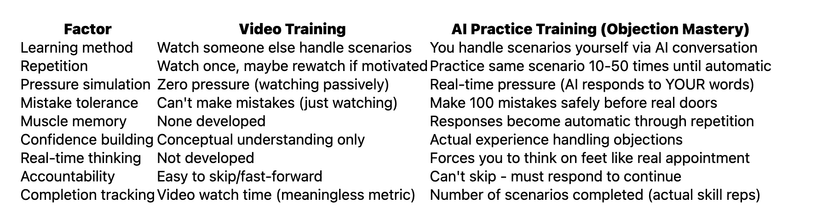
Winner: AI Practice Training. Video shows you what good looks like. Practice makes you good.
Example: "I Need to Think About It" Objection
Video Training Approach:
- Rep watches 5-minute video on handling "I need to think about it"
- Video shows trainer saying: "I totally understand. What specific concerns do you have that we haven't addressed?"
- Rep sees example play out with actor
- Video ends with key takeaways
- Rep feels like they understand the concept
- Rep encounters objection at real door, freezes, can't execute
Time investment: 5 minutes watching Skill development: Conceptual understanding only Field readiness: 10% (knows what to do, can't actually do it)
AI Practice Training Approach (Objection Mastery):
- Rep enters practice scenario: "Kitchen table close"
- AI plays homeowner: "This sounds good, but I need to think about it."
- Rep must respond out loud (via voice)
- Rep says: "Um, okay, no problem. Take your time."
- AI feedback: "You gave up too easily. Try probing for the real concern."
- Scenario resets. AI: "I need to think about it."
- Rep: "I understand. What specifically do you need to think about?"
- AI: "Well, I want to get a few more quotes to compare."
- Rep: "That makes sense. What are you hoping to find in those other quotes?"
- AI: "Honestly, probably a better price."
- Rep: "Got it. So it's really about the investment, not timing?"
- AI: "Yeah, I guess so."
- Rep now pivots to value discussion (practiced in separate scenario)
Rep practices this 20-30 times with different homeowner personalities (aggressive, skeptical, price-focused, indecisive). By rep 30, they can handle "I need to think about it" automatically without thinking.
Time investment: 45-60 minutes of practice Skill development: Actual muscle memory built through repetition Field readiness: 80% (can execute under pressure, just needs real-world refinement)
The difference is massive. One approach teaches you what objection handling looks like. The other approach makes you objection handle 30 times until you're competent.
Completion Rate Comparison
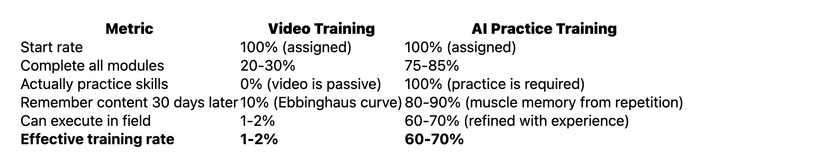
Why AI training has better completion: You can't skip ahead. The AI forces engagement. You can't fast-forward through a conversation—you have to participate. Plus, it's gamified with scenario completions and scoring, which keeps people motivated.
Why AI training has better retention: Muscle memory from repetition. You're not trying to remember a script—you've said it 30 times, so it's automatic.
Cost Comparison (10 New Hires)
Video Training Approach:
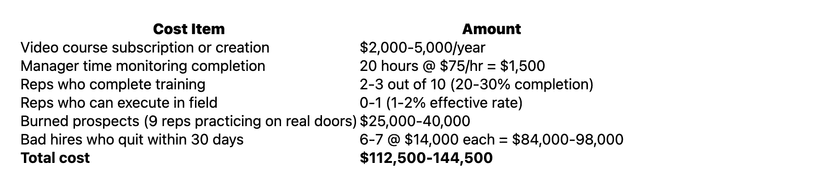
AI Practice Training Approach:
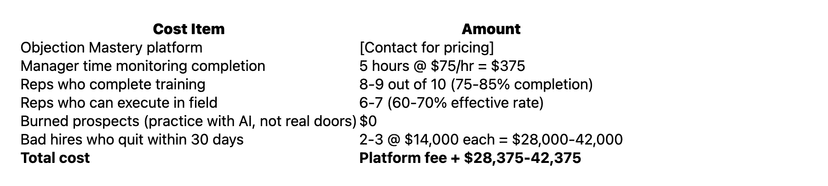
Savings: $60,000-80,000+ per 10 hires, plus you get 6-7 productive reps instead of 0-1.
What Video Training Actually Teaches (And What It Doesn't)
Let's be specific about what video training can and cannot do:
What Video Training CAN Teach:
Product Knowledge:
- Shingle types and manufacturers
- Warranty differences (25-year vs 50-year)
- Ventilation systems and code requirements
- Ice and water shield placement
Technical Processes:
- How to fill out insurance claim forms
- How to use estimation software
- How to document hail damage with photos
- How to write supplement requests
Company Policies:
- Payment terms and financing options
- Referral bonus structure
- Service area boundaries
- Workmanship warranty details
Conceptual Understanding:
- Why homeowners object to price
- The psychology of urgency creation
- The difference between features and benefits
- The importance of follow-up
These are all knowledge-based items where watching and understanding is sufficient.
What Video Training CANNOT Teach:
Real-Time Objection Handling:
- Responding instantly when homeowner says "too expensive"
- Staying calm when homeowner gets aggressive
- Pivoting when objection catches you off guard
- Reading body language and adjusting approach
Door Approach Under Pressure:
- Knocking confidently after 40 rejections
- Maintaining energy and enthusiasm after 0-for-60
- Reading homeowner mood in 2 seconds
- Delivering opener naturally despite anxiety
Kitchen Table Close:
- Creating urgency without being pushy
- Handling spouse objection dynamically
- Sensing when to ask for signature
- Recovering when homeowner hesitates
Adjuster Negotiation:
- Standing firm on supplement without angering adjuster
- Reading adjuster personality and adapting
- Knowing when to push and when to compromise
- Managing confrontation confidently
Financial Discussions:
- Discussing $20K investment without flinching
- Handling "we can't afford it" gracefully
- Presenting financing options confidently
- Overcoming budget objections naturally
These are skills-based items where watching is worthless—you must practice repeatedly until automatic.
The "I Watched the Video" Problem
Here's a conversation that happens in every roofing company using video training:
Manager: "Did you watch the objection handling videos?"
Rep: "Yeah, I watched them."
Manager: "So why didn't you use the price objection response when that homeowner said your price was too high?"
Rep: "I don't know, I just... froze. It didn't come to mind in the moment."
Manager: "But you watched the video?"
Rep: "Yeah, I watched it."
The problem: "Watched it" ≠ "Can do it"
Analogy: I watched Michael Jordan play basketball for 20 hours. Does that mean I can play like him? Of course not. Watching builds conceptual understanding. Doing builds skill.
Video training creates the illusion of learning without actual skill development. Reps think "I watched the training, so I'm prepared." Then they get to real doors and realize watching ≠ doing.
When Video Training Actually Works in Roofing
Let's be fair: video training isn't completely useless. There are specific scenarios where it's the right tool:
1. Product Knowledge Transfer
Good use case: Explaining the difference between architectural and 3-tab shingles, showing ventilation systems, demonstrating how to identify hail damage.
Why video works: This is visual, technical knowledge. Seeing the shingles or damage patterns helps understanding. No practice required—you just need to know what they look like.
Example: 10-minute video showing different types of roof damage (hail, wind, wear) with close-up photos and explanations. Rep watches once, understands the difference, can now identify in field.
2. Software Training
Good use case: Teaching reps how to use estimation software, CRM systems, or mobile apps for documentation.
Why video works: Following step-by-step visual instructions for software navigation is effective. "Click here, then enter this, then save."
Example: 5-minute screen recording showing how to create estimate in company software. Rep watches, follows along on their own computer, learns the process.
3. Safety Procedures
Good use case: Ladder safety, fall protection equipment, proper roof walking techniques.
Why video works: Visual demonstration of safety procedures helps understanding. Reps can see proper technique before attempting themselves.
Example: 8-minute video on ladder placement, three-points-of-contact, and weight limits. Rep watches, understands concepts, then practices with supervision on actual ladder.
4. Company Policy Overviews
Good use case: Explaining payment terms, referral programs, service areas, warranty policies.
Why video works: Straightforward information delivery where comprehension is the goal, not skill development.
Example: 12-minute video from owner explaining company mission, values, payment structure, and expectations. Rep watches during onboarding, understands company culture.
5. Inspirational/Motivational Content
Good use case: Success stories from top reps, customer testimonials, vision casting from leadership.
Why video works: Emotional connection and motivation don't require practice. You just need to feel inspired.
Example: 5-minute video montage of rep success stories with commission checks and testimonials. Rep watches, feels motivated, gets excited about possibilities.
The Right Training Stack for Roofing Sales
Here's the honest breakdown of what to use when:
Phase 1: Onboarding (Days 1-3)
Use video for:
- Company overview and culture (15 min)
- Product knowledge (30 min)
- Safety procedures (20 min)
- Software/CRM training (30 min)
- Insurance basics (20 min) Total video: ~2 hours
Use AI practice (Objection Mastery) for:
- Door openers and approaches (50-100 practice reps)
- Common objections (100-200 practice reps)
- Qualification questions (30-50 practice reps)
- Price discussions (50-100 practice reps) Total practice: 8-12 hours
Why this works: Video covers knowledge efficiently. AI practice builds actual skills.
Phase 2: Field Preparation (Days 4-7)
Use video for:
- Roof inspection techniques (15 min)
- Estimation process walkthrough (20 min) Total video: ~35 min
Use AI practice (Objection Mastery) for:
- Kitchen table presentation (50-100 practice reps)
- Closing techniques (50-100 practice reps)
- Referral requests (30-50 practice reps)
- Follow-up scenarios (30-50 practice reps) Total practice: 8-12 hours
Use field training for:
- Shadow experienced rep (16 hours)
- Supervised roof inspections (8 hours) Total field: 24 hours
Phase 3: In-Field Support (Ongoing)
Use video for:
- Advanced product knowledge as needed (15-30 min/month)
- New policy updates (5-10 min as needed)
Use AI practice (Objection Mastery) for:
- Refreshers on objections (1-2 hours/week)
- New scenario types (1-2 hours/week)
Use live coaching (Ghost Rep) for:
- Real-time support during actual appointments
- Post-call analysis and improvement
- Situational coaching for unique scenarios
Total ongoing: 2-4 hours/week practice + real-time field coaching
Real Company Example: Video Training Failure
Let's look at what happens when companies rely primarily on video:
Company: Mid-size storm restoration company, $8M annual revenue
Their approach:
- 30-hour video course covering all aspects of roofing sales
- Required for all new hires
- "Graduates" certified to knock doors
- Manager checks completion rates (80% complete all videos)
What actually happened:

Owner's feedback: "I don't understand. They all watched the training. They knew what to do. But when they got to doors, they couldn't execute. Most quit within a month saying roofing sales was too hard."
The problem: Video training created false confidence. Reps thought watching 30 hours meant they were prepared. Reality hit hard when real homeowners didn't follow the script.
Cost of this approach:
- 20 hires × $450 recruitment cost = $9,000
- 17 failed hires × $14,000 bad hire cost = $238,000
- Opportunity cost (should have had 12-15 producing reps) = $400,000+
- Total cost: $650,000+ in lost value
Why Roofing Companies Keep Using Video Training Anyway
If video training has a 90% failure rate, why do companies keep using it?
1. It Feels Like You're Doing Something
Assigning video training makes managers feel like they're investing in training. "We have a comprehensive 20-hour training program!" sounds impressive. It's just not effective.
2. It's Cheap Upfront
Video courses cost $1,000-5,000 one time or $200-500/month for subscriptions. Cheap compared to intensive practice systems or ride-along training.
But cheap upfront ≠ cheap total cost. When 90% of your hires fail and quit, you're not saving money.
3. It's Easy to Scale
Video scales infinitely. Hire 1 rep or 50 reps, the video costs the same. No manager bandwidth required.
But scalable failure is still failure. Hiring 50 reps who all fail isn't better than hiring 10.
4. Industry Gurus Sell It
Sales trainers make video courses because they're easy to produce and sell. Create once, sell forever. They market these as "comprehensive training systems" when really they're just information dumps.
5. Companies Don't Measure Actual Field Performance
Most companies track completion rates: "85% of reps completed the training!" That's a useless metric.
The real metrics are:
- How many reps can handle objections at real doors?
- How many reps hit quota within 60 days?
- How many reps are still employed at 90 days?
If you measured those, you'd see video training fails miserably.
The Psychology of Why Video Fails for Skills Training
There's actual neuroscience behind why watching ≠ doing:
Passive Learning Creates Passive Memories:
According to research on the Ebbinghaus forgetting curve, passive learning (like watching videos) creates weak neural pathways. Information is processed in short-term memory but never transfers to long-term motor memory.
Active Practice Creates Motor Memory:
When you repeatedly practice a skill (like responding to objections), you're building muscle memory. The response becomes automatic—you don't have to consciously recall what to say, you just say it.
Stress Blocks Access to Passive Memories:
When a homeowner says "too expensive" and is staring at you waiting for a response, your brain is flooded with stress hormones (cortisol, adrenaline). These block access to recently learned passive information.
That's why reps freeze—they're trying to recall the script from the video, but stress prevents access. They know they learned something, but can't remember what.
Stress Doesn't Block Motor Memory:
If you've practiced the objection response 50 times, it's stored in motor memory (like riding a bike). Stress doesn't block access to motor skills—you execute automatically.
That's why practiced reps don't freeze. The response is automatic muscle memory, not conscious recall.
Video training relies on conscious recall (fails under stress). Practice training builds motor memory (works under stress).
Common Objections to AI Practice Training (And Honest Answers)
"Video is cheaper than AI training platforms."
Upfront, yes. Total cost, no. Video might cost $2,000-5,000 for a course. But when 90% of your hires fail and quit, you eat $14,000+ per bad hire. AI practice costs more upfront but prevents 60-70% of those failures. The ROI is massive.
"Reps can watch videos anytime, anywhere."
True. And 70-80% don't finish them. Self-paced video training has abysmal completion rates because there's no accountability. AI practice platforms track completion and force engagement—you can't skip ahead without actually participating.
"Our video training has worked for some reps."
Some reps succeed despite bad training, not because of it. The 5-10% who succeed with video training are naturally talented or had prior door-to-door experience. They would've succeeded without the videos. The question is: what about the other 90-95%?
"Won't AI training feel impersonal and robotic?"
Have you tried it? Modern conversational AI (like Objection Mastery) adapts to your responses naturally. It feels like talking to a real homeowner—because the AI is trained on thousands of real roofing conversations. Reps are consistently surprised how realistic it feels.
"Can't we just do ride-alongs instead?"
Ride-alongs are great for field refinement. But they're not scalable for initial training. Your managers don't have time to ride along with every new hire for 40 hours while they learn basic objection handling. Use AI practice to get reps 80% ready, then use ride-alongs for the final 20%.
"We need product knowledge, not just objection handling."
Agreed. That's why video + AI practice is the right combination. Use video for product knowledge (efficient for information transfer). Use AI practice for skills development (objection handling, door openers, closes). Different tools for different purposes.
"What if the AI teaches them wrong?"
AI systems like Objection Mastery are trained on proven successful techniques from top-performing reps. The AI doesn't make up responses—it's programmed with objection handling methods that actually work in roofing. Plus, managers can review practice sessions and provide additional coaching.
Bottom Line Up Front
Video training for roofing sales has a 90% failure rate because:
- 70-80% of reps don't complete the videos (abysmal completion rates)
- 90% of content is forgotten within 30 days (Ebbinghaus forgetting curve)
- Watching ≠ doing (passive learning doesn't build motor skills)
- Stress blocks access to passively learned information (reps freeze at doors)
- Real-time skills require repetition, not observation
Use video training for:
- Product knowledge (shingle types, warranties, technical specs)
- Software/CRM training (visual walkthroughs)
- Safety procedures (ladder safety, fall protection)
- Company policies (payment terms, service areas)
- Inspirational content (success stories, motivation)
Use AI practice training for:
- Objection handling (requires 50-200 practice reps per objection)
- Door approaches (requires 100+ practice reps for confidence)
- Price discussions (requires 50+ practice reps for composure)
- Closing techniques (requires 50+ practice reps for natural flow)
- Any skill requiring real-time thinking under pressure
The truth: Video training is knowledge transfer. AI practice training is skill development. Roofing sales is a skills-based job. You need practice, not videos.
If you're spending $5,000 on video courses and wondering why reps keep failing, you're using the wrong tool for the job. Watching someone ride a bike doesn't teach you to ride. Practicing riding a bike 100 times does.
Same principle applies to roofing sales.
Free tools for roofing sales training
Turn this article into rep practice
Use the training library to turn ideas into drills, scripts, and coaching reps can actually use in the field.
Training tools
Browse objection, role-play, and scripting tools built for home improvement sales teams.
Browse training tools →All free tools
See the full tools hub across hiring, management, field sales, operations, and marketing.
Browse all tools →Role Play
Turn training concepts into live practice with AI homeowner scenarios that build muscle memory.
See Role Play →About the Author
Tim Nussbeck
Founder & CEO of GhostRep
Two decades in roofing—knocking doors, running teams, training 1,000+ reps. Built GhostRep to give every rep access to the coaching top teams get.
Training next step
Turn training ideas into drills your reps will actually run
Start with the free training tools if you need scripts, practice reps, or coaching prompts today. Book a walkthrough if you want GhostRep mapped to your onboarding process.
- ✓Best fit if reps need more repetition, not more theory.
- ✓Useful for onboarding, objection practice, and weekly coaching.
- ✓Demo shows how Role Play plugs into your current training process.
Start Here
Browse training tools
Free objection builders, role-play prompts, scripts, and rep-practice templates.
Browse training toolsNeed it mapped to your team?
Talk through your current workflow, traffic mix, and where GhostRep fits before you change anything.
Book a 15-minute walkthroughYou Might Also Like
We used the same AI that trains roofing sales reps to explain GhostRep. What it got right, what it missed, and what managers should know.
Read article →Learn how roofing reps can practice objections without burning leads using AI role play, call review, and low-risk live reps.
Read article →Generic training fails because it does not know your pricing or products. Build AI sales training tuned to your specific roofing operation.
Read article →