A homeowner should not have to absorb the cost of a rep's first attempt at a difficult conversation. Before a new roofing salesperson handles a live appointment, the rep should already know how to slow down, ask a useful question, explain the next step accurately, and stop when the conversation reaches a legal, technical, or insurance boundary.
That does not require a mythical number of repetitions. It requires a practice system with realistic situations, observable standards, useful feedback, and a manager-controlled gate into the field.
This guide owns that practice system. Use the five roofing objection types to label what a homeowner is signaling, the sales role-play scenario generator to draft a drill, and the 30-day onboarding plan to decide when the rep earns access to live leads.
The short version
Run short, varied practice conversations. Grade behavior you can observe. Repeat the situations that expose a gap. Increase difficulty only after the rep can perform the safe behavior consistently.
| Practice stage | What the rep does | What the coach observes | Advancement evidence |
|---|---|---|---|
| Recognition | Listens to a short homeowner statement | Identifies the likely concern without pretending to read intent | Names the concern and one clarifying question |
| Response | Handles one objection in a bounded scenario | Acknowledges, asks, answers accurately, confirms the next step | Meets the rubric in multiple varied attempts |
| Full conversation | Runs a door, inspection, estimate, or follow-up scene | Maintains discovery, accuracy, pacing, and permission | Completes the scene without crossing a boundary |
| Field observation | Shadows or works with a manager present | Transfers the practiced behavior to a real setting | Manager documents specific observed behaviors |
The evidence is behavior—not a personality label, confidence score, or prediction about whether the rep will succeed.
Why repetition counts are the wrong target
There is no credible universal rule that every roofing objection takes exactly 15, 20, or 50 repetitions to learn. The appropriate amount varies with the skill, the rep's experience, the quality of feedback, and how different each scenario is.
Two more useful design rules follow:
- Repeating an identical answer is not the same as learning to adapt. Change a meaningful condition while holding the target behavior steady.
- Make feedback actionable by naming a behavior the learner can change on the next attempt.
A 2019 experiment found better learning on specific throwing and golf-putting tasks under variable or random practice than under the comparison schedules. That motor-learning result cannot prove a roofing conversation, transfer, retention, or close-rate outcome; it only supports testing meaningful variation instead of rehearsing one identical response. Read the PubMed study record and abstract.
Set a proficiency gate instead of a magic repetition quota. A manager might require a rep to demonstrate the target behavior across three meaningfully different scenarios, then revisit it later to confirm retention. That is a company standard, not an industry law.
Build one scenario around one coaching objective
Manufactured role-play often fails because it contains every possible complication at once. A better drill isolates one decision.
Start with five fields:
- Conversation stage: door, inspection, estimate review, follow-up, or referral ask.
- Observable context: only facts a rep could reasonably know, such as two written estimates or a homeowner asking to wait.
- Homeowner statement: plain language, without assigning a hidden personality or motive.
- Coaching objective: one behavior, such as clarifying what is included in the comparison.
- Boundary: what the rep must not claim or decide.
Example:
During an estimate review, the homeowner says, “The other contractor is $2,400 lower.” The rep should acknowledge the difference, ask permission to compare written scopes line by line, and avoid claiming the competitor omitted work unless the documents show it.
That scenario is more useful than “skeptical price shopper who always buys the cheapest option.” The first gives the rep evidence to work with. The second invents a personality and encourages guessing.
Use an observable coaching rubric
Score the response against actions a coach can hear or see.
| Criterion | Pass behavior | Common miss |
|---|---|---|
| Acknowledge | Restates the concern without arguing | Jumps directly into a rebuttal |
| Clarify | Asks one relevant, non-leading question | Assumes the hidden objection |
| Accuracy | Uses approved scope, financing, warranty, and process language | Invents a promise, diagnosis, or coverage outcome |
| Relevance | Answers the concern the homeowner actually raised | Delivers a memorized monologue |
| Permission | Checks whether the homeowner wants the comparison or next step | Pressures for a decision |
| Next step | Proposes a specific, reversible action | Creates urgency the facts do not support |
Keep the rubric short enough to use during a live coaching session. “Sound more confident” is not a gradeable criterion. “Asked permission before opening the scope comparison” is.
Vary the situation, not the truth
Once the rep can perform the target behavior, change one dimension at a time:
- the conversation stage;
- the amount or type of information available;
- whether the homeowner is concise or asks follow-up questions;
- whether another decision-maker is present;
- the next step permitted by company policy.
Do not make practice “harder” by rewarding aggression, inventing hostile personalities, or teaching the rep to defeat a homeowner. The objective is a clear, accurate conversation—not a forced yes.
For example, an authority concern can appear as “I need to talk with my spouse,” “the property manager has to approve this,” or “my insurance agent told me to wait.” The rep should clarify the decision process and offer useful information. The rep should not coach the homeowner on coverage, speak for an absent decision-maker, or manufacture a deadline.
Five low-risk practice formats
1. Manager-led role-play
Best for introducing a new rubric or correcting a specific miss. The manager can pause the scene, replay the exact moment, and model an approved alternative. Keep the drill focused; a five-minute scene and five-minute debrief often produce better feedback than an unstructured half-hour performance.
2. Peer practice with assigned roles
Give the homeowner role the scenario facts and permitted responses. Give the rep only what a rep would know at that point. Rotate roles so each participant learns what a respectful question sounds like from both sides.
3. AI role-play
AI can provide available, repeatable practice, especially when a manager cannot play every homeowner. Treat its output as a simulation, not an employment assessment or source of legal, insurance, or technical truth. Managers should approve scenarios, prompts, and rubrics; review the conversations that inform coaching; and correct unsafe output.
GhostRep Role Play can support the practice stage, while the manager retains responsibility for standards and field authorization. Teams evaluating platforms can use the AI sales-training buyer's guide to compare workflow, evidence, controls, and pricing transparency.
4. Recorded self-review
A rep records an approved explanation—such as how to compare scopes—then marks the exact moments where the explanation became inaccurate, too long, or disconnected from the homeowner's question. Obtain any required consent before recording another person, and follow applicable law and company policy.
5. Observed field practice
This is the bridge into real work, not a place to send a clearly unprepared rep. A manager controls the appointment type, stays available, and debriefs from notes rather than memory. The sales ride-along evaluation provides a structured observation artifact.
Avoid the idea of disposable “C-tier” homeowners. A low-probability lead is still a person who deserves an accurate and respectful conversation.
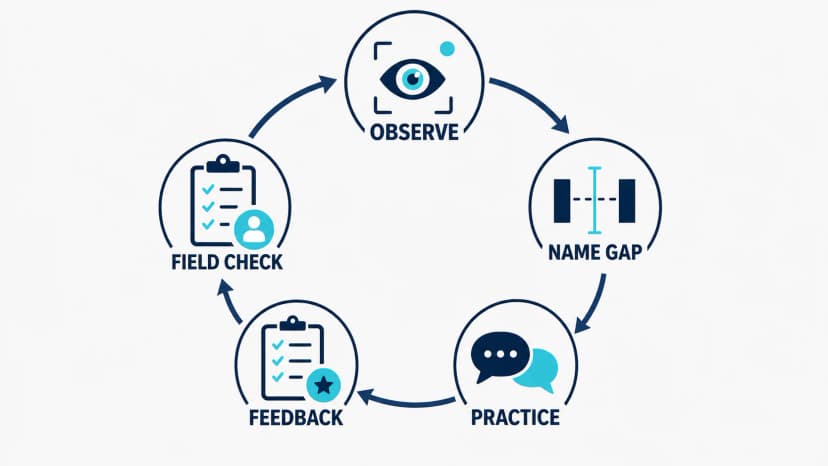
Turn misses into the next drill
The debrief should answer four questions:
- What did the homeowner actually say?
- What did the rep do next?
- Which rubric behavior was present or missing?
- What is the smallest scenario that would let the rep practice that behavior again?
Suppose a rep hears “I need to think about it” and immediately offers a discount. The next drill should not teach a better discount pitch. It should practice acknowledging the pause and asking what information would help the homeowner evaluate the decision. If the answer reveals a scope question, the next practice can focus on scope comparison.
That is pattern recognition: connecting observable language and context to a useful next question. It is not labeling the homeowner or predicting intent.
Completed coaching record example
This record is synthetic. It demonstrates the level of detail a manager should preserve after a short drill; it is not a real employee score or a script to use with every homeowner.
| Record field | Completed entry |
|---|---|
| Scenario | During estimate review, the homeowner says another written estimate is $2,400 lower. |
| First-attempt evidence | The rep immediately said the other contractor “must have left something out” and began defending price before asking to see either scope. |
| Observable gap | Clarify and accuracy: the response assumed a missing item and skipped permission to compare the documents. |
| Assigned drill | Acknowledge the price difference, ask whether the homeowner wants to compare the written scopes line by line, and name only differences visible in the documents. |
| Second-attempt evidence | The rep acknowledged the difference, requested permission, identified one documented material difference, and routed an unanswered installation question to the estimator. |
| Manager gate | Target behavior demonstrated in this drill. Repeat under two varied scenarios; independent estimate comparison remains restricted until the manager observes accurate transfer. |
A practical weekly rhythm
Use a light cycle that connects practice to field evidence:
- Monday: introduce one behavior and demonstrate the rubric.
- Tuesday: run two or three varied short scenarios.
- Wednesday: review one recorded or documented field moment.
- Thursday: practice the gap exposed by that evidence.
- Friday: manager verifies the behavior or keeps the gate in place.
Veteran reps can use the same loop for a narrow issue, such as explaining supplements without implying an insurance outcome. New hires need this practice embedded inside a broader onboarding system, including product knowledge, safety, documentation, and supervised field work.
Field-readiness gate
Before independent appointments, confirm that the rep can:
- explain the company's process and scope using approved language;
- handle the most likely concerns without inventing facts;
- identify when to bring in a manager, estimator, adjuster, or other authorized person;
- document the conversation accurately in the CRM;
- accept “no” or “not now” without pressure;
- follow safety, consent, recording, and data-handling policies.
The gate should record who observed the behavior, in which scenario, against which rubric, and what remains restricted. It should not claim to guarantee performance.
Frequently asked questions
How many times should a roofing rep practice each objection?
There is no universal evidence-backed number. Practice until the rep can demonstrate the required behavior across varied scenarios, then check retention later. Managers should define the gate based on risk and task complexity.
Should reps memorize objection scripts?
Memorize approved facts, process explanations, and useful question structures. Do not require a word-for-word rebuttal that ignores the homeowner's actual concern.
Can AI decide whether a rep is field-ready?
AI can help run practice and organize observations. A responsible manager should make the authorization decision using multiple forms of job-relevant evidence and documented company standards.
What should a rep never practice saying?
Avoid guarantees, unsupported diagnoses, statements about insurance coverage or claim outcomes, invented competitor deficiencies, false urgency, and promises outside the rep's authority.
Where should a team start?
Choose one common conversation, define one safe behavior, create three varied scenarios, and have a manager grade them with the same short rubric. Expand only after the loop works.
Free tools for roofing sales training
Turn this article into rep practice
Use the training library to turn ideas into drills, scripts, and coaching reps can actually use in the field.
Training tools
Browse objection, role-play, and scripting tools built for home improvement sales teams.
Browse training tools →All free tools
See the full tools hub across hiring, management, field sales, operations, and marketing.
Browse all tools →Role Play
Turn training concepts into live practice with AI homeowner scenarios that build muscle memory.
See Role Play →About the Author
Tim Nussbeck
Founder & CEO of GhostRep
20+ years in roofing and home improvement sales—knocking doors, running teams, and building practical coaching systems. Built GhostRep to give every rep access to the coaching top teams get.
Training next step
Turn training ideas into drills your reps will actually run
Start with the free training tools if you need scripts, practice reps, or coaching prompts today. Book a walkthrough if you want GhostRep mapped to your onboarding process.
- ✓Best fit if reps need more repetition, not more theory.
- ✓Useful for onboarding, objection practice, and weekly coaching.
- ✓Demo shows how Role Play plugs into your current training process.
Start Here
Browse training tools
Free objection builders, role-play prompts, scripts, and rep-practice templates.
Browse training toolsNeed it mapped to your team?
Talk through your current workflow, traffic mix, and where GhostRep fits before you change anything.
Book a 15-minute walkthroughYou Might Also Like
Compare seven roof financing options for bad credit, including contractor loans, personal loans, home equity, credit cards, FHA Title I, and local aid.
Read article →Build a four-week custom AI roofing sales training program with approved facts, realistic scenarios, scoring rubrics, manager calibration, and field gates.
Read article →Build a roofing sales training workflow around recorded appointments, live coaching, manager review and focused practice. Evaluate it with your own team.
Read article →