
A 30-day roofing sales onboarding plan should not promise that every new rep will be fully ramped, independently inspecting roofs, or closing at a certain rate by Day 30. It should create a controlled sequence of access, instruction, practice, observation, and manager decisions. The calendar below gives you that sequence while leaving safety authorization, licensing, product certification, employment rules, and field independence with your company.
The page has one job: own the new-rep onboarding calendar. Use the sales onboarding plan tool to draft a company-specific artifact, the training-cost calculator to model manager time, and the Role Play product to deliver practice. Those pages support the calendar; they do not replace it.
Next Step
Build the onboarding system around exact tools
These tools turn the 30-day plan into a real operating workflow for hiring managers and trainers.
First decide what Day 30 means at your company
“Ramped” is too vague to manage. Before the start date, write down which activities a rep may perform independently at four checkpoints: Day 1, Day 7, Day 14, and Day 30. A rep may be ready to make an approved introduction before they are ready to explain a technical scope. They may be ready to observe an inspection but not perform one. They may be ready to enter a lead in the CRM but not change a price, send a contract, or discuss an insurance document.
| Work area | Evidence before access expands | Manager decision |
|---|---|---|
| Safety and property access | Required training completed; company authorization documented | Where the rep may go, with whom, and using which equipment |
| Customer communication | Approved opener, accurate company explanation, permission and handoff language | Which customer moments may be handled independently |
| Product and scope language | Can distinguish known facts, company standards, and questions for a qualified reviewer | Which products or job types the rep may discuss |
| CRM and documentation | Creates a complete practice record with source, next action, owner, and due date | Which fields and stages the rep may edit |
| Pricing, contracts, financing, and insurance | Uses current approved materials and knows when to stop and escalate | What requires manager, estimator, lender, carrier, or legal review |
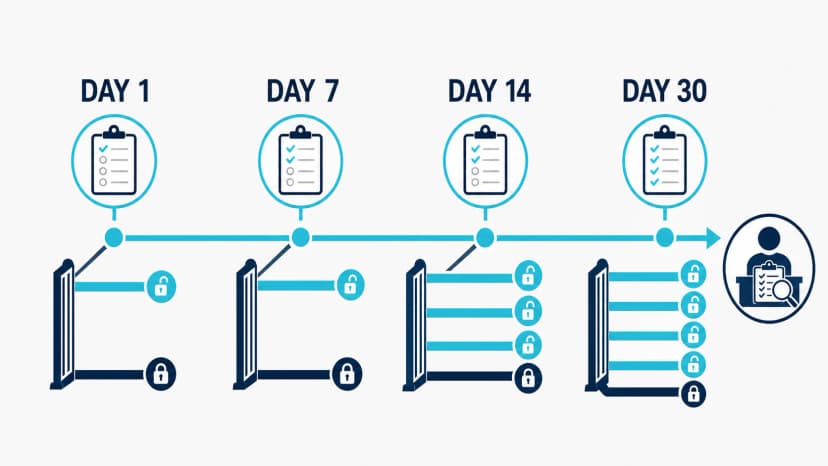
Roofing work can expose people to serious fall hazards. Classroom completion does not authorize roof access. Build the field plan around your written safety program, competent-person decisions, equipment requirements, and applicable rules. OSHA’s construction fall-protection training requirements address hazard-recognition training, certification, and retraining conditions, while the agency’s Protecting Roofing Workers guide provides a roofing-specific overview. Neither source turns this sales calendar into safety instruction or site authorization; your company remains responsible for qualified, job-specific compliance and training.
The 30-day roofing sales onboarding calendar
The calendar is deliberately organized by evidence rather than universal close-rate or activity targets. Replace the sample activities with your company’s real workflow, then decide whether each rep is ready to advance. A missed gate should produce more instruction or supervised practice—not a fabricated score and not automatic employment action.
Days 1–5: orientation and safe access
| Day | Rep work | Manager evidence |
|---|---|---|
| 1 | Role, pay plan, schedule, territory, communication channels, required policies, accommodations path | Rep can explain who owns leads, prices, customer promises, and escalation |
| 2 | Safety orientation and field-access boundaries | Required records completed; no access granted beyond company authorization |
| 3 | Customer journey from first contact through production handoff | Rep can identify the owner and exit evidence for each stage |
| 4 | Core product and service language using current company and manufacturer materials | Rep separates verified fact from assumption and routes technical questions correctly |
| 5 | CRM practice with fictional records | Complete source, notes, next action, owner, and due date without customer data leakage |
Keep product knowledge tied to customer decisions. A new rep does not need to recite every shingle line. They do need to explain the company’s approved system in plain language, find the current warranty document, and know when a question belongs with an estimator, production manager, manufacturer, or licensed professional. Use the roofing sales training library as the maintained source for those materials.
Days 6–10: conversation foundations
- Day 6: practice the approved opener and permission language across two real lead sources.
- Day 7: practice discovery questions that distinguish customer goals, known facts, and unknowns.
- Day 8: explain the next step without promising damage, coverage, price, approval, timing, or a sale.
- Day 9: enter fictional conversations into the CRM and route each next action.
- Day 10: run a manager-reviewed scenario and repeat only the section that needs work.
Do not set an arbitrary requirement such as “complete 150 role plays.” Practice volume matters only when the scenarios change, the target behavior is explicit, and a manager can see whether the behavior improved. The scenario generator creates the briefing; the feedback form captures evidence after the attempt.
For Day 6, compare an approved phone introduction from the roofing cold call script builder with an opening from the roofing door-knocking script generator. For Day 10, practice a specific concern using the objection response builder. The manager should be able to explain why the channel and response changed the words.
Days 11–15: observe real work without turning observation into imitation
Choose a small set of authorized field moments that represent the work: lead intake, pre-appointment preparation, customer arrival, inspection handoff, proposal explanation, and follow-up documentation. The new rep should carry an observation sheet with three columns:
- Observed: what the experienced rep said or did.
- Customer response: what changed in the conversation.
- Question: what the new rep needs clarified before using the approach.
One top rep’s habits are not automatically company policy. After each observation, compare the behavior with approved process and source materials. The ride-along evaluation tool provides a blank evidence-based form without rating personality or predicting performance.
Days 16–20: supervised application
Move from observation to controlled participation. The exact sequence depends on the job and your authorization rules, but a useful progression is:
- Prepare the record and appointment brief.
- Deliver the approved introduction while a qualified person retains ownership.
- Ask the approved discovery questions.
- Summarize verified facts and identify unanswered questions.
- Document the interaction and propose the next action for review.
The manager should decide one behavior to retain and one behavior to practice before the next attempt. “Be more confident” is not useful. “After the customer answers, summarize the concern before explaining the next step” is observable and repeatable.
Days 21–25: bounded independent work
Grant only the access the evidence supports. A rep may be able to confirm appointments, canvass within an assigned area, or complete lead notes independently while still requiring review for technical explanations, proposals, discounts, financing, contracts, and insurance-related language.
Use a daily exception review rather than a public leaderboard. Inspect a small sample of records for missing source, unclear next action, unsupported promise, wrong owner, or overdue follow-up. Then create tomorrow’s practice from the actual pattern. The goal is not to catch the rep; it is to keep weak documentation or risky language from becoming normal.
Days 26–30: review evidence and write the next plan
At Day 30, review the evidence by work area. Do not reduce the decision to revenue alone: lead mix, season, territory, appointment volume, and manager assignment can obscure whether the rep is executing the process.
| Evidence lane | Questions for the review | Possible next decision |
|---|---|---|
| Safe execution | Did the rep remain inside authorization and escalate correctly? | Maintain or expand access; retrain before expansion |
| Customer communication | Are explanations accurate, clear, permission-based, and free of unsupported promises? | Add a new conversation stage or repeat a targeted drill |
| Documentation | Can another person understand the status, evidence, owner, and next action? | Grant broader CRM ownership or keep manager review |
| Coachability | Did a specific behavior change after specific feedback? | Increase field complexity or revise the coaching method |
| Business results | What opportunities existed, what actions were controlled by the rep, and what needs more data? | Set a 30-, 60-, or 90-day development plan |
Completed manager sign-off record
This synthetic record shows how calendar checkpoints become documented access decisions. It does not authorize roof access, technical inspection, contracting, financing, or insurance activity; the company’s qualified owners must make those decisions under applicable rules and policy.
| Checkpoint | Work allowed | Work still restricted | Evidence reviewed | Owner and next review |
|---|---|---|---|---|
| Day 1 | Orientation, fictional CRM records, approved product-source lookup | Customer contact, field access, pricing, contracts, financing, insurance, and technical explanations | Role and pay-plan acknowledgment; escalation map explained back to manager | Sales manager; Day 7 |
| Day 7 | Approved opener and discovery practice; appointment-brief preparation using fictional records | Unsupervised customer contact and every field or transaction authority | Three varied practice records; accurate process explanation; required company training records confirmed by the authorized owner | Sales manager plus safety owner for their respective decisions; Day 14 |
| Day 14 | Observe approved customer and field moments; complete notes for manager review | Independent inspection, technical scope, price changes, contract delivery, financing, and coverage language | Observation sheet, CRM quality sample, documented boundary escalations, targeted coaching record | Sales manager; Day 30 unless an earlier exception review is required |
| Day 30 | Only company-approved lead and documentation tasks supported by the record | Any task without separate evidence, training, license, policy approval, or qualified authorization | Customer-language rubric, supervised attempts, documentation audit, safety/access status, open questions, and exception history | Named owner for each work lane; next written development review set for Day 60 |
A manager should sign the decision actually made, including a narrower-access decision. “Attended 30 days” is not evidence that the rep may perform every task independently.
How to adapt the plan for a cohort or storm season
Training several reps at once can reduce repeated manager lectures, but it creates a different risk: attendance can be mistaken for competence. Deliver policy, product, and process instruction as a cohort; keep field authorization and skill evidence individual. Pair reps for observation, but record each person’s attempt and next practice focus separately.
A storm-season start date changes sequencing, not safety or accuracy. Compress administrative setup, use shorter daily practice blocks, and limit early work to a smaller set of approved tasks. Do not compress roof-access training, technical authorization, documentation standards, or insurance boundaries because lead volume is high. Model the added manager time and rep support in the training-cost calculator before opening a large class.
What happens after a bootcamp or the first 30 days
A workshop can align language and create shared context. It cannot supply the field evidence needed to expand access. Within two business days of any bootcamp, assign one real workflow task, one practice scenario, and one manager observation. Review the result inside the normal weekly cadence.
For Days 31–90, maintain a simple reinforcement loop:
- Sample one documented customer interaction or fictional practice record.
- Choose one observable behavior tied to the current role.
- Practice the exact moment, not the entire presentation.
- Observe the next authorized attempt.
- Record whether the behavior changed and choose the next step.
If the rep needs a financial bridge during ramp, define it in writing before the start date: amount, duration, repayment or draw terms, commission treatment, and what happens if employment ends. Do not rely on an informal “float period.” Have compensation and classification terms reviewed for the worker’s actual role and location.
Next Step
Score the ramp before reps drift
A 30-day plan works better when managers can measure activity, appointment quality, and the exact coaching gaps that show up in week one.
30-day onboarding plan FAQ
Can a roofing sales rep be ready in 30 days?
A rep can become ready for specific bounded tasks in 30 days. Full independence depends on the role, lead type, safety requirements, product complexity, licensing, company process, and evidence from supervised work. Define readiness task by task instead of promising a universal ramp date.
How many role plays should a new rep complete?
Use enough varied attempts to observe improvement in the target behavior. A count by itself is weak evidence. Record the scenario, the behavior, the feedback, and whether the next attempt changed.
When should a new roofing rep go solo?
Only after the company confirms the rep is authorized for the specific task and has demonstrated safe, accurate execution. “Solo” may begin with appointment confirmation or lead documentation long before technical inspection, pricing, contract, financing, or insurance discussions.
What should a manager review on Day 30?
Review safety and authorization, customer communication, documentation quality, response to coaching, and business results in context. Then write the next 30-, 60-, or 90-day plan with explicit access, support, evidence, owner, and review dates.
Does GhostRep replace manager onboarding?
No. GhostRep can help create practice volume, organize evidence, and support coaching. Your managers remain responsible for safety, policy, authorization, source materials, customer promises, and personnel decisions.
Next step: build your company-specific calendar with the sales onboarding plan tool, then connect each week to approved source material, a named manager, and a reviewable piece of evidence.
Free tools for sales managers
Turn this into a manager workflow
Use free management and operations tools to turn coaching ideas into repeatable systems for your reps and managers.
Management tools
Use 1-on-1 scripts, meeting agendas, forecast templates, and escalation tools.
Browse management tools →Operations tools
Build scorecards, SOPs, pipeline templates, and review workflows your team can run every week.
Browse operations tools →AI Sales Coach
Give reps coaching based on real performance data instead of waiting for the next ride-along.
See AI Sales Coach →About the Author
Tim Nussbeck
Founder & CEO of GhostRep
20+ years in roofing and home improvement sales—knocking doors, running teams, and building practical coaching systems. Built GhostRep to give every rep access to the coaching top teams get.
Manager next step
Turn this into a manager workflow your team can repeat
Use the management tools if you need a practical coaching or accountability system first. Book a walkthrough if you want GhostRep tied to rep performance and live coaching.
- ✓Best fit if coaching is inconsistent across reps and managers.
- ✓Useful for 1-on-1s, scorecards, and weekly operating rhythms.
- ✓Demo shows how AI Sales Coach turns performance data into specific guidance.
Start Here
Browse management tools
Open scorecards, coaching docs, forecast templates, and manager workflows.
Browse management toolsNeed it mapped to your team?
Talk through your current workflow, traffic mix, and where GhostRep fits before you change anything.
Book a 15-minute walkthroughYou Might Also Like
See seven useful AI sales manager workflows for roofers, what AI should never own, and a practical pilot and buyer checklist.
Read article →Run a remote roofing sales team with trusted CRM stages, daily exception review, observed field work, coaching records, capacity controls, and clear escalation.
Read article →Run a 15-minute roofing sales meeting that routes safety issues, customer commitments, blocked work, capacity conflicts, and coaching follow-ups.
Read article →