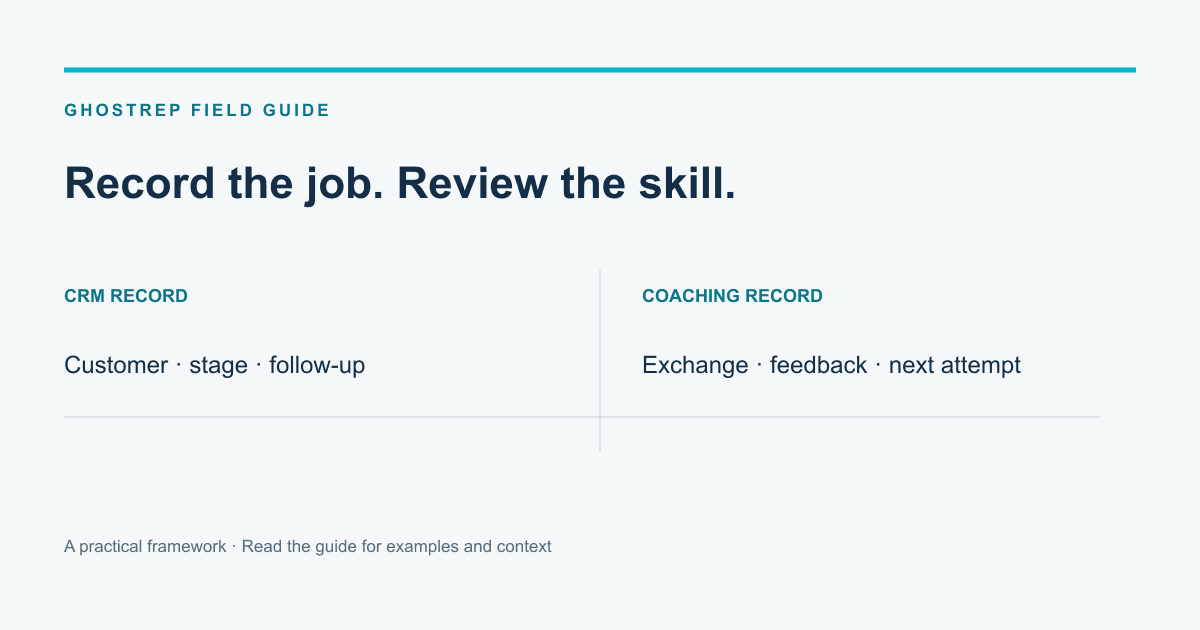
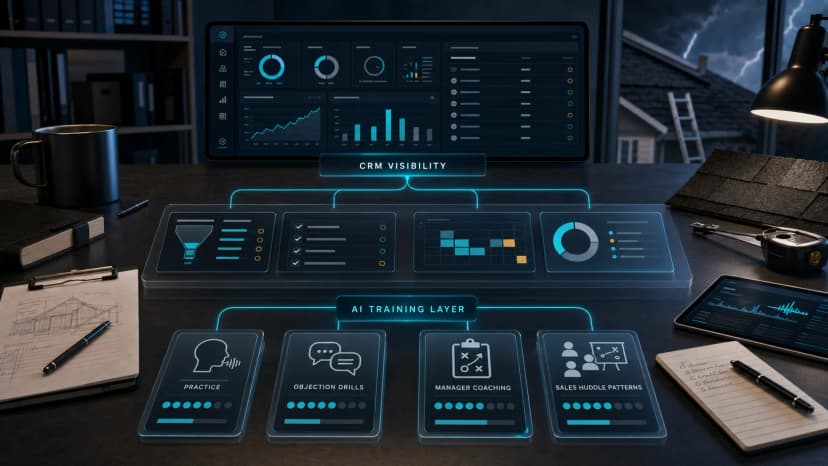
A roofing CRM is designed to improve visibility into the work. An AI training platform is designed to help the rep practice the next homeowner conversation. Neither outcome is automatic.
Choose or fix the CRM when leads, stages, estimates, documents, production handoffs, and follow-up ownership are unclear. Add AI training when the work is visible but reps still lose the same moments: price pressure, insurance confusion, spouse stalls, weak follow-up, and inconsistent closing language.
The standard for AI training is not whether it can generate generic sales copy. The standard is whether it creates better practice, better coaching, and better behavior before the next live lead is at risk. If the question is still which CRM to buy, use the best roofing CRM software comparison first.
Next Step
Choose the CRM before blaming the CRM
If the buying question is still software fit, the canonical CRM comparison should anchor the decision before the team adds a training layer.
The Difference Is Visibility vs Skill
A sales manager opens the CRM on Monday morning.
Four roof replacement proposals are sitting in "sent." All four have follow-up tasks. Two have notes that say the homeowner is "thinking it over." One says the spouse was not available. One says the homeowner had a cheaper bid.
The CRM is doing its job. It shows where the opportunities sit.
The training question is harder:
Which rep actually knows what to say before the next call?
One rep needs to practice the spouse stall. Another needs to clarify scope before defending price. Another needs a clean insurance explanation because the homeowner is confusing deductible, approval, and upgrade cost. A fourth may not need a new message at all; he may need to learn how to earn a next step before leaving the appointment.
That is why CRM data is only the starting point.
The CRM shows:
- appointments booked,
- proposals sent,
- deals won or lost,
- follow-up tasks,
- lead source performance,
- pipeline stages.
That is useful, but incomplete.
The CRM can show that a rep sent ten proposals and only two closed. It cannot, by itself, tell whether the rep:
- lost trust during the inspection,
- answered the deductible question poorly,
- failed to include the spouse,
- defended price before clarifying scope,
- overpromised production timing,
- sent a follow-up message that sounded like every other contractor.
CRM visibility tells the manager where to look. AI training changes what the rep does next.
When CRM Visibility Is Not Enough
Use this diagnostic line before buying another dashboard.
| CRM signal | What the manager sees | Training question |
|---|---|---|
| Proposal sent, no response | The job is stalled | Did the rep earn a specific next step or just send a number? |
| High appointment volume, low close rate | The rep is active but not converting | Which objection or moment is breaking the appointment? |
| Follow-up task completed | The box was checked | Did the follow-up reference the homeowner's real concern? |
| Lost to competitor | Deal marked lost | Was the issue price, scope clarity, trust, timing, or a better sales process? |
| New rep has clean CRM notes | Records look acceptable | Can the rep actually handle pressure without a manager present? |
| Team close rate drops | Outcome changed | Which conversation pattern changed first? |
If the training question is unanswered, more CRM fields will not fix the rep.
The Manager Workflow Before and After
The old workflow is status management:
- Open the CRM.
- Find stalled proposals.
- Tell the reps to follow up.
- Wait to see if anything moves.
The better workflow is skill management:
- Open the CRM and find the stalled proposals.
- Identify the sales moment behind each stall: price, spouse, insurance, timing, trust, or scope.
- Assign the right practice before the rep follows up.
- Use the next one-on-one or huddle to turn the pattern into a standard.
- Watch the next round of CRM outcomes to see whether the behavior changed.
That is the reason AI training belongs in the stack. It changes the manager's next action, not just the dashboard.
What a Serious AI Training Platform Should Change
AI training cannot be "the tool writes a script and everyone pretends that is enablement." For roofing sales teams, it has to change five things.
1. Reps get practice before live leads
Most roofing reps do not get enough repetitions before they are sent into real appointments.
They hear the pitch once, ride along a few times, watch a few videos, then learn by burning leads.
AI training creates controlled practice around the moments that cost money:
- "Your price is higher than the other company."
- "I need to talk to my spouse."
- "My insurance company said they will not pay for that."
- "Can you waive the deductible?"
- "We are not ready to decide today."
- "Another roofer said we do not need all that work."
Role Play makes those moments repeatable before the rep hears them from a real homeowner.
2. Managers get better coaching inputs
Most managers do not have time to sit through every appointment, every follow-up, and every roleplay.
AI training gives the manager a usable coaching view:
- which objection keeps stopping the rep,
- which skill has improved,
- which reps need the same huddle,
- which follow-up standard is being missed,
- which new hire is not ready for unsupervised appointments.
AI Sales Coach should turn that into specific coaching, not vague motivation.
3. Sales huddles become practice, not announcements
Bad huddles are status meetings with coffee.
Good huddles change behavior.
Training Studio turns this week's field pattern into:
- a five-minute objection drill,
- a roleplay scenario,
- a better follow-up example,
- a rep-by-rep coaching prompt,
- a cleaner standard for the next week.
If three homeowners asked about production timing this week, next week's huddle should be a production-timeline drill, not a "close harder" speech.
4. Follow-up gets tied to the real objection
Many roofing follow-ups fail because they are disconnected from the appointment.
The CRM says follow up.
The rep sends:
Just checking in to see if you had any questions.
That message is weak because it does not carry the conversation forward.
AI training helps reps understand what the homeowner actually cared about:
- scope risk,
- insurance approval,
- monthly payment,
- spouse involvement,
- schedule disruption,
- trust in the contractor.
The follow-up should speak to that concern.
5. Rep readiness becomes visible
A CRM can show that a new rep has appointments scheduled.
It does not prove the rep is ready for those appointments.
An AI training platform helps a manager see readiness before the rep is alone with expensive opportunities:
- Can the rep explain the inspection without rambling?
- Can the rep handle a spouse stall?
- Can the rep explain insurance without sounding evasive?
- Can the rep defend scope without attacking the competitor?
- Can the rep ask for the next step cleanly?
That is a different management signal than CRM activity.
Roofing Situations That Need Training, Not Another Dashboard
Price pressure
The CRM can mark "lost on price."
Training asks what happened before price became the reason.
Did the rep clarify scope? Did they explain risk? Did they position options? Did they panic and discount too early? Did they let the cheaper bid define the conversation?
Spouse stalls
The CRM can create a follow-up task.
Training asks whether the rep set the decision-maker standard before the appointment, handled the stall in the room, and created a specific next step that includes the missing person.
Insurance questions
The CRM can store claim notes.
Training asks whether the rep explained the process clearly, stayed compliant, avoided overpromising, and helped the homeowner understand what happens next.
Production handoff anxiety
The CRM can show the job moved to production.
Training asks whether the rep set the right expectations before the contract was signed. Many production complaints begin as sales promises that were never clarified.
Weak follow-up
The CRM can prove the rep followed up.
Training asks whether the message was any good.
New-rep ramp
The CRM can show new rep activity.
Training asks whether the rep is learning the actual sales moments fast enough to protect the territory.
How to Evaluate AI Training Platforms
Use these criteria before buying anything that claims to be AI sales training.
| Evaluation question | Why it matters |
|---|---|
| Does it create realistic roofing scenarios? | Generic sales prompts will not prepare a rep for deductibles, scope confusion, storm urgency, production timing, or spouse stalls. |
| Can reps practice repeatedly without a manager present? | Training cannot depend entirely on ride-alongs and manager availability. |
| Does it help managers coach specific skills? | A score is not useful unless it turns into an action. |
| Can it support sales huddles and one-on-ones? | The platform should improve the manager operating rhythm, not just the rep's solo practice. |
| Does it learn from company patterns? | The best training topics should come from what your team is actually hearing. |
| Does it connect to field context? | Job Intel and Echo-style signals make training more relevant than generic roleplay. |
| Does it avoid fake certainty? | AI should surface patterns and coaching prompts, not invent proof or make unsupported claims. |
If a platform cannot show how it changes the next conversation, it is content generation dressed as training.
CRM AI vs AI Training
Many CRMs are adding AI features. Some are useful.
Summaries, task suggestions, note cleanup, email drafts, lead scoring, and record updates can reduce administrative work.
That does not automatically mean the rep is better trained.
The difference is simple:
Both can be valuable. They should not be confused.
A 30-Day Rollout for AI Training
Start narrow and prove the workflow.
Days 1-7: Pick the weak moment
Choose one problem:
- price objections,
- spouse stalls,
- insurance questions,
- follow-up quality,
- new-rep appointment readiness,
- production timeline expectations.
Do not try to train everything at once.
Days 8-14: Build the scenarios
Use Role Play and Training Studio to build scenarios around the exact language homeowners use.
Bad scenario:
Customer has a price objection.
Better scenario:
Homeowner has a $4,000 cheaper bid, thinks both scopes are the same, and wants to know why your company is higher.
Specificity separates training from theater.
Days 15-21: Coach from performance
Use AI Sales Coach and manager review to identify who needs what.
One rep may need price clarification. Another may need closing language. Another may need insurance explanation practice. Treating them the same wastes time.
Days 22-30: Turn the pattern into a team standard
Bring the pattern into the sales huddle.
Create the standard language. Practice it. Use it in follow-up. Review whether the next appointments sound better.
That is how AI training becomes an operating rhythm instead of a software experiment.
What GhostRep Products Do in This Category
Evaluate GhostRep as a training and coaching layer, not as a CRM replacement.
- Role Play gives reps repetitions on the sales moments they usually learn too late.
- Training Studio helps managers turn patterns into huddles, drills, scenarios, and coaching assets.
- AI Sales Coach helps translate rep behavior and customer context into manager-ready coaching.
- Echo supports the field conversation layer where real homeowner language appears.
- Job Intel gives reps better context before the next conversation.
The CRM owns the work record. GhostRep owns the training loop around the moments that decide whether work moves forward.
Mistakes to Avoid
Mistake 1: Using AI to create more generic scripts
Generic scripts are easy to produce and easy to ignore.
The training should be built from the situations your reps actually face.
Mistake 2: Training without manager ownership
AI does not replace manager judgment. Someone still has to decide what gets practiced, what becomes a standard, and what changes in one-on-ones.
Mistake 3: Confusing completion with competence
A rep completing a module is not the same as handling a real homeowner.
Training should test behavior, not just attendance.
Mistake 4: Trying to solve CRM chaos with training
If leads, jobs, estimates, documents, and production handoffs are disorganized, fix the CRM process first.
Training works better when the operating system is clean enough to show the work.
Mistake 5: Training every rep on the same thing forever
New reps, veteran reps, retail reps, storm reps, and managers do not need identical development plans.
AI training should segment the work, not flatten it.
Next Step
Measure the visible workflow and the invisible skill gap
Use CRM stages and KPI scorecards to find the gap, then use training tools when reps need better language, practice, or manager coaching.
Frequently Asked Questions
What is the difference between a roofing CRM and an AI training platform?
A roofing CRM manages leads, jobs, stages, estimates, documents, tasks, production, invoices, and reporting. An AI training platform improves the sales conversations that move those jobs forward: objection handling, follow-up, roleplay, manager coaching, huddles, and readiness.
Should I buy a CRM or AI training first?
Fix the CRM first if the team cannot track work reliably. Prioritize AI training when the team can see the work but still loses the same sales moments. A training platform cannot replace job management. A CRM cannot replace practice.
Can CRM AI features replace AI sales training?
Usually not. CRM AI often helps with summaries, tasks, email drafts, lead scoring, and record management. Those are admin improvements. AI sales training should improve rep behavior before the next appointment or follow-up.
What sales problems are best suited for AI training?
Price pressure, spouse stalls, deductible and insurance questions, competitor bids, production timeline concerns, weak follow-up, new-rep readiness, and inconsistent closing language. These are good training candidates because reps can practice them before they happen live.
How should managers use AI training without losing control?
Use AI training as a coaching input, not an autopilot. The manager still chooses the priority skill, reviews the pattern, runs the huddle, assigns practice, and holds the rep accountable.
How do I know if AI training is working?
Look for behavior change first. Reps should respond better in roleplay, follow-up should become more specific, one-on-ones should focus on clear skills, and huddles should address real field patterns. Then watch CRM outcomes: proposal movement, follow-up quality, and close-rate consistency.
Does GhostRep need to replace our existing training program?
No. GhostRep can sit around an existing training program by adding repetition, scenarios, conversation context, coaching prompts, and huddle material. Keep what works. Make practice more specific to the moments your team is actually facing.
Where should I go next?
If you still need to choose the CRM itself, read Best Roofing CRM Software: 5 Contractor CRMs Compared. If you want the product-layer view of where GhostRep fits around your CRM, read Roofing CRM vs GhostRep. For the category thesis, read What Is a Roofing CRM in the AI Era?.
Roofing CRM and software cluster
Keep the CRM decision tied to sales execution
Use the CRM articles as a decision set: choose the right source of record, then separate workflow problems from rep-development problems.
About the Author
Tim Nussbeck
Founder & CEO of GhostRep
20+ years in roofing and home improvement sales—knocking doors, running teams, and building practical coaching systems. Built GhostRep to give every rep access to the coaching top teams get.
CRM stack next step
Separate the source of record from the sales-development layer
Use the CRM content to choose the operating system for leads and jobs. Use GhostRep when the visible pipeline still does not explain rep behavior, objections, follow-up quality, or coaching needs.
- ✓Best fit if you are deciding whether the issue is workflow or rep execution.
- ✓Useful for comparing CRM visibility against conversation-level coaching.
- ✓Demo shows how GhostRep sits around the CRM instead of replacing it.
Start Here
Compare CRM vs AI training
Read the side-by-side breakdown before treating every close-rate problem as a CRM problem.
Compare CRM vs AI trainingNeed it mapped to your team?
Talk through your current workflow, traffic mix, and where GhostRep fits before you change anything.
Book a 15-minute walkthroughYou Might Also Like
An AI CRM for roofing should do more than store jobs. See what CRMs track, what they miss, and how conversation intelligence improves follow-up.
Read article →Compare JobNimbus, AccuLynx, ServiceTitan, Roofr, Leap, Jobber, Exterio, and HubSpot by workflow, pricing, integrations, and data exit.
Read article →See where a roofing CRM should stop and GhostRep should start: job records, pipeline stages, rep coaching, call review, roleplay, and close-rate lift.
Read article →