Roofie vs Everyone: Why We Publish Our Pricing (And Why They're All Scared To)
You know what's infuriating? Going to literally ANY software website, training platform, or vendor site in 2025, trying to figure out if you can afford it, and seeing this bullshit:
"Schedule a Demo to Learn About Pricing" "Contact Sales for Custom Quote" "Request Pricing Information"
Translation: "We're going to trap you on a 45-minute sales call with a guy named Chad or Brittany who will ask about your 'pain points' and 'business goals' before they tell you the price. Then they'll pressure you to sign today with a 'limited-time discount' that's actually available every week to hit their quota."
It's 2025. You can buy a $50,000 car online without talking to anyone. You can buy a $2 million house on Zillow. But training platforms, CRMs, and software companies still think you need a boomer in a polo shirt to walk you through a PowerPoint before revealing they charge $200 per user per month.
This isn't customer service. This is manipulative garbage.
Here's why we publish our pricing upfront—and why the entire industry is terrified to do the same.
The "Schedule a Demo" Playbook (Everyone Uses It)
Let's be honest about what's happening on these calls across every industry. Here's the timeline:

The result: You wasted an hour and still don't know if you're getting a good deal because every prospect gets a different price based on what the sales rep thinks they can extract.
This isn't customer service. It's information asymmetry weaponized for profit.
What Those "Discovery Questions" Really Mean
When they ask about your business, they're not trying to help you. They're pricing you.

Every answer you give is ammunition they use to maximize the price they quote you.
The Industries Doing This Right Now
This manipulation isn't unique to one sector. It's everywhere:
💻 Training Platforms: "Let's discuss your learning objectives" = Let me figure out how desperate you are
📈 CRM Software: "Tell me about your sales process" = Let me find your budget ceiling
👥 Recruiting Tools: "How many hires per year?" = Let me calculate the maximum I can charge
📚 LMS Platforms: "What's your team size?" = Let me multiply by $50/user and see if you flinch
🎯 Sales Enablement: "What's your current tech stack?" = Let me see what you're already spending
🏢 HR Software: "Tell me about your pain points" = Let me find out what you'll pay to make it stop
They all use the exact same playbook. Most buyers don't realize they're being manipulated until they compare notes with another company and realize they paid 3x more for the same product.
Why Software Companies Hide Pricing (All of Them)
Here's what they don't want you to know:
💸 Hidden Cost #1: Per-User Pricing That Scales Horribly
Most platforms charge $50-200 per user per month. Sounds reasonable for 5 users at $250-1,000/month, right?
Here's what actually happens: Your bill doubles when you add 5 new employees. You pay for people who quit or get fired. You pay for people who never log in. You pay for seats that sit unused because "we might need them later."
The math they don't want you to do:

This model made sense in 2005 when software cost millions to build and companies had low turnover. It doesn't make sense in 2025 when median tenure is 18 months and half your team turns over every year.
Who this hurts most: High-turnover industries (sales, retail, hospitality, construction, roofing), fast-growing companies constantly hiring, seasonal businesses ramping up and down, and anyone who wants to "try it with the whole team" before committing.
📦 Hidden Cost #2: The Software Stack Trap
They don't tell you upfront that you need 5 different products to actually solve your problem. They fragment their offering so each line item seems "reasonable" until you add it up.

⚠️ Hidden Cost #3: The Overage Trap
"Unlimited" usage... up to [arbitrary limit they don't mention until you hit it]. You don't find out about these limits until you get a surprise $3,500 bill in month 3.
Real examples from real platforms:

Why they do this: Low advertised price gets you in the door. Real revenue comes from overages you didn't budget for. By the time you get hit, you're already integrated and stuck. Switching costs are high, so you just pay it.
🔒 Hidden Cost #4: The Annual Lock-In
They won't tell you this on the demo call, but when you get the contract: month-to-month is 40-60% more expensive, everyone "does annual" because month-to-month pricing is deliberately punitive, and there's a 12-month minimum buried in Section 8, paragraph 3.
Your actual trial period: 12 months whether you like it or not.
Want to cancel in month 3 because the product sucks? You're paying for 9 more months of software you're not using. The sales rep who said "you can cancel anytime" technically wasn't lying—you can cancel after your 12-month contract ends. Plus auto-renewal unless you cancel 60-90 days in advance (when you're not thinking about it).
💰 Hidden Cost #5: The "Implementation Fee" Surprise
After you sign, you discover setup fees that weren't mentioned. That $500/month subscription actually cost you $8,000-20,000 in Year 1 when you include all the fees they didn't mention upfront.

🎯 Hidden Cost #6: The Feature Hostage Situation
The features they showed you in the demo? Half of them are on "Enterprise tier" which costs 3-5x more. After you sign, you try to use a feature they demonstrated and it says "Upgrade to Enterprise to access this feature."

The bait-and-switch: They demonstrated features you don't have access to, hoping you wouldn't notice until after you signed. Now you need to pay 3-5x more to get what they showed you.

The Pricing Manipulation Playbook (Everyone Uses It)
Here are the specific tactics software companies use to hide real costs and maximize what they extract from you:
🎭 Tactic #1: The "Good, Better, Best" Trap
They show you three tiers:
- Basic: Missing every feature you actually need
- Professional: Has most features but caps at 5 users (you have 12)
- Enterprise: Has everything but costs 10x more and requires "custom quote"
What they're actually doing: The Basic tier exists only to make Professional look reasonable. The Enterprise tier exists to make you feel like Professional is the "smart middle choice." You were always going to pay for Professional—the other tiers are psychological anchors.
💸 Tactic #2: The Fake Discount
"Our normal price is $1,000/month, but if you sign today, I can get you 30% off—just $700/month."
The truth: Nobody pays $1,000/month. The real price is $700/month. They invented a fake "list price" so they could "discount" it and make you feel like you're getting a deal.
How to test this: Wait a week. Call back. The "limited time" discount is still available. It's always available. It's not a discount—it's the price.
📈 Tactic #3: The Per-User Trap
"Just $50 per user per month! Very affordable!"
What happens:
- Month 1: 5 users = $250/month (reasonable)
- Month 3: You add 10 employees = $750/month (didn't budget for this)
- Month 6: 3 people quit, you're still paying for their seats = wasted $150/month
- Month 12: You have 20 total user licenses, but only 11 people actively use it = effective cost $91/user instead of $50/user
Why they do this: Because "$50/user/month" sounds cheap, and by the time you realize you're paying for 20 seats to get 11 active users, you're locked in.
🎣 Tactic #4: The Feature Upsell Bait-and-Switch
On the demo, they show you the full product with all features enabled. You're impressed. You sign.
Week 2, you try to use [feature they showed you]. It says "Upgrade to Enterprise to access this feature."
You email sales: "I thought this was included?"
Sales responds: "That's an Enterprise feature. Would you like to upgrade?"
The truth: They demonstrated features you don't have access to, hoping you wouldn't notice until after you signed.
🔌 Tactic #5: The "Integrations Cost Extra" Discovery
"Yes, we integrate with [your CRM/email/calendar/everything]!"
After you sign: "Oh, integrations are $100-300/month each depending on the integration."
You need 3 integrations to make it actually useful. Your $500/month subscription just became $800-1,400/month.
🔄 Tactic #6: The Auto-Renewal Trap
Contract says: "Auto-renews annually unless canceled 60 days prior to renewal date."
What happens:
- You sign on March 15
- You forget about it
- January 15 comes around (60 days before renewal)—you're not thinking about this contract
- March 15 hits—you're auto-renewed for another year
- March 20—you remember you wanted to cancel
- Too bad, you're locked in for 12 more months
Why they do this: Because they know you'll forget, and when you remember, it'll be too late.
🛠️ Tactic #7: The "Implementation Specialist" Extortion
After you sign, they assign you an "implementation specialist" to help you get started.
Sounds great, right? Customer service!
Week 2: "To finish implementation, we need 10 hours of specialist time at $200/hour. Would you like to proceed?"
You already signed the contract. Your team is waiting. You're stuck. You pay the $2,000.
The truth: Implementation should be included. They're just extracting an extra $2,000 because they know you can't back out now.
What You're Actually Paying: The Real Numbers
Let's calculate the real cost using a real example: A company with 10 existing employees that hires 15 new people over the year (typical for growing companies or high-turnover industries).

What they told you on the demo: "It's $100 per user per month, so for 10 users, that's $1,000/month to start."
What you're actually paying in Year 1: $4,733/month average ($56,800 ÷ 12)
What you're paying ongoing: $4,067/month ($48,800 ÷ 12)
Where the costs come from that weren't mentioned:
- You had 25 users at peak, not 10
- 8 of those 25 quit or never logged in (you still paid for them)
- Setup costs were $8,000 (never mentioned)
- You hit usage limits 4 times and paid overages
- Basic support was so bad you had to buy premium
- Core features were locked behind "add-on modules"
Real Examples from Real Companies
These aren't hypotheticals. These are actual pricing models:
Training Platform A: (rhymes with "AbsorbLMS")
- Advertised: "Starting at $8,000/year"
- Actual cost Year 1: $24,000 (setup fees + per-learner charges + content library + support package)
CRM Software B: (rhymes with "Sales Force")
- Advertised: "$25/user/month"
- Actual cost: $150-300/user/month after you add all the features they showed you in the demo
Recruiting Platform C: (rhymes with "Lever")
- Advertised: "Custom pricing starting at $500/month"
- Actual cost: $18,000-30,000/year (base + per-job-post charges + background check integration + support)
Video Training D: (rhymes with "Lessonly")
- Advertised: "$3/learner/month"
- Actual cost: $12,000-20,000/year (minimum user commitments + overage fees + admin seats charged separately)
The pattern: What they advertise is 30-70% less than what you actually pay once you include everything you need to make it work.
Roofie's Transparent Pricing Model
Here's our pricing. Right here. No demo required:
Professional: $499/month
What you get:
- 50 hours/month shared pool (3,000 minutes)
- Training AND recruiting from the same hour pool
- Up to 5 users
- Hours never expire—use them anytime
- No per-user charges
- No overage surprises
Real-world usage:
- Screen 65+ candidates/month (15 minutes each = 16 hours)
- Train 3 active reps constantly (30 min/day × 22 days × 3 reps = 33 hours)
- Total: 49 hours used, 1 hour buffer
💰 Effective cost per hour: $9.98
Or pay annually: $2,999/year (save $2,989 = 50% off)
Enterprise: $899/month
What you get:
- 125 hours/month shared pool (7,500 minutes)
- Training AND recruiting from the same hour pool
- Up to 15 users
- Hours roll over month-to-month (never expire)
- Priority support included
- No per-user charges
- No overage surprises
Real-world usage:
- Screen 130+ candidates/month (15 minutes each = 33 hours)
- Train 8 active reps constantly (30 min/day × 22 days × 8 reps = 88 hours)
- Total: 121 hours used, 4 hours buffer
💰 Effective cost per hour: $7.19
Or pay annually: $5,999/year (save $4,789 = 44% off)
Need More Capacity? Buy Hour Packages (Never Expire)
Instead of surprise overage charges, buy hours upfront when you need them:

Key difference from competitors:
- ✅ Hours never expire—rep quits? Use them on the replacement
- ✅ No surprise bills—you buy what you need upfront
- ✅ Professional customers save 40-50% vs base pricing
- ✅ Your investment never goes to waste
Direct Comparison: Roofie vs Traditional Platforms
Same scenario: Company with 10 employees that hires 15 new people over the year (sales team, retail, hospitality, construction, any high-turnover or fast-growth situation).

"But wait—I have 25 users at peak, not 15. How does that work with Roofie?"
We don't charge per user. You can have 25 users, 50 users, 100 users. The only limit is simultaneous usage—how many people can practice or screen candidates at the exact same time.
Translation: As many people on your team can use Roofie as you want. The limit is just how many can use it at once.
For 99% of companies, 15 simultaneous users (Enterprise plan) is more than enough because your entire team isn't training or screening at the exact same moment. Reps train in the morning, screen candidates in the afternoon, work different shifts, etc.
Compare that to traditional software where:
- User #16 costs you $1,200/year
- User #25 costs you $30,000/year total across all users
- Users who quit cost you $100/month until the contract ends
- Users who never log in still cost you $100/month
With Roofie:
- Add user #16: $0 extra
- Add user #100: $0 extra
- User quits: Use their hours on the replacement, $0 lost
- User never logs in: $0 wasted because you're not paying per-user
Why We're Confident Enough to Be Transparent
Most software companies hide pricing because they're not confident you'll see the value if you know the real cost upfront.
We publish our pricing because:
1. The Product Actually Works
We don't need to trap you on a sales call to convince you. Try Objection Mastery for one week. If your reps aren't handling objections better after practicing 50 times with AI feedback, cancel. We're not worried about that happening because it works.
2. The Model Is Fundamentally Better
Shared hour pool > per-user pricing
When you hire 5 new reps, your Roofie bill doesn't change. When 3 of them quit (because roofing has high turnover), you don't lose money—you use those hours to train their replacements.
Traditional software? You paid for those 3 reps for the full month. That's $300 down the drain. Every month. That's $3,600/year in wasted user fees.
3. No Surprises = No Angry Customers
You know exactly what you're paying. If you need more capacity, you buy hour packages upfront—not get hit with surprise overage charges.
Traditional model: "Your bill this month is $3,800." What? Why? "You went over your recruiting limit and training hours."
Roofie model: "You used 48 of your 50 hours. Want to grab 20 more for next month?" Sure, here's $199. Done.
4. We're Built for High-Turnover Industries
Every other platform penalizes you for turnover:
- You pay per user per month
- When users quit, you lose that money
- You're incentivized to NOT hire aggressively because each new hire increases your monthly bill
Roofie rewards you for hiring:
- Hours never expire
- Rep quits? Use their hours on the replacement
- Your investment in training never goes to waste
- Hire 20 people, keep 5—you didn't waste money on the 15 who quit
What Transparency Actually Means for You
When you can see pricing upfront, you can:
Make Informed Decisions
You don't need to waste 45 minutes on a demo call to figure out if you can afford it. Go to the pricing page, do the math, make a decision.
Compare Apples to Apples
You can actually compare Roofie to competitors instead of getting different prices from different sales reps on different days based on how desperate they are to hit quota.
Budget Accurately
You know exactly what you're paying this month and next month. No surprise bills because you went "over your limit" during storm season.
Avoid Buyer's Remorse
Ever sign a contract, get the first bill, and think "Wait, this is way more than he said on the call"? That's because he was lying—or at least being strategically vague about what's actually included.
With transparent pricing, what you see is what you pay. No hidden fees, no surprise add-ons, no "oh you need the premium tier for that feature."
The "Schedule a Demo" Hall of Shame
Let's look at what you're actually getting when you "schedule a demo" with traditional roofing software:

The translation: "I'm going to waste 45 minutes of your time asking questions I don't care about so I can figure out your budget ceiling, then give you a custom price that extracts maximum dollars while making you feel like you got a deal."
What Modern Buyers Actually Want
It's 2025. The "schedule a demo" model is from 2005. Modern buyers want:
✅ See the price immediately (not after 45 minutes of small talk)
✅ Compare options side-by-side (not get a custom price that's different from everyone else's)
✅ Make a decision on their timeline (not get pressured into "sign today for 20% off")
✅ Try the product first (not commit to 12 months after a canned demo)
✅ Know what they're actually paying (not discover hidden fees in month 2)
Traditional software companies train their sales teams to create FOMO: "This discount expires Friday." "We only have 3 spots left at this price." "I can't guarantee this rate if you wait."
It's all bullshit. The discount is always available. There are no "spots." The rate isn't going anywhere.
We don't play those games because we don't need to. The product works. The pricing is fair. You can see both upfront.
Why the Entire Industry Hates Us For This
Every time we publish our pricing or write about transparent pricing, we get angry emails and LinkedIn messages from competitors, VCs, and SaaS "thought leaders" accusing us of:
- "Devaluing the market"
- "Unfair competition"
- "Race to the bottom pricing"
- "Unsustainable business model"
- "Hurting the industry"
Translation: "You're making it obvious that we're all overcharging, and we're mad about it."
Here's what they're really afraid of:
1. You'll Do the Math and Realize You're Being Robbed
When you can see Roofie's pricing ($6,000-12,000/year) and compare it to what you're currently paying ($40,000-60,000/year), you'll realize the emperor has no clothes.
That's not a 20% difference where you might rationalize the extra cost. That's an 80% difference where there's no justification except "because we can."
2. You'll Realize Per-User Pricing Is a Scam in 2025
Per-user pricing made sense in 2005 when:
- Software cost millions to build
- Companies had low turnover
- Cloud infrastructure was expensive
- Every additional user cost real money
It doesn't make sense in 2025 when:
- Software is cheap to build (AI + no-code tools)
- Median tenure is 18 months
- Cloud infrastructure costs pennies
- Marginal cost per additional user is nearly zero
You're not paying for server costs. You're paying inflated prices because "that's how software pricing works" and nobody questions it.
3. You'll Stop Accepting "Schedule a Demo" Manipulation
Once you see that you can evaluate software by:
- Going to the website
- Seeing the price
- Trying the product
- Making a decision
...you'll stop tolerating vendors who waste your time with 45-minute sales pitches designed to extract maximum dollars.
And that threatens the entire SaaS sales model, which is built on information asymmetry and high-pressure tactics.
4. You'll Expect Transparency From Everyone
Right now, hidden pricing is industry standard. If you question it, sales reps act like YOU'RE the weird one for wanting to see prices upfront.
"Every software company does it this way." "It's because pricing is customized to your needs." "We need to understand your use case first."
All bullshit. They hide pricing because when you see it, you won't buy.
If Roofie succeeds with transparent pricing, other companies will be forced to publish theirs. And when you can compare prices side-by-side, a lot of companies will be exposed as overpriced.
5. They'll Have to Compete on Value, Not Sales Skills
Right now, mediocre products with great sales teams beat great products with bad sales teams.
Why? Because buyers can't compare prices. The sales rep who's most persuasive wins—regardless of whether their product is better.
When pricing is transparent, the better product at a fair price wins. That's terrifying for companies with mediocre products propped up by aggressive sales tactics.
What Other Industries Need to Hear This
This isn't just a software problem. It's everywhere:
Colleges: "Apply to find out tuition costs." Why? Just publish the price.
Healthcare: "We'll bill your insurance and let you know what you owe." How about you tell me upfront?
Car Dealerships: Still playing pricing games in 2025 when Carvana proved you can just list the price.
B2B Services: "Let's hop on a call to discuss scope and pricing." Just send me a price sheet.
The pattern is the same: Industries that rely on information asymmetry HATE transparency because it destroys their ability to price-discriminate and extract maximum value from each customer.
We're not special for publishing our pricing. Everyone else is just scared to do it.
The Bottom Line: Why We Do This
We publish our pricing because we're confident in the product and the value. Period.
If you're a company that deals with hiring, turnover, and training—Roofie saves you $35,000-50,000/year compared to traditional platforms. That's not a sales pitch. That's just math.
You can see our pricing right here in this article. You can see what traditional platforms charge (if you're willing to waste 45 minutes on a demo call). Do the comparison yourself.
We built a model that actually makes sense in 2025:
- ✅ Hours never expire (your investment survives turnover)
- ✅ Shared pool for training and recruiting (one platform, one price)
- ✅ No per-user penalties (hire aggressively without bill shock)
- ✅ No surprise overages (buy hours upfront when you need them)
- ✅ Transparent pricing (make informed decisions without sales pressure)
- ✅ No annual lock-in required (month-to-month available without penalty pricing)
Traditional software companies will tell you this model doesn't work. Of course they will—because it's working for you instead of for them.
What Buyers Should Demand From Every Vendor
If we can publish our pricing, so can everyone else. Here's what you should demand:
1. Real Pricing on the Website
Not "starting at" pricing. Not "custom quote" bullshit. Real pricing that shows:
- What the base plan costs
- What each tier includes
- What add-ons cost
- What overages cost
- What implementation costs
If they won't publish it, it's because they know you won't like what you see.
2. No "Schedule a Demo" Requirement
You should be able to:
- See the pricing
- Try the product (real trial, not a canned demo)
- Make a decision
Without talking to sales. If you WANT to talk to sales for questions, great. But it shouldn't be mandatory to see the price.
3. Clear Per-User vs Per-Usage Pricing
If they charge per-user, they should tell you:
- What happens when users quit
- Whether you can remove/reassign seats
- Whether you pay for inactive users
- What the minimum commitment is
If they're hiding this information, it's because the answers are bad.
4. No Hidden Fees
They should publish:
- Setup fees
- Implementation fees
- Integration fees
- Support tiers and what's actually included in "basic"
- Overage charges and when they kick in
If you have to ask "what are the hidden fees?", there are hidden fees.
5. Real Month-to-Month Pricing
If month-to-month costs 60% more than annual, they're using punitive pricing to force annual commitments.
Real month-to-month should be 10-15% more expensive (to account for lower commitment and higher churn). Anything above that is manipulation.
The "Schedule a Demo" Era Is Over
It's 2025. The sales playbook from 2005 doesn't work anymore.
Buyers are smarter. They've been burned by hidden fees. They've wasted hours on demo calls only to discover the price is 3x what they expected. They're tired of it.
The companies that adapt to transparent pricing will win. The ones that cling to "schedule a demo" manipulation will slowly die as buyers realize they have better options.
Traditional vendors will tell you we're "devaluing the market" or "racing to the bottom."
We're not racing to the bottom. We're exposing the fact that the top was always overpriced.
They'll tell you our pricing "isn't sustainable."
Translation: "We can't compete with that pricing because we're bloated with sales staff, inefficient operations, and VC expectations for 10x returns."
Our pricing is sustainable because we built an efficient business that doesn't need 30 sales reps and a VP of Enterprise Sales with a $300K salary. We built a product that sells itself when you can see the price and try it.
They'll tell you "you get what you pay for."
Translation: "We're expensive, so we must be better."
Price has nothing to do with quality in SaaS. It has to do with how much they can extract before you say no. Expensive software isn't better—it's just better at sales.
Ready to Try It?
Professional: $499/month (or $2,999/year - save 50%)
- 50 hours/month for training + recruiting
- Up to 5 simultaneous users (unlimited total users)
- Hours never expire
- No per-user fees
- No setup fees
- No integration fees
- Everything included
Enterprise: $899/month (or $5,999/year - save 44%)
- 125 hours/month for training + recruiting
- Up to 15 simultaneous users (unlimited total users)
- Priority support included
- Hours roll over and never expire
- No per-user fees
- No setup fees
- No integration fees
- Everything included
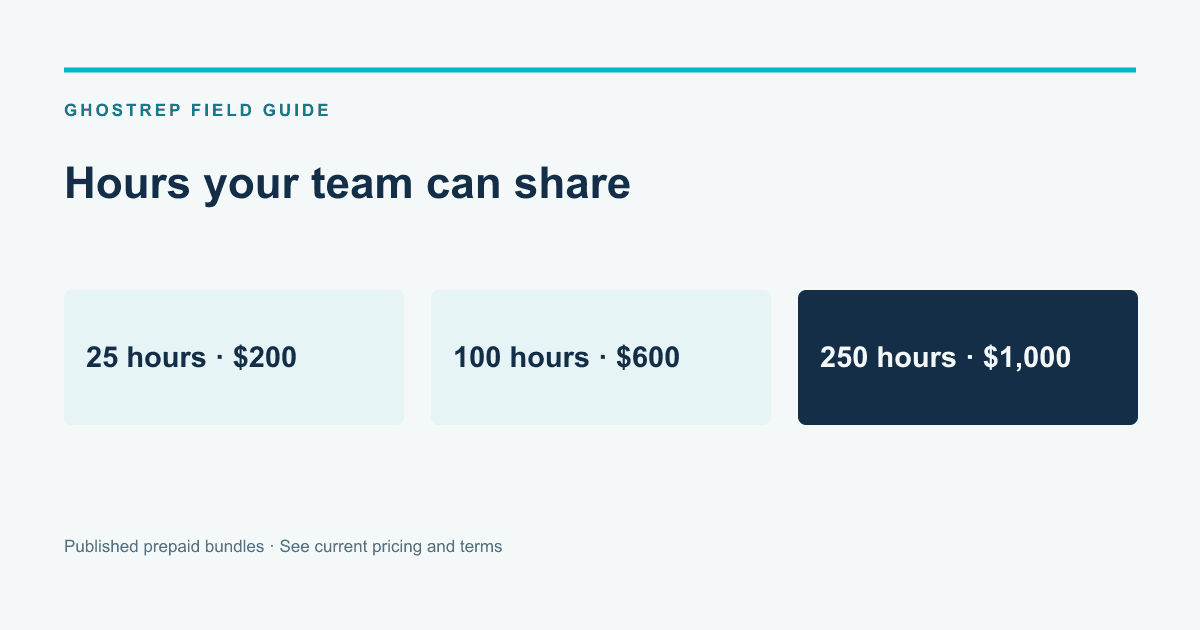
Need more capacity? Buy hour packages (never expire):
- Small: 20 hours - $199 ($9.95/hour)
- Medium: 50 hours - $299 ($5.98/hour) ⭐ Most Popular
- Large: 100 hours - $499 ($4.99/hour) 🔥 Best Value
No demo required. No annual commitment required. No per-user fees. No surprise charges. No bullshit.
That's it. That's the pricing. Now you can make an informed decision without wasting an hour on a call where someone pretends they need to "check with their manager" for a discount that's always available.
The days of needing a boomer in a polo shirt to demo you a product are over.
See the price. Try the product. Make a decision. It's that simple.
If a software company won't show you pricing upfront in 2025, it's because they know you won't like what you see. That's not protecting you—that's protecting them.
Transparency wins. Always.
The GhostRep Advantage
One Platform. Closed Loop System.
Every interaction makes your team better. AI that learns, adapts, and improves with every rep.
Hire
AI screens candidates
Train
1,000+ scenarios
Coach
Real-time guidance
Analyze
AI learns & improves
