A rep can finish every video, ace the product quiz, and still omit a decking allowance while explaining a proposal to a homeowner. Completion proves the lesson played. It does not prove the work transferred.
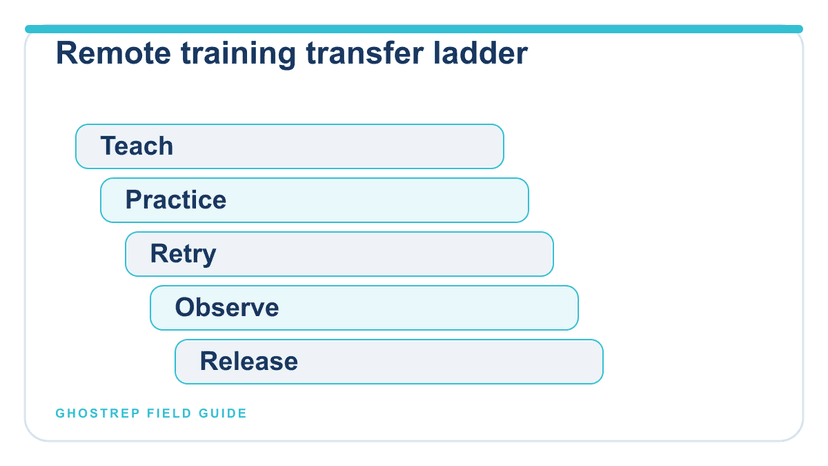
Remote roofing sales training should move through five gates: current reference, short instruction, varied practice, specific retry, and supervised use. The teaching can happen anywhere; responsibility expands only after observed work. This page owns delivery. The remote management guide owns the team once training is underway.
Build the five-layer remote training stack
- Approved reference: the current process, policy, document, or model the rep may rely on.
- Short instruction: what the job is, why it matters, and where authority ends.
- Controlled practice: one behavior across realistic variations.
- Specific feedback and retry: evidence, gap, next action, second attempt.
- Supervised transfer and sign-off: the behavior appears in approved field work and documentation.
OSHA notes that effective education can include on-the-job training and worksite demonstrations, and its safety-management training guidance emphasizes role understanding, hazard recognition, questions, and feedback. OSHA has also explained that computer-based training may need qualified-trainer access and sufficient hands-on experience for applicable safety requirements. A sales curriculum does not replace required safety training, site-specific instruction, or hands-on demonstration.
A four-week remote delivery sequence
| Week | Remote work | Live practice | Observed field work |
|---|---|---|---|
| 1: Role and boundaries | Customer journey, approved sources, CRM workflow, safety and escalation | Explain the process and complete synthetic records | Manager verifies knowledge; no field authorization implied |
| 2: First contact | Permission, discovery, company identity, next-step options | Doorstep, phone, and inquiry-response scenarios | Observed mock block or supervised contact |
| 3: Inspection and proposal handoff | Scope anatomy, documentation, role boundaries, customer update | Photo review, proposal navigation, scope-comparison role play | Qualified owner observes required technical or field tasks |
| 4: Variation and transfer | Objections, follow-up, service escalation, record quality | Mixed scenarios with delayed feedback and retry | Manager records release, restriction, or next practice by responsibility |
This is a delivery pattern, not a promise that every rep becomes independent in four weeks. The 30-day roofing onboarding plan owns the broader calendar and access gates.
Design every remote module around a job decision
A module should answer six questions:
- What must the rep be able to do?
- Which approved source governs the task?
- What does acceptable behavior look like?
- What boundaries or escalation triggers apply?
- How will the rep practice and retry?
- What evidence and observer determine the next access level?
For example, “learn financing” is too broad. A bounded module might ask the rep to locate the current approved financing handoff, explain what the contractor may and may not represent, respond to an unapproved rate question by escalating, and record the customer’s requested next step.
The roofing sales training library explains how to govern source material. The custom AI training program shows how to convert those sources into versioned scenarios and calibrated rubrics.
Use a remote weekly rhythm
- Monday: manager assigns one priority skill from current evidence.
- Tuesday: rep retrieves the approved reference and completes a baseline attempt.
- Wednesday: manager or calibrated system identifies evidence, gap, and retry action.
- Thursday: rep retries in a varied scenario and applies the skill in approved supervised work.
- Friday: manager reviews practice and observed field work, then records pass, restriction, retry, or escalation.
The cadence should adjust to role, weather, territory, experience, lead flow, accessibility, and risk. Do not schedule observed field work merely to satisfy a calendar if conditions are unsafe or the required observer is unavailable.
Remote module: explain a written scope
One remote module from instruction to sign-off
- Name the job: explain included work, the decking allowance, exclusions, and the next decision from the controlling proposal.
- Freeze the sources: proposal v6, product-option sheet, warranty reference, and escalation list.
- Capture the baseline: the rep skips the decking allowance and incorrectly describes all wood as included.
- Coach the exact miss: at 04:12 the rep leaves the controlling document; the retry action is to point to the allowance before explaining it.
- Change the scenario: a new homeowner asks whether “all wood is covered”; the rep must identify the allowance and keep final quantity unknown.
- Earn the remote pass: the behavior appears across three varied proposals without invented terms.
- Observe transfer: a manager watches one virtual or in-person proposal review and checks the resulting CRM disposition.
- Release narrowly: supervised proposal explanation is approved; price changes remain restricted.
Use several practice formats
Manager-led role play
Best for live interruption, immediate clarification, and judgment-heavy situations. Give the manager the homeowner facts and stop conditions; give the rep only what the role would know.
Peer practice
Useful when a short rubric and model answer exist. Rotate roles and require the observer to quote evidence instead of scoring personality.
AI role play
Useful for availability and controlled variation. Managers must approve the scenario, sources, prohibited claims, rubric, and field gate. The role-play scenario generator can draft the exercise; AI output remains simulation evidence, not a source of company truth or an employment decision.
Artifact review
Have the rep produce a CRM record, proposal recap, appointment confirmation, handoff, or inspection-summary draft from synthetic facts. Artifact quality often exposes gaps that a smooth role play hides.
Calibrate remote reviewers
Reviewers should score the same sample independently, quote evidence, compare disagreements, and revise vague anchors. Save examples of a pass, near pass, and critical miss. Repeat calibration after policy, rubric, or platform changes.
Score factual accuracy, discovery before recommendation, plain-language explanation, technical and insurance boundaries, CRM documentation, voluntary next steps, professional response to rejection, and escalation when authority ends. Do not score accent, webcam setup, home environment, perceived enthusiasm, or sales personality unless a lawful, job-related standard has been established and reviewed.
Manager sign-off by responsibility
Release responsibilities one at a time
Inquiry response
- Evidence: Three accurate synthetic records and one supervised live response
- Decision: Released
Proposal explanation
- Evidence: Remote practice passed; field observation passed with manager present
- Decision: Released with current proposal only
CRM documentation
- Evidence: Two records omitted customer-selected time
- Decision: Retry; manager checks next three
Roof access
- Evidence: No hands-on safety or site-specific sign-off in this program
- Decision: Not authorized
Insurance coverage discussion
- Evidence: Outside rep authority
- Decision: Escalate
Plan for privacy and accessibility
Decide what may be recorded, the approved purpose, notice and consent, storage, access, correction, export, and deletion. Use synthetic or de-identified practice data when it can meet the objective. Provide captions, transcripts, keyboard access, readable documents, and reasonable accommodation paths. Have qualified owners review employment and recording practices.
Measure learning and transfer separately
Completion is an operations metric. Learning measures include repeated critical misses, successful retries, manager agreement, and retention checks. Transfer measures include observed field behavior, record quality, safe escalation, and customer handoff. Business outcomes such as close rate and revenue are influenced by lead source, territory, season, pricing, and manager support; do not attribute them to remote training without a credible design.
Frequently asked questions
Can roofing sales training be fully remote?
Instruction and much practice can be remote. Safety, equipment, property access, inspection, and other field responsibilities may require site-specific, hands-on, and qualified observation.
What tools are needed?
A versioned source library, video or audio communication, role-play capability, artifact sharing, a reliable CRM, and a manager-owned sign-off record are enough to begin. Tool count matters less than a connected review path.
How do managers know a remote rep is ready?
Define the responsibility, require accurate performance across meaningful variations, observe transfer in approved work, and record what is released and what remains restricted.
Remote delivery still needs field proof
Remote roofing sales training succeeds when approved knowledge becomes practiced behavior and practiced behavior becomes supervised observed field work. Teach less at once, require better proof, and release responsibility one observable gate at a time.
Free tools for sales managers
Turn this into a manager workflow
Use free management and operations tools to turn coaching ideas into repeatable systems for your reps and managers.
Management tools
Use 1-on-1 scripts, meeting agendas, forecast templates, and escalation tools.
Browse management tools →Operations tools
Build scorecards, SOPs, pipeline templates, and review workflows your team can run every week.
Browse operations tools →AI Sales Coach
Give reps coaching based on real performance data instead of waiting for the next ride-along.
See AI Sales Coach →About the Author
Tim Nussbeck
Founder & CEO of GhostRep
20+ years in roofing and home improvement sales—knocking doors, running teams, and building practical coaching systems. Built GhostRep to give every rep access to the coaching top teams get.
Manager next step
Turn this into a manager workflow your team can repeat
Use the management tools if you need a practical coaching or accountability system first. Book a walkthrough if you want GhostRep tied to rep performance and live coaching.
- ✓Best fit if coaching is inconsistent across reps and managers.
- ✓Useful for 1-on-1s, scorecards, and weekly operating rhythms.
- ✓Demo shows how AI Sales Coach turns performance data into specific guidance.
Start Here
Browse management tools
Open scorecards, coaching docs, forecast templates, and manager workflows.
Browse management toolsNeed it mapped to your team?
Talk through your current workflow, traffic mix, and where GhostRep fits before you change anything.
Book a 15-minute walkthroughYou Might Also Like
Use this roofing sales call review cadence to sample the right conversations, protect manager time, coach one behavior, and track weekly follow-through.
Read article →See seven useful AI sales manager workflows for roofers, what AI should never own, and a practical pilot and buyer checklist.
Read article →Use a 30-day roofing sales onboarding calendar with safety gates, field practice, role play, coaching evidence, and weekly manager decisions.
Read article →