Your sales manager is sitting in the conference room right now with three new reps.
He's on Hour 6 of teaching them how to handle the "my neighbor paid less" objection. One rep gets it. Two don't. He'll repeat this same training tomorrow with the next batch.
Meanwhile, your competitor's new hires are running through their 50th practice scenario today—alone, with AI—while their manager is out fixing pipeline problems and coaching existing reps.
📊 The Cost Everyone Ignores
Most roofing owners compare training by platform price. $6,000 annually for virtual AI training versus $0 for having your manager train reps in the office.
Seems obvious. Use your manager. It's free.
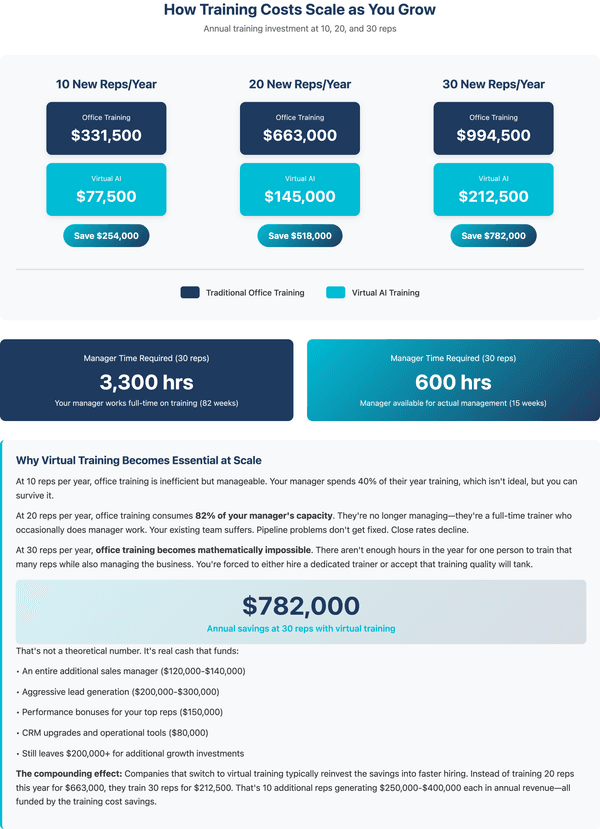
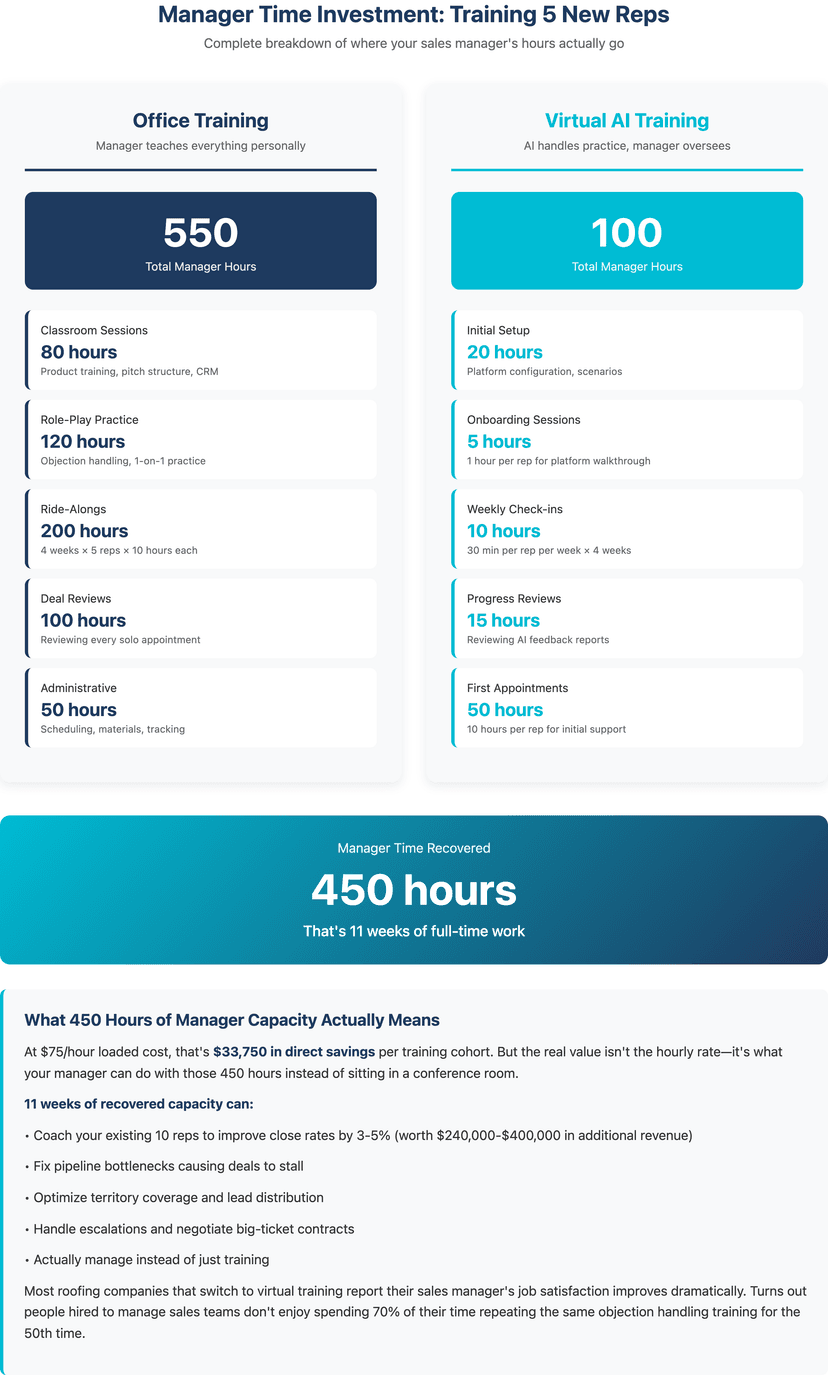
Except it's not free. Your manager costs $75-$100 per hour loaded. And traditional office training burns 550 hours of manager time per cohort of five reps.
That's $41,250-$55,000 in opportunity cost before you count the extended ramp time, the limited practice capacity, and the fact that your manager isn't doing their actual job while they're teaching.
Virtual AI training? Your manager spends 100 hours total on setup and check-ins. The AI handles the 450 hours of repetitive objection practice.
Savings: $33,750-$45,000 in recovered manager capacity. Per training cohort.
⏱️ Speed: The 63-Day Revenue Gap
Traditional in-house training follows a predictable timeline:
Weeks 1-2: Classroom sessions in the office. Product knowledge. Pitch structure. CRM training. Reps sit and listen while your manager talks.
Weeks 3-6: Ride-alongs. Manager accompanies each rep to 3-5 appointments per week. Five reps × 4 weeks × 4 appointments = 80 ride-alongs your manager has to personally attend.
Weeks 7-10: Supervised solo appointments. Reps go alone but manager reviews every deal. Still heavy oversight.
Week 11+: Finally productive independently.
Total timeline: 11-13 weeks until a rep is closing deals without constant manager involvement.
Virtual AI training compresses this timeline dramatically:
Week 1: New hire completes 80-100 objection scenarios with AI. Gets real-time feedback. No waiting for manager availability.
Weeks 2-3: Rep accumulates 200-300 total practice conversations. Patterns start clicking. Confidence builds.
Week 4: Rep goes to field with Ghost Rep Bluetooth coaching for live support. Manager spot-checks, doesn't babysit.
Total timeline: 4-5 weeks until productive.
That 63-day gap matters. According to NRCA data on storm restoration revenue cycles, 60% of storm jobs get signed in the first 45 days after a weather event.
If your training takes 90 days, you're watching revenue evaporate while your reps learn.
💰 The Hidden Costs of Office Training
Manager Opportunity Cost: $41,250 per cohort
Your sales manager earns $120,000-$140,000 annually because they're supposed to be:
- Coaching your existing team to improve close rates
- Fixing pipeline bottlenecks
- Optimizing territory coverage
- Handling escalations and big-ticket negotiations
When they're spending 550 hours training new reps, none of that happens.
The math: $75/hour × 550 hours = $41,250 of manager capacity you're burning on repetitive training tasks an AI can handle.
Extended Draw Period: $20,000 per cohort
Traditional training: 11 weeks to productivity × $1,000/week draw × 5 reps = $55,000 in draw pay before first commission check.
Virtual training: 4 weeks to productivity × $1,000/week draw × 5 reps = $20,000 in draw pay.
Savings: $35,000 per cohort just from getting reps productive 7 weeks faster.
Existing Team Neglect: Unquantified but Real
While your manager is stuck in the office training new hires, your existing reps aren't getting coached. According to research from the Sales Management Association, sales teams that receive regular coaching show 17% higher productivity than those who don't.
Your 10 existing reps each closing $400,000 annually could be closing $468,000 with proper coaching. That's $680,000 in missed revenue because your manager is too busy training.
🎯 Practice Volume: The Real Performance Driver
Here's what kills office training: limited practice capacity.
Your manager can only role-play with one rep at a time. In a training session with five reps, each person gets maybe 4-5 practice conversations. The other four sit and watch.
Accumulated practice scenarios by Week 4:
- Traditional office training: 65-80 scenarios per rep
- Virtual AI training: 350-400 scenarios per rep
That's not a 2x difference. It's a 5x practice volume gap.
Your top performer didn't get good by watching other people practice. They got good by having 500+ real conversations and learning what works. Virtual training with Objection Mastery simulates those 500 conversations in 6 weeks instead of 6 months.
According to research from the ATD (Association for Talent Development), skill mastery requires 20-30 repetitions of a specific pattern before responses become automatic.
A rep who's practiced "neighbor paid less" 40 times responds naturally. A rep who's practiced it 6 times freezes and starts rambling about shingle warranties.
🏢 When Office Training Still Works Better
Virtual AI training dominates on cost and speed. But there are scenarios where in-person office training still has advantages:
Teaching Complex Visual Concepts: How to spot hidden hail damage, photograph documentation for supplements, or explain proper ventilation. These work better when your manager can physically point at a roof.
Solution: Use virtual AI for conversation practice (300+ scenarios). Use office time for 10-15 hours of visual technical training.
Building Initial Company Culture: Your first 10-15 reps benefit from meeting each other and understanding your company's positioning.
Solution: 2-day in-person orientation to cover culture, then virtual AI for 4 weeks of skill development.
Reps Who Need External Accountability: Some people won't practice without someone watching.
Solution: Track practice completion daily. Reps who won't put in 20+ scenarios in Week 1 probably won't knock 100 doors per week either. Cut them early.
📈 The Scaling Problem That Forces the Switch
Most roofing companies switch to virtual training when they hit 10-15 active reps and realize the math stopped working.
Scenario: You're scaling from 10 reps to 25 reps this year
Traditional office training:
- 15 new hires ÷ 5 per cohort = 3 training cohorts
- 550 manager hours × 3 cohorts = 1,650 hours (41 weeks of full-time work)
- Your sales manager literally cannot do their actual job
- Cost: $123,750 in manager opportunity cost
- Plus: $105,000 in extra draw pay from extended ramp times
Virtual AI training:
- All 15 reps train simultaneously (no batching required)
- 100 manager hours × 3 cohorts = 300 hours (7.5 weeks)
- Manager still has 34 weeks to do actual management work
- Cost: $22,500 in manager time + $11,000 platform fee
- Plus: $45,000 in draw pay (7 fewer weeks per rep)
Total savings: $150,250 on one year of scaling.
That pays for an entire additional sales manager.
🔍 Performance: Do AI-Trained Reps Actually Close Deals?
The skepticism is understandable. "How can someone practicing alone with an AI learn better than spending 8 weeks with my best closer?"
The data shows something unexpected.
Traditional office training produces 23% information retention after 90 days, according to Corporate Visions research on sales training effectiveness. Most of what your manager teaches in Week 1 is forgotten by Week 12 because reps were passively listening, not actively practicing.
Virtual practice-based training produces 67% skill retention because reps aren't memorizing—they're building muscle memory through repetition.
Close rate comparison at 90 days:
- Office-trained reps: 24-27% average close rate
- AI-trained reps: 25-28% average close rate
- Top performers (both methods): 32-35%
By Month 6, performance is statistically identical. The ROI advantage comes from:
- 7 weeks faster ramp = 7 additional selling weeks in Year 1
- $33,750 recovered manager time = Manager fixing real problems
- 5x more practice volume = Confidence that shows on appointments
🚀 What It Actually Takes to Switch
Week 1: Platform Setup (8 hours)
- Configure practice scenarios for your pitch
- Customize objection library for your market
- Set up manager dashboard
Week 2-3: Pilot Program (2 new hires)
- Run 2 reps through virtual program
- Compare to recent office-trained cohort
- Gather feedback and adjust
Week 4+: Full Deployment
- All new hires use virtual AI training
- Maintain 2-day orientation for culture
- Track metrics: time to first close, 90-day close rates
Most roofing companies see positive ROI within the first cohort. The manager time savings alone cover the annual platform cost.
⚠️ Where Virtual Training Fails
Low Self-Motivation Reps: If someone won't practice without constant supervision, virtual training tanks. Office training forces practice because the manager is standing there. Track practice volume daily—reps who won't put in 20+ scenarios Week 1 probably won't knock 100 doors per week either.
Complex Technical Deep Dives: Teaching concealed hail damage diagnosis or attic ventilation physics works better in person with visual aids. Use virtual for conversation skills (300+ scenarios), use office time for 10-15 hours of technical training.
Immediate Error Correction: A manager standing next to a rep can interrupt mid-sentence: "Stop. Don't use 'obviously.' Sounds condescending." Virtual requires reviewing recorded feedback after. Solution: First field appointment uses Ghost Rep Bluetooth coaching for real-time intervention.
💡 Real Company Example
Storm Restoration Contractor - Texas (18 active reps)
Before virtual AI:
- Manager spent 550 hours per cohort = $93,500 opportunity cost for 2 cohorts
- Manager burned out, quit in July
- Existing team performance dropped 12% during training
After virtual AI:
- Manager spent 100 hours per cohort = $17,000 total
- Savings: $76,500 in manager capacity
- Existing team improved 6% (manager available for coaching)
- All 8 hires productive by Week 5 vs Week 11
Total first-year impact: $76,500 direct savings + $312,000 from 6 weeks faster ramp + $120K avoiding manager replacement = 3,540% ROI on $11,000 platform investment.
❓ Frequently Asked Questions
How much manager time does virtual training actually require?
Approximately 100 hours for a cohort of 5 reps over 4 weeks:
- Initial platform walkthrough: 1 hour per rep = 5 hours
- Weekly progress check-ins: 30 min per rep per week = 10 hours
- Reviewing AI feedback reports: 15 hours total
- First field appointment support: 10 hours per rep = 50 hours
- Setup and configuration: 20 hours
Compare this to 550 hours for traditional office training of the same cohort.
Do reps trained virtually perform as well as office-trained reps?
After 6 months, close rates are statistically identical (27-30% for both groups). The difference is speed to competency.
Virtual-trained reps hit 25% close rates in Week 5-6. Office-trained reps hit 25% close rates in Week 11-13. By Month 6, both groups are at 28-30%.
The ROI comes from those 6-7 extra selling weeks, not from superior long-term performance.
Can virtual training handle storm season hiring surges?
Yes—this is where virtual training dominates. You can onboard 15 reps simultaneously without waiting for manager availability or coordinating schedules.
Office training requires batching. You can't realistically train more than 5 reps at once because your manager only has two hands. Virtual training scales to n=1 instantly.
What if reps don't do the practice on their own?
Valid concern. Virtual training requires intrinsic motivation. Some reps won't practice without someone watching.
Track practice completion in your manager dashboard. If a rep completes fewer than 20 scenarios in Week 1, that's a red flag. Address it immediately or cut them. Office training doesn't solve the motivation problem—it just delays the discovery.
How long does it take to see ROI?
Most companies break even within the first cohort of 3-5 reps. The manager time savings ($33,750) alone cover the annual platform cost ($6,000-$11,000).
For companies hiring 10+ reps annually, ROI appears in 60-90 days. The faster ramp time means reps generate revenue 6-7 weeks earlier than office training.
Can you still do some in-person training with virtual?
Absolutely. The hybrid model works well: 2-day in-person orientation for culture/CRM/logistics ($2,500 per cohort), then 4-week virtual AI practice for objections (included in platform), plus ongoing Ghost Rep Bluetooth coaching on live appointments. This delivers 85-90% of virtual's ROI while maintaining cultural connection.
What's the realistic cost for a company with 15-20 active reps?
Virtual AI training: $8,000-$11,000 annually (unlimited users)
Traditional office training: $185,000-$215,000 annually (manager time $165,000 + extended draw $20,000-$50,000)
The cost gap is 17-27x at this team size. Virtual pays for itself in the first cohort.
🎯 Bottom Line: Office Training Doesn't Scale
Use office training if:
- You're hiring fewer than 5 reps per year
- Your manager has unlimited time capacity
- Your training needs are primarily technical/visual
- Your reps need constant external accountability
Switch to virtual if:
- You're hiring 8+ reps annually
- Your manager is drowning in training responsibilities
- You need to deploy trained reps quickly (storm season)
- Your bottleneck is manager time, not budget
- You're scaling and need practice capacity beyond one person
For most roofing companies growing past 12-15 active reps, the math forces the switch. Your sales manager simply cannot spend 1,650 hours per year training while also doing their actual job.
The $150,000-$180,000 annual savings from switching to virtual training funds an entire additional sales manager. Or 6 months of aggressive lead generation. Or pay raises for your top performers.
Your competitors are making this switch right now. The question isn't whether virtual training works—it's whether you can afford to keep burning manager time on repetitive training tasks that AI handles better.
Ready to free up 450 hours of manager time per cohort? GhostRep's AI Role Play handles unlimited practice scenarios while your manager focuses on coaching and closing deals. Learn more about how AI-powered training outperforms traditional methods with detailed performance data.
Free tools for sales managers
Turn this into a manager workflow
Use free management and operations tools to turn coaching ideas into repeatable systems for your reps and managers.
Management tools
Use 1-on-1 scripts, culture playbooks, forecast templates, and escalation tools.
Browse management tools →Operations tools
Build scorecards, SOPs, pipeline templates, and review workflows your team can run every week.
Browse operations tools →AI Sales Coach
Give reps coaching based on real performance data instead of waiting for the next ride-along.
See AI Sales Coach →About the Author
Tim Nussbeck
Founder & CEO of GhostRep
Two decades in roofing—knocking doors, running teams, training 1,000+ reps. Built GhostRep to give every rep access to the coaching top teams get.
Manager next step
Turn this into a manager workflow your team can repeat
Use the management tools if you need a practical coaching or accountability system first. Book a walkthrough if you want GhostRep tied to rep performance and live coaching.
- ✓Best fit if coaching is inconsistent across reps and managers.
- ✓Useful for 1-on-1s, scorecards, and weekly operating rhythms.
- ✓Demo shows how AI Sales Coach turns performance data into specific guidance.
Start Here
Browse management tools
Open scorecards, coaching docs, forecast templates, and manager workflows.
Browse management toolsNeed it mapped to your team?
Talk through your current workflow, traffic mix, and where GhostRep fits before you change anything.
Book a 15-minute walkthroughYou Might Also Like
What an AI sales manager should do for roofing companies: live coaching, call review, rep prioritization, playbook enforcement, and manager leverage.
Read article →Use this 30-day roofing sales onboarding plan to ramp new reps faster with scripts, role play, field practice, live coaching, and manager feedback.
Read article →Your rep closes 18% when the team average is 32%. Before you fire him, run this 5-step PIP for roofing sales managers.
Read article →