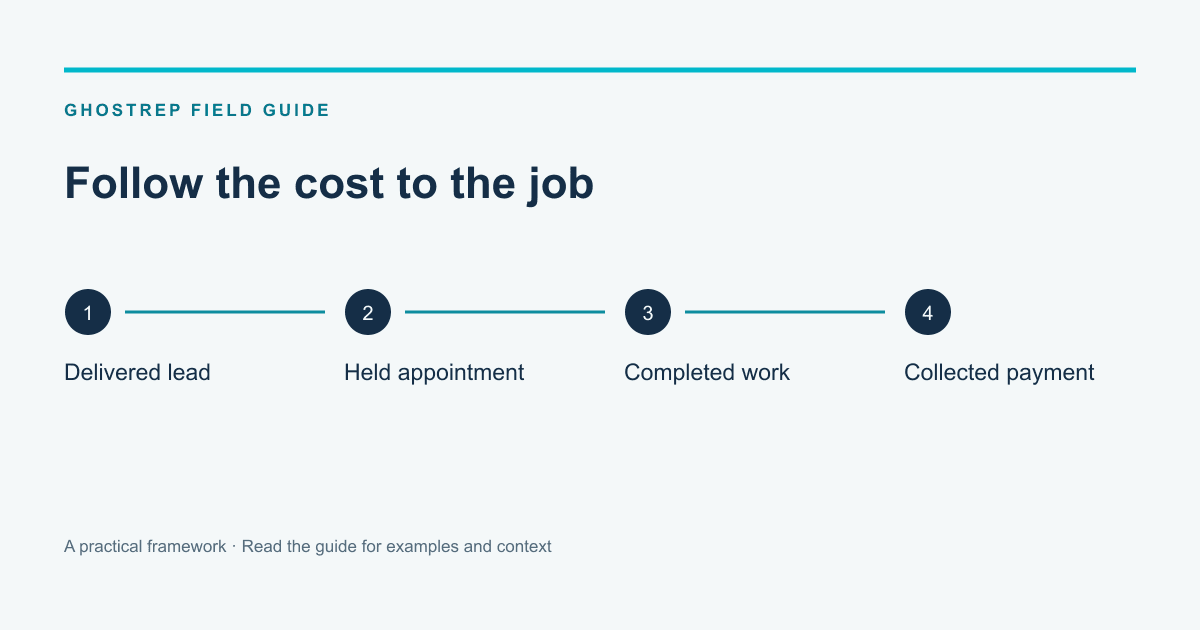
Angi roofing leads are worth evaluating through your own delivery records, costs and completed jobs. A low quoted price per lead does not establish a low cost to acquire a customer. Equally, an expensive unsuccessful lead does not establish how a whole program will perform.
Start with the current offer for your services and area. Angi’s lead and opportunity documentation explains that homeowners can connect with professionals through different lead and opportunity paths. Confirm the specific product and terms you are considering rather than assuming every Angi inquiry follows one model.
If you are comparing marketplace offers, the Angi and HomeAdvisor guide explains how to identify the product and agreement behind the name.
Next Step
Check the alternatives while Angi is still on your mind
Searchers comparing Angi are usually comparing cost, speed, and whether the economics beat other channels. Give them that path immediately.
Define the work you want before accepting more volume
A repair inquiry, a replacement estimate and an emergency request require different capacity. Specify which work your team can serve, where it can travel and when someone can respond. Keep the service mix visible in the evaluation.
Ask for the current written pricing, billing rules, lead information, credit process and commitment. Establish how settings can be changed and what happens to charges when a lead is disputed. Use the actual agreement for your account; this article does not supply a universal Angi lead price.
Track the whole path to a collected job
Create a source record for each delivered opportunity. Keep the acquisition date, service requested, market, charge and any approved credit. Record whether the company reached the customer, booked an appointment, completed the inspection, sold the work, completed it and collected payment.
Do not delete unsuccessful or disputed leads from the denominator. They are part of the cost of the test. Keep open outcomes visible so an early report does not treat pending work as a win or loss prematurely.
The lead economics measurement standard provides a field dictionary and workbook for that chain. Use the same definitions when comparing Angi with another source.
A transparent cost example
These numbers are illustrative, not Angi pricing or a roofing benchmark. Suppose a company spends $2,000 on a defined group of leads after approved credits and assigns $800 of additional sales-handling cost to that group. Total acquisition cost is $2,800.
| Completed and collected jobs | Total acquisition cost | Cost per collected job |
|---|---|---|
| 2 | $2,800 | $1,400 |
| 4 | $2,800 | $700 |
| 7 | $2,800 | $400 |
The table shows why the same spending can produce different economics. It does not predict which result your team will achieve. Compare acquisition cost with the contribution from those jobs, including the delivery costs you have chosen to measure.
For a deeper model, use the roofing lead cost calculator. Keep booked appointments, signed work and collected jobs separate throughout the calculation.
Separate repair and replacement results
Do not assume repair work always has a particular margin or that a fixed share of repair customers will buy a replacement later. Record the actual work and costs. If a repair customer returns for a replacement, link the later job to the record without counting projected future revenue as already earned.
This separation helps explain what the source is providing. It may produce useful small jobs but fewer replacement consultations than expected. The decision should reflect that observed mix and your capacity to serve it.
Next Step
Compare paid lead platforms against true lead cost
The right comparison is not Angi versus zero. It is Angi versus every other path to a booked, profitable roofing job.
Review the first response and handoff
A lead can fail after delivery because the company did not reach the customer, misunderstood the request or booked an appointment the field team could not support. Review the actual contact attempts and receiving records.
Choose a named owner for incoming inquiries. Make the service area, available appointment process and escalation path clear. Use the first-response guide to check whether the information reaches the right person. A faster reply is useful when it leads to an accurate conversation, not merely a logged attempt.
Listen to the appointment before blaming the source
A customer who requested help can still leave an appointment confused about scope or next steps. Review a sample of conversations where appropriate. Identify whether the rep understood the customer’s question, explained the proposal and agreed on the follow-up.
Echo can support that review and live coaching in the field. It does not change the lead supplier’s terms or guarantee that an inquiry will become a job. Use the conversation evidence to separate qualification, scheduling and sales-explanation problems.
Run a bounded test
Choose one service mix and area, a spending limit and an evaluation period. Keep staffing and handling practices stable enough to understand the result. Record any changes, including a storm, staffing shortage or adjustment in the services accepted.
Review billing disputes and open outcomes during the test. At the end, allow enough time for the relevant jobs to complete and collect, or label the result preliminary. Compare the same kind of work from another source when possible.
Next Step
Move from review content into a decision tool
If the question is still whether Angi deserves budget, the next step should be job-level ROI math, not more generic lead opinions.
Decide whether to continue, revise or stop
Continue when the completed-job economics, service mix and operational demands fit your business. Revise the settings or process when the evidence points to a specific correctable problem. Stop when the current offer and observed results do not support the cost or workload.
Avoid scaling simply because the team had one strong week. Keep the original assumptions and actual results together so the next decision can be explained.
Are Angi leads shared?
Confirm the distribution and connection model for the product offered to your account. Angi documents several ways homeowners and professionals connect; use the current written terms rather than a blanket assumption.
What is a good cost per lead?
It depends on the work, handling costs, conversion to completed jobs and job contribution. A lead price alone is insufficient to decide whether the channel works for your company.
Should a roofing company use only one source?
Compare the actual economics and operational demands of each source. The lead-channel guide can help organize the decision without assuming one channel wins everywhere.
Free lead-generation resources
Turn traffic strategy into pipeline actions
Use free marketing and field tools to turn website, referral, and follow-up ideas into lead flow your reps can actually work.
Marketing tools
Generate ad copy, email sequences, company bios, and lead-conversion messaging for your market.
Browse marketing tools →Field sales tools
Create follow-up assets, texts, and homeowner-facing copy once a lead is already in motion.
Browse field sales tools →Job Intel
Give reps better customer context before the follow-up so lead quality is easier to convert.
See Job Intel →About the Author
Tim Nussbeck
Founder & CEO of GhostRep
20+ years in roofing and home improvement sales—knocking doors, running teams, and building practical coaching systems. Built GhostRep to give every rep access to the coaching top teams get.
Lead-gen next step
Turn traffic into pipeline math before you buy more leads
Start with the ROI calculator or lead-generation tools if you are still diagnosing the economics. Book a walkthrough if you want GhostRep tied to lead handling, follow-up, and close-rate lift.
- ✓Best fit if traffic is arriving but too little of it turns into revenue.
- ✓Useful for modeling conversion lift before you increase spend.
- ✓Demo shows how field execution and coaching change lead economics after the click.
Start Here
Model your conversion lift
Estimate what more leads, better close rates, and faster rep ramp are worth in revenue.
Model your conversion liftNeed it mapped to your team?
Talk through your current workflow, traffic mix, and where GhostRep fits before you change anything.
Book a 15-minute walkthroughYou Might Also Like
Angi and HomeAdvisor share a parent. Compare published lead-sharing and credit terms, account fees, renewal risks, and a free contractor offer worksheet.
Read article →Enter your local HomeAdvisor lead quote, contact rate, held inspections, sold jobs, labor, and gross profit to plan a controlled roofing lead pilot.
Read article →Compare roofing SEO and Google Ads using fully loaded spend, qualified leads, signed and completed jobs, gross profit, cost per job, and true ROI.
Read article →