Short answer: A company cannot choose 1099 status merely because a rep is commission-only or agrees to the label. First document how the relationship actually works. Then have a qualified payroll, tax, or employment-law advisor apply every relevant federal, state, and local test. Only after classification should you design the pay plan.
Scope: This guide is educational, not legal or tax advice. It does not score, diagnose, or determine any worker's status.
For a roofing owner, “W2 or 1099?” often sounds like a cost question. One column has payroll taxes, insurance, tools, and perhaps benefits. The other appears to have a commission check and little else.
That comparison starts in the wrong place. W-2 and 1099-NEC are reporting forms. They are not two compensation packages a company can freely offer for the same working relationship. The facts of the relationship come first.
A rep may sign an independent-contractor agreement and still be an employee under an applicable law. A rep may also work remotely, set some hours, or receive no benefits without becoming an independent contractor. The IRS says the substance of the relationship, not the contract label, controls.
Next Step
Use the matching hiring and comp tools
If you are reworking rep classification or role design, start with the exact documents and operating templates tied to that decision.
W2 vs 1099 Roofing Sales: The Operating Differences
| Question | Employee relationship | Independent business relationship |
|---|---|---|
| Who directs the work? | The company may direct how, when, and where sales work is performed. | The business generally controls its own methods; the customer specifies the result. |
| Who bears business risk? | The employer ordinarily bears the operating risk and provides the system in which the rep works. | The independent business may invest, incur unreimbursed business expenses, serve other customers, and realize profit or loss through managerial decisions. |
| Who handles taxes? | The employer generally withholds applicable payroll taxes and reports wages on Form W-2. | A self-employed contractor generally handles its own tax obligations; qualifying payments may be reported on Form 1099-NEC. |
| Who supplies the operation? | The company often supplies leads, pricing authority, CRM, training, brand, and production handoff. | The business may bring its own methods, tools, market presence, and capacity to perform for multiple customers. |
| Benefits and protections | Applicable wage-and-hour, unemployment, workers' compensation, leave, and benefit rules depend on the jurisdiction and plan. | The business generally arranges its own benefits and insurance. Calling a worker a contractor does not waive laws that actually apply. |
| Commission design | A commission plan must still comply with applicable wage, overtime, deduction, and payment-timing rules. | Contract payment terms still do not decide worker status or override applicable law. |
These are operational contrasts, not a status test. A single fact rarely settles the question, and different laws can reach different answers.
In practical terms, a roofing sales role can look more employee-shaped when the company supplies the leads and sales system, sets price and territory, trains the method, requires ongoing CRM and meeting routines, and expects the rep to perform the company's core sales work indefinitely. A relationship can look more independent-business-shaped when the seller markets to multiple customers, controls its methods and commercial decisions, makes meaningful investments, bears business risk, and is engaged for a defined result. Those descriptions help a manager organize the facts; they are not a classification verdict, and no one should count them as points.
The Three IRS Factor Groups
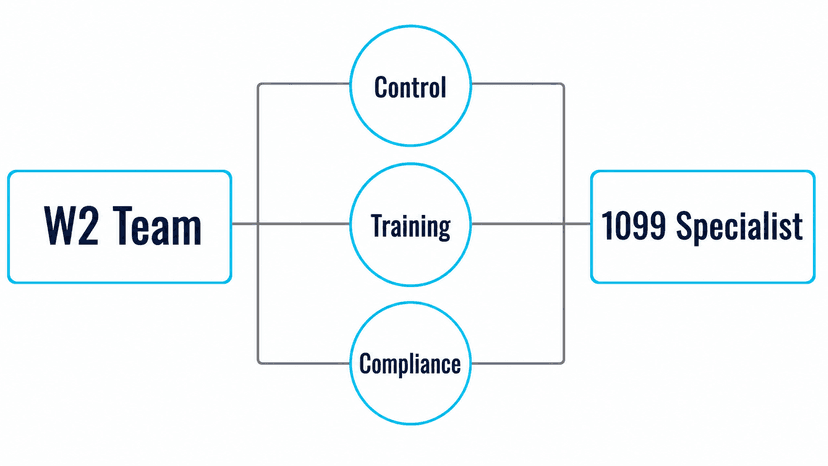
For federal employment-tax purposes, the IRS organizes the evidence into behavioral control, financial control, and the parties' relationship. The agency says there is no magic number of facts that makes a worker an employee or contractor.
1. Behavioral control
Ask who has the right to direct how the rep does the job—not only whether a manager exercises that right every day. Instructions and training can matter.
In a roofing sales operation, document who sets canvassing hours, assigns territories and leads, approves pricing, requires scripts or inspections, mandates CRM steps, reviews calls, and corrects performance. Do not turn that list into a points quiz. The importance of each fact depends on the full relationship.
2. Financial control
Document whether the worker has a meaningful investment, unreimbursed business expenses, an opportunity for profit or loss, and freedom to make services available to the market. Also record how payment works.
Supplying a phone or truck does not decide the case by itself. The more useful question is whether the rep is operating an independent business: finding customers, choosing investments, managing costs, serving other clients, and making decisions that can change profit or loss.
3. Relationship of the parties
Look at the whole arrangement: written agreements, employee-type benefits, expected permanence, and whether the work is a key activity of the company. The IRS cautions that a contract label is not enough and that the absence of benefits does not necessarily indicate contractor status.
A long-running, exclusive relationship selling the roofing company's core service presents different facts from a separate estimating firm engaged for one defined project. Neither description alone produces a legal answer.
The DOL Uses a Different Legal Lens
The Department of Labor analyzes whether a worker is economically dependent on an employer under the Fair Labor Standards Act or is in business for themself. Its Fact Sheet 13 describes six factors in the 2024 regulation: opportunity for profit or loss through managerial skill, investments, permanence, control, whether the work is integral to the business, and skill and initiative. No factor automatically controls.
The current federal picture requires care:
- The 2024 regulation remains the published rule. It uses the six-factor economic-reality analysis.
- DOL enforcement policy changed in May 2025. Field Assistance Bulletin 2025-1 says Wage and Hour Division investigators will not apply the 2024 rule's analysis in current enforcement matters and will instead use earlier principles described in the bulletin. The bulletin says it does not change existing regulations.
- A replacement was proposed in February 2026. The DOL proposal would rescind the 2024 rule and use a different economic-reality framework. As of this article's August 16, 2026 update, it is a proposal—not a final rule.
That moving federal backdrop is one reason a generic online quiz cannot classify a roofing rep. State and local laws may also use stricter or different tests.
A Manager's Fact Inventory Before Calling Counsel
Use these questions to collect evidence, not to generate a verdict. Do not total the answers, assign a color, or treat one “yes” as decisive.
- Schedule and territory: Who decides when and where the rep works? Can the rep accept or decline an assignment?
- Leads and customers: Does the rep find and market to their own customers, or work only company-provided leads under the company's name?
- Price and terms: Who can negotiate price, discounts, scope, financing, and contract terms?
- Sales method: Are scripts, inspections, CRM steps, meetings, ride-alongs, and follow-up sequences optional or required? Who enforces them?
- Training: Is the person bringing an established business method, or being trained to perform the company's method?
- Investment and expenses: Who pays for tools, travel, insurance, marketing, software, helpers, rework, and other operating costs?
- Profit or loss: Can managerial choices—rather than simply working more hours or closing more assigned leads—change the worker's profit or loss?
- Other customers: Is the rep free in practice to advertise and perform similar work for other companies?
- Duration: Is the engagement indefinite or tied to a defined project or result?
- Place in the business: Is selling roofs a central part of what the company sells to customers?
- Benefits and agreements: What do the agreements say, what benefits are offered, and do those documents match daily reality?
- Other laws: Which state and local classification, wage, unemployment, workers' compensation, licensing, and tax rules apply?
Bring the factual record, contracts, pay statements, training materials, CRM requirements, and expense policies to qualified advisors. If federal employment-tax status remains unclear, a business or worker can ask the IRS for a determination using Form SS-8. That process addresses federal employment taxes; it does not replace analysis under every other law.
Compare Economics Only After Classification
Once the relationship has been classified, build a full cost model. Do not compare an employee's loaded cost with only a contractor's commission rate.
For an employee model, budget for the commission or base, employer payroll obligations, applicable insurance and benefits, equipment, lead costs, training, supervision, and ramp time. For an independent business, contract pricing may reflect its taxes, insurance, equipment, marketing, travel, administrative time, and risk. The company may also spend more internally on vendor administration and quality control.
Shifting an expense to a worker does not by itself create independent-contractor status. Likewise, reimbursing an expense does not by itself create employee status. Expenses are facts within a wider analysis.
Once an advisor has confirmed the worker model, use the roofing sales rep cost and break-even model to estimate the company's fixed seat cost, variable commission, ramp cash, and completed-and-collected job requirement.
For market pay and role-level context—not classification—see how much roofing sales reps make.
Build the Commission Plan Around the Real Payment Event
“Sold,” “installed,” and “collected” are not interchangeable. A signed $20,000 contract may cancel. The completed scope may change through supplements or change orders. A finished job may still have an unpaid balance. A written plan needs to define both its calculation basis and the business milestone it proposes for payment.
Before publishing a plan, settle these operating questions with payroll and counsel:
- Is commission calculated from contract revenue, collected revenue, or defined gross profit?
- Which job costs enter a gross-profit calculation, and when are those costs final?
- How are approved, completed, and collected supplements or change orders treated?
- What happens when a customer cancels, financing fails, scope shrinks, or payment arrives late?
- When is commission legally earned, when is it paid, and which adjustments or deductions are permitted in each applicable state?
- Do tier thresholds use booked contracts, completed production, collections, or another clearly defined basis?
The roofing sales commission plan builder can turn your job size and margin assumptions into a draft with a worked example. It is a planning handoff, not a classification or wage-law tool; have qualified advisors review the result before use.
Four Shortcuts That Do Not Resolve Status
“Commission-only means contractor”
Pay method and worker classification are separate questions. Commission-only pay does not establish independence, and employee commission plans still must comply with applicable wage-and-hour rules.
“The contract says 1099”
The IRS and DOL look beyond the label. A well-drafted agreement should match the real operation; it cannot reverse contrary facts.
“They set their own hours”
Schedule freedom is one fact. Pricing authority, training, investment, customer source, permanence, business risk, and the rest of the relationship still matter.
“We do not offer benefits, so they are a contractor”
The IRS expressly says the absence of employee-type benefits does not necessarily mean independent-contractor status.
Bottom Line
Do not pick a tax form to hit a labor-cost target. Write down how the roofing sales role actually operates, apply every relevant legal test with qualified advisors, and make the agreement match reality.
Then design compensation from the correct economic events: the defined commission basis, completion status, collections, supplements, job costs, and the point at which commission is legally earned and payable. Classification first. Pay-plan math second.
Next Step
Turn the rep model into a trackable ramp
Whether the rep is W2 or 1099, the next problem is the same: define expectations, score the early work, and train before bad habits set in.
Frequently Asked Questions
Can a roofing company choose W2 or 1099 for a sales rep?
Not simply by preference or agreement. Classification depends on how the relationship actually works under the federal, state, and local laws that apply. Document the facts and obtain qualified advice before selecting the reporting and payroll treatment.
Does commission-only pay make a roofing rep a 1099 contractor?
No. The method of pay does not determine worker status. A commission-only worker may still be an employee, and applicable wage, overtime, deduction, and payment rules still need review.
What does the IRS look at for employee versus contractor status?
For federal employment taxes, the IRS groups evidence into behavioral control, financial control, and the type of relationship. It considers all relevant facts and does not use one fixed number of factors.
What does the Department of Labor look at?
Under the FLSA, the DOL uses an economic-reality analysis focused on whether the worker is economically dependent on an employer or in business for themself. The 2024 regulation, current enforcement policy, and a proposed 2026 replacement do not align perfectly, so confirm the current position when making a decision.
Can an online quiz classify a roofing sales rep?
No. A checklist can help a manager collect facts, but it should not score or determine status. Different laws may apply different tests, and the weight of a fact depends on the full relationship.
What if federal tax status is still unclear?
A business or worker may file IRS Form SS-8 to request a federal employment-tax determination. Because other federal, state, and local laws may apply separately, also consult qualified advisors for the broader analysis.
Free tools for sales hiring
Make hiring easier to operationalize
If this article surfaced a hiring gap, start with free templates and frameworks before you overhaul the whole process.
Hiring tools
Generate scorecards, interview questions, onboarding plans, and accountability docs.
Browse hiring tools →All free tools
Browse every free GhostRep tool if you want hiring, training, and management resources in one place.
Browse all tools →Structured hiring resources
Use consistent, job-related questions and scorecards while keeping every employment decision with a human.
Browse hiring resources →About the Author
Tim Nussbeck
Founder & CEO of GhostRep
20+ years in roofing and home improvement sales—knocking doors, running teams, and building practical coaching systems. Built GhostRep to give every rep access to the coaching top teams get.
Hiring next step
Turn hiring advice into a documented human process
Start with free hiring resources if you need job descriptions, structured interview worksheets, or onboarding docs. GhostRep's standard product walkthrough begins with post-hire onboarding, practice, and coaching.
- ✓Best fit if managers are wasting time on low-signal interviews.
- ✓Useful for job-related evidence notes, interview structure, and onboarding clarity.
- ✓Use consistent job-related questions and keep every employment decision with a human reviewer.
Start Here
Browse hiring tools
Generate evidence worksheets, structured questions, onboarding plans, and accountability docs.
Browse hiring toolsNeed it mapped to your team?
Talk through your current workflow, traffic mix, and where GhostRep fits before you change anything.
Book a 15-minute walkthroughYou Might Also Like
Compare the $71,310 BLS employee median with three published roofing sales pay offers, commission terms, first-year limits, and a free offer worksheet.
Read article →Screen roofing sales candidates with job-based scorecards, structured interviews, human review, and practical AI hiring compliance guardrails.
Read article →Model a roofing sales rep's fixed seat cost, variable commission, payroll burden, ramp cash, and break-even completed and collected jobs.
Read article →