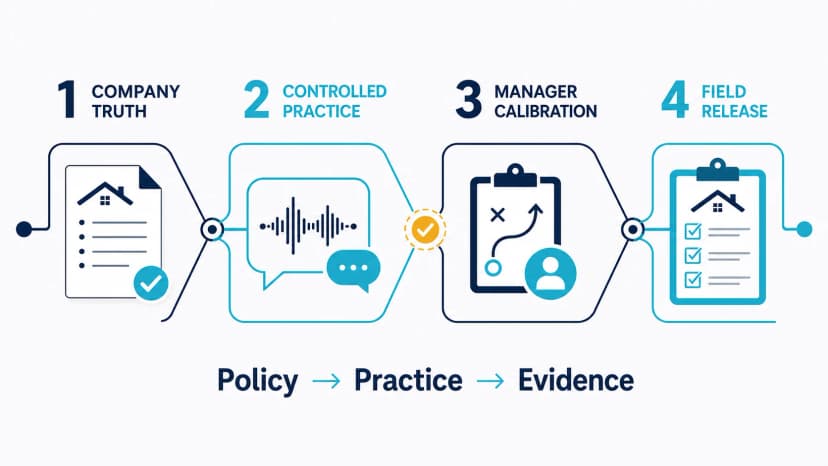
A custom AI roofing sales training program should convert your approved company policy into controlled practice, coaching evidence, and a manager-owned field release. A useful four-week pilot does not begin by uploading every sales script you can find. It begins with one roofing workflow, one current source of truth, three to five realistic scenarios, an observable rubric, and a named person who can approve changes.
The distinction matters. “Custom” is often reduced to a logo, a synthetic homeowner who mentions a local competitor, or a chatbot that repeats the company script. None of those changes proves that a rep can explain a written scope accurately, stay inside insurance and financing boundaries, or document the agreed next step. The program below treats AI training as a policy-to-practice compiler: approved facts go in; scenarios turn those facts into decisions; rubrics turn performance into reviewable evidence; managers calibrate the evidence; and supervised field work determines readiness.
This page owns that four-week program architecture. Use the roofing sales training library to govern the underlying reference material, the role-play scenario generator to draft one exercise, and the objection-practice guide to coach a specific conversational miss.
Next Step
Use ChatGPT inside a governed training system
A custom program still needs approved truth sources, privacy boundaries, observable scoring, manager review, and retries. Use the operating-boundary guide before treating generated material as training.
The four-week custom AI roofing sales training program
This is a pilot sequence, not a universal certification timeline. Keep the first cohort small enough for a manager to review the underlying attempts. Limit the scope to one role and one conversation stage—for example, retail proposal review for sales representatives. Roof access, inspection technique, contracting authority, insurance communication, and financing activity require their own company-approved gates.
| Week | Manager work | Rep work | Required evidence | Gate |
|---|---|---|---|---|
| 1: Control the truth | Choose one workflow; approve sources, boundaries, and escalation owners | Learn the workflow and complete a baseline scenario without coaching | Source register, workflow map, baseline attempt, known-unknown list | No scenario is assigned until its permitted facts are current and owned |
| 2: Practice one decision | Approve three to five scenario variations and an anchored rubric | Attempt, review evidence, retry the same skill in a changed context | First attempt, task-gap-action feedback, second attempt, critical-miss record | No pass based on total score if a critical boundary was crossed |
| 3: Calibrate the coaches | Score common samples independently; resolve evidence disagreements | Practice across lead source, homeowner concern, and information availability | Calibration record, revised anchors, three varied attempts | Managers must agree on what a pass and critical miss look like |
| 4: Test field transfer | Observe supervised work; audit AI evidence; decide release, retry, or restriction | Apply the skill in a supervised appointment or approved field simulation | Field observation, CRM record, rep reflection, manager decision | Simulation completion alone never grants field authority |
Week 1: turn company knowledge into controlled inputs
Begin with the smallest body of knowledge that can support one real job decision. If the pilot trains a rep to compare two retail proposals, the source set may include the company’s current proposal template, product-option sheet, warranty reference, financing handoff language, scope-comparison checklist, escalation list, and CRM disposition standard. It does not need payroll files, customer claim folders, or five years of abandoned scripts.
Inventory each source before it becomes training material. NIST’s Privacy Framework guidance treats privacy risk as a life-cycle issue arising from data processing, not only from a security breach. For a roofing team, that means deciding what data the training task truly needs, who can access it, how long it remains, and how it is removed—not merely asking whether the vendor encrypts it.
Company truth register — retail proposal
Retail proposal template v6
- Training use: Required scope fields and customer-facing sequence
- Owner: Sales operations
- Effective and review rule: Effective Jul. 1; review after any template release
- Status: Approved
Manufacturer warranty summary
- Training use: Permitted warranty explanation and source reference
- Owner: Production manager
- Effective and review rule: Review quarterly and after manufacturer notice
- Status: Approved with source link
Financing handoff card
- Training use: What the rep may explain and when to escalate
- Owner: Finance-program owner
- Effective and review rule: Review on provider or offer change
- Status: Approved; rates excluded from scenario
Lost-deal notes from CRM
- Training use: Language patterns for synthetic scenario design
- Owner: Sales manager
- Effective and review rule: De-identify before use; delete working export after approval
- Status: Restricted working input
Top-rep call transcript
- Training use: Possible example language
- Owner: Unassigned
- Effective and review rule: Consent and policy basis not documented
- Status: Excluded
The last row is intentional. A useful register records exclusions as well as approvals. A transcript does not become company truth because the rep closed the deal. It may contain private information, an unsupported promise, an obsolete offer, or language leadership would not want reproduced at scale.
Capture a baseline before teaching the answer
Give each rep the same bounded scenario before showing the rubric. Save the attempt, the facts made available, the scenario version, and the date. The baseline is not a trick and should not affect compensation or discipline. It shows which decisions the program must train and gives the manager something concrete to compare with later attempts.
For this pilot, the baseline homeowner says: “The other bid is $2,400 lower. Why should I pay you more?” The rep receives both written scopes but no explanation of the differences. The desired behavior is not a memorized value pitch. It is to acknowledge the concern, ask permission to compare the written scope, identify only documented differences, explain what remains unknown, and agree on a next step.
Week 2: specify the scenario and anchor the rubric
A scenario specification keeps company facts, homeowner behavior, scoring, and safety boundaries from collapsing into one giant prompt. It also makes the exercise reviewable when a policy changes.
Scenario specification — lower competing proposal
Version and owner:
Retail-Compare-01 v1.2; sales operations; approved Jul. 26Job stage:
Retail proposal review after both written scopes are availablePrimary objective:
Compare documented scope before defending priceVisible facts:
The competing total is $2,400 lower; both proposals include architectural shinglesWithheld until asked:
The homeowner has not compared ventilation, decking allowance, disposal, or workmanship coverageHomeowner behavior:
Calm but skeptical; answers relevant questions; declines if the rep attacks the competitorPermitted sources:
Both written scopes, approved warranty summary, current company processProhibited moves:
Inventing omitted work, claiming the competitor cuts corners, changing price, guaranteeing performance, or creating false urgencyStop and escalate:
Rep is asked for an unapproved discount, legal conclusion, financing approval prediction, or technical answer absent from the approved sourceEnd condition:
Homeowner agrees to a documented next step, requests time, or declines; the rep records the actual outcome
Build variations by changing one meaningful condition at a time: only one scope is available; the competing bid is not itemized; the homeowner cares more about timing than price; or the rep must escalate a ventilation question. Difficulty should come from decisions and missing information, not from making the synthetic homeowner hostile or unpredictable.
Use behaviorally anchored scoring
“Confidence,” “charisma,” and “natural closer” are impressions, not useful coaching criteria. Score visible job behavior and preserve the source behind the score. Research on structured feedback has described actionable feedback in terms of the task, the observed performance gap, and an action plan; the primary study record is a useful basis for making coaching notes specific without pretending the study proves roofing-sales outcomes.
| Behavior | 0: absent or unsafe | 1: partial | 2: complete |
|---|---|---|---|
| Diagnoses the concern | Launches into a pitch or assumes price is the only issue | Acknowledges price but asks a broad, unfocused question | Acknowledges the difference and asks what the homeowner has compared |
| Uses evidence | Invents a difference or attacks the competitor | Mentions a documented difference without confirming relevance | Compares only written items and labels unknowns as unknown |
| Explains the decision | Promises an outcome or uses unsupported urgency | Lists features without connecting them to the homeowner’s concern | Explains the documented tradeoff in plain language and checks understanding |
| Closes the loop | Pressures after a decline or leaves no recorded next step | Suggests a next step without confirming agreement | Confirms the voluntary next step and records the actual disposition |
Keep critical misses outside the arithmetic. For this scenario, inventing a defect, guaranteeing an outcome, changing an offer without authority, hiding a material term, or continuing after a clear decline requires review even if every other row scored well. The manager may use a total as a routing aid, but the underlying conversation remains the evidence.
Week 3: calibrate managers before scaling practice
If two managers score the same evidence differently, more AI-generated attempts will multiply the disagreement. Calibration is the quality-control step most generic training programs omit.
- Select one pass, one near pass, and one critical-miss attempt from the pilot.
- Have each manager score independently and quote the exact words supporting each rating.
- Compare disagreements row by row. Do not average them away.
- Revise the anchor if reasonable reviewers cannot apply it consistently.
- Save the final example, decision, rationale, rubric version, and approver.
Where the managers disagreed
Manager A scored evidence use 2; Manager B scored 1:
Record reviewed: Rep compared ventilation but stated the competitor “probably skips it”
Resolution: Score 0 and critical review: the rep invented competitor intent
System change: Add “label unknowns as unknown” to the 2 anchor and calibration libraryManagers disagreed on next-step quality:
Record reviewed: Rep said, “I’ll call tomorrow,” without homeowner agreement
Resolution: Score 1: a next step was proposed but not confirmed
System change: Add an agreed-next-step example to the rubric noteAI marked the attempt as a pass:
Record reviewed: Transcript contained an unapproved discount offer
Resolution: Human override to critical review
System change: Add discount-authority trigger and retain override for audit
NIST’s Generative AI Profile emphasizes governance and testing, evaluation, verification, and validation across the AI life cycle. In this program, that becomes practical: test scenarios before assignment, preserve human overrides, document known limits, create an incident path, and reassess the system when sources or behavior change.
AI scores may help a manager find evidence, but they should not automatically hire, discipline, promote, compensate, or terminate a person. Employment use requires job-related criteria, appropriate review, accommodation and correction paths, and qualified HR or legal oversight. Training evidence is strongest when it is used to decide the next practice or supervision step.
Week 4: require field-transfer evidence
Passing a simulation proves performance in that simulation. It does not prove safe roof access, technical inspection skill, contracting authority, or consistent performance with a homeowner. The final week tests whether the trained behavior appears in supervised work.
Use an observed appointment, lawful and consented recording, manager-led field simulation, or another method approved by the company. The manager looks for the same behavior trained in Week 2, then checks the resulting CRM record. If the rep compares only documented scope in practice but speculates about a competitor in the field, the release decision is retry—not “close enough.”
Field-release notes for this skill
Three varied role-play attempts
- Observed result: No critical misses; documented-scope behavior appeared across all three
- Decision: Eligible for supervised field observation
Manager-observed proposal review
- Observed result: Rep asked what had been compared, labeled one unknown, and avoided a prediction
- Decision: Pilot skill demonstrated
CRM disposition
- Observed result: Follow-up date recorded, but homeowner’s requested comparison was omitted
- Decision: Documentation retry required
Final release
- Observed result: Conversation behavior passed; CRM evidence incomplete
- Decision: Restricted: supervised use continues until documentation passes
A partial release is often more accurate than a binary pass. The rep may be ready to present an approved scope with a manager available but not ready to change offers, discuss financing details, inspect independently, or handle an insurance escalation. Name the authority being granted instead of issuing a vague “certified” badge.
Keep the custom program current
Company-specific training gets dangerous when the company changes but the scenarios do not. Assign a program owner and make each change traceable.
- Policy change: pause affected scenarios, update the source, identify downstream exercises, reapprove, and publish a new version.
- Unsafe or unsupported output: preserve the example, restrict the scenario if needed, identify the source or instruction failure, correct it, and regression-test similar scenarios.
- Manager override: retain the evidence and rationale; recurring overrides may reveal a broken rubric or system behavior.
- Access change: review permissions when an employee changes role or leaves.
- Retention event: delete raw customer or employee material when its approved purpose ends; keep only the de-identified evidence the program needs.
- Program retirement: remove duplicate drills, obsolete offers, unsubstantiated claims, and scenarios that no longer train a job behavior.
The remote roofing sales training guide covers delivery when manager and rep are not in the same office. The 30-day onboarding plan shows where this pilot fits inside a broader new-hire sequence.
Measure the pilot without inventing ROI
Separate learning evidence, system quality, manager workload, and business outcomes. A close-rate change during four weeks may reflect lead source, weather, territory, pricing, manager involvement, or rep mix. Do not credit the tool simply because two lines moved at the same time.
Measures that change a decision
- Critical-miss recurrence
- How to calculate or review it: Count the same defined boundary miss across versioned attempts
- Decision supported: Revise instruction, scenario, supervision, or source material
- Successful retry
- How to calculate or review it: Compare first and second attempts on the same observable behavior
- Decision supported: Determine whether feedback produced the intended correction
- Manager agreement
- How to calculate or review it: Review where calibrated managers differ and why
- Decision supported: Clarify rubric anchors or retrain reviewers
- Field transfer
- How to calculate or review it: Observe whether the trained behavior appears in supervised work and documentation
- Decision supported: Release, restrict, or assign another practice cycle
- Content incident rate
- How to calculate or review it: Track unsupported, stale, private, or unsafe output by scenario version
- Decision supported: Pause, correct, test, or retire affected content
- Manager review load
- How to calculate or review it: Record review and correction time without assuming it should reach zero
- Decision supported: Decide whether the workflow is maintainable
Revenue, close rate, average selling price, cancellation rate, and rep retention may still matter. Treat them as multi-factor business measures and define comparison periods before seeing the result. A responsible pilot can show that coaching evidence improved without claiming that AI caused every downstream sale.
What the platform must demonstrate
After the program is defined, ask vendors to run the same approved scenario and show the operating controls—not a polished generic demo.
- How are sources added, versioned, disabled, and removed?
- Can a manager see which source and scenario version governed an attempt?
- Can managers edit rubrics, inspect evidence, and override output?
- What happens when the system lacks an approved answer?
- Who can access recordings, transcripts, scores, and exports?
- What are the vendor’s retention, deletion, and customer-data training terms?
- Can the workflow support captions, keyboard use, correction requests, and alternative practice?
- How does the system behave when an integration fails?
The AI sales training software comparison provides the broader buying scorecard. Once the scenario and rubric are approved, managers can run interactive attempts in GhostRep Role Play and turn recurring evidence into follow-up drills in Training Studio. Product use does not remove the company’s approval, privacy, coaching, or field-release responsibilities.
Frequently asked questions
How much company content should we upload?
Upload only the current, approved material needed for the training objective. Label each source with an owner, effective date, review trigger, access rule, and status. Exclude private or stale material unless there is a documented need and approved handling process.
What is the best first custom scenario?
Choose a frequent, bounded conversation with an approved evidence base and visible behavior. Comparing two written retail scopes without inventing differences is stronger than a broad “close a difficult homeowner” prompt.
Should we use real customer recordings?
Only after the company confirms applicable consent and recording requirements, notice, purpose, vendor data use, access, retention, deletion, and redaction. Synthetic or de-identified examples are preferable when they can meet the same training objective.
What score should a roofing rep need to pass?
There is no universal pass score. Define the critical behaviors and misses for the job, test whether reviewers can apply the rubric consistently, require variation, and verify transfer in supervised work. A total score should not erase a critical boundary violation.
Can AI decide whether a rep is field-ready?
No. AI may organize attempts and flag evidence. A qualified manager must review the underlying work, confirm company-specific authority and safety gates, and decide what supervision or practice comes next.
Does a custom program always take four weeks?
No. Four weeks is a manageable pilot structure, not a promise of mastery or full onboarding. The scope, source quality, manager availability, role risk, and observed evidence determine the actual timeline.
Build the evidence system before scaling the AI
The best custom AI roofing sales training program is not the one with the most uploaded content or the most lifelike homeowner. It is the one that keeps company truth controlled, practices one meaningful decision at a time, makes feedback observable, calibrates managers, and requires observed field work before authority expands.
Start with one workflow. Approve the facts. Complete the scenario specification. Anchor the rubric. Run the four-week pilot. Then scale only the parts that survive manager review and supervised field transfer.
Free tools for roofing sales training
Turn this article into rep practice
Use the training library to turn ideas into drills, scripts, and coaching reps can actually use in the field.
Training tools
Browse objection, role-play, and scripting tools built for home improvement sales teams.
Browse training tools →All free tools
See the full tools hub across hiring, management, field sales, operations, and marketing.
Browse all tools →Role Play
Turn training concepts into live practice with AI homeowner scenarios that build muscle memory.
See Role Play →About the Author
Tim Nussbeck
Founder & CEO of GhostRep
20+ years in roofing and home improvement sales—knocking doors, running teams, and building practical coaching systems. Built GhostRep to give every rep access to the coaching top teams get.
Training next step
Turn training ideas into drills your reps will actually run
Start with the free training tools if you need scripts, practice reps, or coaching prompts today. Book a walkthrough if you want GhostRep mapped to your onboarding process.
- ✓Best fit if reps need more repetition, not more theory.
- ✓Useful for onboarding, objection practice, and weekly coaching.
- ✓Demo shows how Role Play plugs into your current training process.
Start Here
Browse training tools
Free objection builders, role-play prompts, scripts, and rep-practice templates.
Browse training toolsNeed it mapped to your team?
Talk through your current workflow, traffic mix, and where GhostRep fits before you change anything.
Book a 15-minute walkthroughYou Might Also Like
Build safe roofing objection practice with realistic scenarios, observable coaching criteria, and readiness gates—without using homeowners as practice targets.
Read article →Build a roofing sales training workflow around recorded appointments, live coaching, manager review and focused practice. Evaluate it with your own team.
Read article →A practical roofing sales rep training timeline: first appointment, first sale, consistent production, full ramp, and what speeds it up.
Read article →