Short answer: Roofing canvassing ROI is (collected gross profit attributable to canvassing − total canvassing acquisition cost) ÷ total canvassing acquisition cost. Contract value is not ROI, and hourly wages are not the whole cost.
The operating rule: Forecast with expected decimals; reconcile with actual completed and collected jobs. Do not scale a crew from doors, appointments, or signed pipeline alone.
A roofing door-knocking ROI calculator should follow one canvassing cohort from paid field time to collected gross profit. The chain is: paid hours → productive door time → doors → contacts → qualified leads → appointments set → inspections held → signed jobs → completed jobs → collected jobs. Skip a stage and the result may tell you that the crew is active without telling you whether the channel pays.
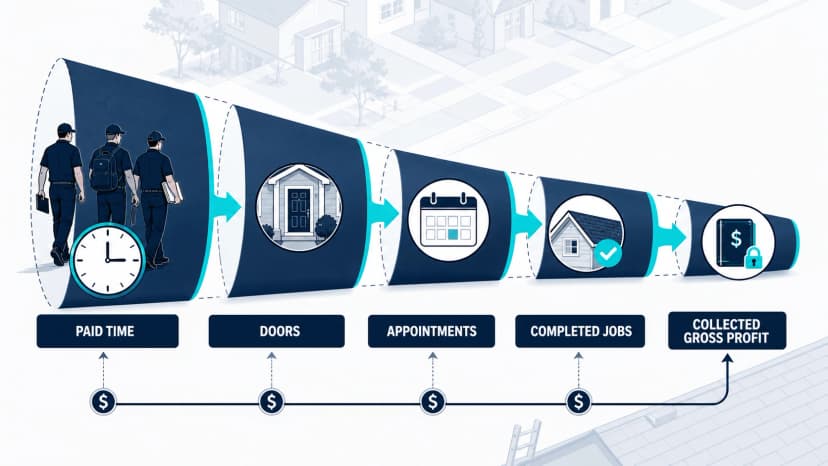
The calculator below uses your company’s costs and conversion rates. It opens with one illustrative sample so the formulas are visible; the sample is not a GhostRep benchmark or a promise. Replace every value with a defined cohort from your payroll, CRM, production, and accounting records.
Use it in two passes. First, forecast a downside, base, and upside case without prematurely rounding expected jobs. Then, after the attribution window has matured, replace the forecast with actual integer results and actual collected revenue. That separation is the difference between a planning model and an evidence-backed ROI report.
Roofing Door-Knocking ROI Calculator
How the scenario band works: the downside and upside columns apply the selected relative change to each funnel conversion rate, with rates capped between 0% and 100%. Costs, door pace, job value, and gross margin stay fixed. This is a stress test—not a confidence interval, forecast guarantee, or industry benchmark.
Read the sample correctly: the base case spends $1,250 to produce an expected 1.54 collected jobs, not “one and a half actual roofs.” Across many comparable cohorts, 1.54 is the average result implied by the assumptions. For a finished cohort, enter actual counts and actual collected revenue instead of converting the forecast to a whole number.
The sample’s 417.1% ROI means the expected gross profit after direct job cost exceeds the canvassing acquisition cost by $5,214. It does not mean the company has 417.1% net profit. Office overhead, financing, taxes, and other company costs may still sit below the gross-profit line.
The Door-Knocking ROI Formula
Build the answer in six moves:
- Total acquisition cost = field compensation + payroll burden + manager/training + vehicle + software/data + other allocated canvassing cost. This is what the cohort actually consumed.
- Expected collected jobs = doors × every stage conversion from contact through collection. This is a forecast, so retain decimals.
- Collected gross profit = collected revenue × realized gross-margin rate. This is the economic value available to pay for acquisition and overhead.
- Net canvassing contribution = collected gross profit − total acquisition cost. This is the value left after canvassing pays for itself.
- Canvassing ROI = net canvassing contribution ÷ total acquisition cost. This tests whether the mature cohort cleared the company's hurdle.
- Break-even collected jobs = total acquisition cost ÷ gross profit per collected job. This is how many completed, paid jobs the cohort must produce.
Define the gross-margin line before using it. If sales commission is already deducted when your accounting system reports job gross profit, do not add the same commission to acquisition cost again. If the margin excludes commission, add the canvassing-attributable commission once. The purpose is a complete model, not double counting.
What Counts as Canvassing Cost?
Start with the company ledger, not a national wage estimate. “$25 per hour” may describe cash wage while omitting employer payroll cost, paid training, paid drive time, manager review, vehicle expense, software, data, permits, branded materials, and the cost of replacing a short-tenure hire. The roofing sales rep cost worksheet owns the deeper employment-cost calculation.
The U.S. Bureau of Labor Statistics separates wages from benefits in its Employer Costs for Employee Compensation data. That does not give a roofing company its loaded canvasser rate; it confirms why a wage-only denominator is incomplete. For employee payroll categories, use the company ledger and current IRS Publication 15 rather than copying a stale tax percentage into the article.
Vehicle cost needs the same discipline. Actual company cost, a documented reimbursement policy, and the IRS optional mileage method are different methods. The IRS mileage table changes over time and is not a universal estimate of what every canvassing vehicle costs. Choose one policy, document it, and use it consistently across cohorts.
Paid hours and productive door time are also different. For covered employees, required job-related training and travel between work locations during the workday can count as work time under the Department of Labor’s hours-worked guidance. The calculator therefore pays the loaded hourly cost across paid hours while doors depend on productive time. It is a managerial accounting distinction, not individualized wage advice.
Why a Signed Roof Is Not Realized ROI
A signature is a pipeline event. The job can cancel, fail to reach production, change scope, collect less than expected, or sit outside the reporting window. Qualifying in-home transactions may also fall under the Federal Trade Commission’s Cooling-Off Rule, which generally requires disclosures about a three-business-day cancellation right for covered door-to-door sales over $25.
That does not mean every roofing transaction has the same legal treatment; federal, state, and local rules can overlap. It means a signed contract is a weak endpoint for realized channel economics. Keep signed, completed, and collected jobs as separate CRM stages. Use signed jobs for pipeline planning and collected gross profit for the final ROI reconciliation.
Attribution also needs a written rule. Record the canvassing cohort, rep, territory, first qualified interaction, job type, and a consistent time window. If a homeowner first came from branded search, a referral, or an existing customer list, do not automatically give canvassing full credit because a rep later knocked the door. Compare channel economics in the roofing marketing ROI model only after source rules match.
Reconcile a Finished Canvassing Cohort
Forecast inputs tell you what might happen. Historical reconciliation tells you what did happen. Use the same reporting period, territory definition, and cost-allocation policy for every rep or cohort.
- Payroll/timekeeping: reconcile paid hours, compensation, and payroll burden. Confirm that training, meetings, and required travel receive the treatment required by company policy and law.
- General ledger and allocation schedule: reconcile manager time, vehicle, software, materials, and permits. Use the same allocation rule for every cohort.
- Canvassing platform and CRM: reconcile doors through inspections held. Every stage should be defined, deduplicated, timestamped, and owned.
- CRM and production system: reconcile signed, canceled, and completed jobs. Do not close the report before the cohort has matured.
- Accounting: reconcile collected revenue and direct job cost. Count cash actually collected and use one gross-margin definition.
- CRM governance record: preserve the source and attribution window. The same rule should also work for paid, referral, and organic leads.
A roofing sales KPI scorecard can standardize the weekly stage definitions. A canvassing app can capture doors and dispositions, but software cannot repair ambiguous source rules or missing accounting data.
Diagnose the Funnel Before Scaling It
Each unit cost answers a different question. Cost per contact tests route density, productive time, and when the team worked. Cost per qualified lead tests whether “lead” has a real definition. Cost per set versus held inspection isolates appointment fallout. Cost per signed versus completed job exposes cancellation or production loss. Cost per collected job finally connects acquisition to cash.
Do not call the smallest rate the “highest leverage” without testing economics. A 10% relative improvement at one stage has the same multiplicative effect on expected collected jobs as a 10% relative improvement at another stage, assuming everything else stays fixed. The real decision depends on cost, controllability, sample size, safety, capacity, and whether the stage is measured correctly.
- Low productive-time ratio: audit drive and admin time, route shape, meeting load, and timekeeping. Recluster with the territory builder before demanding more doors.
- Contacts but few qualified leads: audit the lead definition, property and decision authority, service fit, and duplicate records. Clarify qualification; do not pressure every contact.
- Qualified leads but few sets: audit the opening, relevance, next-step clarity, and rep-specific notes. Test one bounded change with the canvassing script generator.
- Sets but few held inspections: audit lead quality, time to confirmation, schedule fit, and owner assignment. Standardize the appointment confirmation workflow.
- Held inspections but few signed jobs: audit the estimator or closer, job mix, scope, pricing, financing, and follow-up. Separate canvasser performance from closer conversion.
- Signed jobs but weak collected margin: audit cancellation, production, supplements, receivables, and margin policy. Stop scaling acquisition until the downstream leakage is understood.
Compare Reps and Territories Fairly
Do not compare a new rep in a drive-heavy repair territory with an experienced rep in a dense replacement territory and call the difference talent. Match time window, job type, storm-event window, route density, source rules, manager, closer, paid-hour treatment, and cohort maturity.
Territory variables should be operational: travel, density, verified event window, service fit, historical contact-to-collected performance, active capacity, and local solicitation rules. Do not target or rank neighborhoods using stereotypes about age, fixed income, household type, or assumed wealth. NOAA’s Storm Events Database can document a reported event window; it does not prove damage to a particular parcel or establish insurance coverage.
Weather is also a safety condition before it is a conversion variable. OSHA recommends water, rest, shade, schedule/workload controls, and acclimatization for outdoor heat exposure in its heat guidance. Put those requirements into staffing and productive-time assumptions. Never turn hazardous weather into a tactic for getting more homeowners to answer.
Measure Training Without Inventing Lift
A calculator can model a possible conversion change; it cannot prove what caused it. If a rep’s set rate improves after training, territory, lead mix, manager involvement, tenure, scheduling, and follow-up may also have changed.
Define one observable behavior, score it before deployment, record paid practice and manager time, and compare matched cohorts. For example: the rep states a truthful reason for the visit, asks one neutral qualification question, respects a clear “no,” confirms the next step, and records the outcome correctly. Use Echo only when live coaching is the identified constraint. Use the separate software and training ROI calculator when the investment decision is the tool itself rather than the canvassing channel.
Compliance and Field Controls Belong in the Model
Solicitation hours, permits, registration, do-not-knock rules, recording consent, worker classification, wage treatment, and contract disclosures vary by jurisdiction and facts. A job title or commission plan does not settle federal outside-sales status; the Department of Labor’s outside-sales fact sheet says actual duties and where the work occurs matter.
Use qualified local legal, payroll, and tax advisers for the company’s policy. In the ROI model, include the cost of compliant permits, training, recordkeeping, safety controls, and paid time where applicable. Excluding a required cost does not make canvassing more efficient; it makes the model incomplete.
When to Scale, Fix, or Pause Canvassing
- Scale cautiously when multiple mature cohorts clear the company’s gross-profit hurdle, fulfillment capacity exists, and the downside case is survivable.
- Fix one stage when definitions are clean, the sample is large enough to be useful, and one rep/process handoff is consistently weaker across comparable cohorts.
- Change territory or schedule when productive time, travel, and contact economics—not conversation conversion—are the constraint.
- Pause when source attribution is unreliable, costs are missing, held appointments cannot be traced to completed jobs, safety/compliance controls are unresolved, or signed pipeline repeatedly fails to become collected margin.
For a cross-channel decision, compare the completed-job economics against the roofing lead cost benchmark framework. Do not compare canvassing cost per set appointment with paid media cost per raw form lead; match the same funnel stage and attribution rule.
Roofing Door-Knocking ROI FAQ
What is a good cost per lead for roofing canvassing?
There is no defensible universal number. A useful threshold is the maximum acquisition cost your collected gross profit, capacity, cash cycle, and target ROI can support. Define “lead” first, then compare the same stage and cost-allocation method across mature cohorts.
Should I use cost per set or held appointment?
Track both. Cost per set isolates the door conversation and qualification process. Cost per held inspection includes the handoff, scheduling, confirmation, and lead-quality loss. A program can look efficient at the set stage and expensive at the held stage.
Why does the forecast show decimal jobs?
Expected value is an average across repeated comparable cohorts. Rounding 1.54 expected collected jobs to one or two before calculating revenue distorts the forecast. Use decimals for planning and actual whole-job counts for a finished historical period.
What happens when a conversion rate is zero?
Downstream counts become zero, and downstream unit costs should show `N/A` because division by zero is undefined. A zero result is not a $0 lead or appointment.
Does hourly or commission pay create better ROI?
The calculator does not choose a lawful compensation plan. Enter the company’s actual fully loaded cost once, then compare behavior, retention, quality, and collected economics. Classification and wage rules depend on actual duties, jurisdiction, and facts.
When is canvassing ROI realized?
A forecast can be updated at every stage, but realized ROI should use a mature cohort’s collected revenue, direct job cost, and total acquisition cost. Signed contract value is pipeline, not cash or gross profit.
Use the denominator that failed
Fix the measured handoff before adding more field hours
If qualified leads are not setting, test the door conversation. If sets are not holding, fix confirmation. If held inspections are not becoming collected margin, audit closing, production, and accounting before blaming canvassing.
Methodology note: Formulas, official sources, and page behavior were reviewed July 24, 2026. No universal roofing-canvassing conversion benchmark was used. The opening numbers are an illustrative calculation, not GhostRep customer performance. This page is general operational information, not legal, payroll, tax, insurance, or safety advice.
Free lead-generation resources
Turn traffic strategy into pipeline actions
Use free marketing and field tools to turn website, referral, and follow-up ideas into lead flow your reps can actually work.
Marketing tools
Generate ad copy, email sequences, company bios, and lead-conversion messaging for your market.
Browse marketing tools →Field sales tools
Create follow-up assets, texts, and homeowner-facing copy once a lead is already in motion.
Browse field sales tools →Job Intel
Give reps better customer context before the follow-up so lead quality is easier to convert.
See Job Intel →About the Author
Tim Nussbeck
Founder & CEO of GhostRep
20+ years in roofing and home improvement sales—knocking doors, running teams, and building practical coaching systems. Built GhostRep to give every rep access to the coaching top teams get.
Lead-gen next step
Turn traffic into pipeline math before you buy more leads
Start with the ROI calculator or lead-generation tools if you are still diagnosing the economics. Book a walkthrough if you want GhostRep tied to lead handling, follow-up, and close-rate lift.
- ✓Best fit if traffic is arriving but too little of it turns into revenue.
- ✓Useful for modeling conversion lift before you increase spend.
- ✓Demo shows how field execution and coaching change lead economics after the click.
Start Here
Model your conversion lift
Estimate what more leads, better close rates, and faster rep ramp are worth in revenue.
Model your conversion liftNeed it mapped to your team?
Talk through your current workflow, traffic mix, and where GhostRep fits before you change anything.
Book a 15-minute walkthroughYou Might Also Like
Angi and HomeAdvisor share a parent. Compare published lead-sharing and credit terms, account fees, renewal risks, and a free contractor offer worksheet.
Read article →Enter your local HomeAdvisor lead quote, contact rate, held inspections, sold jobs, labor, and gross profit to plan a controlled roofing lead pilot.
Read article →Compare roofing SEO and Google Ads using fully loaded spend, qualified leads, signed and completed jobs, gross profit, cost per job, and true ROI.
Read article →