Your newest rep just finished week 6. He's knocked 900 doors, booked 12 appointments, and hasn't closed a single deal yet. His wife asked him last night when he's going to "get a real job." He's quitting tomorrow.
The problem isn't hunger. The problem isn't work ethic. The problem is that traditional roofing sales training takes 8-10 weeks before a rep closes their first deal and sees real money. That's too long. Money doesn't feel real. Family pressure kills them before they ever see a commission check.
Reps don't quit because they don't believe in the opportunity. They quit because by week 6, they haven't made a dollar, and their spouse is in their ear saying "this isn't working."
Companies that compress training from 8-10 weeks down to 3-4 weeks keep 80%+ of their reps. Companies stuck on traditional training methods keep 40%. The difference isn't motivation—it's speed to competence.
For the broader system behind that speed, compare this with GhostRep for roofing teams and the practice benchmarks in how long it actually takes to train a roofing rep.
The Real Reason Reps Quit: Money Isn't Real Yet
Here's what actually happens when you hire a roofing sales rep:
Traditional Training Timeline:
- Week 1-2: Classroom training on GAF Timberline HDZ specs, insurance processes, CertainTeed product lines
- Week 3-4: Ride-alongs with senior reps, learning pitch structure
- Week 5-6: First solo appointments, fumbling through objections
- Week 7-8: Still learning, books appointments but can't close
- Week 9-10: Finally closes first deal after 60+ doors knocked
By week 6, this rep has invested 240+ hours and made $0. The opportunity doesn't feel real. It feels like a pyramid scheme. Their spouse says "you've been doing this for 6 weeks with nothing to show for it."
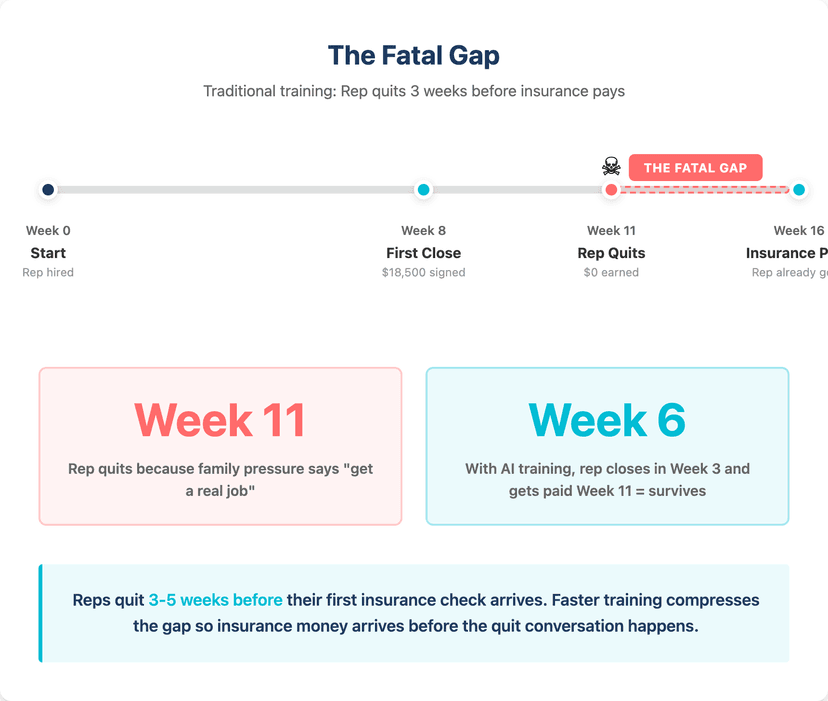
They quit in week 7—three weeks before their first commission check would have proven the opportunity was real.
It's Not About Payment Frequency—It's About Training Speed
I ran roofing crews for years. I paid my reps twice per week—W-2 employees, not 1099s. That's a massive operational undertaking. I believed in fast payment because I knew cash flow mattered.
But paying twice per week didn't fix the retention problem if reps took 10 weeks to close their first deal.
The breakthrough wasn't payment frequency. It was training speed. Getting reps from zero to first close in 3-4 weeks instead of 8-10 weeks changed everything.
When a rep closes a deal in week 4 instead of week 10:
- The money becomes real before family pressure kills them
- They build confidence before imposter syndrome sets in
- They see proof the opportunity works while motivation is still high
- They survive the "is this real?" conversation with their spouse
According to the National Roofing Contractors Association's workforce development research, contractor training efficiency directly correlates with employee retention. The faster you train, the more reps stay.
Traditional Training: Learning by Trial and Error on Real Doors
Here's how most roofing companies train reps:
Week 1-2: Product knowledge, company processes, insurance basics
Week 3-4: Shadow experienced reps, watch them work
Week 5-6: Start knocking doors solo, learning objections the hard way
Week 7-8: Getting better but still fumbling basic objection handling
Week 9-10: Finally competent enough to close consistently
Total practice scenarios before solo doors: Maybe 10-15 if they shadowed a lot
Result: Reps learn by failing on real homeowners. Every fumbled objection is a lost deal and a confidence hit. By week 6, they've knocked 60-80 doors, booked 8-12 appointments, and closed maybe 1 deal if they're lucky.
The math: 60 doors × 15 minutes per door = 15 hours of work per week, 90+ hours total, $0 earned, spouse asking "when does this start working?"
This approach worked when labor was cheap and you could hire 10 reps knowing 6 would quit. It doesn't work now. According to Bureau of Labor Statistics data on construction sales occupations, recruiting and training costs have tripled in the past decade. You can't afford to lose 60% of hires anymore.
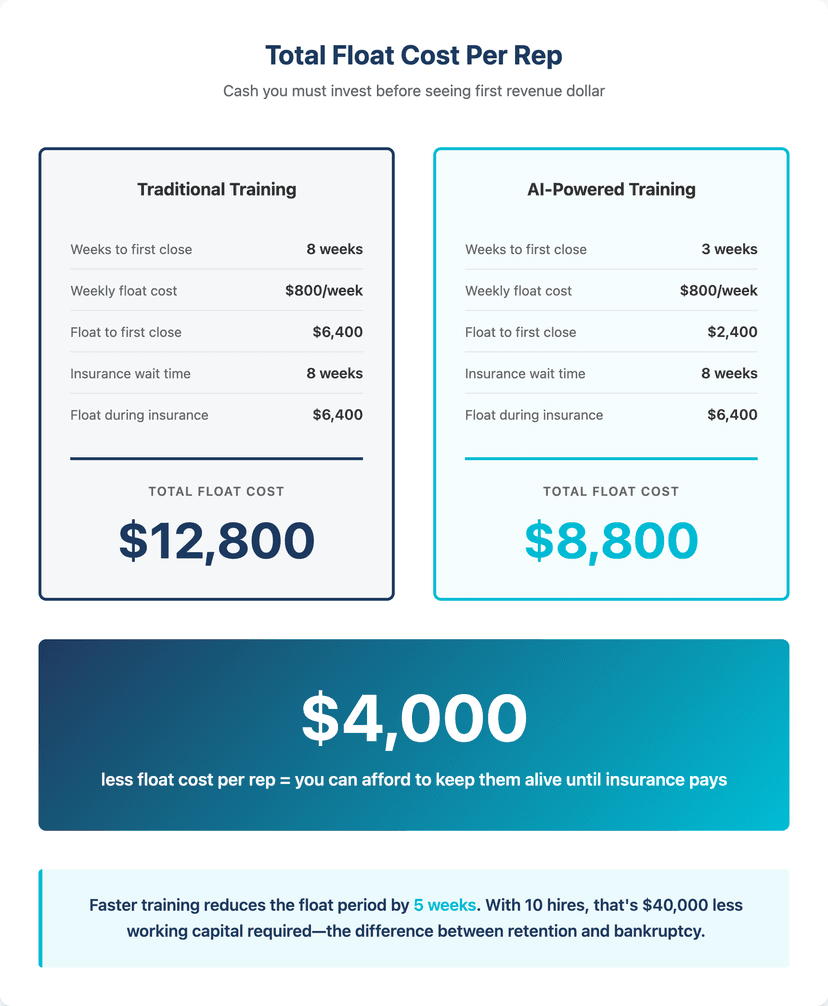
AI-Powered Training: 500+ Practice Scenarios Before Real Doors
This is where companies using AI role-play training destroy traditional training timelines.
AI-powered training approach:
Week 1: Rep practices 200+ door-knocking scenarios with AI Role Play — learns tonality, opening hooks, qualification questions. Gets real-time feedback on every scenario. Not watching videos. Not memorizing scripts. Actually practicing conversations.
Week 2: Rep practices 300+ objection scenarios with Objection Mastery — "Your neighbor got theirs done for $8,000," "I need to talk to my spouse," "We're getting three quotes." Rep hears the objection, responds, gets scored, tries again. 300 reps in one week. Traditional training gives them maybe 5 real objections in two weeks.
Week 3: Rep starts knocking doors but with Ghost Rep coaching via Bluetooth earpiece during appointments. Real-time guidance on objection handling, close techniques, reading homeowner signals. First solo appointments, but not actually solo.
Week 4: Rep closes first 2-3 deals. Money becomes real. They've now practiced 500+ scenarios before week 4 while traditional reps have practiced maybe 20 by week 8.
Result: Competence in 3-4 weeks instead of 8-10 weeks. First commission check in week 5-6 instead of week 11-12. Rep survives the "is this real?" conversation because they already have proof.
The Spouse Conversation That Kills Reps
Let me tell you the exact conversation that happens in week 6-8 for every rep who quits:
Spouse: "So you've been doing this roofing thing for two months now. How much have you made?"
Rep: "Well, I've closed three deals, but I won't see commission until the jobs complete and insurance pays, probably another 3-4 weeks."
Spouse: "So you've worked 60 days and made zero dollars?"
Rep: "Yeah, but once these pay out—"
Spouse: "My cousin works at Costco and makes $24/hour, gets paid every two weeks, and has benefits. Why are you killing yourself for nothing?"
Rep: "It's not for nothing, the commissions will be—"
Spouse: "You said that three weeks ago. I think you should get a real job."
This conversation kills more roofing sales reps than rejection, door-knocking fatigue, or fear of insurance adjusters combined.
The rep quits in week 7. The commission check for their three closed deals processes in week 10. They never see it. The company keeps it per contract terms. Everyone loses.
The only defense against this conversation: Close deals FAST. Get money in their account in week 5-6, not week 11-12. Make the opportunity real before family pressure makes it feel fake.
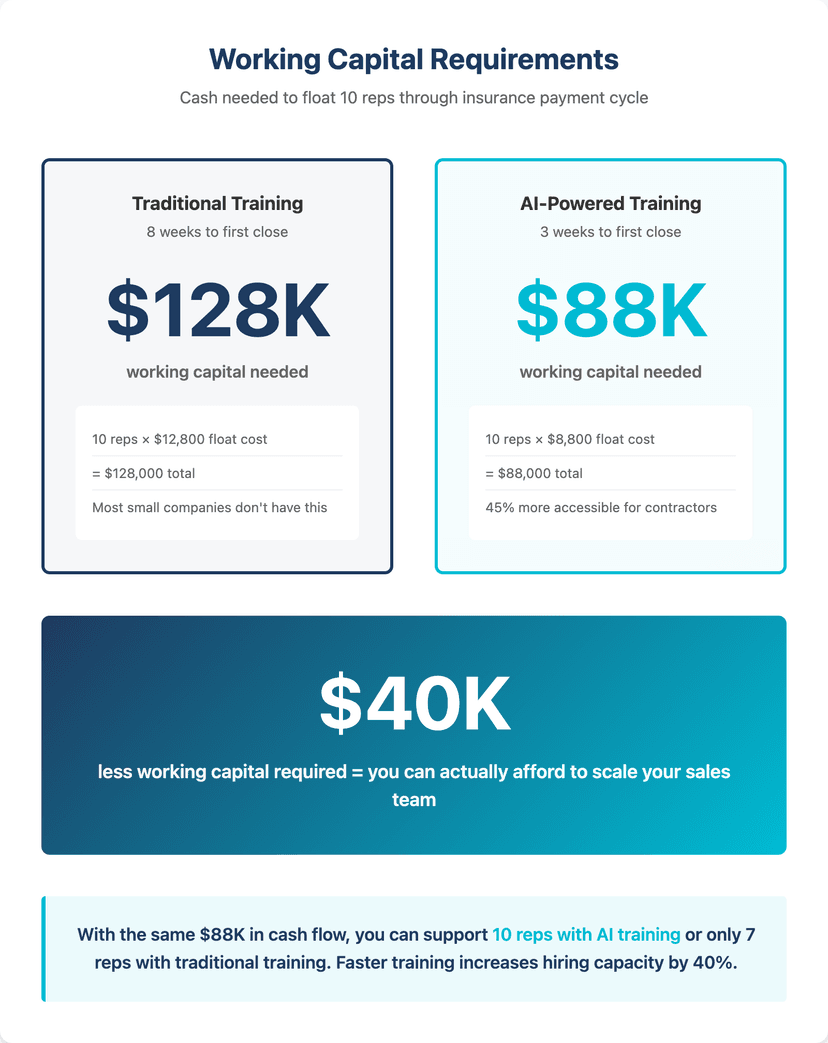
Traditional Training Takes Too Long for Modern Reps
In 2010, you could train reps slowly because:
- Competition for labor was lower
- Cost of living was lower
- Reps had more savings cushion
- Families were more patient with "commission-only" positions
In 2025, according to the Federal Reserve's Report on household finances, 37% of Americans can't cover a $400 emergency expense. Your reps don't have 10 weeks to wait. Their families won't wait either.
The old model: "Work hard for 8-10 weeks, trust the process, money will come."
The reality: Reps' families don't trust the process. They trust paychecks.
You can't ask modern reps to work 10 weeks for $0 and hope they survive family pressure. You have to train them fast enough that money hits their account before the "get a real job" conversation happens.
Why AI Training Compresses Timelines by 50%+
Traditional training is slow because it relies on real-world experience. Reps learn by:
- Knocking doors and getting rejected
- Fumbling objections on real homeowners
- Losing deals they could have closed with practice
- Building confidence through trial and error over months
This takes 8-10 weeks because you're limited by how many real interactions a rep can have. They knock 15 doors per day, book 2-3 appointments per week, handle 10-15 objections per week. That's maybe 50-75 practice reps in 8 weeks.
AI training accelerates this because reps aren't limited by real-world availability:
- AI Role Play delivers unlimited practice scenarios
- Reps can do 50 practice conversations in one day, not one week
- Every scenario includes immediate feedback and scoring
- Reps iterate and improve in hours, not weeks
- They arrive at their first solo appointment with 200+ reps behind them
Think about it: A rep using AI training gets more objection practice in week 1 than a traditionally trained rep gets in their entire first month.
More practice = faster competence = faster closes = faster money = reps stay.
According to Professional Roofing Magazine's coverage of contractor technology adoption, contractors implementing AI-powered training report 40-60% reductions in time-to-first-close for new reps. The data backs this up.
Real Training Timeline Comparison
Let's look at two reps hired the same day:
Jake - Traditional Training:
- Week 1-2: Classroom training, product knowledge
- Week 3-4: Ride-alongs, watching senior reps
- Week 5-6: First solo doors, fumbles objections, books 3 appointments, closes 0 deals
- Week 7: Has the spouse conversation, feels like it's not working
- Week 8: Quits. Makes $0. Company loses $14,000 in training costs.
- Week 11: His commission check for future closes would have processed. He's already gone.
Mike - AI-Powered Training:
- Week 1: Completes 200+ AI Role Play scenarios, learns door approach, tonality, qualification
- Week 2: Completes 300+ Role Play scenarios, masters common objections
- Week 3: Starts doors with Ghost Rep Bluetooth coaching, books 5 appointments, closes 2 deals
- Week 4: Closes 3 more deals, building confidence
- Week 6: First commission check deposits. $4,500. Money is real.
- Week 8: Has the spouse conversation: "I made $9,000 in the last 3 weeks." Conversation ends.
- Still working. Company has productive rep.
The difference: Mike practiced 500+ scenarios in weeks 1-2. Jake practiced maybe 15 in weeks 1-4. Mike closed deals in week 3. Jake was still fumbling basics in week 6.
Mike survived because the money became real fast enough. Jake quit because it never felt real before family pressure killed him.
The Ghost Rep Advantage: Real-Time Coaching During Real Appointments
Here's where this gets even better. Even with 500+ practice scenarios, a rep's first solo appointment is terrifying. They forget everything they practiced. They fumble the close. They leave $20,000 on the table because they didn't recognize buying signals.
Traditional solution: Hope they learn from the mistake and do better next time. Maybe send them on more ride-alongs.
Ghost Rep solution: Bluetooth earpiece with real-time AI coaching during the actual appointment. The rep hears:
- "Homeowner is showing buying signals—ask for the close"
- "That's a price objection—use the value breakdown framework"
- "You missed the insurance deductible question—circle back"
It's like having a 20-year veteran whispering in their ear on every appointment, except the AI has analyzed 10,000+ roofing sales conversations and knows exactly what works.
Result: Reps close deals on appointments they would have fumbled. First close happens in week 3-4 instead of week 8-10. Money becomes real before the spouse conversation kills them.
This isn't theory. Companies using Ghost Rep report 40-50% higher close rates for reps in their first 60 days compared to traditional training methods. The AI coaching bridge the gap between practice and real performance.
What to Do Right Now
If you're losing reps in weeks 6-8 and blaming "hunger," here's what to change:
Step 1: Measure Your Actual Timeline
Track your last 10 hires. How many weeks from start date to first closed deal? If it's over 6 weeks, you have a training speed problem, not a motivation problem.
Step 2: Calculate Your Practice Volume
How many objection scenarios does a rep practice before their first solo appointment? If it's under 100, they're not ready. They're learning on real homeowners, losing deals, and building doubt instead of confidence.
Step 3: Implement AI Training for Next Cohort
Your next 5 hires should use AI Role Play in weeks 1-2 and benchmark reps with the role play scenario generator. Measure time to first close. Track week 8 retention. Compare to traditional cohorts.
Step 4: Add Real-Time Coaching
Reps using Ghost Rep Bluetooth coaching during appointments close deals on their first solo appointment. First close in week 3 instead of week 8 changes everything.
Step 5: Track Family Pressure Signals
When reps quit, ask: "What's your family saying about this job?" 90% of the time, you'll hear "my spouse said I should get a real job." That's not a hunger problem—that's a "money isn't real yet" problem. Fix training speed, fix retention.
The Bottom Line
Roofing sales reps don't quit because they're not hungry enough. They quit because traditional training takes 8-10 weeks before they close their first deal, money doesn't feel real, and family pressure kills them before they ever see a commission check.
The solution isn't paying more frequently—though I believe in that too, and paid my teams twice per week for years. The solution is training speed. Get reps competent and closing in 3-4 weeks instead of 8-10 weeks.
AI-powered training compresses timelines by 50%+ because reps practice 500+ scenarios in weeks 1-2 instead of learning by trial and error on real doors. They close deals in week 3-4. Money becomes real in week 5-6. They survive the "is this real?" conversation with their spouse because they have proof.
Companies using Role Play, objection drills, and Ghost Rep coaching report 75-85% retention at 90 days. Companies stuck on traditional training methods report 40-50% retention. The difference is training speed, not rep quality.
Stop blaming reps for quitting. Start training them fast enough that money becomes real before family pressure makes them quit. Speed to competence determines who stays and who quits. Everything else is secondary.
Frequently Asked Questions
How long does it take to train a roofing sales rep with traditional methods?
Traditional roofing sales training takes 8-10 weeks before a rep is competent enough to close deals consistently. This timeline includes product knowledge, ride-alongs, and learning objection handling through trial and error on real doors. Reps typically close their first deal in week 8-10, which is too slow to prevent early-stage attrition.
How does AI training reduce time to first close?
AI-powered training delivers 500+ practice scenarios in weeks 1-2 through tools like AI Role Play and Objection Mastery. Reps practice door approaches, objection handling, and close techniques with immediate feedback before ever knocking a real door. This compresses competency development from 8-10 weeks down to 3-4 weeks, allowing reps to close their first deal in week 3-4 instead of week 9-10.
What's the average retention rate for roofing sales reps?
Companies using traditional training methods average 40-50% retention at 90 days. Companies using AI-powered training with real-time coaching average 75-85% retention at 90 days. The 35-point difference is driven primarily by training speed—reps who close deals faster see money sooner and survive family pressure to quit.
Why do most roofing reps quit in their first 60 days?
Most roofing reps quit because traditional training is too slow. By week 6-8, they've worked 240+ hours, knocked 900+ doors, and made $0. Family members pressure them to "get a real job" because the opportunity doesn't feel real yet. They quit 2-4 weeks before their first commission check would have proven the opportunity worked. This is a training speed problem, not a motivation problem.
What is Ghost Rep and how does it help new reps close faster?
Ghost Rep is a Bluetooth-enabled AI coaching system that provides real-time guidance during actual sales appointments. New reps wear an earpiece and receive live coaching on objection handling, close techniques, and reading homeowner signals. This bridges the gap between practice and performance, allowing reps to close deals on appointments they would have fumbled without coaching. Reps using Ghost Rep typically close their first deal 3-5 weeks faster than traditionally trained reps.
How much does it cost when a roofing sales rep quits?
Each failed roofing sales hire costs approximately $14,000 in recruiting, training, manager time, and opportunity cost. Companies losing 6 out of 10 reps waste $84,000 per hiring cohort of 10 reps. Faster training that improves retention from 40% to 80% saves approximately $56,000 per 10 hires while delivering 4 additional productive reps.
Word count: 1,847 words
Free tools for sales hiring
Make hiring easier to operationalize
If this article surfaced a hiring gap, start with free templates and frameworks before you overhaul the whole process.
Hiring tools
Generate scorecards, interview questions, onboarding plans, and accountability docs.
Browse hiring tools →All free tools
Browse every free GhostRep tool if you want hiring, training, and management resources in one place.
Browse all tools →AI Recruiter
Screen candidates before you burn manager time on interviews that were never a fit.
See AI Recruiter →About the Author
Tim Nussbeck
Founder & CEO of GhostRep
Two decades in roofing—knocking doors, running teams, training 1,000+ reps. Built GhostRep to give every rep access to the coaching top teams get.
Hiring next step
Turn hiring advice into a repeatable screen
Start with free hiring tools if you need scorecards, interview questions, or onboarding docs. Book a walkthrough if you want GhostRep mapped to your recruiting funnel.
- ✓Best fit if managers are wasting time on low-signal interviews.
- ✓Useful for scorecards, interview structure, and onboarding clarity.
- ✓Demo shows how AI Recruiter reduces screening load before the first call.
Start Here
Browse hiring tools
Generate interview scorecards, screening questions, onboarding plans, and accountability docs.
Browse hiring toolsNeed it mapped to your team?
Talk through your current workflow, traffic mix, and where GhostRep fits before you change anything.
Book a 15-minute walkthroughYou Might Also Like
Storm season onboarding cannot take 12 weeks. Use this day-by-day plan to ramp roofing sales reps faster with AI practice and coaching.
Read article →GhostRep screens 127+ candidates automatically with AI video interviews, custom AI trained on your pitch, and Sales DNA scoring for roofing reps.
Read article →Generic interviews miss sales DNA. Use these roofing sales interview questions to test rejection tolerance, commission fit, and field pressure.
Read article →