When the first written scope on a roofing job comes from someone else, that document quietly becomes the frame for every later conversation. Quantities, assembly, assumptions, and missing items get discussed as deviations from it—even if the contractor never wrote down its own construction opinion.
Build the contractor estimate first: measured quantities, proposed assembly, current costs, assumptions, exclusions, and unresolved field questions. The advantage is not “getting more from insurance.” It is preserving an independent record that production, the homeowner, and authorized claim professionals can compare without confusing construction scope with coverage.
Construction estimating is not policy interpretation. A contractor should not promise coverage, negotiate a claim where licensing is required, tell a homeowner what the insurer must pay, or present a construction observation as a coverage conclusion. Rules vary by state and activity. The NAIC’s Consumer’s Guide to Home Insurance describes the claim process at a general level, including the potential value of having a contractor meet with the policyholder and adjuster. It does not authorize a contractor to perform regulated adjusting work.
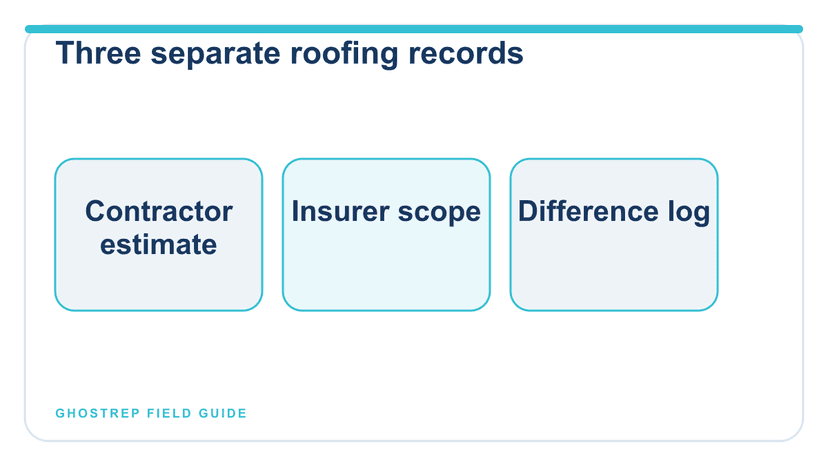
Keep three records separate
| Record | Owner and purpose | What it should not become |
|---|---|---|
| Contractor estimate | Contractor’s proposed construction scope, quantities, assumptions, exclusions, and price | A promise of coverage or insurer payment |
| Insurer estimate or claim document | Insurer’s claim evaluation and payment fields under its process | The contractor’s production plan without independent review |
| Customer agreement | Approved work, price, parties, terms, disclosures, and signatures | An ambiguous blend of possible claim proceeds and undefined work |
Depending on jurisdiction and workflow, additional records may include inspection notes, change orders, engineering documents, public-adjuster communications, or code determinations. Name the owner and authority for each one.
Build the estimate from a source stack
1. Reconciled measurements
Record roof planes, pitch, eaves, rakes, valleys, ridges, hips, penetrations, stories, access, and the measurement method. Preserve both the source report and field verification. Explain any difference instead of silently selecting the larger quantity. If a condition could not be measured safely, mark the limitation and identify the next inspection step.
2. Located observations
Photos should have date, location, orientation, and an observation written in neutral language. “Three creased tabs on the west slope near the lower rake” identifies what is visible. “Covered wind damage” combines technical causation and policy treatment that may require different authority.
The roofing inspection summary generator can organize verified field notes. A responsible inspector must review the result; the tool does not diagnose damage from missing evidence.
3. Assembly and scope
Describe the existing assembly and proposed assembly. Include only work supported by the observed condition, chosen design, manufacturer requirements, adopted code, company standard, or explicit allowance. Common categories include:
- tear-off, layers, loading, disposal, and protection;
- deck condition and a clearly stated unknown-condition process;
- underlayment, leak barrier, starter, field product, ridge, and accessories;
- edge metal, wall and penetration flashing, ventilation, and transitions;
- height, pitch, access, staging, permits, cleanup, and warranty work; and
- work specifically excluded, deferred, or priced as an allowance.
Do not add an item because a template contains it. Do not omit an item because another estimate does not.
4. Current local cost basis
Name the market, effective date, supplier quote or price source, tax treatment, labor assumptions, payroll burden, equipment, disposal, subcontractor quote, overhead method, and estimator. A national price-per-square cannot represent every access condition, product, labor market, assembly, or company cost structure.
5. Authority and assumptions
If a line depends on adopted code, manufacturer instructions, an authority-having-jurisdiction decision, engineering, or another qualified determination, cite the exact source and edition. Separate a verified requirement from an estimator assumption. “Code upgrade” is not enough; identify the requirement, applicability, and responsible reviewer.
Estimate-control record: initial scope
Control record for one estimate
Project state:
Example: Initial contractor estimate; no tear-off findings yet
Source or owner: Estimator, July 24Measured area:
Example: 31.4 squares before waste; field dimensions reconcile within 1.8% of report
Source or owner: Measurement report plus field sketchVisible condition:
Example: Creased tabs documented on west slope; cause not assigned in estimate
Source or owner: Photos W-03 through W-08Deck:
Example: Condition concealed; includes no assumed replacement quantity
Source or owner: Unit price and approval process stated for verified tear-off findingsVentilation:
Example: Existing intake area unresolved; final design held for calculation
Source or owner: Production manager assigned before orderingPricing basis:
Example: Supplier quote dated July 23, current labor sheet v6, local disposal quote
Source or owner: Attachments P-01 through P-03Coverage statement:
Example: None; customer directed to insurer or authorized adviser for policy questions
Source or owner: Sales boundaryRelease gate:
Example: Estimate may be presented after ventilation and contract-term review
Source or owner: Estimator plus production approval
The example is useful because unresolved conditions remain unresolved. A clean document does not require false certainty.
Compare estimates by reason, not just total
When an insurer or another contractor estimate arrives, preserve the original versions and compare them line by line. A difference matrix should show the quantity, assembly, action, cost basis, evidence, and owner of the next question.
| Difference | Contractor record | Next action |
|---|---|---|
| Roof area | Field sketch and report produce 31.4 squares before waste | Reconcile plane dimensions with the other estimate |
| Existing layers | One visible layer; concealed conditions not verified | Do not assume a second layer; define tear-off documentation process |
| Ventilation | Design held pending intake calculation | Production owner completes calculation and documents assembly |
| Price date | Supplier and labor sources dated July 23 | Ask what market and date the comparison used |
| Policy/payment fields | Not part of contractor price explanation | Customer directs coverage and payment questions to insurer or authorized professional |
The contractor can explain why its own scope and price differ. The contractor should avoid speaking for another estimator’s intent or for policy coverage.
Use change control when new facts appear
An upfront estimate is a versioned baseline, not a claim that concealed conditions do not exist. Hidden deck deterioration, concealed flashing, revised measurements, a documented code determination, product availability, or a current price change may justify a revised construction scope.
Every revision should state:
- what new fact appeared and when;
- where the evidence is stored;
- which line, quantity, assumption, or exclusion changed;
- the cost and schedule effect;
- who approved the construction change; and
- what customer or other authorized approval is required.
The roofing supplement script can organize a factual request around documented scope differences. It should not predict approval or turn a contractor into an unlicensed claim representative.
Explain the boundary to the homeowner
“This is our construction scope and price based on the conditions we could inspect, the work we propose, and the assumptions listed here. It is independent of a coverage decision. Your insurer or authorized adviser answers policy questions. If another estimate uses different quantities or work, we can explain our documentation and update our estimate when verified new facts change the construction scope.”
Once scope, assumptions, exclusions, and price are approved, the proposal copy generator can help turn those facts into a customer-facing draft. It should not create missing scope or terms.
Quality gates before presentation
- estimator, version, market, and review date are visible;
- measurements reconcile and limitations are stated;
- photos map to neutral observations;
- scope matches the proposed assembly and actual evidence;
- cost sources and effective dates are retained;
- assumptions, allowances, exclusions, and unknowns are easy to find;
- code, manufacturer, engineering, and authority claims cite their source;
- coverage promises and unauthorized claim representation are absent;
- customer agreement and production scope use the approved version; and
- change-control responsibility is assigned.
The retail-to-storm training guide covers the broader operating transition. The virtual appointment guide explains how to present documents remotely without losing control of versions and next steps.
Frequently asked questions
Should a roofer copy the insurer’s estimate?
No. The contractor should build and preserve its own evidence-backed construction scope and price, then compare differences. Another estimate may use different purposes and assumptions.
Does an upfront estimate guarantee payment?
No. It documents the contractor’s proposed work and price. Coverage and claim payment are separate decisions owned by the insurer and other authorized parties.
How should unknown deck damage be estimated?
State what could not be observed, avoid inventing a quantity, and define the inspection, documentation, unit-price, approval, and change-order process for verified conditions.
When should the contractor revise the estimate?
When new verified facts change measurements, scope, assembly, cost, or schedule. Preserve the earlier version and document the reason, evidence, owner, and approval path.
Lead with an independent construction record
Upfront estimating is disciplined independence: measure the job, describe visible conditions, design the proposed construction scope, price it from current local evidence, expose assumptions, and preserve versions. That creates a defensible production and customer record without crossing into coverage promises or unauthorized claim work.
Free storm sales resources
Make storm-season training usable in the field
Use free tools for inspection summaries, follow-up language, adjuster prep, and objection handling before the next appointment hits.
Field sales tools
Build inspection summaries, homeowner updates, and post-appointment follow-up assets.
Browse field sales tools →Training tools
Use training tools for claim scripts, rebuttals, canvassing language, and storm-specific prep.
Browse training tools →Echo
Coach reps live during door knocks, inspections, and follow-up conversations when storm volume spikes.
See Echo →About the Author
Tim Nussbeck
Founder & CEO of GhostRep
20+ years in roofing and home improvement sales—knocking doors, running teams, and building practical coaching systems. Built GhostRep to give every rep access to the coaching top teams get.
Storm-season next step
Turn storm-season advice into field execution
Use the field tools first if you need inspection summaries, homeowner updates, or follow-up language. Book a walkthrough if you want GhostRep mapped to storm-volume coaching.
- ✓Best fit if the issue is speed, consistency, and field execution.
- ✓Useful for inspection summaries, claim prep, and storm follow-up.
- ✓Demo shows how Echo supports reps when volume spikes and managers cannot be everywhere.
Start Here
Open storm-field tools
Build homeowner updates, inspection summaries, and follow-up assets for real appointments.
Open storm-field toolsNeed it mapped to your team?
Talk through your current workflow, traffic mix, and where GhostRep fits before you change anything.
Book a 15-minute walkthroughYou Might Also Like
What retail roofers need to add storm restoration: claim boundaries, supplement documentation, cash-flow realities, and a responsible starting plan.
Read article →Compare HailTrace storm data with GhostRep sales coaching. HailTrace shows where to knock; GhostRep helps reps win the conversation at the door.
Read article →Compare storm chasing and local territory roofing with your job volume, margin, acquisition, travel, warranty, and overhead costs.
Read article →