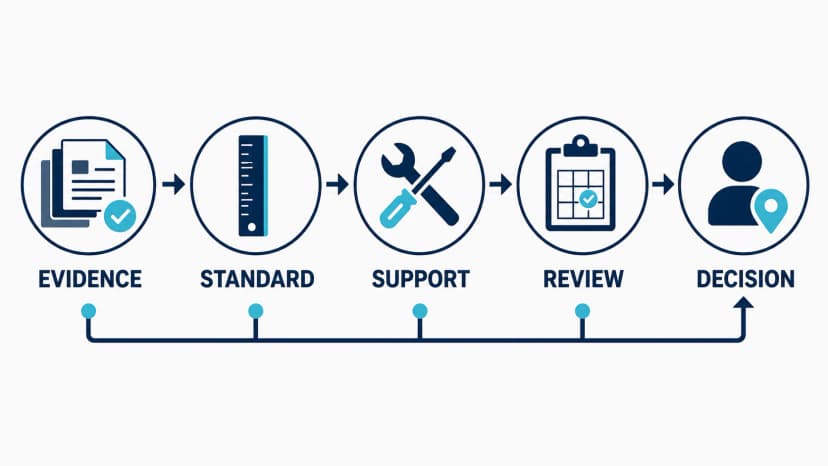
A roofing sales performance improvement plan should explain a documented gap, the job-related standard, the support the company will provide, the evidence used at each review, and who owns the next decision. It should not diagnose a rep's attitude, promise that improvement prevents discipline, or turn a short sales slump into a predetermined termination document.
Use the sales PIP builder to organize a draft after the manager has gathered the facts. The generated artifact is not legal advice and should be reviewed under the company's policies and applicable employment law before it is issued.
Next Step
Turn the PIP into a working process
These tools help managers diagnose the gap, score the rep fairly, and coach toward a measurable recovery plan.
PIP template for a roofing salesperson
| Section | What to include |
|---|---|
| Role and period | Job title, manager, plan start, scheduled reviews, and plan end |
| Documented gap | Specific records, dates, and source systems |
| Required standard | Existing job expectation or policy, applied consistently |
| Controllable behavior | Actions the rep can perform, not only lagging revenue |
| Support | Coaching, access, examples, practice, tools, or approved field observation |
| Evidence | CRM records, observed behaviors, completed tasks, and quality checks |
| Review cadence | Who meets, when, and what evidence will be discussed |
| Open issues | Data disputes, leave, accommodation request, territory or lead-quality concern |
| Acknowledgment | Confirmation of receipt—not forced agreement with every statement |
| Review | HR or qualified employment counsel as appropriate |
Do not paste a template into an employee file without reviewing the actual role, classification, jurisdiction, handbook, prior communication, and consistency with comparable cases.
Diagnose the system before the rep
Revenue alone cannot tell you why performance changed. Start with a funnel by lead source, territory, manager, and time period.
| Funnel stage | Evidence to inspect | Possible company-side issue | Possible rep-side behavior |
|---|---|---|---|
| Lead to contact | lead age, duplicates, valid contact rate | poor routing or stale source | slow first attempt or incomplete cadence |
| Contact to appointment | recorded disposition and notes | wrong targeting or offer | weak discovery or missing next step |
| Appointment held | confirmation and cancellation reason | scheduling or travel problem | inaccurate confirmation or late arrival |
| Inspection to estimate | inspection record and handoff | production or estimating delay | incomplete documentation |
| Estimate to decision | scope, follow-up, loss reason | price, financing, capacity | unclear comparison or weak follow-through |
| Sold to production | handoff quality and change orders | operational bottleneck | missing scope details or promises outside authority |
A veteran rep's plateau may reflect territory saturation, lead-mix change, pricing, manager capacity, seasonality, or a narrow skill gap. Compare like with like before calling it effort. A PIP should not be used to conceal a compensation, lead-allocation, or operational problem.
Use the sales KPI scorecard to define the metric and denominator before placing it in an individual plan.
Write the gap in observable language
Weak:
Jordan lacks urgency and does not seem committed.
Stronger:
From June 1–30, 14 of 22 assigned inbound leads had no first-attempt activity recorded within the team's published two-business-hour standard. The CRM activity report was reviewed with Jordan on July 2; two records remain disputed and are excluded pending review.
The stronger version identifies the period, population, standard, source, prior discussion, and uncertainty. It does not pretend to know motive.
Use verified data. Reconcile duplicate leads, reassigned opportunities, approved leave, CRM outages, and late imports. Give the employee a way to correct material factual errors.
Choose standards the rep can influence
Closed revenue and gross profit matter, but they are lagging outcomes affected by lead source, market, price, operations, and season. Pair them with controllable behaviors and quality checks.
Examples:
- record the required first-attempt activity within the published service level;
- use the approved appointment-confirmation workflow;
- complete inspection handoff fields before estimate assignment;
- document the customer's stated next step and follow-up date;
- attend assigned coaching and demonstrate the target behavior in practice;
- escalate insurance, financing, technical, or contract questions outside the rep's authority.
Do not create a new standard for one person after the fact. If the team has never had a documented CRM expectation, fix the operating standard before treating it as settled disciplinary evidence.
Match support to the gap
Support should make the expected behavior possible and create relevant evidence.
| Gap | Useful support | Evidence at review |
|---|---|---|
| Slow lead response | routing check, notification setup, protected call block | timestamped activity and exception notes |
| Missed confirmations | approved text/call workflow and task automation | confirmation tasks and appointment outcomes |
| Scope comparison | manager modeling and bounded role-play | rubric from varied practice plus observed estimate review |
| Weak CRM notes | required-field example and note audit | completeness and accuracy sample |
| Production handoff errors | checklist and joint review with operations | accepted handoffs and documented corrections |
Use the objection-practice system for a skill gap and the ride-along evaluation for observed field behavior. Do not use AI output as the sole basis for discipline or an employment decision.
Routine coaching belongs in the sales manager one-on-one workflow; keep it separate from the formal artifact and its authorized review process.
Set a review cadence
A practical plan might include a kickoff, short weekly evidence reviews, and a final scheduled review. The right duration depends on the behavior and how often the rep has a fair opportunity to demonstrate it. A rare seasonal task cannot be meaningfully evaluated on the same schedule as daily CRM follow-up.
At each review:
- reconcile the data;
- identify which standard was met or missed;
- document support provided;
- record material context or a dispute;
- agree on the next review and evidence source.
Avoid surprise scoring criteria. If the plan changes, document what changed, why, when it becomes effective, and how the rep can demonstrate it.
Completed roofing sales PIP example
Planning boundary: The completed record below is synthetic general information. It is not ready to issue to an employee and is not legal advice. Verify every fact, apply the company's actual policies consistently, give the employee a correction process, and obtain HR or qualified employment-law review for the specific role, facts, location, prior practice, leave, accommodation, and protected-activity context.
| Plan field | Completed synthetic entry |
|---|---|
| Role and dates | Residential sales representative; planning example starts August 3, 2026; evidence reviews August 10, 17, and 24; final scheduled review August 31 |
| Verified gap | From June 1–30, 14 of 22 assigned inbound leads lacked a first-attempt record within the published two-business-hour standard. Two disputed records are excluded pending routing-log review. |
| Job-related standard | For valid, assigned inbound leads received during scheduled hours, record the first attempt or an approved exception within two business hours using the existing CRM workflow. |
| Company support | Manager verifies routing and notifications on August 3, provides two completed record examples, protects a daily response block, and reviews exceptions before calculating results. |
| Review evidence | Assignment timestamp, first-attempt timestamp, approved exception note, duplicate or reassignment record, and the employee's correction or context note. Revenue and close rate are context, not the pass/fail measure. |
| Weekly review | Manager and rep reconcile the eligible population, preserve disputed records separately, document support delivered, and sign the next evidence date. No criterion changes without a dated written revision. |
| Decision ownership | Manager prepares the evidence summary; HR or qualified counsel reviews where appropriate; the company makes any employment decision under its policy and applicable law. This example promises no outcome. |
The worked example deliberately excludes the two disputed records instead of treating uncertainty as failure. If the routing review later resolves them, the record should show what changed, who verified it, and which review period is affected.
Handle accommodations, leave, and protected activity carefully
Employment requirements vary. Managers should not guess about medical conditions or use a PIP to investigate them. If an employee requests a workplace change related to a medical condition, raises protected leave, reports discrimination or safety concerns, or identifies another protected issue, involve HR or qualified counsel promptly.
The EEOC's guidance on performance and conduct standards emphasizes clear expectations, accurate measures, reliable feedback, consistent application, and reasonable-accommodation obligations. That guidance is a starting point, not a substitute for advice about a specific situation.
Keep medical information and accommodation records in the proper confidential process rather than in general coaching notes.
What the plan should not say
Remove language that:
- calls the document “legally defensible” or promises legal protection;
- guarantees termination, continued employment, or a particular outcome;
- assigns motive, personality, honesty, or medical explanation;
- creates unattainable targets or changes lead access to ensure failure;
- uses invented facts or benchmark claims;
- confuses coaching notes with a complete personnel record;
- says acknowledgment means the employee agrees with every claim.
The company should decide consequences under its policies and applicable law after reviewing the evidence—not ask a generator to make that decision.
When a PIP may be the wrong tool
Pause and get appropriate guidance when the issue involves immediate safety, violence, harassment, fraud, serious policy violations, protected activity, leave, accommodation, classification, wage-and-hour questions, or facts the company has not investigated. A routine performance template is not designed to resolve those issues.
A PIP may also be premature when the standard was never communicated, tools or lead access were unavailable, the data is materially disputed, or the manager has not separated a company process failure from an individual behavior.
Manager QA checklist
- Is every factual statement tied to a record, date, or direct observation?
- Is the standard job-related, previously communicated, and consistently applied?
- Did we separate lead, territory, price, and operational factors from rep behavior?
- Can the rep control the required action?
- Does the support match the gap?
- Are measurement definitions and review dates clear?
- Is there a process for corrections and contextual notes?
- Have accommodation, leave, retaliation, and consistency concerns been routed correctly?
- Has HR or qualified counsel reviewed the plan where appropriate?
- Does the document avoid promising an employment outcome?
Next Step
Coach the next conversation, not just the last number
When close rate drops, managers need a rep-level plan, field practice, and scorecard language that makes the next appointment better.
Frequently asked questions
How long should a roofing sales PIP last?
Long enough to provide a fair opportunity to demonstrate the specific behavior under normal working conditions. The period depends on task frequency, lead volume, season, support, policy, and legal context; there is no universal 30-day rule.
Should a PIP use close rate or revenue?
They can provide context, but pair lagging outcomes with controllable, job-related behaviors and comparable inputs. Define the denominator and time period.
Can AI write the final PIP?
AI can organize user-supplied facts into a draft. A trained person must verify every statement, remove invented content, apply company policy consistently, and obtain HR or legal review as needed.
Is a PIP required before termination?
That depends on the facts, jurisdiction, contract, policy, collective bargaining agreement if any, and prior practice. Get qualified advice; this guide does not answer that legal question.
How should a veteran sales plateau be handled?
First compare the rep's funnel with prior periods and comparable inputs. If the evidence shows a narrow behavior gap, use targeted support and an appropriate review cycle. Do not assume lower revenue proves lower effort.
Free tools for sales managers
Turn this into a manager workflow
Use free management and operations tools to turn coaching ideas into repeatable systems for your reps and managers.
Management tools
Use 1-on-1 scripts, meeting agendas, forecast templates, and escalation tools.
Browse management tools →Operations tools
Build scorecards, SOPs, pipeline templates, and review workflows your team can run every week.
Browse operations tools →AI Sales Coach
Give reps coaching based on real performance data instead of waiting for the next ride-along.
See AI Sales Coach →About the Author
Tim Nussbeck
Founder & CEO of GhostRep
Two decades in roofing—knocking doors, running teams, training 1,000+ reps. Built GhostRep to give every rep access to the coaching top teams get.
Manager next step
Turn this into a manager workflow your team can repeat
Use the management tools if you need a practical coaching or accountability system first. Book a walkthrough if you want GhostRep tied to rep performance and live coaching.
- ✓Best fit if coaching is inconsistent across reps and managers.
- ✓Useful for 1-on-1s, scorecards, and weekly operating rhythms.
- ✓Demo shows how AI Sales Coach turns performance data into specific guidance.
Start Here
Browse management tools
Open scorecards, coaching docs, forecast templates, and manager workflows.
Browse management toolsNeed it mapped to your team?
Talk through your current workflow, traffic mix, and where GhostRep fits before you change anything.
Book a 15-minute walkthroughYou Might Also Like
Learn how to take roofing sales call notes that separate sourced facts, customer statements, unknowns, commitments, and the next owned action.
Read article →Use seven decision gates to plan a roofing CRM rollout from workflow mapping and pilot through role training, go-live, and 30/60/90-day reviews.
Read article →Build a clear intake-to-calendar handoff for roofing leads with ownership, urgency, follow-up status, and a defined stop once the appointment is booked.
Read article →