AI can help a roofing company organize applications, ask the same structured questions, summarize job-related evidence, and flag responses for human review. It should not decide who deserves a job, guess whether someone is honest, or score personality from a face, accent, disability, or other protected characteristic.
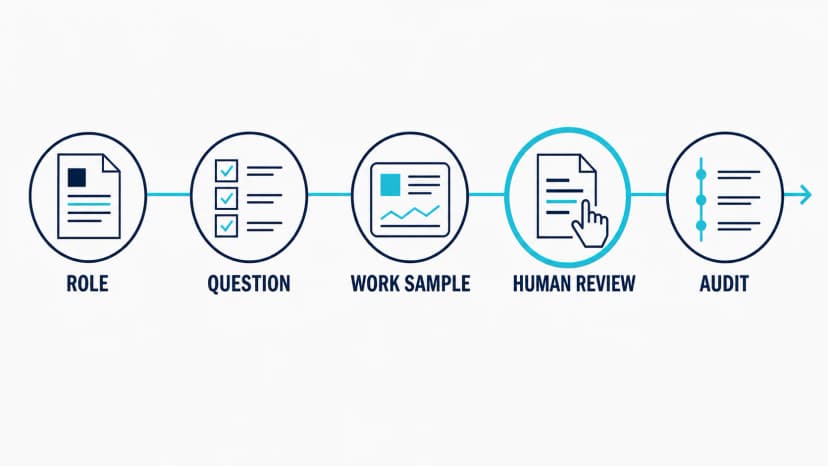
The strongest screening process starts with the work. Define what a rep must do, translate those duties into a scorecard, ask every candidate comparable questions, provide an accessible alternative, and have a trained person review the evidence before advancing or rejecting anyone.
For a roofing sales role, that evidence may include how a candidate prepares for a canvassing block, responds after repeated rejection, explains a complex issue to a homeowner, follows up after an appointment, or applies coaching to a second attempt. It should not include whether the candidate looks like a current top performer or matches a manager's idea of “sales DNA.”
Core rule: AI assists with consistency and administration. The employer remains responsible for the selection process, accommodations, validation, and final decision.
This guide is operational information, not legal advice. Employment laws and notice requirements vary by jurisdiction. Review the process with qualified employment counsel before deployment.
A Six-Stage AI-Assisted Screening Process
| Stage | What the system can assist with | What a person must own |
|---|---|---|
| 1. Define the role | Turn a job description into draft competencies and structured questions | Confirm essential duties, lawful requirements, compensation, and working conditions |
| 2. Build the scorecard | Standardize criteria, prompts, and note fields | Set job-related rubrics and remove proxies for protected characteristics |
| 3. Conduct the first screen | Ask the same questions, capture responses, and create a review summary | Disclose the technology, provide accommodations, and monitor completion |
| 4. Run a work sample | Present a consistent roofing-sales scenario and record the response | Ensure the exercise reflects the actual role and does not test an unrelated limitation |
| 5. Review and interview | Organize evidence against the rubric and identify missing information | Check the original response, investigate flags, and make the decision |
| 6. Audit outcomes | Aggregate completion, advancement, and outcome data | Review validity, adverse impact, accommodations, overrides, and process changes |
Start with a written rubric before reviewing applicants. The free sales candidate scorecard can help establish a consistent structure, and the sales interview questions tool can generate a draft question set. A manager should review both against the actual job before they are used.
What Belongs on a Roofing Sales Scorecard
| Criterion | Job-related evidence | Avoid using as a proxy |
|---|---|---|
| Homeowner communication | Explains an inspection next step in plain language and checks for understanding | Accent, vocal style, facial expression, or similarity to current reps |
| Follow-through | Gives a specific example of tracking commitments through completion | Employment gaps or assumptions about family responsibilities |
| Coachability | Revises a door opener or appointment response after receiving clear feedback | Agreement with the interviewer or enthusiasm alone |
| Field planning | Describes how to prepare a territory, document activity, and follow up | Age, appearance, or a broad “culture fit” score |
| Objection handling | Clarifies the homeowner's concern before answering and avoids unsupported promises | A memorized script delivered with confidence |
| Roofing knowledge | Only the knowledge genuinely required on day one; otherwise evaluate learning ability | Industry pedigree when the company intends to train the skill |
A score should point back to observable evidence. “Candidate gave two specific follow-up examples and described the tracking method” is reviewable. “Candidate has natural hustle” is not.
Completed screening scorecard example
The example below is synthetic. It shows how a reviewer can preserve the original evidence, score only the declared criterion, and keep an unknown open. The 7-of-10 total is a routing aid for a structured human follow-up; it is not an automated advance, rejection, or hiring decision.
| Criterion | Observed evidence | Rubric score | Human follow-up |
|---|---|---|---|
| Homeowner communication | Explained why photos precede an estimate, asked whether the sequence was clear, and made no coverage promise | 2 of 2 | Verify the behavior in a second scenario with less information |
| Follow-through | Named a calendar and task list but did not provide a completed example or explain how missed commitments are recovered | 1 of 2 | Ask for one specific record, deadline, miss, and corrective action |
| Coachability | Removed an unsupported urgency claim and used the manager's requested permission question on the second attempt | 2 of 2 | Retain both attempts in the work-sample record |
| Field planning | Described territory preparation and activity logging; did not address how a property-access restriction changes the plan | 1 of 2 | Present a bounded access scenario and record the response |
| Objection handling | Acknowledged a price concern but began comparing contractors before asking to review the written scopes | 1 of 2 | Run a scope-comparison follow-up with the same rubric |
Reviewer record: 7 of 10 on this synthetic rubric. Status: additional structured interview needed. Decision owner: hiring manager after source-response review and any required accommodation process. Unknowns remain unknown until the candidate supplies evidence.
Structured Questions and Work Samples
Ask the same core questions in the same order, then use consistent follow-ups when a response needs clarification. A structured process makes candidates easier to compare and reduces the temptation to advance someone because the conversation simply felt good.
Field rejection
Question: “You have knocked twenty doors without setting an appointment. Walk me through what you do before the next five doors.”
Score for: a safe reset, review of the opener, territory awareness, continued respectful activity, and a plan to record the result. Do not infer resilience from voice tone or facial analysis.
Homeowner explanation
Question: “A homeowner asks why you need photos and an inspection before discussing price. Explain the next step without making an insurance or coverage promise.”
Score for: plain language, an accurate process, permission, and no guarantee about damage, approval, or claim outcome.
Coachability work sample
Give the candidate a short door opener, one specific coaching note, and a second attempt. Score whether the revision addresses the note. This tests application of feedback more directly than asking whether the person considers themselves coachable.
Follow-through
Question: “Tell me about a time a sale or project required several follow-ups. What did you promise, how did you track it, and what happened?”
Score for: a concrete system, accurate communication, and ownership of missed steps. Verify material claims later rather than asking AI to label the candidate truthful or deceptive.
Compliance Guardrails for AI Screening
The U.S. Equal Employment Opportunity Commission explains that employment tests and selection procedures can violate federal anti-discrimination law if they intentionally discriminate or disproportionately exclude a protected group without legal justification. The EEOC recommends that employers use properly validated, job-related procedures, understand their limits, and consider equally effective alternatives with less adverse impact. Read the agency's employment tests and selection procedures guidance.
The Department of Justice's ADA guidance warns that hiring technology can screen out qualified people with disabilities even without discriminatory intent. Employers should evaluate the technology before and during use, tell applicants enough to request an accommodation, provide a clear accommodation process, and offer an accessible alternative when needed. See ADA.gov guidance on algorithms, AI, and disability discrimination in hiring.
Minimum guardrail checklist
- Document each essential job duty and the evidence used to assess it.
- Tell applicants when and how AI or automated technology is used.
- Provide a clear, non-punitive way to request an accommodation or alternative format.
- Do not ask pre-offer disability questions or use technology to infer medical information.
- Do not score protected characteristics or proxies such as age, accent, appearance, or facial movement.
- Require a person to review source responses before any adverse decision.
- Record who reviewed the evidence, what criteria were applied, and why the decision was made.
- Measure advancement and selection outcomes, investigate disparities, and change the process when a less discriminatory effective alternative is available.
- Revalidate the process when the role, territory, compensation model, or assessment changes.
Flags That Require Human Review
A flag is a prompt to investigate, not proof that a candidate is unqualified.
| Review flag | Appropriate follow-up | Do not assume |
|---|---|---|
| Response is incomplete | Ask the same neutral follow-up or offer the work sample in another accessible format | The candidate lacks effort or ability |
| Resume and interview dates differ | Ask the candidate to clarify dates and verify material history consistently | The candidate lied |
| Audio or video quality is poor | Offer a retry or another accessible channel | The candidate communicates poorly |
| Work-sample answer misses a requirement | Check whether the requirement was clear and genuinely essential | The candidate cannot learn the process |
| Score differs sharply from interviewer notes | Review the original response against the written rubric and document the resolution | The automated score or manager instinct is automatically correct |
How to Measure Screening Quality
Speed is useful only if the process remains job-related, accessible, and accurate. Track:
- Application, completion, advancement, interview, offer, and acceptance counts.
- Accommodation requests, completion after accommodation, and recurring accessibility failures.
- Human overrides of automated summaries or scores and the documented reason.
- Interviewer agreement when two people apply the same rubric.
- Performance against clearly defined job milestones after hire, without treating retention alone as proof that the screen is valid.
- Outcomes by legally appropriate demographic groups, reviewed with counsel for adverse impact.
Do not train a model only to imitate past hiring decisions. Historical decisions can carry forward old preferences and exclusions. Compare the process with the work the rep actually performs and reassess it when the job changes.
Use a Year-Round Recruiting Cadence
“Always be recruiting” should mean maintaining a consistent, lawful process—not keeping people in a hidden scoring pool or inviting applications for jobs that do not exist. Publish accurate role status, compensation structure, territory, travel, canvassing, and timing. Tell prospects whether they are applying for an open seat, a future opening, or an opt-in talent community.
- Monthly: review forecasted hiring needs, approved openings, source quality, and candidate experience issues.
- Before storm hiring: confirm manager capacity, onboarding gates, field safety, equipment, territory, and lead access before increasing application volume.
- For future-interest candidates: obtain permission to retain contact information, explain how long it will be kept, and provide an opt-out or deletion path under applicable policy and law.
- When a role changes: update the scorecard and revalidate questions before comparing new candidates with old results.
A pipeline is not a substitute for an approved headcount plan. Connect forecasted hires to the manager time and task-based onboarding capacity described in the 30-day roofing sales onboarding plan.
Connect the Screen to Onboarding
Screening should hand the manager a development plan, not a permanent label. A candidate who communicates well but needs roofing vocabulary may be a good training candidate if product knowledge is not required on day one. A rep who performs well on a work sample still needs documented field safety, company process, and product training.
Use the 30-day onboarding guide to turn the accepted offer into specific checkpoints. Build reusable practice assets with the roofing sales training library framework. If a vacancy is already open, model the operating tradeoffs with the sales rep turnover cost calculator.
If administrative volume is the bottleneck, evaluate whether a screening tool can administer consistent questions, capture source responses, and organize evidence without making the employment decision. Require clear notice, an accommodation path, access to the original response, and documented human review.
Start with the process: Create a role-specific candidate scorecard and structured interview questions. Add technology only after the job-related criteria, accommodation process, reviewer responsibilities, and audit plan are documented.
AI Roofing Rep Screening FAQ
Should AI reject roofing sales candidates automatically?
No. Use AI to administer consistent questions, organize evidence, and flag items for review. A trained person should review the source material and apply the job-related rubric before an adverse decision.
Can AI detect whether a candidate is lying?
AI can identify inconsistencies or missing information, but it should not label a person deceptive from voice, face, or response style. Ask for clarification and verify material claims using a consistent process.
What if an applicant cannot use the interview technology?
Provide a clear accommodation process and an accessible alternative that measures the same job-related skills. Requesting an accommodation should not lower the candidate's chance of advancement.
What should the human reviewer inspect?
Review the original answers, work sample, rubric, automated summary, any accommodation context, and the reason for each score. Document overrides and do not rely on a summary when the underlying evidence is available.
Free tools for sales hiring
Make hiring easier to operationalize
If this article surfaced a hiring gap, start with free templates and frameworks before you overhaul the whole process.
Hiring tools
Generate scorecards, interview questions, onboarding plans, and accountability docs.
Browse hiring tools →All free tools
Browse every free GhostRep tool if you want hiring, training, and management resources in one place.
Browse all tools →Structured hiring resources
Use consistent, job-related questions and scorecards while keeping every employment decision with a human.
Browse hiring resources →About the Author
Tim Nussbeck
Founder & CEO of GhostRep
20+ years in roofing and home improvement sales—knocking doors, running teams, and building practical coaching systems. Built GhostRep to give every rep access to the coaching top teams get.
Hiring next step
Turn hiring advice into a documented human process
Start with free hiring resources if you need job descriptions, structured interview worksheets, or onboarding docs. GhostRep's standard product walkthrough begins with post-hire onboarding, practice, and coaching.
- ✓Best fit if managers are wasting time on low-signal interviews.
- ✓Useful for job-related evidence notes, interview structure, and onboarding clarity.
- ✓Use consistent job-related questions and keep every employment decision with a human reviewer.
Start Here
Browse hiring tools
Generate evidence worksheets, structured questions, onboarding plans, and accountability docs.
Browse hiring toolsNeed it mapped to your team?
Talk through your current workflow, traffic mix, and where GhostRep fits before you change anything.
Book a 15-minute walkthroughYou Might Also Like
Compare W2 employees and 1099 contractors for roofing sales using current IRS and DOL factors, operating costs, and a manager fact checklist.
Read article →Compare the $71,310 BLS employee median with three published roofing sales pay offers, commission terms, first-year limits, and a free offer worksheet.
Read article →Compare current training with an AI-supported workflow using consistent costs, manager time and observed outcomes. Includes a worked cost model.
Read article →