The honest breakdown of costs, accuracy, speed, and when to use each approach
Next Step
Compare recruiting options with a real candidate scorecard
Whether the first screen is AI or human, the hiring decision still needs a consistent scorecard and better interview structure.
The Short Answer
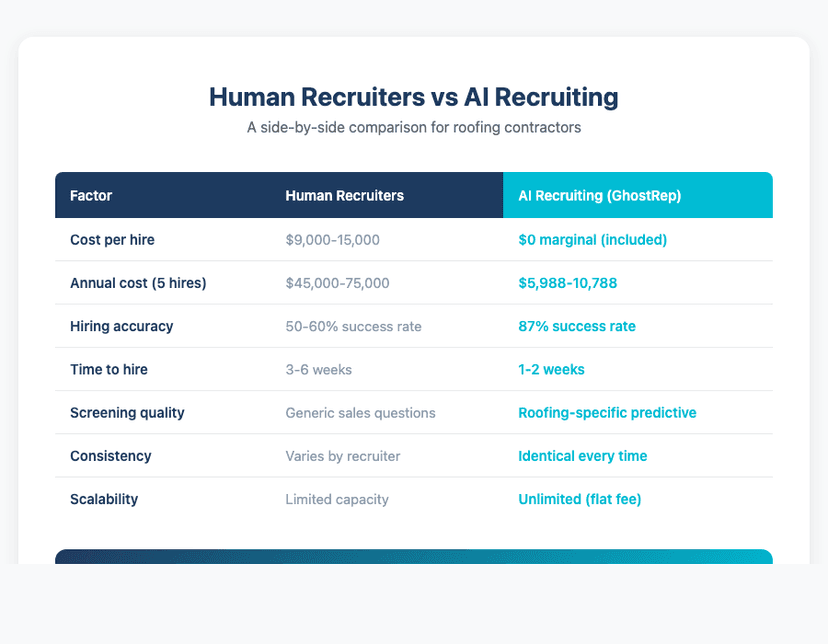
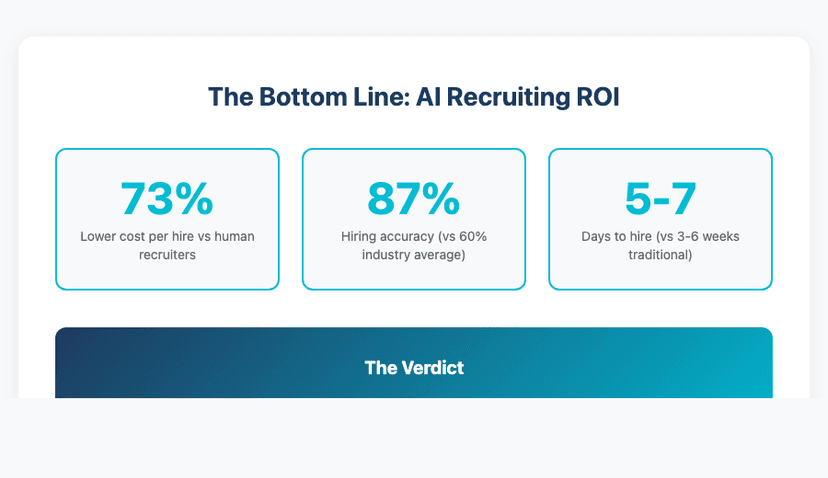
If you're hiring roofing sales reps, you have two main options: pay human recruiters $9,000-15,000 per placement (with 50-60% accuracy), or use AI recruiting that screens candidates automatically with 87% accuracy at near-zero marginal cost.
Human recruiters excel at sourcing passive candidates, building relationships, and selling your opportunity to top talent. AI recruiting excels at efficiently screening large volumes of active applicants with objective data and consistent criteria.
Here's what matters: they solve different problems. Human recruiters find candidates. AI recruiting screens candidates. The question isn't "which is better"—it's "which problem do you actually have?"
For most roofing companies hiring 3-10 reps per year from active applicants (Indeed, ZipRecruiter), AI recruiting saves $36,000-150,000 annually while improving quality. For specialized roles requiring passive candidate outreach, human recruiters still make sense.
This article breaks down the real costs, accuracy data, and helps you figure out what works for your situation.
What Human Recruiters Actually Do
Let's start with what you're paying for when you hire an external recruiting firm.
You contact a recruiter who specializes in sales (rarely roofing-specific). You explain the role: commission-only roofing sales, door knocking, need someone with resilience and sales experience. The recruiter takes notes, asks about compensation structure, talks about their process.
Then they go to work. They post your job on their networks. They search resume databases. They reach out to people who aren't actively looking (passive candidates). They make calls. They screen candidates over the phone. They present 3-5 finalists to you.
You interview the finalists. Maybe you hire one. Maybe not. If you do hire someone, the recruiter sends an invoice for $9,000-15,000 (typically 15-20% of first-year compensation, estimated at $60,000-75,000 for roofing sales reps).
What human recruiters are good at:
They can reach passive candidates—people who aren't actively job searching but might be open to the right opportunity. This is valuable for specialized or senior roles where the best candidates aren't on Indeed.
They build relationships. A good recruiter will sell your opportunity to candidates, handle objections, and shepherd the process. They're essentially doing sales on your behalf.
They add credibility. Having a third party validate your company can make it feel more legitimate to skeptical candidates.
They provide market intelligence. Experienced recruiters know what competitors are paying, what messaging works, what candidates care about.
What human recruiters aren't good at:
Volume. A recruiter typically presents 3-5 candidates per search. If you need to screen 200 applicants during storm season, that's not their model.
Roofing expertise. Most external recruiters are generalists. They're reading from your job description but don't understand the nuances of roofing sales—door knocking psychology, commission-only tolerance, adjuster dynamics. Their screening questions are generic sales questions, not roofing-specific.
Objectivity. Recruiters are incentivized to make placements. They get paid when you hire someone. This creates subtle pressure to present candidates who might not be ideal fits.
Cost efficiency. At $9,000-15,000 per hire, the costs add up fast. Five hires per year = $45,000-75,000 in recruiter fees.
The accuracy problem nobody talks about:
Industry data shows that external recruiter placements succeed (still employed and hitting targets at 6 months) about 50-60% of the time. That's better than random (30-40% with manager phone screens), but it's not great.
Why? Because phone screens—even professional ones—don't predict roofing sales success well. Someone can interview great and bomb in the field. The traits that make someone good at interviewing (polished, professional, knows what to say) aren't the same traits that make someone good at knocking doors in 95-degree heat after 47 rejections.
The timeline is slow:
From initial contact to hire typically takes 3-6 weeks. In storm season when you need bodies knocking doors next week, that's too slow. By the time the recruiter presents candidates, the opportunity is half over.
What AI Recruiting Actually Does
AI recruiting is fundamentally different. It's not about finding candidates—it's about efficiently screening the candidates who already applied.
Here's how it works: You post your job on Indeed or ZipRecruiter like normal. But instead of applications hitting your inbox, you include an AI recruiting link. Candidates click it and get interviewed immediately by AI—voice-based conversation, 5-20 minutes depending on their qualifications.
The AI asks roofing-specific questions that actually predict success: commission tolerance ("You could work 60 hours and earn $0 that week—can you handle that financially and emotionally?"), rejection resilience (scenario-based questions about hostile homeowners), learning ability, problem-solving with actual roofing situations.
The AI adapts based on responses. If someone is clearly unqualified (wants hourly pay, afraid of heights), the interview ends quickly at 5 minutes. If they show promise, it goes deeper—15-20 minutes of comprehensive assessment.
You receive detailed reports with numerical scores (0-100), clear recommendations (Strong Hire / Consider / Pass), specific strengths and concerns noted, and suggested next steps. Your time investment: 30 minutes per week reviewing scored candidates instead of 20 hours per week doing phone screens.
What AI recruiting is excellent at:
Volume screening. The AI can interview 200 candidates in a weekend while you sleep. You can't. Your recruiter can't. The throughput is unlimited.
Consistency. The AI asks the same questions to everyone. No bad days. No unconscious bias. No fatigue on candidate #47. Every candidate gets the same thorough assessment.
Roofing-specific evaluation. The questions are built specifically for roofing sales success prediction: commission structure comfort, rejection handling, height tolerance, physical demands acceptance, learning style for technical knowledge.
Objective data. You get numerical scores based on answers that correlated with success in thousands of prior hires. Not "I have a good feeling about this person." Actual data.
Speed. Candidates are screened within minutes of applying. No waiting days for callbacks. No scheduling phone screens. Immediate assessment.
Cost efficiency. After buying prepaid wallet hours, there's no marginal cost per hire beyond the hours candidates use. Screen 5 candidates or 500—same price.
What AI recruiting isn't good at:
Sourcing passive candidates. If someone isn't actively applying to jobs, the AI never talks to them. It only screens active applicants who clicked your job posting.
Relationship building. The AI interviews candidates professionally, but it's not schmoozing them, getting them excited about your culture, or handling their concerns with empathy the way a human recruiter would.
Selling your opportunity. If your company is unknown or your compensation structure is below market, a human recruiter can position it better than AI can.
Complex judgment calls. For nuanced situations requiring human intuition—like sensing when someone is being dishonest or recognizing potential despite rough edges—humans still have an advantage.
The accuracy is proven:
87% of candidates the AI recommends as "Strong Hire" are still employed at 6 months and hitting performance targets. This is significantly better than human recruiters (50-60%) and dramatically better than manager phone screens (30-40%).
Why? Because the AI is evaluating traits that actually predict roofing sales success, not interviewing skills. It's pattern-matching against thousands of successful and unsuccessful hires.
The timeline is instant:
Candidate applies Monday at 9 AM. AI interviews them by 9:20 AM. Report is in your dashboard by 9:25 AM. You can schedule an in-person interview that afternoon if they're a strong match.
Side-by-Side Comparison
The Real Cost Comparison
Let's be specific about what this actually costs over a year.
Scenario: 5-person roofing sales team, typical hiring needs
Human Recruiter Approach:
You need to hire 5 reps this year (normal turnover + growth).
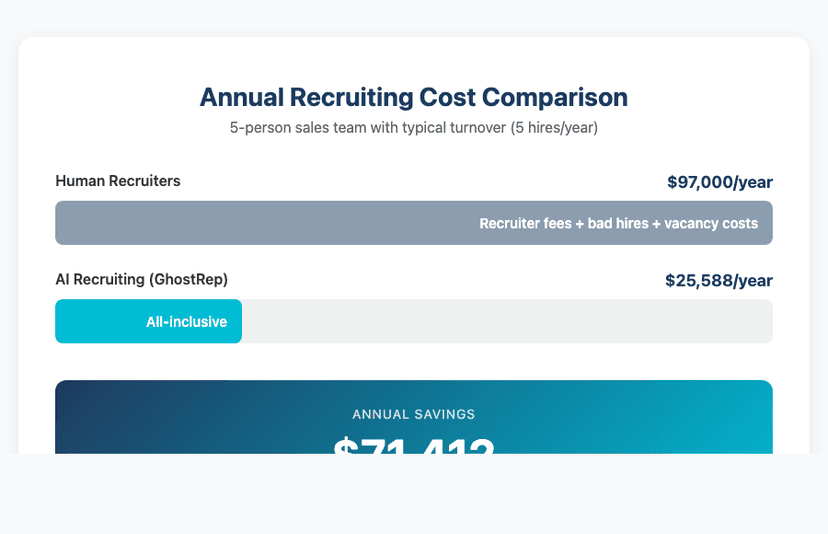
- Recruiter fees: 5 hires × $12,000 average = $60,000
- Your time doing final interviews: 10 hours (2 hours per hire)
- Time to hire: 3-6 weeks each
- Success rate: 50-60%, so 2-3 of those 5 will fail
- Bad hires that need replacement: 2.5 × $12,000 = $30,000 additional
- Total first-year cost: $90,000
Plus you still spend time on final interviews. Plus the 2-3 failed hires cost you in training investment, burned prospects, and opportunity cost ($76,000 per bad hire when you factor everything in).
Total real cost: $90,000 + (2.5 bad hires × $76,000) = $280,000
AI Recruiting Approach:
You post jobs on Indeed/ZipRecruiter like normal.
- Indeed/ZipRecruiter sponsored posts: $400-600/month × 4 hiring months = $2,000
- GhostRep prepaid wallet: starts at $200 for 20 hours, with 100 hours for $600 or 250 hours for $1,000 when hiring volume is higher
- Your time reviewing scored candidates: 30 min/week × 52 weeks = 26 hours
- Your time on final interviews: 10 hours (2 hours per hire)
- Time to hire: 1-2 weeks each
- Success rate: 87%, so 0.65 of those 5 will fail
- Bad hires that need replacement: Minimal (87% accuracy prevents most)
- Total first-year cost: $7,988
Plus higher success rate means fewer bad hires: (0.65 bad hires × $76,000) = $49,400 vs $190,000
Total real cost: $7,988 + $49,400 = $57,388
Savings with AI recruiting: $222,612 per year (79% reduction)
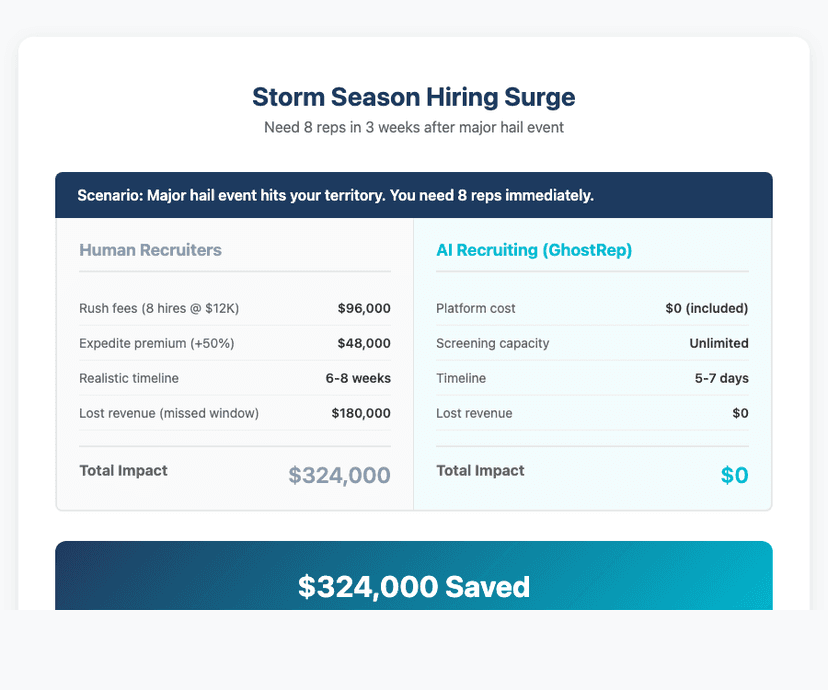
Scenario: Storm season hiring surge
You need 10 reps in 2 weeks for storm season.
Human Recruiter Approach:
- Recruiter fees: 10 hires × $12,000 = $120,000
- Timeline: 3-6 weeks (storm season half over)
- Volume limitations: Recruiter can't source 10 qualified candidates that fast
- You end up hiring whoever you can find, lowering standards
- Bad hire rate increases to 60%+ due to desperation
- Outcome: You miss peak storm opportunity while waiting for candidates
AI Recruiting Approach:
- Indeed/ZipRecruiter aggressive sponsored posts: $2,000
- GhostRep subscription: Already included
- AI screens 200+ applicants in 3 days
- You review 20-25 "Strong Hire" recommendations (4 hours)
- Interview 15 finalists over 3 days
- Hire 10 within 1 week
- 87% accuracy maintained (no desperation hiring)
- Outcome: Team ready before peak storm period
Difference: $118,000 in recruiter fees saved, plus you capture full storm opportunity (potentially $500,000+ in additional revenue)
When Human Recruiters Make Sense
Let's be fair—there are situations where paying a human recruiter is worth it.
1. Senior or specialized roles
If you're hiring a VP of Sales, Regional Manager, or highly specialized role, human recruiters add value. These positions require passive candidate sourcing (the best people aren't on Indeed) and careful vetting of complex experience.
2. When you have zero employer brand
If your company is unknown and you're competing against established players, a recruiter can sell your opportunity better than a job posting can. They're essentially your sales team for recruiting.
3. When you need hand-holding
Some companies want a recruiter to manage the entire process—sourcing, screening, scheduling, negotiating offers. If you value that white-glove service and have budget, it exists.
4. When you're hiring extremely infrequently
If you hire one person every 2-3 years, the subscription cost of AI recruiting might not make sense. Pay-per-placement could be more economical.
5. Geographic markets with limited applicant flow
If you're in a rural area where job postings generate only 5-10 applicants, you might need a recruiter to actively source candidates from other regions.
When AI Recruiting Makes Sense
For most roofing companies, AI recruiting is the better choice.
1. You're hiring 3+ people per year
At 3 hires per year, AI recruiting pays for itself in saved recruiter fees alone ($36,000 saved vs the selected prepaid wallet bundle). Everything beyond that is pure savings.
2. You hire from active applicants (Indeed, ZipRecruiter)
If your jobs get 50+ applications, you don't need sourcing—you need efficient screening. That's exactly what AI recruiting solves.
3. Storm season hiring surges
When you need to hire 5-10 people in 2 weeks, human recruiters can't move fast enough. AI recruiting scales instantly.
4. You're tired of phone screens eating your life
If you're spending 15-20 hours per week on phone screens that produce mediocre results, AI recruiting gets that time back immediately.
5. You want objective readiness data
AI recruiting gives you numerical scores and predictive data, not "I think this person will work out." Data-driven hiring beats gut-feel hiring.
6. Budget constraints
With prepaid bundles starting at $200 and scaling to $1,000 for 250 hours, AI recruiting is accessible even for small companies. $60,000+ in recruiter fees is not.
The Combined Approach (What Smart Companies Do)
Here's what most successful roofing companies figure out: use both strategically.
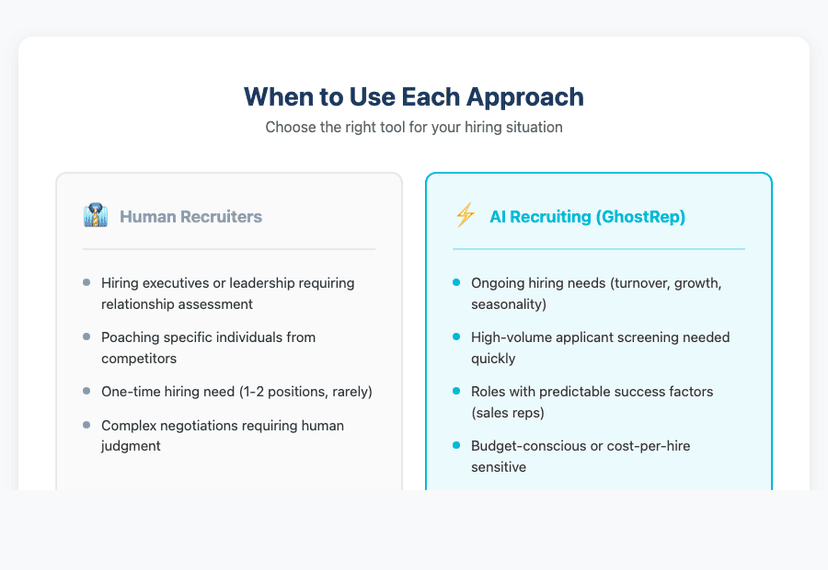
Use AI recruiting for:
- High-volume screening of active applicants
- Entry-level to mid-level sales rep positions
- Storm season hiring surges
- Ongoing pipeline building (always accepting applications)
- Cost-efficient baseline recruiting
Use human recruiters for:
- Senior management positions (VP Sales, Regional Managers)
- Specialized technical roles (estimators with PE licenses, etc.)
- Passive candidate outreach when you need someone specific
- Markets where your job postings generate insufficient volume
- When you need help selling a tough compensation structure
Example integrated strategy:
Year-round baseline:
- Job postings live on Indeed/ZipRecruiter with AI recruiting link
- Candidates screened automatically
- You review "Strong Hire" recommendations weekly
- Hire 2-4 reps per year this way
- Cost: prepaid GhostRep wallet hours + job posting ads
Senior role (once every 2-3 years):
- Hire executive recruiter for VP of Sales search
- Pay $15,000-20,000 for placement
- Worth it for specialized senior role requiring passive outreach
Total annual cost: prepaid GhostRep wallet usage + occasional senior placement when needed
Compare to all-recruiter approach: $60,000-90,000+/year
Savings depend on usage, but the model avoids recruiter fees while improving quality.
Addressing Common Concerns
"Won't candidates be turned off by talking to AI instead of a human?"
In practice, no. Candidates appreciate the efficiency. They're not waiting 3-5 days for a callback—they're interviewed immediately. Plus, 90% of job applicants never hear back from companies at all (they just get ghosted). An immediate AI interview is better than silence.
The AI discloses upfront that it's AI-powered screening. Candidates know what they're getting into. Strong candidates appreciate objective assessment over "Did I catch the manager on a good day?"
"Can AI really assess cultural fit and soft skills?"
AI assesses traits that predict success: commission tolerance, rejection resilience, learning ability, problem-solving. These are the traits that matter in roofing sales.
Cultural fit assessment happens during your in-person interviews. AI recruiting gets you to the right candidates faster—you still make the final judgment on culture, team dynamics, and intangibles.
"What if the AI makes mistakes?"
The AI provides recommendations, not decisions. You're the final decision-maker. If a "Strong Hire" seems off in your interview, don't hire them.
But statistically, the AI is making fewer mistakes than you are. 87% accuracy vs your 30-40% accuracy with phone screens. Trust the data, but verify with your own judgment.
"Doesn't this just favor people who are good at talking to AI?"
No. The AI evaluates answer content, not delivery style. It's assessing whether someone can handle commission-only structure, rejection, and roofing-specific scenarios—not whether they're charismatic on camera.
Actually, this removes bias that favors smooth talkers. The AI doesn't care if someone is charming—it cares if their answers predict roofing sales success.
"Can I customize the questions to fit my company?"
Yes. You can add 5-10 custom questions specific to your operation (territory requirements, schedule expectations, specific tools/systems). But the core predictive questions stay consistent—that's what makes the 87% accuracy possible.
"What about hiring for culture and values alignment?"
AI recruiting handles capability assessment (can they do the job?). You handle culture assessment (do they fit our team?) during in-person interviews.
This is actually more efficient. Don't waste 20 hours screening people who can't do the job. Use AI to filter for capability, then invest your time assessing culture fit with the qualified candidates.
Next Step
Keep the new hire from becoming the next turnover stat
Once a candidate clears screening, the next ranking signal for the business is whether the rep ramps without burning the first leads.
Making the Decision
Choose Human Recruiters If:
You're hiring for senior/specialized roles requiring passive sourcing - VP of Sales, Regional Managers, specialized technical positions where the best candidates aren't actively looking.
Your job postings generate fewer than 20 applicants - If you're not getting volume, you need someone actively sourcing candidates.
You need someone to sell your opportunity to skeptical candidates - Unknown company, below-market comp, or difficult sell? Human touch helps.
You hire less than 2 people per year - Subscription economics don't make sense at very low volume. Pay-per-placement might be more cost-effective.
You value white-glove service over cost efficiency - Want someone managing the entire process end-to-end? That's what recruiters do.
You have $50,000-100,000+ annual recruiting budget - If cost isn't a constraint and you want human relationships, recruiters work.
Choose AI Recruiting If:
You're hiring 3+ entry/mid-level reps per year - At 3 hires annually, AI recruiting pays for itself in saved recruiter fees alone ($36,000 saved vs the selected prepaid wallet bundle).
Your job postings generate 50+ applicants - You don't need sourcing, you need efficient screening. That's exactly what AI recruiting solves.
You're spending 10+ hours per week on phone screens - AI recruiting gets that time back immediately.
You need to hire fast, especially storm season - When you need 5-10 people in 2 weeks, human recruiters can't move fast enough. AI recruiting scales instantly.
You want 87% accuracy vs 50-60% - Objective data-driven assessment beats subjective phone screens.
Budget is constrained - $6K-11K annually vs $50K-100K makes AI recruiting accessible even for smaller companies.
You want objective data-driven hiring decisions - Numerical scores and predictive data instead of "I think this person will work out."
Scaling team size and need system that scales with you - Same flat fee whether you screen 5 or 500 candidates.
Use Both If:
You want maximum results at optimal cost - Leverage AI for volume, use recruiters strategically for specialized roles.
You hire mix of entry-level and senior positions - Different roles need different approaches.
You do both volume hiring and specialized hiring - Use the right tool for each situation.
You recognize they solve different problems - Sourcing vs screening are different challenges requiring different solutions.
Bottom line: For most roofing companies doing volume hiring of sales reps, AI recruiting saves $35,000-200,000+ annually while improving quality from 50-60% accuracy to 87% accuracy.
Human recruiters still have a place for specialized roles and passive sourcing. But for your bread-and-butter sales rep hiring from active applicants, AI recruiting is dramatically better on every metric that matters: cost, speed, accuracy, and scalability.
For roofing teams, the next step is simple: review AI Recruiter, tighten your job post with the job description generator, and standardize finalist screening with the sales interview questions tool.
This comparison is based on verified industry data on recruiter fees and success rates, plus GhostRep customer data. Last updated November 1, 2025.
Free tools for sales hiring
Make hiring easier to operationalize
If this article surfaced a hiring gap, start with free templates and frameworks before you overhaul the whole process.
Hiring tools
Generate scorecards, interview questions, onboarding plans, and accountability docs.
Browse hiring tools →All free tools
Browse every free GhostRep tool if you want hiring, training, and management resources in one place.
Browse all tools →AI Recruiter
Screen candidates before you burn manager time on interviews that were never a fit.
See AI Recruiter →About the Author
Tim Nussbeck
Founder & CEO of GhostRep
Two decades in roofing—knocking doors, running teams, training 1,000+ reps. Built GhostRep to give every rep access to the coaching top teams get.
Hiring next step
Turn hiring advice into a repeatable screen
Start with free hiring tools if you need scorecards, interview questions, or onboarding docs. Book a walkthrough if you want GhostRep mapped to your recruiting funnel.
- ✓Best fit if managers are wasting time on low-signal interviews.
- ✓Useful for scorecards, interview structure, and onboarding clarity.
- ✓Demo shows how AI Recruiter reduces screening load before the first call.
Start Here
Browse hiring tools
Generate interview scorecards, screening questions, onboarding plans, and accountability docs.
Browse hiring toolsNeed it mapped to your team?
Talk through your current workflow, traffic mix, and where GhostRep fits before you change anything.
Book a 15-minute walkthroughYou Might Also Like
80% of roofing sales applicants lie on resumes. AI screening catches liars in 72 hours, scoring candidates 1-100 on traits that predict commission success.
Read article →Compare W2 vs 1099 roofing sales reps by true cost, misclassification risk, retention, training ROI, and why serious roofing teams usually choose W2.
Read article →GhostRep screens 127+ candidates automatically with AI video interviews, custom AI trained on your pitch, and Sales DNA scoring for roofing reps.
Read article →