March 15th. Your sales manager just gave two weeks notice. Storm season starts in six weeks. You've got three reps total—one still can't handle price objections.
You open Indeed and type "roofing sales rep needed immediately."
You're about to make the same mistake 80% of roofing companies make every spring.
Storm season hiring fails because the timeline doesn't work. By the time you post ads, screen 200 applications, interview candidates, and train new hires, you're 8-12 weeks deep. Your new reps finally get competent just as the work dries up.
Companies practicing Always Be Recruiting (ABR) have trained reps ready by week 3. They generate $400,000-$600,000 more revenue per hiring cycle than competitors stuck in reactive mode.
That's not a slight advantage. That's the difference between a profitable storm season and playing catch-up all summer.
You've heard "Always Be Closing" your entire career. ABC. The old mantra.
Here's the new one: Always Be Recruiting. ABR.
Not when you're desperate. Not when storm season starts. Not when someone quits.
Always.
🌪️ The Timeline Problem Nobody Talks About
Here's what actually happens when you wait until storm season to hire:
Week 1-3: You post "URGENT HIRING" ads alongside 30 other companies. (Your recruiting ad generator can write a better ad than 90% of what's on Indeed right now.) Applications flood in from people who got fired from their last roofing job or have never sold a roof. Half the scheduled interviews no-show. You hire whoever seems halfway competent because you need bodies now.
Week 4-7: Training burns your manager's most valuable time during peak season. New hires learn your pitch while your competitors' February hires are already closing deals at 30%.
Week 8: Your first "good" rep quits after going 0-for-15. You've wasted four weeks of training and fifteen storm leads.
Week 9-11: Survivors finally close at 15%—well below your team average. Just as they're getting competent, the easy storm work dries up.
Week 12: Most new hires quit because "there's no more work." You burned $25,000-$40,000 per rep for eight weeks of mediocre performance.
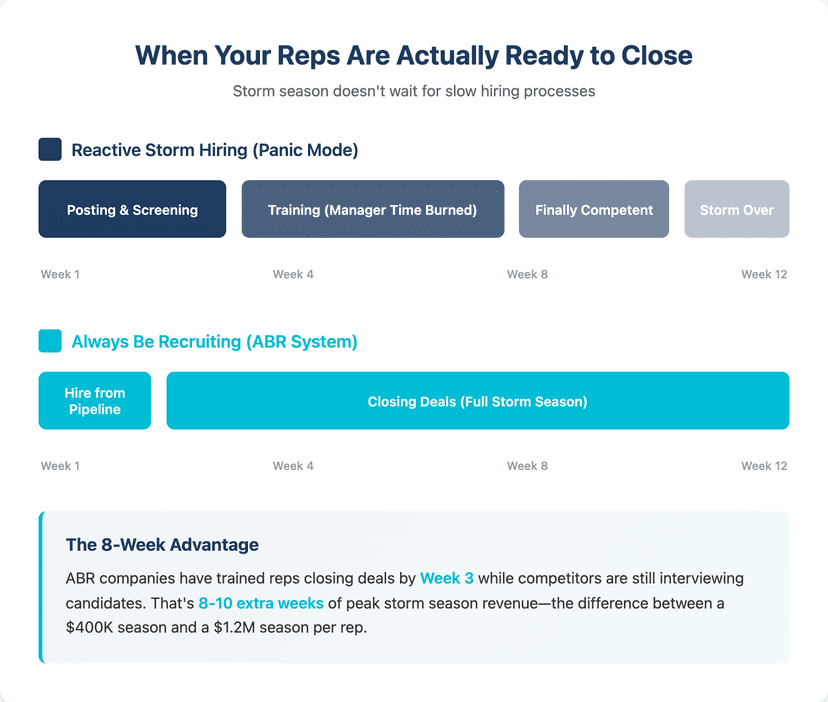
Meanwhile, your competitor practicing ABR had a pipeline ready in January. They hired in February, trained during slow season, and had field-ready reps closing by week 3.
You're playing catch-up. They're printing money.
⚠️ Five Reasons Reactive Storm Hiring Guarantees Failure
1. Top Talent Isn't Available When You're Desperate
The best roofing reps are already working and making $80,000-$150,000. They're not on Indeed waiting for your "URGENT HIRING" post.
According to SHRM data, passive candidates are 120% more likely to succeed than active job seekers.
When you panic-post during storm season, you're competing for whoever happens to be unemployed right now. And there's usually a reason they're unemployed.
2. Everyone Competes for the Same Pool
The week after hail hits, every roofing company within 200 miles posts identical ads. Candidates know they have leverage. They interview with everyone and take the first decent offer.
The National Roofing Contractors Association reports 67% of roofing reps quit within their first year—highest turnover in construction.
Reactive hiring makes this worse. You're hiring people motivated by short-term storm money, not long-term fit.
3. Desperation Kills Quality Control
When you need bodies next week, standards drop.
That guy fired from his last two jobs? Hire him. Can't explain the 8-month gap? Hire him anyway. Showed up 20 minutes late? At least he showed up.
The U.S. Bureau of Labor Statistics shows construction employers spend $4,129 per hire. Roofing companies spend 2-3x that due to turnover.
Desperation hiring amplifies this because bad hires fail faster.
4. Training During Peak Season Burns Resources
Your sales manager should be helping A-players close bigger deals, not babysitting rookies who can't handle objections.
Every hour spent training someone who'll probably quit is an hour not spent with your best performers.
At $75-$100/hour of manager time, that's $6,000-$10,000 in opportunity cost per training cycle.
5. Rookies Waste Your Best Leads
Storm leads are gold. Fresh hail damage, motivated homeowners, approved insurance claims. These should close at 40-50%.
Instead, you're handing them to three-week reps who botch closes because they don't know how to ask for the business.
According to Insurance Information Institute data, storm damage claims increased 35% between 2020-2024.
These leads are more valuable than ever. Wasting them on untrained reps is business malpractice.
🎯 The Always Be Recruiting (ABR) Philosophy
Smart roofing companies recruit constantly—regardless of whether they have open positions.
Not when desperate. Not when storm season hits. Always.
When business is great and you don't "need" anyone, that's precisely when to recruit most aggressively. Something unknown is lurking—a surprise hailstorm, a key rep getting poached, an injury. When it happens, you want a pipeline ready within days.
When you just hired two great reps and your team is full, keep recruiting. One might not work out. You might land a huge contract. A competitor might poach someone.
When it's February and storm season is months away, that's prime recruiting time. You're not competing with 30 other companies. You can vet properly. You can train when your manager has bandwidth.
ABR means you're never desperate, never settling, never burning storm leads on untrained reps.
📊 What ABR Actually Looks Like in Practice
Traditional Storm Hiring (Reactive): Post ads when desperate → Hire whoever's available → Interview in a rush → Train during peak season → New hires get storm leads and waste them → 60-70% quit within 90 days → Constantly short-staffed.
Always Be Recruiting (Proactive): Run campaigns year-round → Hire from qualified pipeline → Proper screening, no exceptions → Train during off-season → New hires practice on regular leads first → 30-40% quit (better retention) → Always at full capacity with bench strength.
The difference isn't just hiring better people. It's having options when you hire.
When you're desperate, you have no leverage. When you practice ABR, you choose the best from a pre-screened pool.
🤖 How AI Makes ABR Actually Sustainable
ABR sounds great until you realize continuous recruiting is a full-time job.
Someone needs to post ads constantly, screen hundreds of applications, conduct phone screens, schedule interviews, follow up with candidates, and maintain a pipeline database.
Most roofing companies don't have HR departments. The owner or sales manager is doing this while trying to run the business.
That's why we built GhostRep's AI Recruiting Agent.
It handles the entire top-of-funnel process:
- Continuous candidate sourcing across Indeed and ZipRecruiter
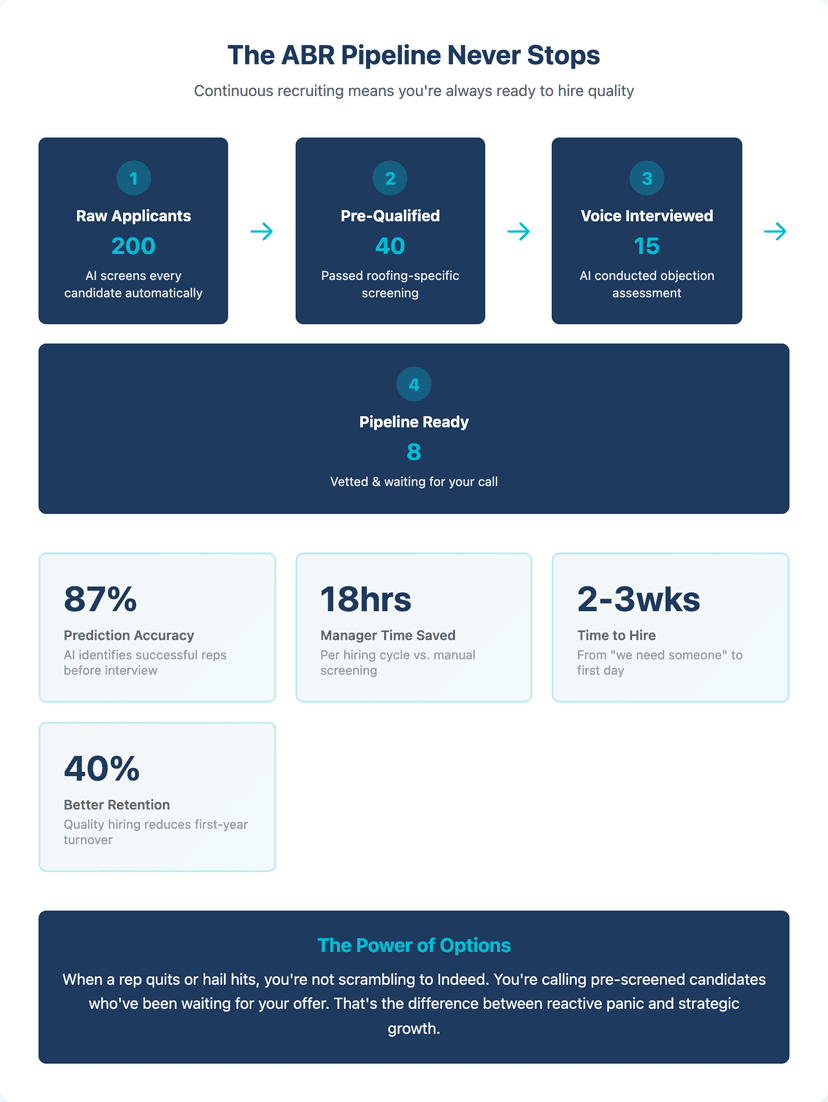
- Automated pre-screening with roofing-specific questions that filter 80% of bad fits
- Voice-based interviews assessing objection handling and communication style
- 87% accuracy in predicting success before you waste time interviewing
- Pipeline management that keeps strong candidates warm automatically
Practically: Instead of 20 hours screening 200 applications, you spend 2 hours interviewing the 8 candidates AI vetted. Instead of settling for whoever's available during storm season, you hire from a pipeline you've nurtured for months.
Your manager focuses on revenue. AI handles screening.
💰 The Numbers: What ABR Actually Costs vs. What It Saves
Let's talk ROI with specific numbers for hiring 5 reps for storm season:
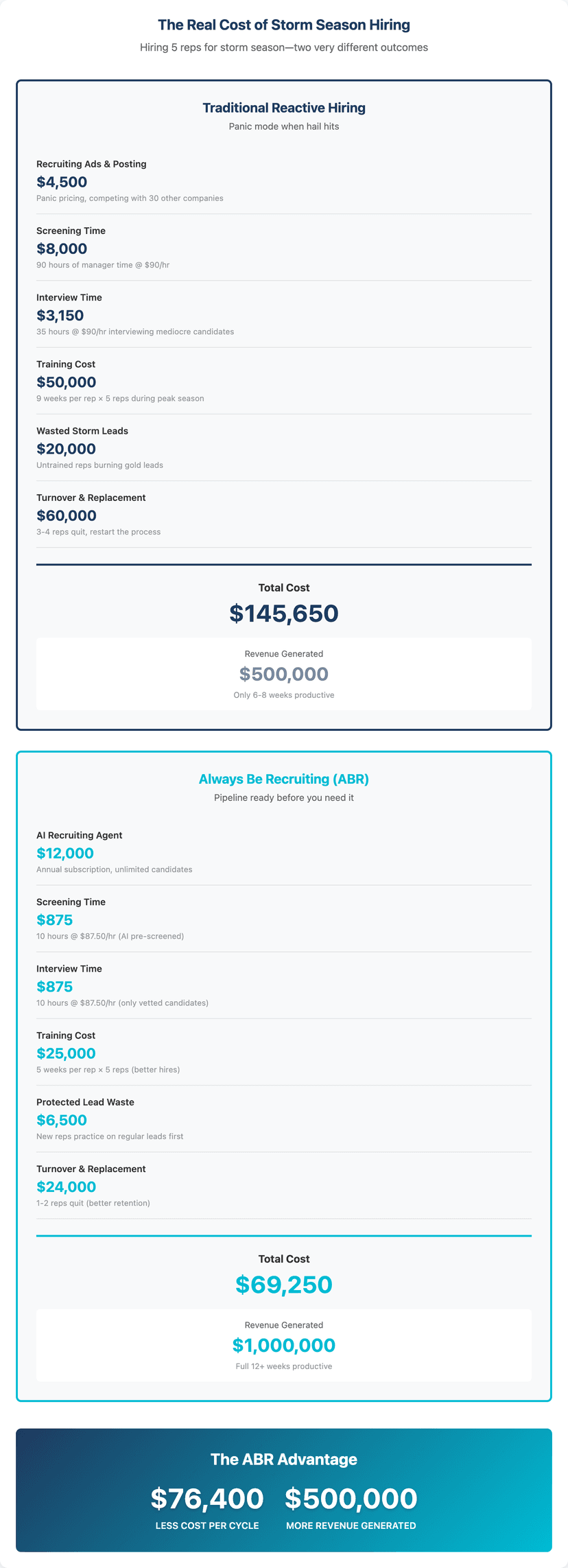
Traditional Reactive Hiring (5 Reps):
- Recruiting ads: $4,500 (panic pricing)
- Screening time: $8,000 (90 hours at $90/hr)
- Interview time: $3,150 (35 hours at $90/hr)
- Training: $50,000 (9 weeks per rep during peak season)
- Wasted storm leads: $20,000 (untrained reps burning gold)
- Turnover: $60,000 (3-4 reps quit, restart process)
- Total Cost: $145,650
- Revenue Generated: $500,000 (only 6-8 weeks productive)
ABR with AI (5 Reps):
- GhostRep prepaid wallet: $1,000 for 250 shared hours across recruiting and training
- Screening time: $875 (10 hours, AI pre-screened)
- Interview time: $875 (10 hours, only vetted candidates)
- Training: $25,000 (5 weeks per rep, better hires)
- Protected leads: $6,500 (practice on regular appointments first)
- Turnover: $24,000 (1-2 reps quit, better retention)
- Total Cost: $69,250
- Revenue Generated: $1,000,000 (full 12+ weeks productive)
Bottom Line: ABR costs $76,400 less per cycle AND generates $500,000 more revenue.
Missing peak storm season because you don't have trained reps costs more than any recruiting system. One experienced rep during storm season generates $400,000-$600,000. If you're short two reps, that's $800,000-$1,200,000 in lost revenue.
📅 Your Recruiting Calendar (Hint: Always)
January-March (Off Season): Prime time. Less competition, lower candidate expectations, time for training. Build your bench when it's cheap.
April-June (Early Storm Season): Keep recruiting in maintenance mode. Your AI Recruiting Agent handles this automatically.
July-September (Peak Storm Season): Focus on revenue. AI continues screening in the background.
October-December (Late Season): Review performance. Make offers to pipeline candidates for January starts.
Every Month: Check in with strong candidates who weren't ready. Build relationships that pay off later.
Notice what's missing? Panic.
🎁 The Hidden Benefit: You Stop Settling
Reactive hiring makes you desperate. Desperation makes you settle.
When you need someone RIGHT NOW, you ignore red flags. You hire the candidate who was 20 minutes late. You bring on the guy who couldn't explain his last three job exits.
ABR eliminates desperation by ensuring you always have options.
When your pipeline is full, you can say no to poor fits, hold out for better candidates, and maintain standards.
GAF's contractor network statistics show companies with structured recruiting retain reps 40% longer. That compounds as experienced reps close more deals, waste fewer leads, and attract better talent.
The quality of your team is directly correlated to how desperate you are when you hire.
❓ Frequently Asked Questions
How much should roofing companies spend on recruiting annually?
Plan for 8-12% of total revenue in recruiting and training costs. A company generating $3,000,000 annually should budget $240,000-$360,000. Companies spending less experience chronic understaffing and higher turnover costs that eat the savings.
What's the best time to hire roofing sales reps?
January through March offers the best conditions—less competition, lower candidate expectations, time for training before storm season. Avoid April-June when 30+ companies compete for the same candidates.
How long does it take to train a roofing sales rep?
Traditional training takes 8-12 weeks before reps close consistently. Quality hires with door-to-door experience can be field-ready in 4-6 weeks with proper objection training. Poor hiring extends training indefinitely or results in early turnover.
🚀 What Changes Tomorrow
Stop treating recruiting like an emergency. Start treating it like a system.
This Week: Set up your AI Recruiting Agent, sharpen your job description, and post ads even if you're fully staffed. Screen 10 candidates to practice your process.
This Month: Conduct 3-5 interviews with candidates who are strong but not ready yet. Build relationships with people who could join in 3-6 months.
This Quarter: Hire someone during off-season and train them before storm season. Build a pipeline of 20-30 qualified candidates. Stop panic-hiring when someone quits.
This Year: Never post another "URGENT HIRING" ad. Always have your next hire ready. Build a reputation as the company that only hires quality.
The roofing companies winning right now aren't the ones with the best ads or highest commissions. They're the ones who never run out of talent because they're always recruiting.
ABC is dead. ABR is how you build a dominant roofing company.
Most roofing companies recruit when desperate. The best companies recruit always. GhostRep's AI Recruiting Agent handles continuous candidate screening so you always have a pipeline ready.
Free storm sales resources
Make storm-season training usable in the field
Use free tools for inspection summaries, follow-up language, adjuster prep, and objection handling before the next appointment hits.
Field sales tools
Build inspection summaries, homeowner updates, and post-appointment follow-up assets.
Browse field sales tools →Training tools
Use training tools for claim scripts, rebuttals, canvassing language, and storm-specific prep.
Browse training tools →Echo
Coach reps live during door knocks, inspections, and follow-up conversations when storm volume spikes.
See Echo →About the Author
Tim Nussbeck
Founder & CEO of GhostRep
Two decades in roofing—knocking doors, running teams, training 1,000+ reps. Built GhostRep to give every rep access to the coaching top teams get.
Storm-season next step
Turn storm-season advice into field execution
Use the field tools first if you need inspection summaries, homeowner updates, or follow-up language. Book a walkthrough if you want GhostRep mapped to storm-volume coaching.
- ✓Best fit if the issue is speed, consistency, and field execution.
- ✓Useful for inspection summaries, claim prep, and storm follow-up.
- ✓Demo shows how Echo supports reps when volume spikes and managers cannot be everywhere.
Start Here
Open storm-field tools
Build homeowner updates, inspection summaries, and follow-up assets for real appointments.
Open storm-field toolsNeed it mapped to your team?
Talk through your current workflow, traffic mix, and where GhostRep fits before you change anything.
Book a 15-minute walkthroughYou Might Also Like
Compare HailTrace storm data with GhostRep sales coaching. HailTrace shows where to knock; GhostRep helps reps win the conversation at the door.
Read article →Write your own estimate before the adjuster arrives instead of waiting on their number. Upfront estimating strategy for insurance roofing jobs.
Read article →Learn how retail roofers can add storm restoration sales with local trust, canvassing, insurance talk tracks, adjuster prep, and rep practice.
Read article →