
At 6:42 p.m. a homeowner texts a photo of water below a ceiling vent and writes, “Your roof is leaking.” The first responder has two jobs: help route an urgent condition and avoid guessing at the cause. “We’ll take care of everything” is comforting for ten seconds and dangerous for the next ten days.
These scripts separate empathy from authority. The employee can acknowledge the experience, capture the original words, reduce immediate risk, assign an owner, and promise a specific update. Cause, liability, refund, repair scope, warranty, and insurance decisions stay with the people authorized to make them.
Open one service-recovery record
Open the incident record before promising a remedy
Customer statement
- What to record: Original words plus a neutral summary
- Boundary: Do not rewrite as a company conclusion
Immediate condition
- What to record: Active water, electrical exposure, unstable material, injury, access risk
- Boundary: Use emergency policy; do not improvise safety advice
Project evidence
- What to record: Agreement, scope, change orders, photos, work orders, messages, payments
- Boundary: Preserve originals and version history
Owner
- What to record: One role with decision authority
- Boundary: First responder may not be remedy owner
Next update
- What to record: Date, time, channel, and responsible person
- Boundary: Promise an update you control, not an unverified outcome
Cause and remedy
- What to record: Known, unknown, reviewer, and authorization
- Boundary: Separate empathy from admission and investigation from decision
Closure proof
- What to record: Work completed, document corrected, credit authorized, customer notified
- Boundary: “Ticket closed” is not proof
The first-response framework
- Acknowledge the impact: “I’m sorry you’re dealing with this.”
- Confirm what you heard: “I have the concern as [neutral summary]. What did I miss?”
- Follow the immediate-safety policy: route urgent conditions without diagnosing cause.
- Name the owner and update time: give a person or role and a commitment the company can meet.
- Protect the investigation: explain that cause and remedy follow record review and authorized decision.
Empathy does not require guessing. “I’m sorry there is water in the room” acknowledges the customer’s experience. “Our crew caused the leak” is a conclusion that may require inspection and review.
Script: active leak report
“I’m sorry you have water coming in. If there is exposed electrical equipment, sagging material, injury, or another immediate danger, follow [approved emergency instruction] and avoid the area. I recorded the location as [customer description]. [Owner] will contact you by [time] about the immediate next step. We will inspect before stating the cause or permanent remedy.”
First responder may: record, route, trigger approved emergency steps, and set the next update. First responder may not: declare warranty coverage, assign fault, or promise a permanent repair before review.
Use the emergency roof-response workflow when the condition requires safety triage, qualified dispatch, or temporary-work authorization.
Script: nails, debris, or cleanup concern
“Thank you for telling us. I have the concern as [item and location]. Please avoid handling sharp material. [Owner] will coordinate the cleanup review by [time], and we will confirm what was completed afterward.”
The closure record should identify the area checked, method used, person responsible, date, and customer notification. A photo may support the record but does not replace a complete site check.
Script: missed schedule or delayed update
“I’m sorry we missed the timing you were given. The current verified status is [fact]. [Owner] is checking [dependency], and we will update you by [time] even if the final schedule is not available. I do not want to give you another date until it is confirmed.”
This script repairs the controllable failure first: the missed communication commitment. Do not hide uncertainty behind a new date that production, weather, inspection, material, or permitting owners have not approved.
Script: property-damage concern
“I’m sorry about the damage you reported. I recorded [neutral description], where it is located, and when you noticed it. Please send photos through [approved channel] if it is safe and you are comfortable doing so. [Owner] will review the site and project record. We will not ask you to accept a cause or remedy before that review.”
Escalate injury, major property damage, threatened litigation, insurer involvement, environmental concern, or safety hazard according to company policy. Preserve evidence and avoid editing the customer’s original message.
Script: billing or estimate dispute
“I understand you are questioning [specific charge, allowance, change order, or payment]. I will compare it with the signed agreement, controlling estimate, approved changes, and payment record. [Billing owner] will respond by [time]. I cannot change the balance until that review is complete, but I will make sure the disputed item is clearly identified.”
Do not turn a dispute into a sales objection. The company must first reconcile the documents. If the record is wrong, correct it visibly and explain the correction.
Script: repeated communication failure
“You should not have had to repeat the request. I have consolidated the issue into one record and assigned [owner]. The next update is due [time]. Please reply to this thread so the context stays together. If another employee contacts you separately, tell us so we can correct the handoff.”
The manager should close duplicate tickets, preserve their history, and identify why ownership fragmented. The remote management guide shows how to route unresolved exceptions without making customers coordinate the company.
Script: workmanship or warranty question
“I recorded the concern as [observed symptom or customer statement]. [Qualified owner] will compare it with the agreement, installation record, approved warranty terms, and site conditions. We will update you by [time]. I do not want to label the cause or coverage before that review.”
A warranty question may involve scope, installation, product, maintenance, weather, later work, or another condition. The script keeps the customer informed without making a technical or contractual conclusion from the phone.
Missed-cleanup case file
Missed-cleanup incident from report to closure
Customer report:
Two roofing nails found near east driveway at 8:10 a.m.; photo received
Decision: Cleanup concern; cause not yet concludedImmediate response:
Customer asked not to handle nails; driveway use paused
Decision: Site-review priorityOwnership:
Production manager assigned; update promised by 10 a.m.
Decision: Promise controlled by assigned ownerInvestigation:
Crew log shows magnetic sweep completed; east driveway not initialed
Decision: Return sweep authorizedResolution:
East drive, walk, beds, and curb swept; three nails recovered; checklist corrected
Decision: Operational correction completedClosure:
Customer notified at 9:42 a.m.; confirmed access restored
Decision: Close incident; audit similar work orders
Give each role an authority ladder
| Role | May do | Must escalate |
|---|---|---|
| First responder | Acknowledge, record, apply emergency policy, assign owner, set update time | Cause, liability, refund, warranty, legal, insurer, or major safety decision |
| Project/production owner | Review site and work record; authorize bounded operational correction | Contract change, large credit, injury, major damage, disputed fault |
| Billing owner | Reconcile agreement, changes, invoices, and payments | Contract interpretation or settlement outside authority |
| Executive/qualified adviser | Make decisions within assigned legal, technical, financial, or insurer authority | Anything outside license, policy, or delegated limit |
Keep service recovery separate from review pressure
Do not make a remedy conditional on changing or removing an honest review. The FTC’s Consumer Reviews and Testimonials Rule guidance addresses deceptive review practices, including incentives conditioned on sentiment and review suppression concerns. The roofing review guide owns the review workflow; service recovery should focus on the incident.
Likewise, do not turn a repaired problem immediately into a referral ask. The customer referral-program guide owns permission, eligibility, disclosure, and incentive controls.
Measure commitments and recurrence
Track time to acknowledgment, time to owner assignment, promised updates met, emergency-policy activations, reopen rate, incident category, repeated root causes, authorized resolution, and closure evidence. Do not invent a universal “save rate.” A reopened leak and a corrected scheduling email are not equivalent events.
When a non-urgent incident needs a written update, use the stage and ownership controls in the roofing email template guide. The message should carry the verified record; it should not become a second, conflicting incident log.
The useful manager question is not “Did the employee sound empathetic?” It is “Did the customer receive a safe, accurate, owned next step—and did the company do what it promised?”
Frequently asked questions
Should a roofer apologize before knowing who caused the problem?
You can acknowledge the customer’s experience and inconvenience without making an unsupported conclusion about cause, fault, warranty, or remedy.
Should the first responder promise a refund?
Only if the role has explicit authority and the facts satisfy the approved policy. Otherwise, record the requested remedy and route it to the decision owner.
When is a service-recovery ticket complete?
When the authorized action is completed, evidence is attached, the customer receives the outcome or update, and any systemic correction is assigned. A status change alone is not closure.
Recovery ends when the customer can verify the fix
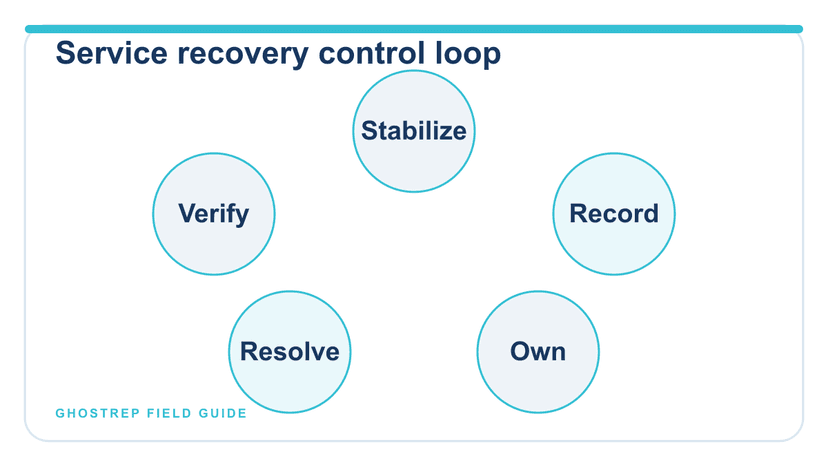
Good roofing service recovery separates empathy, evidence, authority, and closure. Stabilize the immediate condition, preserve the customer’s account, assign one owner, promise the next update instead of an unverified outcome, and prove the resolution was completed.
Free tools for roofing sales training
Turn this article into rep practice
Use the training library to turn ideas into drills, scripts, and coaching reps can actually use in the field.
Training tools
Browse objection, role-play, and scripting tools built for home improvement sales teams.
Browse training tools →All free tools
See the full tools hub across hiring, management, field sales, operations, and marketing.
Browse all tools →Role Play
Turn training concepts into live practice with AI homeowner scenarios that build muscle memory.
See Role Play →About the Author
Tim Nussbeck
Founder & CEO of GhostRep
20+ years in roofing and home improvement sales—knocking doors, running teams, and building practical coaching systems. Built GhostRep to give every rep access to the coaching top teams get.
Training next step
Turn training ideas into drills your reps will actually run
Start with the free training tools if you need scripts, practice reps, or coaching prompts today. Book a walkthrough if you want GhostRep mapped to your onboarding process.
- ✓Best fit if reps need more repetition, not more theory.
- ✓Useful for onboarding, objection practice, and weekly coaching.
- ✓Demo shows how Role Play plugs into your current training process.
Start Here
Browse training tools
Free objection builders, role-play prompts, scripts, and rep-practice templates.
Browse training toolsNeed it mapped to your team?
Talk through your current workflow, traffic mix, and where GhostRep fits before you change anything.
Book a 15-minute walkthroughYou Might Also Like
Build safe roofing objection practice with realistic scenarios, observable coaching criteria, and readiness gates—without using homeowners as practice targets.
Read article →Compare seven roof financing options for bad credit, including contractor loans, personal loans, home equity, credit cards, FHA Title I, and local aid.
Read article →Use a safe seven-step process to verify, role-play, observe, version, and update a roofing sales script without testing claims on homeowners.
Read article →