At 7:58 a.m., the sales meeting should already know what needs attention: one unsafe field condition, two customer promises due today, an inspection without access confirmation, and a production handoff waiting on a decision. At 8:15, every item should have an owner and due time.
That is the whole meeting. Do not make every rep narrate every deal. Pipeline inspection, coaching, training, and announcements belong elsewhere. Fifteen minutes can route today’s exceptions when the CRM contains the facts; it cannot reconstruct missing records in public.
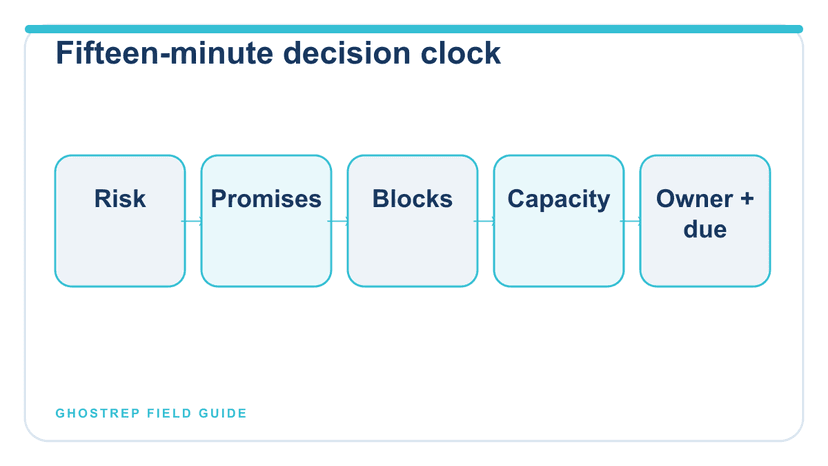
The 15-minute roofing sales meeting agenda
| Time | Question | Output |
|---|---|---|
| 0:00–2:00 | Is there a safety, customer-harm, consent, or urgent service issue? | Immediate owner and escalation path |
| 2:00–5:00 | Which customer commitments are due or at risk today? | Protected promise, owner, due time |
| 5:00–8:00 | Which appointment, inspection, estimate, or handoff is blocked? | Decision owner and unblock action |
| 8:00–11:00 | Where is capacity, territory, travel, or weather creating risk? | Reassignment or operating decision |
| 11:00–13:00 | What work needs coaching or follow-up outside this meeting? | Named one-on-one or practice action |
| 13:00–15:00 | Who owns each action, and when will it be complete? | Read-back of decisions and due times |
The sales meeting agenda tool can produce a blank team-specific version. This article explains how to run it without turning the meeting into reporting theater.
Prepare the board before the meeting
The manager or CRM owner should open a short exception view:
- safety, service, privacy, consent, or customer-risk escalations;
- customer updates and appointments due today;
- records with no owner or next action;
- blocked stage transitions;
- territory, travel, weather, and workload conflicts;
- handoffs missing required fields; and
- coaching actions due.
The board should use existing records. Do not ask reps to prepare slide decks for a 15-minute control meeting. If the CRM cannot produce the view, log that as a system issue and repair the workflow outside the meeting.
Use five facilitation rules
- Facts before opinions: identify the record, stage, customer commitment, and missing decision.
- One owner: “sales and production” is not an owner.
- One due time: “ASAP” is not a commitment.
- Park investigation: assign a smaller group and report-back time.
- No public coaching trial: route individual development to a one-on-one or practice session.
The manager should stop deal storytelling with a routing question: “What decision is blocked, who can make it, and by when?”
The 8:15 decision record
Decisions recorded by 8:15 a.m.
Active leak report:
Record: Customer called at 7:42; electrical fixture near water
Decision: Emergency policy activated; ordinary callback paused
Owner and due time: Service manager, immediateInspection summary overdue:
Record: Customer promised update by noon
Decision: Manager review prioritized before forecast work
Owner and due time: Sales manager, 10:30Tomorrow appointment unconfirmed:
Record: No response to approved confirmation
Decision: Use alternate permitted channel; do not access without confirmation
Owner and due time: Assigned rep, 3:00Travel conflict:
Record: Two inspections 71 miles apart with 30-minute gap
Decision: Reassign second inspection after customer approval
Owner and due time: Dispatcher, 9:00Proposal-comparison miss:
Record: Rep speculated about competitor scope
Decision: Remove from group discussion; assign controlled practice
Owner and due time: Manager and rep, Friday 1:00Production handoff gap:
Record: Selection field blank on signed job
Decision: Do not release to production until verified
Owner and due time: Rep, 11:00
This record is short because it captures decisions, not transcripts. The sales-to-production handoff process owns the downstream stage gate.
What does not belong in the 15-minute meeting
Full pipeline narration
Review stage definitions, aging, source cohorts, and forecast inputs in a scheduled pipeline review. The daily meeting should only route current exceptions.
Individual performance correction
Do not surprise a rep with a public score or vague criticism. Use the sales manager one-on-one tool and bring the underlying work.
A complete training session
The meeting may name the skill and assign practice. The sales daily huddle tool can create a separate short drill, while longer development belongs in the training program.
Announcements and leader monologue
Send reference information asynchronously when no team decision is required. Use meeting time for coordination.
Run the same format remotely or in person
For remote and hybrid teams, display the shared exception board, not a gallery of webcams. Speak in the same order, record decisions in the source system, and allow a clear path for private or sensitive escalation. The remote sales management guide owns the broader operating system.
Audit the meeting itself
Weekly check on the meeting itself
Started from current records
- Record: Exceptions visible before meeting
- Corrective action: Repair dashboard or cutoff if not
Protected customer promises
- Record: All due-today commitments reviewed
- Corrective action: Move segment earlier if repeatedly missed
Named owners and times
- Record: No “team” or “ASAP” actions
- Corrective action: Facilitator requires read-back
Parked investigation
- Record: Long topics assigned outside meeting
- Corrective action: Create owner and report-back time
Closed prior actions
- Record: Completion record attached
- Corrective action: Reopen or escalate unsupported closures
Ended on time
- Record: 15-minute limit held
- Corrective action: Remove reporting and training from agenda
The sales KPI scorecard should remain a separate measurement artifact. A meeting is not successful because every metric was read aloud. It is successful because exceptions received responsible decisions.
Frequently asked questions
Should a roofing sales team meet every day?
A brief daily exception meeting can help during active operations, but the right frequency depends on team size, season, lead flow, and whether the shared records already route work. Do not meet by habit when no coordination job exists.
Who should attend?
Only roles needed to route the day’s exceptions. Production, service, finance, or dispatch owners can join the relevant segment or receive an assigned action rather than sitting through the entire meeting.
What if meetings always run longer than 15 minutes?
Identify whether the team is reconstructing missing CRM data, coaching publicly, solving complex incidents, or reading announcements. Repair the source problem and move those jobs to the appropriate format.
End with owners, not updates
The 15-minute roofing sales meeting is a control surface, not a stage. Start with safety and customer commitments, route blocked work and capacity, assign coaching privately, and end with one owner and one due time for every action.
Free tools for sales managers
Turn this into a manager workflow
Use free management and operations tools to turn coaching ideas into repeatable systems for your reps and managers.
Management tools
Use 1-on-1 scripts, meeting agendas, forecast templates, and escalation tools.
Browse management tools →Operations tools
Build scorecards, SOPs, pipeline templates, and review workflows your team can run every week.
Browse operations tools →AI Sales Coach
Give reps coaching based on real performance data instead of waiting for the next ride-along.
See AI Sales Coach →About the Author
Tim Nussbeck
Founder & CEO of GhostRep
20+ years in roofing and home improvement sales—knocking doors, running teams, and building practical coaching systems. Built GhostRep to give every rep access to the coaching top teams get.
Manager next step
Turn this into a manager workflow your team can repeat
Use the management tools if you need a practical coaching or accountability system first. Book a walkthrough if you want GhostRep tied to rep performance and live coaching.
- ✓Best fit if coaching is inconsistent across reps and managers.
- ✓Useful for 1-on-1s, scorecards, and weekly operating rhythms.
- ✓Demo shows how AI Sales Coach turns performance data into specific guidance.
Start Here
Browse management tools
Open scorecards, coaching docs, forecast templates, and manager workflows.
Browse management toolsNeed it mapped to your team?
Talk through your current workflow, traffic mix, and where GhostRep fits before you change anything.
Book a 15-minute walkthroughYou Might Also Like
See seven useful AI sales manager workflows for roofers, what AI should never own, and a practical pilot and buyer checklist.
Read article →Use a 30-day roofing sales onboarding calendar with safety gates, field practice, role play, coaching evidence, and weekly manager decisions.
Read article →Run a remote roofing sales team with trusted CRM stages, daily exception review, observed field work, coaching records, capacity controls, and clear escalation.
Read article →