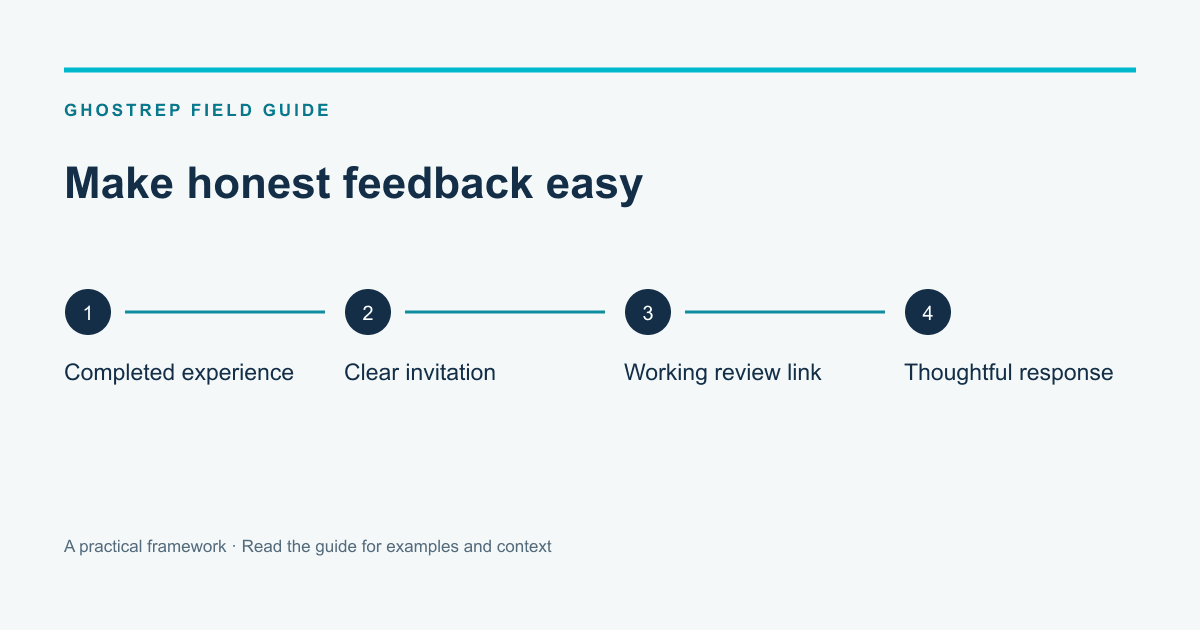
A useful roofing review helps a future customer understand what it was like to work with your company. The goal is to make it easy for real customers to describe their experience, then use that feedback to improve the service and answer the questions other homeowners have.
A review process does not need a promised conversion lift. It needs a clear owner, an honest request, a working link and a sensible way to respond. This guide follows that process from the completed work to the next inquiry.
Next Step
Use the exact review and follow-up tools
If review generation is inconsistent, start with the field tools that help reps ask at the right moment and keep the message clean.
Ask for feedback on a recognizable experience
Choose a point when the customer has experienced the work you want feedback on. Confirm what has actually been completed and whether there are unresolved questions. The request should refer to that real interaction without telling the customer what to say.
Google’s review guidance permits asking customers for reviews through a link or QR code and prohibits incentives for posting, changing or removing reviews. Build the request around honest feedback rather than a particular star rating.
Give one person ownership of the request
Decide who checks the project status, sends the request and records that it was sent. Without an owner, one customer may receive several messages while another receives none. Use the same process consistently instead of selectively directing only satisfied customers to the public review page.
Keep a record of the channel and timing appropriate to your company’s contact process. A request is an invitation, not a requirement for the customer to finish the project or receive support.
Make the message easy to recognize
Identify the sender and company. Mention the completed work factually. Invite the customer to describe their experience and provide the direct review link. Keep the request short enough that the action is easy to find.
Here is an illustrative message to adapt with verified details:
Hi [Name], this is [Rep] from [Company]. Thank you for working with us on [completed work]. If you would like to share your experience, you can leave a review here: [direct review link]. We appreciate your feedback.
The review request tool can help prepare a draft. Check the link and the project reference before sending it through your normal authorized process.
Remove friction from the link
Open the exact link on a phone and confirm it reaches the intended business profile. If you use a QR code on a leave-behind, print a test and scan it at the size the customer will receive. Include a readable alternative for someone who does not want to scan.
Do not surround the request with several competing actions. A customer should not have to navigate a homepage, find the business profile and search for the review button before understanding what you asked.
Leave the customer’s words to the customer
Do not write a testimonial for someone to post as their own experience. Do not prescribe a rating, insert a project outcome they did not report or ask them to include a list of search keywords. A specific, independent description is more useful than a company-written paragraph repeated across profiles.
If a customer sends private feedback that you want to quote elsewhere, obtain permission for that use and preserve the approved wording. Keep a record of the source so the company can distinguish an actual quotation from an illustrative example in marketing material.
Respond without exposing the project record
Thank the reviewer and address the feedback at an appropriate level. Avoid publishing personal, payment, claim or other private information in a public response. If a concern needs investigation, explain how the company can continue the conversation through its support process.
The review response tool can prepare a starting point. A person familiar with the situation should review it. The response should sound like the company is listening, not like it is arguing with the reviewer or copying the same apology to everyone.
Use review themes to improve the customer experience
Look for recurring topics: communication during scheduling, clarity of the proposal, site cleanup, project updates or unanswered questions. Compare those themes with the work the company can investigate.
If customers repeatedly mention uncertainty about the next step, review how the team explains it. A manager can use a relevant recorded conversation in Echo to identify where the explanation became unclear, then prepare a more specific practice exercise. Reviews can point to a question worth investigating; they do not establish every detail of what happened.
Show proof in the right place
Use approved customer evidence where it helps someone make a decision. A service page might pair a relevant review with a real project photo and a factual description of the work. Keep the location and project details accurate and respect any limits on publication.
Do not put invented scores, unattributed quotations or unsupported improvement percentages beside the review. The credibility comes from the source and relevance of the evidence, not the number of decorative badges around it.
Measure the process without promising a lift
| Measure | What it can tell you |
|---|---|
| Eligible completed interactions | The set of customers covered by your request process. |
| Requests sent | Whether the process is being followed consistently. |
| Reviews received | The feedback returned during the period. |
| Recurring themes | Questions or service issues worth investigating. |
| Attributed inquiries | Customer-reported or measured discovery paths, where available. |
Keep the reporting period and definitions stable. A change in inquiry volume may also reflect season, advertising, search visibility or capacity. Do not assign every new lead to a change in reviews.
Connect reviews to local discovery
Accurate business information, useful service pages and genuine evidence help a prospective customer evaluate the company. The Google Maps guide explains the broader profile work. Reviews are one part of that work, not a secret ranking formula.
Should we offer a reward for a review?
Google’s guidance prohibits incentives for posting, changing or removing reviews. Keep any referral or customer promotion separate from the review request and check the applicable platform rules.
Should we request only positive reviews?
Invite honest feedback through a consistent process. Do not screen customers so only favorable responses reach the public review page.
What should we improve first?
Test the real request and link, confirm ownership, and review a sample of responses. Fix the process customers actually encounter before adding another campaign.
Free lead-generation resources
Turn traffic strategy into pipeline actions
Use free marketing and field tools to turn website, referral, and follow-up ideas into lead flow your reps can actually work.
Marketing tools
Generate ad copy, email sequences, company bios, and lead-conversion messaging for your market.
Browse marketing tools →Field sales tools
Create follow-up assets, texts, and homeowner-facing copy once a lead is already in motion.
Browse field sales tools →Job Intel
Give reps better customer context before the follow-up so lead quality is easier to convert.
See Job Intel →About the Author
Tim Nussbeck
Founder & CEO of GhostRep
20+ years in roofing and home improvement sales—knocking doors, running teams, and building practical coaching systems. Built GhostRep to give every rep access to the coaching top teams get.
Lead-gen next step
Turn traffic into pipeline math before you buy more leads
Start with the ROI calculator or lead-generation tools if you are still diagnosing the economics. Book a walkthrough if you want GhostRep tied to lead handling, follow-up, and close-rate lift.
- ✓Best fit if traffic is arriving but too little of it turns into revenue.
- ✓Useful for modeling conversion lift before you increase spend.
- ✓Demo shows how field execution and coaching change lead economics after the click.
Start Here
Model your conversion lift
Estimate what more leads, better close rates, and faster rep ramp are worth in revenue.
Model your conversion liftNeed it mapped to your team?
Talk through your current workflow, traffic mix, and where GhostRep fits before you change anything.
Book a 15-minute walkthroughYou Might Also Like
Angi and HomeAdvisor share a parent. Compare published lead-sharing and credit terms, account fees, renewal risks, and a free contractor offer worksheet.
Read article →Improve Google Maps ranking for roofers with an eligible Business Profile, accurate categories, genuine reviews, local prominence, and clean measurement.
Read article →Use eight roofing email marketing templates for inquiries, appointments, estimates, project updates, service recovery, referrals, and re-engagement.
Read article →