Can roofing Facebook ads produce leads under $50? Yes, a raw form submission can cost less than $50 in some accounts and periods. No, $50 is not a defensible roofing benchmark or promise. Auction conditions, service area, offer, creative, conversion path, lead definition, season, competition, and measurement all change the result.
Treat $50 as a predeclared media-CPL hypothesis. Follow the same dated cohort through valid identity, qualification, contact, held appointment, signed job, completion, collection, and collected gross profit. A campaign wins only if the promise in the ad survives that chain.
Cheap is a denominator problem. A contractor can report a $40 Meta CPL while excluding creative, management, tracking, and intake labor. The same campaign can produce a $100 qualified-lead cost, a $375 held-appointment cost, or a $1,500 completed-and-collected-job cost. None of those numbers is automatically good or bad. The company must compare each one with its own capacity, realized margin, and required operating contribution.
Facebook and Instagram usually create or interrupt demand in a feed; search channels more often capture a person already looking. That difference affects the offer and qualification path, but it does not make one channel universally better. Use the roofing lead-generation guide to choose channels. Use this page only for the Meta-specific test: campaign objective, conversion location, creative, form, permission record, CRM feedback, and mature-job economics.
Method and limits: The cited Meta, FTC, FCC, Eleventh Circuit, and NOAA materials inform the platform, measurement, and communication boundaries in this guide. GhostRep did not inspect your Ads Manager, CRM, consent language, job-cost records, or jurisdiction. All roofing dollar and conversion examples below are illustrative equations—not account results, industry averages, forecasts, confidence intervals, or legal advice. Revalidate Meta's interface and terms before launch, and have qualified counsel review automated calling/texting, insurance, financing, privacy, and applicable state rules.
Next Step
Turn cheap lead claims into an ad-and-follow-up workflow
Low CPL only matters if the offer, landing page, and rep follow-up turn that attention into booked appointments.
Calculate Whether $50 Is Affordable Before Opening Ads Manager
Start at the completed and collected job, not at the platform form. Define how much acquisition cost one realized job can carry after preserving the contribution the business needs for overhead, warranty/rework risk, and operating profit.
Allowable acquisition cost per collected job = collected gross profit per job − company-required reserve.
Allowable fully loaded raw CPL = allowable acquisition cost per collected job × mature raw-to-collected conversion.
Allowable media CPL = allowable fully loaded raw CPL − nonmedia campaign cost per raw lead.
The historical conversion must use one mature cohort. Do not multiply unrelated “best month” rates from different periods or count signed work as if it were collected. If the company has no usable history, the first campaign is a bounded data-collection test, not proof that the target is affordable. The broader roofing lead-cost calculator owns cross-channel acquisition math; this page applies that discipline to Meta.
Illustrative affordability chain: assume one completed and collected job produces $5,000 of gross profit and the company requires a $3,500 reserve for overhead, warranty risk, and operating contribution. That leaves a $1,500 acquisition ceiling per collected job.
If one mature cohort produced five collected jobs from 100 raw leads, the 5% raw-to-collected conversion supports $1,500 × 5% = $75 fully loaded cost per raw lead.
If creative, management, tracking, and intake consumed $2,500 across those 100 leads, nonmedia cost was $25 per raw lead. The predeclared media threshold becomes $75 − $25 = $50. Replace every illustrative input with the company's job-cost, accounts-receivable, campaign, labor, and policy records.
This does not prove that Meta will deliver $50 leads or that five jobs will mature in 30 days. It proves only that, under the displayed assumptions, paying more than $50 in media per raw lead would exceed the company's $1,500 fully loaded acquisition ceiling unless conversion, nonmedia cost, or job contribution improves.
Pass the Readiness Gate Before Buying Traffic
Do not launch because Ads Manager is available. Launch when the operating system can preserve and answer the demand the campaign creates.
- Serviceability: one explicit market, actual service radius, supported roof/service types, and real scheduling availability.
- Offer: one truthful next step that sales and production can deliver exactly as described.
- Qualification: a written valid-lead and qualified-lead definition with reason codes. The roofing lead-qualification checklist can hold the reusable intake rules.
- Routing: a named owner, backup owner, staffed contact window, stable lead ID, and failure alert.
- Measurement: media cost, nonmedia cost, source IDs, CRM stages, job outcomes, collection, and gross profit.
- Capacity: sales appointment and production capacity. A profitable channel can still be the wrong channel to scale when crews are full.
- Permission and claims: approved form disclosure, privacy notice, contact process, opt-out suppression, and substantiation for every ad statement.
If a test lead disappears between Meta and the CRM, a text is sent without the approved record, or the office cannot explain the ad's offer, fix the system before live spend. More traffic amplifies those failures.
One Lead, Three Receipts
A platform row alone cannot prove a roofing acquisition. Give each lead three connected receipts. This is the page's operating spine.
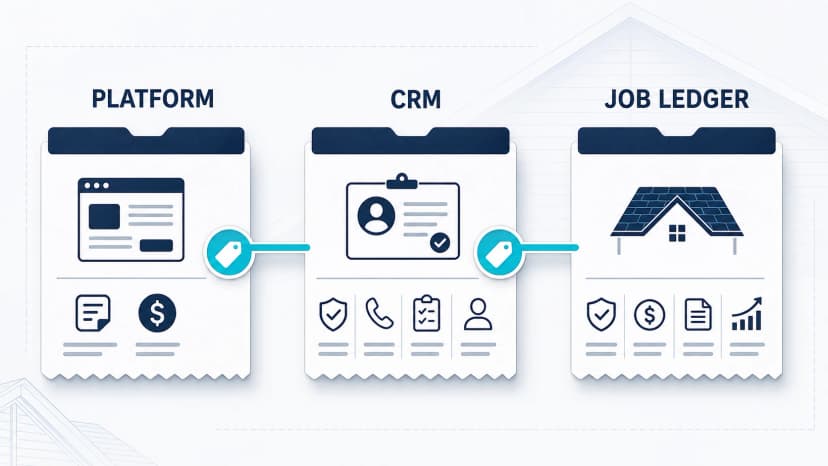
- Media receipt: preserve the account, campaign, ad set, ad, creative, form or destination, source timestamp, spend, and chosen attribution setting in Ads Manager plus an immutable export. It answers which promise, path, and reporting rule produced the record.
- Permission receipt: preserve seller identity, purpose, channel, disclosure and privacy version, form ID, timestamp, contact choice, and current opt-out state in the form archive and suppression record. It answers what the person requested, which contact was authorized, and what later stopped.
- Operating receipt: join the stable CRM lead ID to validation, qualification reason, attempts, contact, appointment, job, collection, direct cost, and gross profit in the CRM, job-cost system, and accounts receivable. It answers whether the same lead became a completed, collected, profitable job.
The join should survive duplicate merging, rep reassignment, and a job created weeks later. Preserve the original source and cohort even when the CRM creates a separate opportunity or job ID. Never overwrite campaign history because the lead entered through a second form.
Choose the Objective, Conversion Location, and Performance Goal
Meta's current lead-ads guidance supports instant forms and website forms within the Leads objective. Its messaging guidance also supports lead paths through Messenger and Instagram messaging. Account eligibility, placement, and interface labels change, so verify the live setup rather than copying an old screenshot.
Meta describes “maximize number of leads” and, for eligible instant-form campaigns, “maximize number of conversion leads” with CRM feedback. Its Advantage+ leads materials say automation can be default-on for eligible Leads campaigns. That is a platform configuration—not evidence that automation will lower a roofing company's qualified-lead or completed-job cost.
| Path | Use when | Required proof | Primary failure to test |
|---|---|---|---|
| Instant form | The team needs a mobile in-app inquiry and can retrieve, validate, and route it reliably | Form/version ID, prefilled-field confirmation, consent record, stable lead ID, CRM outcome feedback | Accidental, duplicate, wrong-area, or weak-intent submissions |
| Website form | The service needs more context, scheduling, or a controlled higher-consideration page | Landing-page view, form event, Pixel/CAPI setup where applicable, UTM/source join, mobile QA | Page speed, broken event, message mismatch, or unnecessary friction |
| Message | Staff can manage a conversational intake and state who will respond, on which channel, and when | Conversation source, question path, permission state, owner, CRM handoff | Unstaffed inbox, inconsistent qualification, or lost handoff |
| Call | Coverage and answer quality are reliable during the advertised window | Source number, answer/missed disposition, permission and recording rules, CRM record | Missed calls, accidental taps, weak attribution, or inconsistent intake |
Do not call one path “high quality” by default. Compare valid, qualified, held, completed, and collected outcomes under the same definitions. If website-form completion is the constraint, use the roofing website-conversion guide rather than turning this article into a CRO manual.
Freeze the Metric Dictionary and Maturity Date
Write the definitions before launch and preserve them for the cohort:
- Raw lead: one Meta-reported submission, message, or call event under the selected reporting rule.
- Valid unique lead: a reachable-looking person/contact record after invalid and duplicate rules are applied. Valid does not mean qualified.
- Qualified lead: a valid lead meeting the documented service area, supported need, timing, relationship/authorization, and company-policy criteria. A tenant or reporter may route differently rather than being silently discarded.
- Contacted: a two-way exchange, not merely an outbound attempt.
- Appointment set: a mutually accepted date/time and purpose.
- Held appointment: the documented meeting occurred under the company's rule.
- Signed job: an accepted agreement; not yet completed revenue.
- Completed and collected job: work has reached the declared completion and collection milestone.
- Collected gross profit: collected revenue minus actual direct job cost under the company's job-cost policy.
- Fully loaded campaign cost: media plus management, creative, form/page, tracking, call/text systems, and attributable intake labor under a declared accounting policy.
Assign a maturity cutoff when the ad window closes. A 30-day campaign may need another 30, 60, or more days for included jobs to complete or close out. That is a company observation window, not a universal roofing-sales-cycle claim. The cohort stays open until jobs complete, cancel, or reach the documented cutoff.
Use Three Truthful Roofing Creative Briefs
Creative should make a verifiable promise the form, confirmation, and intake conversation can keep. Use actual, permissioned project evidence. The roofing Facebook ad-copy generator can turn an approved brief into copy; the manager still owns substantiation and final approval.
| Brief | Truthful promise and evidence | One variable to test | Do not claim |
|---|---|---|---|
| Retail replacement planning | Explain the documented estimate or exterior-condition visit; show a real local project and scope evidence used with permission | Project-sequence proof versus owner explanation while offer and form stay fixed | Assumed property condition, universal savings, hidden “free” conditions, or unreviewed financing terms |
| Repair-versus-replacement triage | Offer a documented visit to determine whether repair, monitoring, or replacement evaluation is the next useful step | Problem-led versus process-led creative while service area and path stay fixed | Diagnosis before inspection, false emergency, guaranteed repair timing, or unnecessary sensitive-data request |
| Verified post-storm process | State the verified event, source/date, and inspection process; explain that an area report does not establish damage at an address | Educational checklist versus inspection-process explanation | “Your roof was damaged,” insurance approval, deductible manipulation, fabricated deadlines, panic, or scarcity |
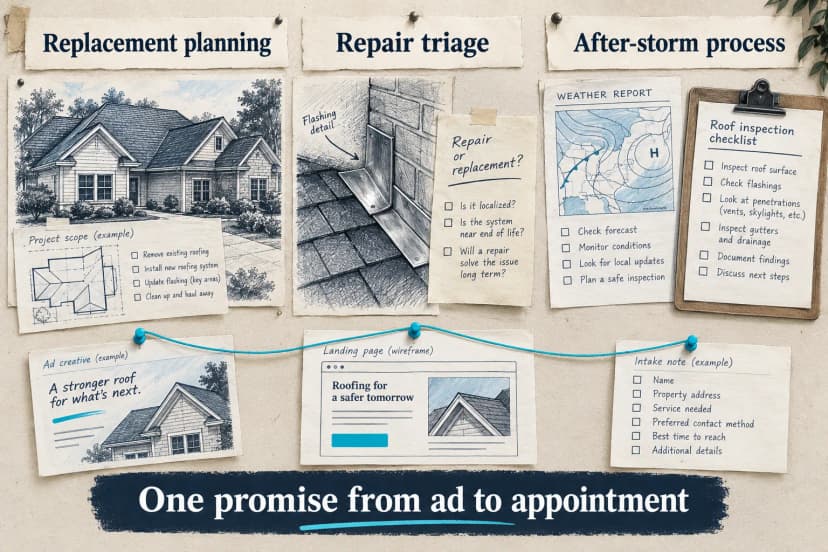
Three finished ad and landing-page examples
Each example below includes the copy and the destination brief. They are drafts for a company that can deliver the stated visit and documentation. Add the real contractor name and supported area, verify the offer, and use permissioned project images before launch. The AI illustration above explains composition; do not pass it off as your project evidence.
A. Retail roof replacement planning
Ad headline: Know what your roof estimate includes
Planning a roof replacement? Start with a written explanation of the work, not just a total price. Request an estimate conversation about materials, tear-off, flashing, ventilation, cleanup, and the questions an inspection needs to answer. We’ll confirm your location and the next available appointment before scheduling.
- Creative to produce
- A real, permissioned project photograph beside a readable excerpt of its actual scope. Hide names, addresses, prices, and anything the customer did not approve for reuse.
- Landing-page headline
- Compare the scope before choosing your roof
- Page body and action
- Show what the estimate includes, which conditions require an inspection, the supported area, and the next appointment step. Button: “Request an estimate conversation.” Do not label an inquiry as a booked appointment.
- Intake match
- Ask whether the person is planning replacement, has an existing estimate, and wants a scope discussion. Record the questions they want answered. The office should be ready to explain the same scope items promised in the ad.
B. Repair-versus-replacement triage
Ad headline: Start with the roofing question you have
A ceiling stain or a roofing concern does not tell you the full scope of work. Ask about an inspection to document what can be observed and discuss the next useful step: repair evaluation, further investigation, or replacement planning. Send your service-area ZIP and the type of help you need; our office will confirm whether we can help and explain scheduling.
- Creative to produce
- An authentic, close-up documentation example with an explanation of what the image shows and what it cannot establish. Avoid a dramatic damage photograph unrelated to the offer.
- Landing-page headline
- Get a documented next step for your roof concern
- Page body and action
- Explain supported repair and inspection services, visit charges if applicable, limitations, and how urgent situations are routed. Button: “Ask about an inspection.” Keep emergency availability accurate.
- Intake match
- Ask what was observed, whether there is an active issue, and the requested timing. Route urgent or unsupported work through the company’s real process instead of treating every inquiry as a replacement appointment.
C. A documented after-storm process
Ad headline: What a roof inspection can tell you after a storm
After severe weather, a neighborhood report is a reason to ask questions—not proof that a particular roof is damaged. Learn how an inspection documents visible conditions, what further evaluation may be needed, and how a contractor explains proposed work. Request our inspection process and available appointment options. Insurance coverage questions belong with your insurer or authorized insurance professional.
- Creative to produce
- A real inspection checklist or contractor-process demonstration. If referencing a local storm, identify the verified event, source, and date. A generic weather illustration must not masquerade as a local damage report.
- Landing-page headline
- Understand the inspection before deciding what comes next
- Page body and action
- Show the documentation process, service area, scheduling expectations, and contractor-versus-insurer roles. Button: “Request inspection information.” Omit claim-approval promises and invented deadlines.
- Intake match
- Confirm the requested contractor service and record observed concerns. Do not require policy numbers or a claim filing just to explain the process.
Change one meaningful variable at a time. For example, compare a permissioned project photo with an owner’s process explanation while keeping the replacement offer, destination, and intake rules fixed. Use the Facebook ad-copy tool for alternative wording after the brief is approved, and keep the original promise with each creative record.
The FTC's advertising guidance says claims must be truthful, non-deceptive, fair, and supported by a reasonable basis. Fine print cannot rescue a misleading headline. Meta may review the copy, image, targeting, and destination, and the live Advertising Standards should be checked before launch.
For recent storms, use a current local National Weather Service report. NOAA's Storm Events Database can support later historical research, but NOAA notes that records can lag and may use multiple sources. A storm report never proves damage to a particular roof.
Build the Form and Confirmation Around the Handoff
Ask only what the next operational step can use. A practical first form may request ZIP/service area, type of help, timing, property relationship, preferred contact channel/time, and the minimum contact details required. Let “tenant or occupant,” “authorized property manager,” and “other” route appropriately instead of forcing someone to claim ownership.
The introduction can say:
[Contractor] serves [specific area]. Submit this form to request an inspection or estimate conversation. Submission does not confirm damage, insurance coverage, pricing, availability, or an appointment.
Contact preference is not automatically the same thing as legal consent. Use counsel-reviewed, unprechecked choices where required. Name the contractor, purpose, expected channel, and relevant technology; link the applicable privacy policy beside the action; capture the exact disclosure version, form ID, timestamp, stable lead ID, and later revocation state. Do not collect policy numbers, full claim details, financial data, medical data, or other sensitive fields merely because a form supports custom questions.
Meta's current Lead Ad Terms place responsibility on the advertiser for disclosures, consents, offer terms, permitted lead-data use, security, and applicable law. Its Business Tools Terms add notice, permission, data-use, and security responsibilities. Those terms are not legal advice and may change.
The confirmation should identify the company, restate the request, say which channel will be used and when, provide a direct route for corrections or urgent safety issues, and explain that an appointment is not final until confirmed. The appointment-confirmation tool owns the later logistics message.
Connect Retrieval, Pixel/CAPI, CRM Stages, and Finance
Lead retrieval and outcome feedback are different jobs. A CRM integration can pull a new Meta lead into the system. Meta's form guidance separately describes sending downstream CRM lead data through Conversions API so the platform can receive later outcomes. Turning on a “conversion leads” performance goal does not automatically create or validate that integration.
Meta's Conversions API documentation says CAPI can connect website, CRM, offline, phone, and other events for measurement and optimization. For website events, Meta recommends considering CAPI alongside Pixel. Its current Pixel setup guidance does not make a Pixel sufficient for completed-job tracking.
- Paid media owns the ad record: campaign, ad, creative, path or form version, and source timestamp must reconcile to spend and the archived promise.
- Marketing operations owns retrieval: the Meta lead or event ID must join to one stable CRM lead ID without missing or duplicate source records.
- Compliance or operations owns permission: disclosure version, purpose, channel, timestamp, and opt-out state must control the current contact workflow.
- Sales operations owns CRM outcomes: validation, qualification, contact, set, held, signed, and cancel reason need complete definitions and timestamps.
- Production and finance own realized economics: job ID, completion, collected revenue, and direct job cost must carry the same cohort into gross profit.
- Marketing operations owns approved Meta feedback: supported downstream event, source ID, timestamp, and deduplication key must prevent duplicate browser, server, or CRM events and exclude prohibited data.
Keep two views: the platform's attributed report under the frozen account setting, and the company's CRM/finance cohort. They answer different questions. Neither view alone proves that the ad caused an outcome. Never backfill a platform-attributed conversion into the finance ledger without a real lead/job join.
Run a Bounded 30-Day Test
Set the media cap from the maximum tolerable loss, qualified-lead target, company history, cash, and capacity—not from a public daily-budget recommendation. Meta's budget guidance distinguishes daily and lifetime budgets and advises sufficient duration for the system to learn. That does not establish a universal roofing test budget.
- Before day 1: choose one market, service, offer, path, qualified definition, attribution setting, loss cap, and first variable. Run test leads end to end. Do not launch with a broken join, unsafe claim, missing owner, or unstaffed handoff.
- Days 1–3: use a small preapproved canary amount. Verify delivery, service-area accuracy, form completion, contact validity, CRM arrival, and consent evidence. Hard-stop for lost leads, missing disclosure, false creative, wrong geography, or inability to respond.
- Days 4–10: compare approved creative while market, offer, path, and handling stay fixed. Record creative ID, delivery, outbound action, form starts and completions, valid outcomes, and duplicates. Do not split into more treatments than the budget can support.
- Days 11–17: inspect disqualification reasons, contact, set, held, opt-outs, complaints, and staffing without rewriting definitions. Do not declare a raw-CPL winner from an immature or tiny sample.
- Days 18–24: if evidence supports it, hold the best-supported creative and test one form, path, or handoff change with a clean start date. Do not change audience, creative, form, and follow-up simultaneously.
- Days 25–30: freeze material changes, close the ad window, reconcile media and nonmedia cost, and assign maturity dates. Preserve valid, qualified, contacted, set, held, signed, completion, and collection states; do not scale from immature signed-job data.
Use formal A/B tooling when available and when the budget can support the comparison. If it cannot, run one treatment, collect a baseline, and be honest about uncertainty. Daily edits can reset or contaminate the evidence the test was supposed to create.
Reconcile the Illustrative $50 Media-CPL Cohort
Return to the opening assumptions after the cohort matures: $5,000 in media and $2,500 in nonmedia cost produce 100 raw leads. Eighty are valid and unique, 50 qualify, 20 appointments hold, six jobs sign, and five complete and collect.
- Media CPL: $5,000 ÷ 100 = $50.
- Fully loaded raw CPL: $7,500 ÷ 100 = $75.
- Qualified-lead cost: $7,500 ÷ 50 = $150.
- Held-appointment cost: $7,500 ÷ 20 = $375.
- Signed-job cost: $7,500 ÷ 6 = $1,250.
- Completed and collected job cost: $7,500 ÷ 5 = $1,500.
- Collected gross profit: 5 × $5,000 = $25,000.
- Contribution after acquisition: $25,000 − $7,500 = $17,500.
The campaign exactly reaches the illustrative acquisition ceiling. That is not a command to scale. Check complaint/opt-out rate, job mix, cancellation reasons, production capacity, cash timing, and whether later cohorts preserve the result. Use the roofing marketing ROI model for channel-wide profit analysis and keep lead-cost benchmarks separate from company thresholds.
Download the lead-to-completed-job tracking files
The roofing Facebook ads tracking sheet follows raw source events into actual CRM and job outcomes. Campaign costs live in a separate file so a $5,000 media invoice is not accidentally counted once for every lead. These are portable CSV records, not another CPL calculator.
- Blank lead and job tracker (CSV) — source ID, stable CRM ID, permission reference, stage dates, job ID, collection, and direct cost.
- Blank campaign-cost and maturity sheet (CSV) — one row per cohort with separate media and nonmedia costs.
- Completed 100-lead example (CSV) and matching example costs (CSV) — the fictional cohort reconciles to the $50 media-CPL example above.
- Open the field guide and reconciliation instructions.
Use record IDs in the export. Keep personal details, messages, consent evidence, and job documents in the systems approved to hold them.
- Freeze the cohort: retain every raw event, including invalid and duplicate ones. Record the reporting window, attribution rule, qualification definition, and maturity cutoff in the cost file.
- Join without multiplying: a duplicate points to the existing CRM record and does not earn another qualified lead or job. Count each completed-and-collected job ID once. If one lead produces multiple jobs, keep a separate job ledger linked to that lead instead of repeating lead-stage counts.
- Use actual stage dates: an attempted call is not contact; a set appointment is not held; a signed job is not completed and collected. Leave an unreached milestone blank.
- Reconcile the sample: 100 raw rows become 80 valid unique leads, 50 qualified leads, 20 held appointments, six signed jobs, and five completed-and-collected jobs. Five jobs at $20,000 collected revenue and $15,000 direct cost each produce $25,000 collected gross profit.
- Close the economics: the separate $5,000 media plus $2,500 nonmedia ledger gives $7,500 total acquisition cost. Dividing by five collected jobs gives $1,500 per job; contribution after acquisition is $17,500. The example’s open or lost leads remain visible.
Use the existing marketing ROI model to compare the reconciled inputs. The point of this sheet is to preserve the evidence behind the denominator before a campaign is scaled.
Diagnose the Failed Gate Before Changing Ads
| Evidence pattern | Inspect | Next controlled check | Do not conclude |
|---|---|---|---|
| Little or no delivery | Policy, auction, budget, schedule, geography, account setup | Verify approval and serviceable audience; change one delivery constraint | “Roofing Facebook ads do not work” |
| Delivery but little qualified engagement | Promise, creative, proof, audience-message fit | Test one truthful hook or proof format | A universal CTR target proves lead quality |
| Clicks but few website-form completions | Mobile page, speed, message match, form, event setup | Repair the measured page/form failure | Instant forms are always better |
| Cheap raw forms but many invalids/duplicates | Path, identity fields, placement, duplicate and geography rules | Add the smallest useful verification or qualifier | Low platform CPL means a good campaign |
| Valid but few qualified leads | Offer, service area, service mix, definition | Review reason codes; change one offer or question | The sales team caused poor source fit |
| Qualified but few contacted/held | Routing, staffing, permission, channel preference, appointment process | Audit timestamps, outcomes, and promise continuity using the roofing follow-up cadence owner | One universal response-time statistic solves it |
| Held but few signed | Fit, estimate, pricing, rep assignment, sales process | Audit appointment evidence and dispositions | Meta lead quality alone caused the close rate |
| Signed but few completed/collected | Cancellation, financing, scope, production, collection, maturity | Keep the cohort open and reconcile operations | Signed revenue is realized return |
| Completed jobs but weak collected gross profit | Job mix, direct cost, supplements, rework, acquisition ceiling | Recalculate from realized job economics | Cheap CPL makes an unprofitable cohort acceptable |
| Meta reports conversions absent from CRM | Lead retrieval, event mapping, stable IDs, attribution, duplication | Repair the join and audit both ledgers | Platform attribution is the finance ledger |
| Economics pass but crews are full | Production capacity and scheduling | Hold or reduce spend until capacity exists | More volume is automatically better |
Assign the diagnosis to the owner of that system. The paid-media manager should not silently redefine a qualified lead; the sales manager should not blame creative for missed routing; production should not allow a signed-job report to hide cancellations. A shared sales KPI scorecard can keep evidence and owners visible.
Use Explicit Stop, Repair, Continue, and Scale Rules
Stop immediately when a claim is false or unsubstantiated, the form/privacy/permission path is broken, leads leak outside the supported area, records are lost, required suppression fails, the team cannot staff the advertised next step, or the preapproved maximum loss is reached.
Repair and restart with a new clean period when tracking, routing, form completion, duplicate handling, or the ad-to-intake promise breaks. Preserve the failed period; do not merge it into a later clean cohort.
Continue cautiously when the sample is too small or the job outcomes are immature. “Not enough evidence” is a legitimate result. It is not permission to call the campaign a winner or loser.
Scale gradually only when multiple relevant cohorts hold inside the company's valid-lead, qualified-lead, held-appointment, completed-job, complaint/opt-out, gross-profit, cash, and capacity boundaries. A single unusually profitable roof should not authorize a permanent budget increase.
Correct the Consent, Opt-Out, and Claim Record
Many marketing articles still state that the FCC's 2023 federal one-to-one lead-generator rule is currently in force. That is obsolete. The Eleventh Circuit vacated the added one-to-one and logically/topically-related restrictions in January 2025. The FCC's July 2025 conforming order repealed the revised definition and reinstated the earlier prior-express-written-consent rule.
That does not mean “consent is unnecessary.” Federal requirements still differ by technology, message, number type, relationship, and other facts; state rules can add obligations. Named-seller, purpose-specific, channel-specific disclosure remains a conservative form-design practice and may be required by other law, contract, or vendor rule. Do not describe it as the still-effective federal one-to-one rule.
The FCC's consent-revocation order addresses reasonable revocation methods, standard stop words, and an outside processing limit for covered requests. A narrow January 2026 waiver delays through January 31, 2027 only the requirement that an opt-out from one type of informational message apply across unrelated categories from the caller. It does not erase ordinary campaign/channel revocation or do-not-call duties. Operationally suppress promptly and retain the evidence.
The FTC's Telemarketing Sales Rule guide covers disclosures, misrepresentation, calling times, caller ID, do-not-call, records, and technology distinctions for covered activity. Commercial email has a separate framework; the FTC's CAN-SPAM guide is not an SMS rule. Counsel should map the actual campaign before launch.
Next Step
Compare Facebook leads against the rest of the channel mix
Use the broader ROI pages to see whether Facebook is lowering acquisition cost or just creating more low-intent conversations.
Frequently Asked Questions
Can roofing Facebook leads cost under $50?
They can in a particular account and period, but no source can promise it for your market. Define whether $50 means media cost per raw form, fully loaded cost per valid lead, qualified lead, held appointment, or mature completed job. Predeclare the definition and compare the result with your own acquisition ceiling.
Should a roofer use an instant form or website form?
Choose the path the team can measure and fulfill. Instant forms reduce the handoff to an external page but may require stronger validity and qualification controls. Website forms provide more context and control but introduce page-speed, mobile, tracking, and form-friction risks. Compare mature outcomes under the same definition.
What is a qualified roofing Facebook lead?
A valid unique lead that meets the company's written service-area, supported-need, timing, relationship/authorization, permission, and policy criteria. Publish the definition internally before the campaign and record the reason when a lead does not qualify.
Do roofers need Pixel and Conversions API?
It depends on the path and measurement design. A website form needs correct browser/server event planning; Meta recommends considering CAPI with Pixel for website events. Instant-form lead retrieval is separate from sending later CRM outcomes back through Conversions API. Neither setup replaces the CRM/finance cohort or guarantees attribution and performance.
What is the right daily budget?
There is no universal roofing amount. Set the cap from maximum tolerable loss, desired qualified-lead evidence, historical conversion, cash, and sales/production capacity. If the budget cannot support multiple treatments, run one controlled treatment rather than fragmenting the sample.
How fast should the team follow up?
Set a response standard the company can staff, capture timestamps, and compare contact and held-appointment outcomes by source and period. Do not repeat an unsupported universal response-time or race-to-lead statistic. The important evidence is whether this operation kept the expectation stated in its ad, form, and confirmation.
How should roofing Facebook ad ROI be calculated?
Use the company's declared attribution rule and a mature cohort. Reconcile collected gross profit from completed jobs with fully loaded campaign cost. Platform-attributed revenue is a marketing report, not causal proof or the finance ledger.
Source note: Platform and regulatory references were carried forward from the July 24 version. The September 11 update adds worked creative briefs and downloadable lead-to-job records. Recheck the sources before campaign launch because Meta features, policies, terms, and communications rules can change; some Meta documentation requires a logged-in account.
Free lead-generation resources
Turn traffic strategy into pipeline actions
Use free marketing and field tools to turn website, referral, and follow-up ideas into lead flow your reps can actually work.
Marketing tools
Generate ad copy, email sequences, company bios, and lead-conversion messaging for your market.
Browse marketing tools →Field sales tools
Create follow-up assets, texts, and homeowner-facing copy once a lead is already in motion.
Browse field sales tools →Job Intel
Give reps better customer context before the follow-up so lead quality is easier to convert.
See Job Intel →About the Author
Tim Nussbeck
Founder & CEO of GhostRep
20+ years in roofing and home improvement sales—knocking doors, running teams, and building practical coaching systems. Built GhostRep to give every rep access to the coaching top teams get.
Lead-gen next step
Turn traffic into pipeline math before you buy more leads
Start with the ROI calculator or lead-generation tools if you are still diagnosing the economics. Book a walkthrough if you want GhostRep tied to lead handling, follow-up, and close-rate lift.
- ✓Best fit if traffic is arriving but too little of it turns into revenue.
- ✓Useful for modeling conversion lift before you increase spend.
- ✓Demo shows how field execution and coaching change lead economics after the click.
Start Here
Model your conversion lift
Estimate what more leads, better close rates, and faster rep ramp are worth in revenue.
Model your conversion liftNeed it mapped to your team?
Talk through your current workflow, traffic mix, and where GhostRep fits before you change anything.
Book a 15-minute walkthroughYou Might Also Like
See sourced roofing lead prices, minimum orders, and a $228.15 paid-search benchmark. Compare contact lists, exclusive leads, and live transfers fairly.
Read article →Angi and HomeAdvisor share a parent. Compare published lead-sharing and credit terms, account fees, renewal risks, and a free contractor offer worksheet.
Read article →Compare roofing lead channels beyond referrals with three worked budgets, stop-or-scale rules, inquiry-call branches, and a free planning worksheet.
Read article →