Last month you hired someone who crushed the interview. This week they quit after 80 doors. The problem wasn't them—it was your interview questions.
You asked corporate HR questions that predict exactly nothing about roofing sales success. "Tell me about yourself." "What's your biggest weakness." "Where do you see yourself in five years." All useless.
The questions that actually matter probe for door-to-door experience patterns, rejection resilience under sustained pressure, problem-solving when income falls short, physical job tolerance, self-learning capability, and storm season commitment.
90% of successful roofing reps come from outside the roofing industry. Servers, pest control reps, retail workers, solar sales. They succeed because they have the traits that matter—not because they know what architectural shingles are. Most roofing contractors use generic interview questions.
That's why 60% of new hires quit before month 3. Here are the 8 questions that actually predict success—the same framework GhostRep's AI Recruiting Agent uses to screen candidates with 87% accuracy. You can also use this interview questions generator to build a custom question set for your team.
Next Step
Turn the interview guide into a scoring process
Interview questions work better when every answer is scored against the same sales-readiness standard.
The 8 Questions That Actually Matter
1. "Walk me through your worst financial month. What was your income, what did you do?"
What you're really asking: Can they survive commission volatility?
Green flags:
- Specific numbers ("I made $800 that month, picked up DoorDash to cover rent")
- Problem-solving under pressure
- No victim mentality
Red flags:
- Vague answers ("I've never struggled financially")
- Blaming external factors ("The economy tanked, nobody was buying")
- Never experienced actual financial stress
Why this matters: Month 1-2 in roofing sales will generate $500-$2,000 for most reps. If they've never made $800 in a month and figured out how to survive, they'll quit when reality hits. According to NRCA research, financial stress during ramp-up is the #1 reason new sales reps quit.
2. "Have you ever gone 0-for-100 in anything? Tell me about it."
What you're really asking: How do they handle sustained rejection?
Green flags:
- Specific story with exact numbers ("Knocked 127 doors before my first solar appointment")
- Kept going anyway
- Found humor or detachment strategy
Red flags:
- "That's never happened to me"
- Can't recall specifics
- Says they "don't let rejection bother them" without proof
Why this matters: Your new rep will get 40+ rejections daily. That's 200+ per week. If they've never experienced rejection saturation and developed coping mechanisms, they'll internalize it and quit.
3. "Homeowner's insurance denies the full roof replacement. Adjuster says 'spot repair only.' What do you do?"
What you're really asking: Do they problem-solve or give up?
Green flags:
- "I'd call the adjuster to understand their reasoning"
- "I'd check if the GAF Lifetime warranty requires full replacement"
- "I'd review Owens Corning's wind damage coverage terms"
- "I'd look up CertainTeed's upgrade options that might push it to full replacement"
- "I'd Google common insurance denial tactics for this situation"
- "I'd ask my manager or shadow a senior rep handling a similar case"
- Shows initiative to learn, not just accept defeat
Red flags:
- "I'd tell the homeowner sorry, nothing we can do"
- "I'd move on to the next lead"
- Doesn't recognize this is a solvable problem
Why this matters: Insurance supplements generate 40-60% of roofing revenue. If they don't instinctively problem-solve when initial denials happen, they'll burn qualified leads. Most successful supplement claims require 2-3 back-and-forth exchanges with adjusters.
4. "You quote $28,000. Homeowner says their neighbor got theirs done for $19,000. What do you say—literal words?"
What you're really asking: Can they handle price objections without folding?
Green flags:
- Acknowledges the concern directly
- Asks clarifying questions ("What scope did they get? Same materials?")
- Confident explanation of value differences
- Doesn't immediately drop price
Red flags:
- Gets defensive ("Well, they probably got ripped off")
- Immediately offers discount
- Can't articulate value beyond "we're better quality"
Why this matters: Price objections happen on 60-80% of estimates. If they don't have a natural, conversational response ready, they'll lose deals or tank margins offering unnecessary discounts. GhostRep's Objection Mastery trains reps through 1,000+ pricing objection scenarios.
5. "It's your first week solo. You don't know how to handle a situation. What's your process?"
What you're really asking: Are they self-sufficient learners?
Green flags:
- "I'd Google it first"
- "I'd check YouTube for tutorials"
- "I'd Slack the team group chat"
- "I'd shadow a senior rep for a day"
- Multiple strategies, shows resourcefulness
Red flags:
- "I'd wait to ask my manager"
- Only one strategy
- Expects to be spoon-fed answers
Why this matters: You can't babysit 10 reps. The ones who succeed are the ones who figure it out—whether that's Googling GAF warranty details, YouTubing proper flashing installation, or reaching out to other reps. Self-learners survive. Dependent reps don't.
6. "Storm season starts April 15th. We need everyone working 12-hour days, 7 days a week through July. Your sister's wedding is June 10th. What do you do?"
What you're really asking: How committed are they when it counts?
Green flags:
- "I'd go to the ceremony only, skip the reception"
- "I'd work split shifts that day to make it work"
- Shows they've thought through real sacrifice scenarios
Red flags:
- "Family always comes first"
- "I'd take the weekend off"
- Doesn't understand storm season is non-negotiable
Why this matters: Storm season is when reps make 60-70% of annual income. If they're not willing to sacrifice personal plans during this 12-week window, they won't hit numbers. Period.
7. "Can you climb a 20-foot ladder comfortably? Any back problems or physical concerns?"
What you're really asking: Can they physically do the job?
Green flags:
- "Yes, I've worked construction/landscaping/manual labor"
- No hesitation
- Confident about physical capability
Red flags:
- Pauses or hesitates
- "I'm working on my back injury"
- "I'm not great with heights"
Why this matters: Roof inspections require ladder work. If they're afraid of heights or have chronic back problems, they'll avoid inspections, miss details, and close fewer deals. Physical capability is non-negotiable.
8. "Why sales? Why roofing?"
What you're really asking: Are they here for money or do they romanticize the job?
Green flags:
- "I want to make $100K+ and roofing pays better than solar/pest control/windows"
- Honest about money motivation
- Researched realistic income potential
Red flags:
- "I'm passionate about helping homeowners" (nobody is passionate about selling shingles)
- "I love roofing" (you can't love something you've never done)
- Can't name a dollar amount they want to make
Why this matters: Reps motivated by money stick around when month 1-2 sucks. Reps motivated by "passion" quit when reality doesn't match their expectations. You want mercenaries, not missionaries.
💡 Critical Insight: Background doesn't predict success. Traits do. A restaurant server who's survived commission volatility (tips), handled constant rejection (rude customers), and problem-solved under pressure (kitchen delays) will outperform a corporate sales rep with "relevant experience" but zero door-to-door resilience. 90% of successful roofing reps come from outside the industry. Stop asking about industry knowledge. Start asking questions that force candidates to prove they have the traits that matter.
How to Score Responses
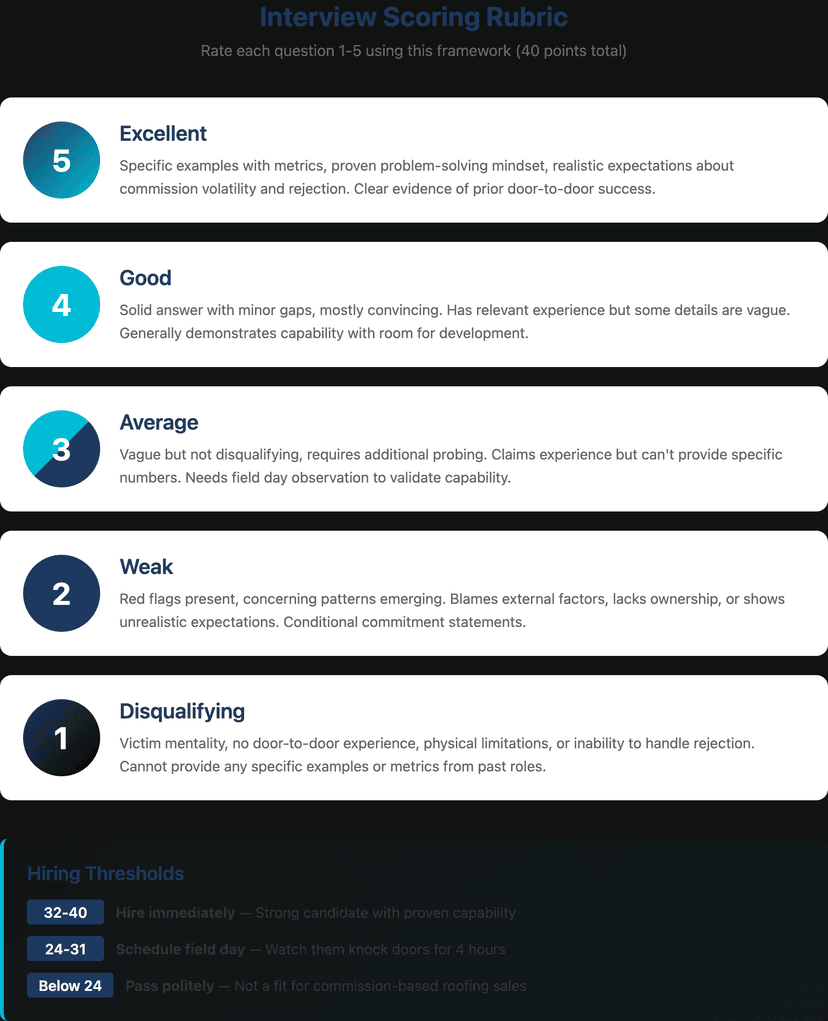
Scoring framework: 1-5 scale per question (40 points total)
- 5 = Excellent: Specific examples, metrics, problem-solving mindset, realistic expectations
- 4 = Good: Solid answer, minor gaps, mostly convincing
- 3 = Average: Vague but not disqualifying, needs probing
- 2 = Weak: Red flags present, concerning patterns
- 1 = Disqualifying: Victim mentality, no experience, physical limitations
Hiring thresholds:
- 32-40 points: Hire immediately
- 24-31 points: Schedule field day (watch them knock doors for 4 hours)
- Below 24 points: Pass
Score honestly. Data beats gut feel.
Background Doesn't Matter. Traits Do.
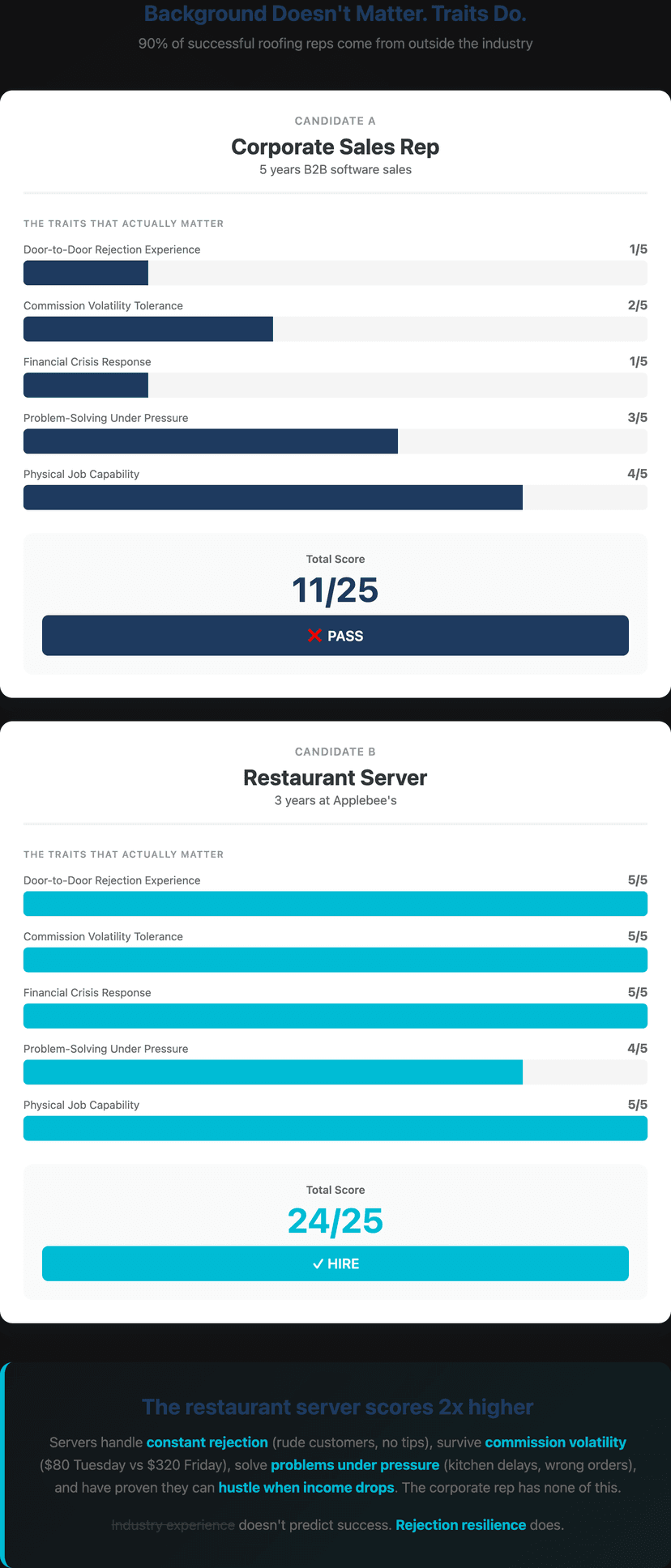
The corporate sales rep with "5 years of relevant experience" scores 11/25 on traits that predict roofing sales success. The restaurant server with zero industry experience scores 24/25.
Why? Servers have survived commission volatility (tips fluctuate daily), handled constant rejection (rude customers, no tips), problem-solved under pressure (kitchen delays, wrong orders), and proven they can hustle when income drops. The corporate rep has none of this.
Industry experience doesn't predict success. Rejection resilience does. Stop filtering for roofing backgrounds. Start filtering for traits.
How to Structure the Interview
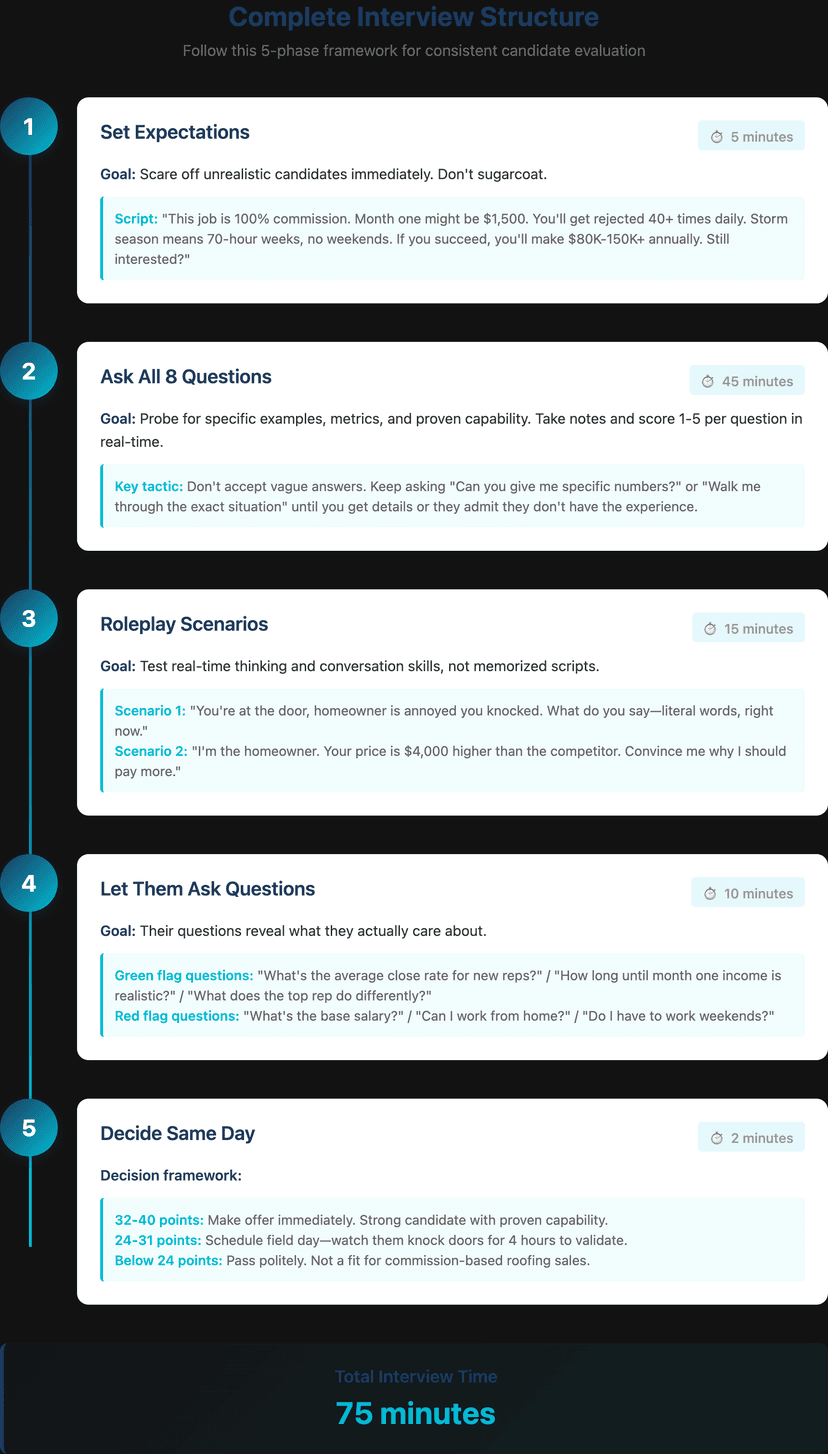
Phase 1: Set the Stage (5 min) "This job is 100% commission. Month one might be $1,500. You'll get rejected 40+ times daily. Storm season means 70-hour weeks, no weekends. If you succeed, $80K-150K+ annually. Still interested? Good."
Phase 2: Ask All 8 Questions (45 min) Take notes. Score 1-5 in real-time on your candidate scorecard. Don't accept vague answers—keep probing until you get specifics or they admit they don't have the experience.
Phase 3: Two Roleplay Scenarios (15 min) "You're at the door, homeowner is annoyed. What do you say—literal words." "I'm the homeowner, your price is $4K higher. Convince me."
Phase 4: Let Them Ask Questions (10 min) Green flags: "What's the average close rate for new reps?" / "How long until month one is realistic?" Red flags: "What's the base salary?" / "Can I work from home?"
Phase 5: Decide Same Day
- 32+/40: Make offer immediately
- 24-31/40: Schedule field day (watch them knock doors)
- Below 24/40: Pass
Frequently Asked Questions
What questions predict roofing sales success? Questions that reveal actual capability, not theoretical knowledge. The eight core areas: income expectations and crisis response, door-to-door rejection experience with specific numbers, insurance problem-solving, price objection handling, self-learning capability, storm season commitment, and physical capability. Learn more about training successful reps with GhostRep's Objection Mastery.
What's an automatic disqualification? Victim mentality ("the market is bad," "customers have no money"), vague claims without proof, no door-to-door experience, and physical concerns (back problems, height fears). If they can't provide specific metrics from past door-knocking jobs, they haven't done it. GhostRep's AI Recruiting Agent automatically screens candidates using this framework with 87% accuracy.
How long is the full screening process? Initial interview: 75 minutes. Field day (if borderline): 4 hours watching them knock doors. Total: 1 day for strong candidates. Manually doing this takes time—GhostRep automates candidate screening so you focus on final interviews with pre-screened candidates.
Next Step
Connect hiring signals to the first 30 days
The best hiring process does not stop at the interview. It turns candidate signals into a tighter onboarding plan before the rep touches leads.
The Bottom Line
Stop hiring based on generic interview answers. The contractors who win at scale have repeatable hiring systems that identify actual capability, not likability.
Manually screening candidates this way takes 75 minutes per person. If you want to see the product path behind that workflow, start with AI sales rep screening. GhostRep's AI Recruiting Agent automates this process, screening hundreds of candidates using the same framework while you focus on final interviews with the pre-screened winners.
Free tools for sales hiring
Make hiring easier to operationalize
If this article surfaced a hiring gap, start with free templates and frameworks before you overhaul the whole process.
Hiring tools
Generate scorecards, interview questions, onboarding plans, and accountability docs.
Browse hiring tools →All free tools
Browse every free GhostRep tool if you want hiring, training, and management resources in one place.
Browse all tools →AI Recruiter
Screen candidates before you burn manager time on interviews that were never a fit.
See AI Recruiter →About the Author
Tim Nussbeck
Founder & CEO of GhostRep
Two decades in roofing—knocking doors, running teams, training 1,000+ reps. Built GhostRep to give every rep access to the coaching top teams get.
Hiring next step
Turn hiring advice into a repeatable screen
Start with free hiring tools if you need scorecards, interview questions, or onboarding docs. Book a walkthrough if you want GhostRep mapped to your recruiting funnel.
- ✓Best fit if managers are wasting time on low-signal interviews.
- ✓Useful for scorecards, interview structure, and onboarding clarity.
- ✓Demo shows how AI Recruiter reduces screening load before the first call.
Start Here
Browse hiring tools
Generate interview scorecards, screening questions, onboarding plans, and accountability docs.
Browse hiring toolsNeed it mapped to your team?
Talk through your current workflow, traffic mix, and where GhostRep fits before you change anything.
Book a 15-minute walkthroughYou Might Also Like
Your commission-only roofing rep costs $573K in 6 months through territory destruction and lead waste. See the math that exposes the 1099 cost myth.
Read article →GhostRep screens 127+ candidates automatically with AI video interviews, custom AI trained on your pitch, and Sales DNA scoring for roofing reps.
Read article →Estimate roofing sales rep earnings from deal size, commission rate, close rate, appointment volume, ramp speed, and realistic field productivity.
Read article →