Free hiring tool
Roofing Sales Recruiting Ad Generator
Write a short recruiting ad that gets field sales reps to reply. Pick your platform and rep type, name your one best reason to join, and the generator drafts an ad sized for Facebook/Instagram, Indeed, LinkedIn, or SMS — built for roofing and home-improvement teams.
Strong candidates may be actively searching, casually comparing roles, or already working for a competitor. Generic copy like “fast-growing company seeking motivated individuals” gives any of them little reason to keep reading. An accurate benefit, a substantiated proof point, and one clear way to respond make the opportunity easier to evaluate. Below the generator you'll find example ads for each platform, the line between an ad and a job description, and the wording that quietly gets an ad ignored.
Built by Tim Nussbeck — founder of GhostRep, 20+ years in home improvement sales.
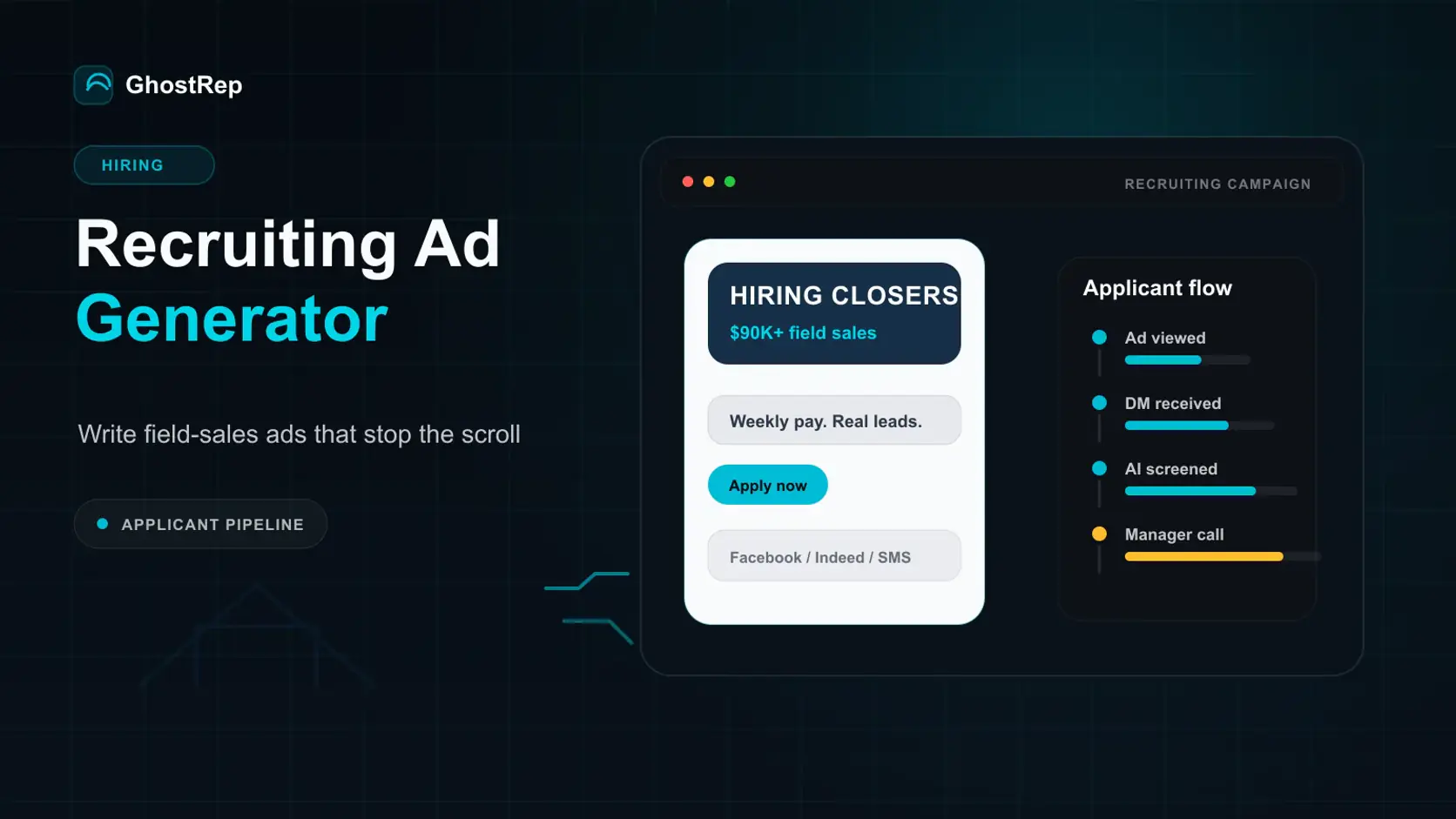
Every ad the generator writes has
- A hook, not a header. A first line about the role’s strongest verified benefit, not generic “we’re hiring.”
- One verified proof point. Use a figure or benefit you can substantiate; never invent earnings or results.
- One clear action. DM a keyword, text a number, or tap apply — never three at once.
- Sized to the platform. Short for social and SMS, fuller for Indeed, professional for LinkedIn.
Enter your details
Free to use. Replace bracketed placeholders with verified facts before publishing. If you have real team photos, test them against your other creative instead of assuming one format will perform best.
What a clear roofing recruiting ad looks like
Strip away the platform differences and strong recruiting ads tend to do the same three things.
The first line is about them, not you. A number, a pay-speed promise, or a verified proof point. If your opening is only your company name and how long you've been in business, the candidate still does not know why the role is relevant.
Use one proof point you can defend. Weekly pay, leads provided, or a substantiated earnings figure can clarify the offer. Pick the strongest accurate point instead of stacking claims the candidate cannot verify.
One action, as easy as possible. DM a keyword, reply to a text, tap apply. The ad's entire job is to get a hand raised; the selling and screening happen in the conversation after. For Meta campaigns, select the employment Special Ad Category when required by the platform.
Roofing recruiting ad examples by platform
The same offer reads differently on each platform. Here's the same roofing closer role written four ways — steal the structure and swap in your city and your real numbers. The dollar figures below are placeholders to show the shape, not benchmarks.
Facebook / Instagram
Short and scroll-first. If you have real crew photography, test it against your other creative.
Roofing sales — [verified pay range], paid [verified schedule]

[Verified proof point supplied by your company]. [Accurate lead or appointment structure].

• [Verified benefit]
• [Verified benefit]
• [Verified training or support detail]

Adding [verified hiring count] closers in [City] before [real deadline, if any].
DM “ROOF” and we’ll send the details.
Why it works: Leads with verified compensation and one substantiated benefit, then asks for one low-friction action.
Indeed
Candidates here are already job-searching, so you get more room — but the first two lines still do the work.
Roofing Sales Representative — [verified pay range]

[Company] is hiring [verified hiring count] roofing sales representatives in [City]. Compensation: [verified structure, range, and payout timing].

The work: [accurate day-to-day responsibilities for this role].

What you need: [job-related qualifications and requirements only].

Apply: [accurate application steps and response timing].
Why it works: Uses the extra length for accurate compensation, responsibilities, and requirements without pretending a short ad replaces the full job description.
Better for experienced reps and sales managers. Professional tone, less hype.
We’re hiring an experienced roofing sales closer in [City].

If you’re already selling roofs and want [verified benefit], [verified benefit], and [verified support detail], it may be worth a conversation. [Verified proof point, if supplied].

Open to a quick call this week? Message me and I’ll share the specifics.
Why it works: Speaks to someone already employed and skeptical of hype. Names the concrete advantages (leads, pay speed, back-office support) without the emoji-heavy feed voice.
Text / SMS
For warm lists and referrals — a rep who gave you their number, or a name a current rep passed along. Keep it a couple of lines.
Hey [Name] — [Company] is adding roofing closers in [City]. [Verified selling point]. Worth a 10-minute call this week? Reply YES and I’ll send the details. Reply STOP to opt out.
Why it works: Personal, specific, and asks for a small next step. Use recruiting texts only with the appropriate consent and honor opt-out requests.
Want a version tuned to your platform, rep type, and best selling point? Use the generator above. For a talking-head video ad instead of copy, the recruiting video script writes the 30-second script.
The ad is the hook — not the job description
The most common way a roofing recruiting ad fails is by trying to be the whole posting. An ad that lists every responsibility, requirement, and benefit reads like a contract and stops nobody's scroll. The ad and the job description are two different documents doing two different jobs.
The ad earns the reply. The job description — with the honest pay section, the real day-to-day, and the employment terms — is what the interested rep reads next. Write the ad to get a hand up; let the posting do the qualifying. When the two say different things about the money, you lose the rep in the first call, so build them from the same numbers.
Employment-ad and outreach guardrails
A recruiting ad is a job advertisement, and the same rules apply. Wording that signals a preference by age, sex, or another protected trait — “young, energetic guys,” “salesman,” “recent grads” — can draw a complaint even when you never meant it that way, and that exact language is common in roofing hiring posts. The EEOC's guidance on job advertisements spells out what counts. Sell the money and the opportunity, not a demographic — it's both safer and a better ad. This isn't legal advice; run your standard ad language past your own advisor.
Treat recruiting texts as regulated outreach, not a cold-blast shortcut. Confirm that you have the consent required for the way you send them, identify the employer, and honor opt-out requests. The FCC's consent and opt-out rules cover automated calls and texts; state rules may add requirements.
What happens after the ad works
If an ad produces more replies than your team can review consistently, decide how you'll qualify applicants before you run it. Score applicants against the same bar with the candidate scorecard, and treat recruiting as a running system, not a one-off post — our Always Be Recruiting guide explains how a continuous recruiting pipeline can reduce last-minute hiring pressure.
If the screening volume is the bottleneck, our structured-screening guide explains how to organize consistent job-related evidence for manager review. And if you're also weighing what those hires cost against what they earn you, the turnover benchmarks put numbers on why a better ad and a tighter screen pay off.
Mistakes that get a recruiting ad scrolled past
Describing the job instead of selling it
A recruiting ad isn’t the posting. Its only job is to stop the scroll and earn a reply. Lead with what the rep gets — money, leads, pay speed — and save the responsibilities list for the job description they read next.
Hiding the pay behind “competitive compensation”
Give candidates accurate compensation information they can evaluate. Use a substantiated range or actual historical figure, and follow the pay-transparency rules that apply where the job is advertised.
Stacking three calls to action
DM us, call, apply, and text creates unnecessary choice. Pick the single lowest-friction action for that platform and make it obvious.
Manufacturing urgency that isn’t real
A fake “last 2 spots” gets found out in the first call and sets a dishonest tone. If storm season or a real territory opening is your reason to act now, use it. If not, let the opportunity carry the ad.
Frequently asked questions
What makes a good roofing sales recruiting ad?
Lead with the role’s strongest accurate benefit, add one proof point you can substantiate, and end with one clear action. That proof can be verified compensation, pay timing, provided appointments, training, or another concrete part of the offer. Keep the social version short and make the next step obvious.
How much should a recruiting ad say about pay?
Be specific and accurate. Use a genuine pay range, compensation structure, or historical figure you can substantiate rather than an aspirational number. Requirements vary by state and locality, so have the final posting reviewed for applicable pay-transparency rules. For broader roofing compensation context, see our roofing sales pay guide.
What’s the difference between a recruiting ad and a job description?
The ad is the hook; the job description is the full picture. The ad’s one job is to stop the scroll and earn a reply — a few lines, one proof point, one action. The posting the applicant reads next carries the responsibilities, the honest pay section, and the classification. Build that with the sales job description generator so the ad and the posting line up.
Which platform should I run roofing recruiting ads on?
Match the format to how candidates use the channel. Keep Facebook and Instagram concise and select Meta's employment Special Ad Category when required. Indeed gives candidates room to review the work and compensation. LinkedIn can use a more professional introduction. Use SMS only with the appropriate consent and an opt-out path. Google Jobs is different: it surfaces eligible job-posting pages or third-party listings; it is not a place to paste a standalone ad. Review Google's job-posting guidance before publishing a job page.
Can I use the same recruiting ad in different cities?
You can keep the structure, but every location, territory, compensation detail, and hiring deadline must remain accurate for that market. Create a localized version for each real opening and track results separately instead of presenting one national message as though every city has the same role.