Free hiring tool
Roofing Sales Job Description Generator
Pick your pay structure and rep type, and this free roofing sales job description generator writes the full posting: the pay section with honest numbers, W2 or 1099 wording, the actual daily work, requirements that filter instead of decorate, and a clear way to apply.
Most contractor job posts fail the same way: “competitive compensation” where a number should be, an HR-template requirements list, and nothing about what the job actually is. The rep you want — the one already earning somewhere else — skips those posts. The rep who applies anyway is the one who quits in week two when reality hits.
Built for contractor field sales — roofing first; the same structure works for solar, HVAC, and windows. Storm and retail roles get different descriptions, because they are different jobs.
Below the generator: a full roofing sales rep job description example, exact pay-section wording for each pay structure, and the difference between a job description and a recruiting ad.
Created by Tim Nussbeck — founder of GhostRep, 20+ years in home improvement sales.
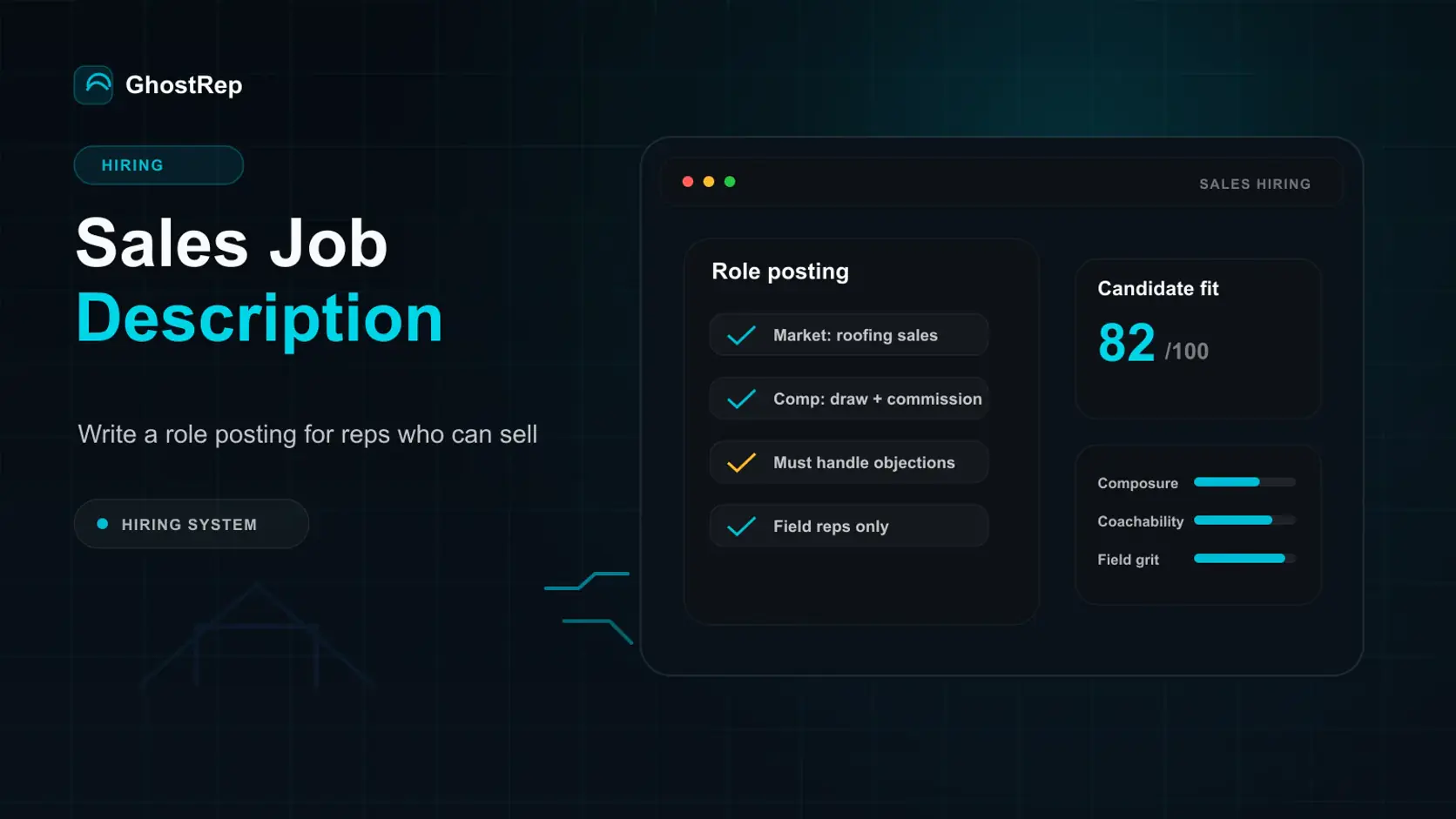
Every job description includes
- Honest pay section. Structure, a realistic average-rep number, and when reps get paid.
- The actual daily work. Canvassing, inspections, kitchen tables — not “generate opportunities.”
- Required vs. preferred. What truly disqualifies, separated from what’s just nice to have.
- Classification up front. W2 or 1099 stated in the posting, not sprung in the interview.
Enter your details
Free to use. Swap the generated pay figures for your real numbers before posting. Your actual average is more believable than a placeholder, and some states require compensation details in job postings.
The pay section is the whole posting
A roofing rep reads the pay section first, and if it says “competitive” or “DOE,” they read nothing else. Here is what to state for each structure — with the wording:
Use your average, not your outlier. The rep who joins on a top-performer number and lands on the average quits angry and tells the market why — and in roofing, reps talk. If you're not sure what an honest range looks like, our breakdown of what roofing sales reps actually make covers real earnings by role and market, and the full cost of a sales rep shows what the hire costs you on the other side of the table.
Posting the number is also a compliance issue in some states. Colorado's Equal Pay for Equal Work Act requires compensation information in job postings. If you hire across state lines, check the current state rules before posting; a real range is clearer for candidates and safer than vague pay language.
Say W2 or 1099 in the posting — and make sure it's true
Classification changes everything the rep is signing up for: taxes, insurance, expenses, and how they weigh your commission number against a W2 offer down the street. Put it in the posting. A 1099 offer that first appears in the interview reads as a bait-and-switch, and the reps experienced enough to know the difference are exactly the ones you're trying to attract. Our W2 vs. 1099 guide for roofing sales walks through which model fits which operation.
One caution while you write it: the label in your posting doesn't decide the law. The U.S. Department of Labor says employers are responsible for determining whether a worker is an employee under the FLSA, and its current guidance uses an economic-reality test for contractor classification, and a rep you schedule, equip, and manage like an employee may be one no matter what the job post said. If your model is 1099, write the posting to match the reality — set your own schedule, paid per sold job — and if you can't write it that way honestly, the classification is the problem, not the wording. The true cost of a 1099 rep covers the trade-off in numbers.
Roofing sales rep job description example
A storm restoration rep posting, start to finish. Steal the structure, swap in your market and your real numbers — the figures below are placeholders that show the pattern, not benchmarks.
The opportunity
We're adding two storm restoration sales reps for the Dallas–Fort Worth market. Last year our average rep earned $84,000 and our top third cleared $120,000 — commission-only, 1099, paid weekly on collected jobs. Replace these with payroll-backed numbers before posting.
The work
Canvass storm-hit neighborhoods after hail events. Inspect roofs and document damage — you'll be on ladders and walking slopes daily. Meet insurance adjusters on-site, present scopes at kitchen tables, and follow your jobs from signature through build day. Summer is the season; expect full weeks when the storms come.
You need
A valid driver's license and reliable truck, comfort on a ladder, and the discipline to knock doors after your third no. Roofing experience helps but isn't required — we've trained closers out of pest control, solar, and gyms. What we can't train is showing up.
We provide
Storm-response lead flow, a two-week paid training program, an office team that handles supplements and permitting so you can sell, and weekly pay with no commission caps.
How to apply
Reply with your name, city, and one sentence on the hardest thing you've ever sold. We call every qualified applicant within two business days.
Notice what it doesn't say: “dynamic self-starter,” “fast-paced environment,” or a mission statement. Every line either informs or filters. Want one built for your pay structure, rep type, and market? Use the generator above.
Job description vs. recruiting ad — two different jobs
Owners conflate these constantly and end up with a 500-word Facebook ad nobody reads or a three-sentence Indeed post nobody trusts. The ad gets attention; the description qualifies. You need both, and they are not the same document.
This page writes the description. For the scroll-stopper that points at it, use the recruiting ad generator — it's built for the feed, not the careers page.
Where the job description sits in your hiring flow
The description is step two. Step one is deciding what the job actually pays — if the comp plan isn't settled, the posting is fiction, and the commission plan builder settles it first. Downstream, applicants get evaluated against the candidate scorecard — the description attracts, the scorecard decides — and the ones you hire start on the 30-60-90 onboarding plan. An honest posting feeds all three: it's the difference between onboarding a rep who knew what they signed up for and replacing one who didn't. If the post keeps attracting people who fail before they build a pipeline, pair this tool with the new-rep 90-day failure diagnostic.
That replacement math is the reason to sweat the wording at all. Roofing sales runs some of the highest turnover in home improvement, and a common cause is the gap between what the posting promised and what the job is — our turnover benchmarks put numbers on what each mis-hire costs. And if screening the applicant flood is the bottleneck, our structured-screening guide explains how to collect consistent job-related evidence while keeping every callback and employment decision with a human reviewer.
Frequently asked questions
What should a commission sales rep job description include?
Five things, stated plainly: the pay structure (commission-only, base plus commission, or draw) with a realistic first-year number based on your average rep, the employment classification (W2 or 1099), the actual daily work — canvassing, inspections, kitchen-table presentations, adjuster meetings — the requirements that are truly required versus preferred, and what happens after they apply. A rep reading job posts at 9pm is qualifying you as fast as you are qualifying them, and the posts that answer these five questions get the serious applicants.
Should the job posting say W2 or 1099?
Yes — state the classification in the posting, not in the interview. A rep planning their taxes, insurance, and truck expenses needs to know before they apply, and a surprise 1099 offer after two interviews reads as bait-and-switch. Also make sure the classification is legally accurate: U.S. Department of Labor guidance uses an economic-reality test, and calling a rep a contractor in the posting does not make them one under the law.
How is a roofing sales rep job description different from a generic sales JD?
The work is physical and event-driven, and the description has to say so. Roofing reps climb ladders, walk steep roofs, canvass storm-hit neighborhoods in summer heat, and sit kitchen tables at 7pm — none of which appears in a software-sales template. Storm and retail roles also differ from each other: storm reps need the insurance claim process and surge travel; retail reps need financing conversations and referral discipline. Write the roof into the description, or you will hire someone who quits the first week of July.
How long should a sales job description be?
Between 300 and 600 words: a short opening that sells the opportunity with a real number, bullets for the daily work and requirements, a plain pay section, and one clear way to apply. A rep scrolling on their phone gives a post one screen to earn a second one. If the opening paragraph does not land, nothing after it gets read.
Can I use the same job description for storm and retail sales reps?
No. Storm reps work event-driven surges, travel to hit markets, and live inside the insurance claim process. Retail reps work year-round on referrals, repeat business, and financing conversations. The skills overlap less than owners assume, and a single generic posting attracts candidates who fit neither role — write one description per role and say which one you are hiring for.
Where should I post a field sales job description?
Start with the channels where field sales reps already look: Indeed-style job boards, Facebook hiring posts, local trade groups, industry Facebook groups, and your own crew’s referrals. Post the same description everywhere, track which source produces hires who are still selling after 90 days — not which one produces applications — and move your budget to what actually survives.