Subcontractor Agreement
Generate a subcontractor agreement covering scope, payment terms, insurance, and liability. Built for home improvement contractors.
Created by Tim Nussbeck — 20 years in home improvement sales, 1,000+ reps trained, founder of GhostRep
Enter your details
Created by Tim Nussbeck
Founder of GhostRep · 20+ years in home improvement sales · Trained 1,000+ reps
Every tool on this page comes from real field experience and GhostRep's production AI workflow, not filler templates.
What Is a Subcontractor Agreement?
A subcontractor agreement is the document that determines who pays when something goes wrong on a job you sold. With roofing net profit margins typically running 6% to 12%, a single uninsured callback or warranty dispute can erase the margin on an entire month of production. Most contractors operate on handshake arrangements with their subcontractor crews until a callback dispute has no written workmanship standard to reference, or a workers' compensation claim lands on your desk for a sub's uninsured employee. According to the IRS contractor classification guidelines, the distinction between an independent contractor and an employee has specific legal criteria — and a properly executed written agreement is the primary document that establishes which side of that line your subcontractors fall on.
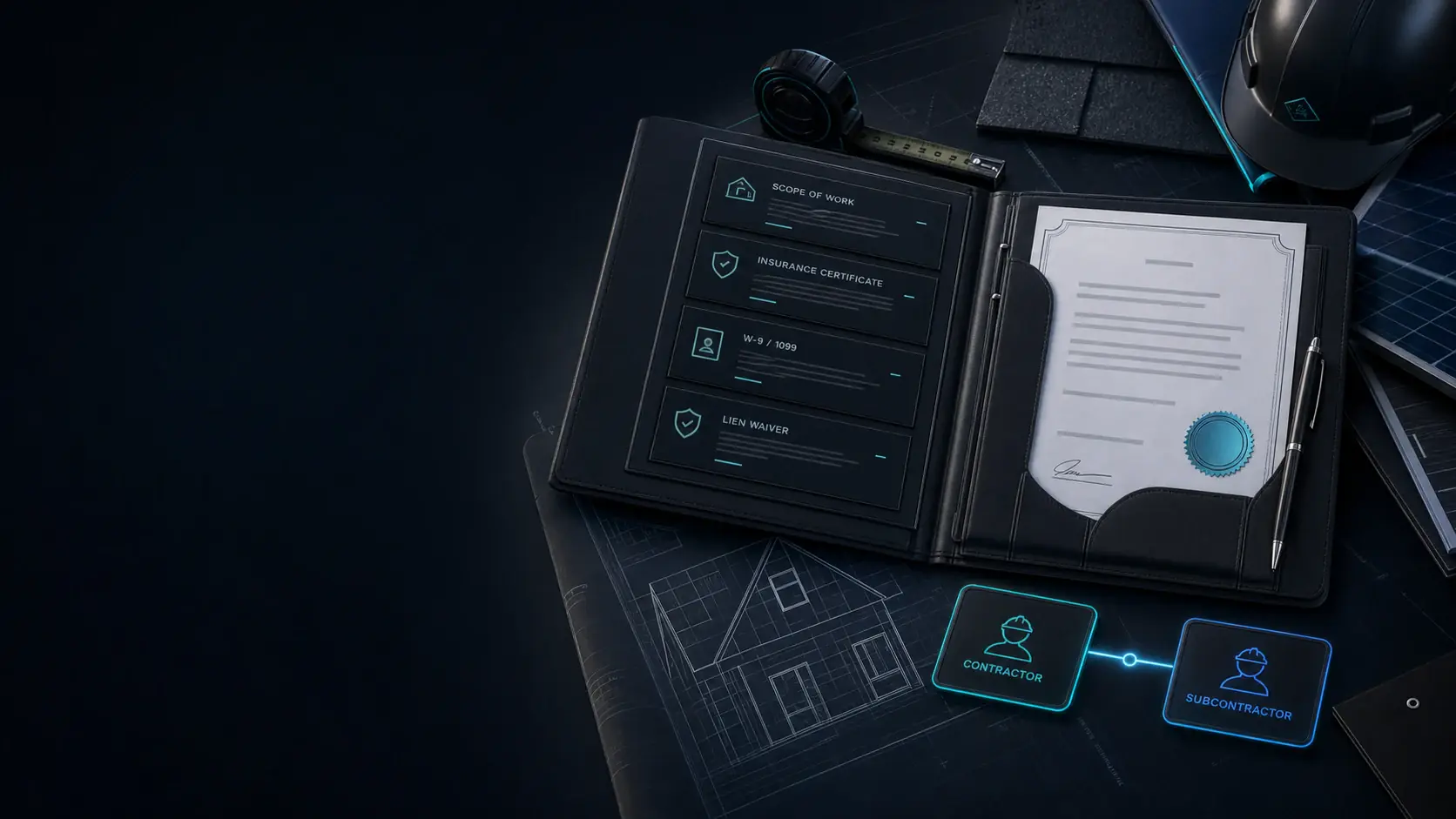
This generator builds a subcontractor agreement covering independent contractor status, scope of work, payment terms and schedule, insurance requirements, workmanship and callback standards, site safety obligations, indemnification, and termination. Whether you run a roofing company, a solar installation business, an HVAC operation, or a general contracting firm, enter your scope, payment structure, and state, and get a document you can review with an attorney and use as the foundation for every crew relationship going forward.
For a deeper look at the financial implications of how you classify your workers, read our breakdowns of W-2 vs. 1099 classification and the true cost of a 1099 rep. AI Sales Coach tracks subcontractor performance metrics alongside rep data so you can identify which crews deliver consistent quality and which ones generate callbacks.
How to Use This Tool
Describe the specific scope of work
The scope defines what this agreement covers. "Residential shingle re-roof" and "commercial TPO installation" are different agreements with different skill requirements, material handling expectations, and safety obligations. A specific scope prevents scope-creep disputes and defines exactly what workmanship standards apply.
Select your payment structure
Per-square rates are the most common for residential roofing and create clear, per-job accounting. Flat per-job rates work well when job complexity is consistent. Day rates introduce variable cost risk if jobs run long. Your payment structure choice affects the agreement's invoicing, dispute resolution, and payment timing sections.
Enter your company name and state
State law governs independent contractor classification standards, required workers' compensation provisions, and lien rights — all of which affect the agreement's language. Operating without a state-specific agreement means the generic terms may not be enforceable in your jurisdiction.
Collect current insurance certificates before every job
The agreement requires minimum insurance coverage. Your obligation does not end at getting the certificate once — require current certificates before each active job season and any time a subcontractor's policy could have expired. An expired certificate provides no protection when you need it.
Have an attorney review before using with any crew
This generator produces a professionally structured template. An employment attorney familiar with your state's contractor classification and construction law should review it before you execute it. A $300–$500 legal review on an agreement you will use for every crew relationship is a sound investment.
Common Mistakes to Avoid
| What Most Reps Do | What Works Better |
|---|---|
| Using a generic contract template without state-specific language | State law governs contractor classification, workers' comp requirements, and lien rights. A generic agreement may not be enforceable in your jurisdiction. |
| Not requiring current insurance certificates before each job | Collect certificates before every active season and verify they name your company as additional insured. An expired certificate provides zero protection when you need it. |
| Leaving workmanship standards vague or undefined | Define specific standards — no exposed fasteners, proper flashing, full adhesion — with a callback timeline. Written standards prevent the interpretation disputes that destroy subcontractor relationships. |
| No termination clause or requiring cause to end the relationship | Allow either party to terminate with written notice for any reason, with all completed work paid to date. An agreement without a clear exit creates messy separations. |
What Makes a Good Subcontractor Agreement
Independent contractor status explicitly established. The agreement must document the factors that establish independent contractor — not employee — status: the sub provides their own tools, sets their own schedule, works for multiple clients, and directs their own crew. Missing or weak independent contractor language is the primary legal vulnerability that allows a sub's injury claim to become your workers' compensation liability.
Specific insurance minimums with you named as additional insured. Requiring "insurance" is not enough. The agreement should specify minimum coverage amounts — $1 million general liability per occurrence is a common residential minimum — and require that your company is named as an additional insured on the policy. Without additional insured status, a claim on a job you sold may not be covered by the sub's policy.
A written workmanship standard with a callback timeline. Define what workmanship means: no exposed fasteners, proper valley flashing, full adhesion on hip and ridge, etc. Define the callback obligation: if a workmanship defect is identified within one year, the sub returns to correct at no cost within five business days. Written standards with defined remedies prevent the interpretation disputes that destroy subcontractor relationships.
A termination clause that does not require cause. You need the ability to stop using a subcontractor without a legal dispute. The agreement should allow either party to terminate with written notice — typically 10–30 days — for any reason, with all completed work paid to date. An agreement without a clear termination provision creates a messy separation from a crew whose work quality has declined or whose relationship has become problematic.
Pro Tip
Include a scope-of-work attachment with every agreement — vague agreements create disputes, specific ones prevent them. The master agreement covers standard terms that apply to every engagement. The scope-of-work exhibit defines the specific job, rate, timeline, and deliverables for each project. This structure lets you onboard new subcontractors once and document each engagement with a one-page attachment rather than re-executing the full contract every time. For the financial framework behind structuring these relationships, see our breakdowns of W-2 vs. 1099 classification and the true cost of a 1099 rep.
Frequently Asked Questions
do I need a written contract with my subcontractors?
Yes — a written agreement is not optional if you want meaningful protection. A verbal arrangement with a sub whose employee is injured on your job site becomes your liability problem when there is no document establishing independent contractor status, insurance requirements, or indemnification. This applies to roofing crews, solar installers, HVAC technicians, and every other trade you subcontract. Most contractors who have been through a job site injury claim once never use a verbal-only arrangement again.
what insurance should a subcontractor carry?
At minimum: general liability with a $1 million per-occurrence limit, workers' compensation covering all crew members (required in most states regardless of 1099 status once a threshold number of workers is reached), and commercial auto if they drive to job sites. Require proof of current coverage before each season and name your company as an additional insured on the general liability policy. A sub who pushes back on insurance requirements is a liability risk you do not want on your jobs — whether they install roofs, solar panels, HVAC systems, or windows.
am I liable if a subcontractor's worker gets injured on my job?
Potentially, yes — especially if the worker can argue they were functioning as an employee rather than an independent contractor, or if your company is shown to have controlled the work methods. A properly executed subcontractor agreement that establishes independent contractor status, combined with a current insurance certificate and a clear scope-of-work document, substantially reduces but does not eliminate your exposure. An employment and construction attorney in your state is the right resource for a specific liability assessment.
what payment terms should I use for subcontractors?
The most common structure is net-7 to net-14 from job completion and homeowner sign-off for residential jobs, with a 10-15% retainage held until any callbacks are confirmed resolved. Requiring an invoice matching your purchase order before releasing payment creates a documentation trail. Paying too slowly damages your ability to attract quality crews during high-demand periods; paying too fast without workmanship verification removes your leverage on callbacks.
can I use one subcontractor agreement for all my crews?
A master agreement with crew-specific scopes of work attached as exhibits is a common and efficient approach. The master covers standard terms — insurance requirements, independent contractor status, workmanship standards, callback obligations, indemnification, and termination. A job-specific exhibit covers the scope, rate, and payment terms for each engagement. This structure minimizes paperwork while keeping each engagement properly documented without re-executing the full agreement each time.
what happens if a subcontractor does poor work and refuses to fix it?
A written agreement with a defined workmanship standard and callback obligation establishes the sub's contractual duty to return and correct the work. If they refuse, you withhold any unpaid amounts under the retainage provision, document the deficiency with photos and a written notice, hire another crew to complete the correction, and charge the cost back against the withheld retainage. Without a written agreement, this entire process becomes a dispute with no documented standard to hold the sub accountable against.
Related Tools
Priority Tool Cluster
These are the tool pages GhostRep is pushing hardest for discovery right now.
Sales KPI Scorecard
Turn rep activity, conversion, and pipeline metrics into a weekly scorecard a manager can actually run.
Sales PIP Builder
Create a performance improvement plan when a sales rep is slipping and managers need a documented path forward.
ROI Calculator
Model payback period, revenue upside, and close-rate lift before you buy or roll out anything.
Homeowner Text Generator
Write same-day follow-up and homeowner-facing messages reps can send without sounding robotic.
Track Subcontractor Performance Alongside Rep Data
AI Sales Coach identifies which crews deliver consistent quality and which ones generate callbacks — so your subcontractor decisions are based on data, not gut feel.
Learn MoreCreate Free AccountMore Operations Tools
SOP Generator
Generate roofing SOP templates and standard operating procedures for sales, production, follow-up, handoffs, and contractor operations.
Sales KPI Scorecard
Generate a sales KPI scorecard template for roofing, solar, HVAC, and home improvement teams with benchmarks, close-rate metrics, and coaching gaps.
Sales Pipeline Template
Generate a contractor sales pipeline template for CRM or spreadsheet tracking, with deal stages, follow-up rules, and production handoff criteria.
Roofing Workflow
Use this tool inside the full roofing workflow so reps get better practice, tighter follow-up, and clearer revenue math instead of one-off outputs.
Go beyond documents
GhostRep trains your reps live — not just generates documents.
AI-powered objection mastery, role play, and real-time coaching that actually changes close rates.
Create Free Account