At 8:07 Monday morning, the remote manager should not need six Slack messages to learn that yesterday’s estimate was never sent, today’s inspection lacks access confirmation, and one rep has four appointments across a three-hour drive. Those are operating exceptions, not reasons to watch green status lights.
A remote roofing team needs a shared customer record, trustworthy stages, visible capacity, and a short queue of decisions. Managers inspect promises and blocks; they coach from specific work later. This page owns that operating system. The remote training guide owns how reps learn and earn additional responsibility.
Write the remote management contract
Before choosing dashboards, define what every rep and manager owes the system.
The remote team operating agreement
- Customer record
- The rep records the verified outcome, customer-stated need, and next action by the company cutoff. The manager removes duplicate rules and conflicting required fields.
- Stage truth
- The rep uses a stage only when its required facts exist. The manager publishes the entry, exit, owner, and aging definition for that stage.
- Customer promise
- The rep records the promised update, owner, and due time. The manager reviews at-risk promises before asking for an internal forecast.
- Capacity
- The rep exposes appointments, active work, travel, and blocks. The manager routes from workload and customer facts—not punishment, favoritism, or a green status light.
- Coaching
- The rep brings one attempt, field record, or question. The manager quotes the work, names the gap, assigns one practice, and schedules the next observation.
- Escalation
- The rep raises safety, legal, technical, insurance, pricing, or customer-risk issues. The manager follows the published severity, response-time, and ownership rules.
Build a pipeline managers can trust
A remote manager cannot inspect a rep’s memory. Each stage needs visible entry requirements. “Proposal” might require the controlling estimate version, delivery date, recipient, open questions, and agreed next action. “Inspection complete” might require date, assigned inspector, observation artifact, limitations, and promised customer update.
The sales pipeline template helps define stage contracts. The production-handoff CRM fields guide owns the downstream record that production needs after a sale.
Do not equate missing CRM fields with employee misconduct automatically. First determine whether the field was required, usable on mobile, understood, and compatible with the workflow. A system defect repeated across several reps is a management problem.
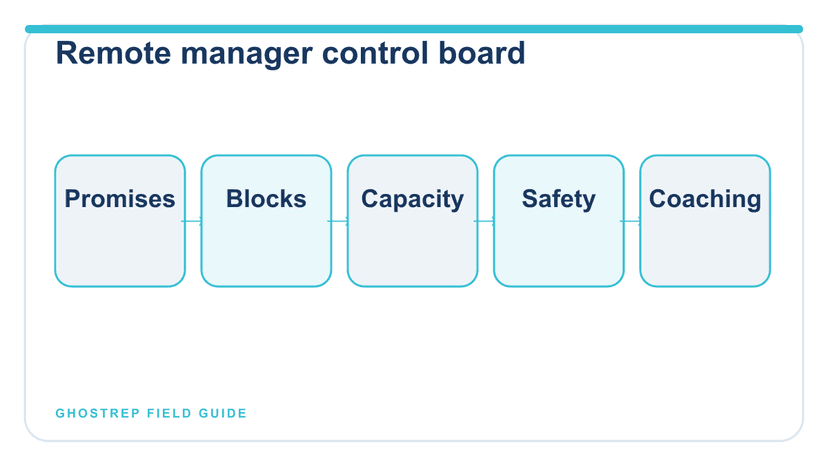
Manage the exception board—not every click
Today’s exception board
Customer update at risk:
Evidence: Inspection summary promised today; manager review incomplete
Owner: Sales manager
Due action: Review by 11 a.m.; customer update by noonAppointment unconfirmed:
Evidence: Tomorrow 9 a.m.; no confirmation response
Owner: Assigned rep
Due action: Use approved confirmation path by 3 p.m.Stage aging:
Evidence: Estimate-review stage 12 days; no dated customer pause
Owner: Rep and manager
Due action: Correct stage or record next decision todayCapacity risk:
Evidence: Rep has five inspections across two distant territories tomorrow
Owner: Dispatcher
Due action: Rebalance before new work assignmentSafety escalation:
Evidence: Rep reported aggressive dog at vacant property
Owner: Operations
Due action: Block solo visit; follow field-safety policyData integrity:
Evidence: Two records for same property with different owners
Owner: CRM owner
Due action: Merge after preserving activity history
The manager’s daily review should protect customers and unblock work before asking for a forecast. A polished revenue number built on overdue promises and false stages is not useful management.
Use four meeting layers
Daily 15-minute exception meeting
Review safety or customer risk, commitments due today, blocked stages, capacity conflicts, and named next actions. The 15-minute roofing sales meeting format provides the agenda and completed record.
Weekly pipeline record review
Sample records by stage and source. Confirm stage requirements, next-action quality, aging, and conversion definitions. Do not make every rep narrate every opportunity.
Weekly coaching conversation
Review one job behavior supported by a call, role-play attempt, field observation, or record. Agree on one practice and one later observation. Keep this separate from a public team meeting.
Monthly system audit
Look for repeated broken handoffs, fields no one can complete, manager scoring disagreement, overloaded territories, ineffective automations, privacy risks, and policy drift. Correct the system before blaming people for predictable failure.
Manage capacity with a visible workload model
Lead count alone does not describe workload. A rep with ten geographically dispersed inspections may have less capacity than a rep with twenty nearby proposal follow-ups. Review appointment count, travel, active opportunities by stage, overdue customer commitments, complexity, administrative work, weather constraints, and planned absence.
The roofing sales team capacity calculator provides a transparent planning model. Use it as a routing aid, not an automated employee verdict.
Require observed field work without spying
Remote does not mean unobserved. Use scheduled ride-alongs, manager-observed virtual appointments, lawful and consented recordings, artifact review, CRM evidence, customer handoff quality, and supervised field work. Tell employees what is collected, why, who can access it, how long it remains, and how inaccurate records can be corrected.
NIST’s Privacy Framework guidance describes privacy risk across the data life cycle and offers a useful model for inventorying data processing, roles, risks, and controls. It is voluntary guidance, not a substitute for applicable law or employment review.
Do not use location, recording, activity, or AI scoring as invisible surveillance. Collect the minimum evidence needed for the stated operational or coaching purpose. Have qualified HR and legal owners review monitoring, recording, accommodation, discipline, and employment decisions.
Use a coaching record that ends in another observation
A coaching note that creates the next observation
Task:
Confirm scope equivalence before responding to a lower-price objectionObserved evidence:
Rep defended price before asking which written items differedGap:
Diagnosis step absent; competitor assumption introducedPractice:
Run three varied scope-comparison scenarios using approved documentsManager support:
Provide current comparison checklist and one approved exampleNext observation:
Review one supervised proposal discussion FridayRestriction:
Independent competitor comparison remains restricted until observed accurately
The sales manager one-on-one tool can structure the conversation. The evidence should lead to support and practice, not a vague instruction to “be more confident.”
Build a dashboard that routes decisions
A useful remote management view may include:
- customer commitments due or overdue;
- stage aging with the company definition;
- appointments proposed, scheduled, confirmed, held, and rescheduled;
- workload and territory conflicts;
- records missing required evidence;
- service, safety, consent, or escalation incidents;
- coaching actions due; and
- system errors or automation failures.
The sales KPI scorecard can organize operational measures. Publish each numerator, denominator, source, period, and owner. Do not rank reps from incomplete or non-comparable cohorts.
Frequently asked questions
Should managers monitor remote roofing reps all day?
No. Define the evidence needed for customer service, safety, routing, and coaching; review exceptions; and use transparent, lawful observation methods. Presence indicators are not performance evidence.
What should a remote roofing sales rep report daily?
Verified outcomes, customer commitments, stage changes, next actions, capacity constraints, and escalations. The CRM should hold the record; the meeting should route exceptions.
How do you create accountability without micromanagement?
Make stage requirements and commitments explicit, assign one owner and due time, audit balanced samples, and close the loop on support promised by management as well as work promised by reps.
Remote management is queue control
Remote roofing sales management is not an always-on video call. It is a disciplined evidence system: trusted stages, visible commitments, daily exception routing, fair capacity decisions, specific coaching, and transparent field observation. Manage what customers and the team need next—not the color of a status dot.
Free tools for sales managers
Turn this into a manager workflow
Use free management and operations tools to turn coaching ideas into repeatable systems for your reps and managers.
Management tools
Use 1-on-1 scripts, meeting agendas, forecast templates, and escalation tools.
Browse management tools →Operations tools
Build scorecards, SOPs, pipeline templates, and review workflows your team can run every week.
Browse operations tools →AI Sales Coach
Give reps coaching based on real performance data instead of waiting for the next ride-along.
See AI Sales Coach →About the Author
Tim Nussbeck
Founder & CEO of GhostRep
20+ years in roofing and home improvement sales—knocking doors, running teams, and building practical coaching systems. Built GhostRep to give every rep access to the coaching top teams get.
Manager next step
Turn this into a manager workflow your team can repeat
Use the management tools if you need a practical coaching or accountability system first. Book a walkthrough if you want GhostRep tied to rep performance and live coaching.
- ✓Best fit if coaching is inconsistent across reps and managers.
- ✓Useful for 1-on-1s, scorecards, and weekly operating rhythms.
- ✓Demo shows how AI Sales Coach turns performance data into specific guidance.
Start Here
Browse management tools
Open scorecards, coaching docs, forecast templates, and manager workflows.
Browse management toolsNeed it mapped to your team?
Talk through your current workflow, traffic mix, and where GhostRep fits before you change anything.
Book a 15-minute walkthroughYou Might Also Like
See seven useful AI sales manager workflows for roofers, what AI should never own, and a practical pilot and buyer checklist.
Read article →Use a 30-day roofing sales onboarding calendar with safety gates, field practice, role play, coaching evidence, and weekly manager decisions.
Read article →Run a 15-minute roofing sales meeting that routes safety issues, customer commitments, blocked work, capacity conflicts, and coaching follow-ups.
Read article →