
An insurance agent does not need another roofer asking for a policyholder list. The agent needs a contractor they can describe in one honest sentence: what the contractor does, how the homeowner gives permission, what happens after the handoff, and which insurance questions go back to an authorized insurance professional.
That is the referral advantage. Not lunches, gifts, or implied claim influence—an operating handoff the agent can trust. The relationship fails when the roofer pressures for private data, promises coverage, blurs professional roles, or pays an incentive nobody reviewed.
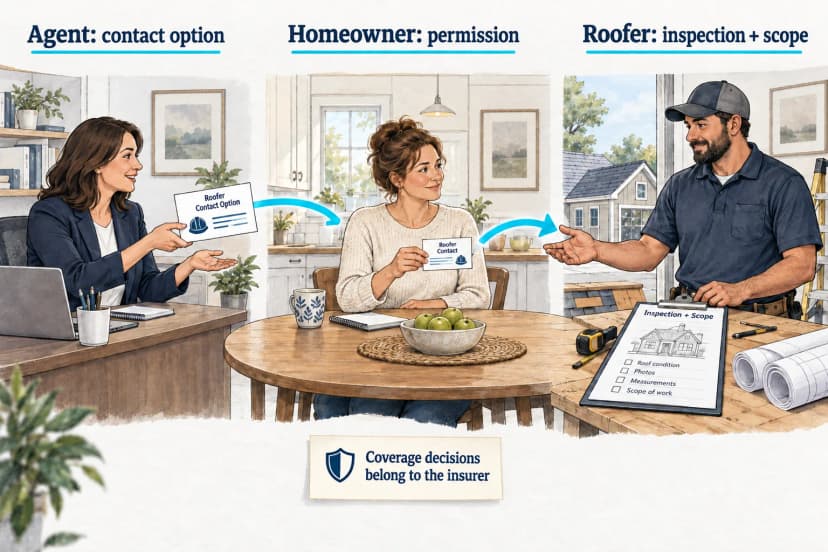
Keep three roles separate
| Role | May own | Should not be represented as owning |
|---|---|---|
| Insurance agent or licensed producer | Policy service within license and carrier authority; customer-directed insurance questions | Contractor scope, workmanship, or field inspection |
| Roofing contractor | Inspection observations, contractor estimate, proposed scope, product and work process | Coverage decision, insurer obligation, legal interpretation, or guaranteed claim result |
| Insurer/adjuster or other authorized claim role | Claim investigation and decisions within assigned authority | Contractor workmanship or sales representation |
| Homeowner | Permission, selection, questions, records, and decisions that belong to the insured/customer | Being treated as a lead source without informed participation |
The NAIC’s model-law library includes the Producer Licensing Model Act and related state-law charts. Model provisions are not themselves a substitute for the law of a particular state. Licensing, referral activity, fees, compensation, disclosure, rebating, privacy, and producer conduct vary. Have qualified insurance and legal owners review the exact relationship before exchanging value or customer information.
Give the agent a service reason to refer
An insurance agent does not need another contractor asking for “all your roof claims.” The agent needs a contractor who reduces confusion for a customer without crossing role boundaries.
- Answer contractor-process questions promptly.
- Explain observations and proposed work in writing.
- Label unknowns instead of predicting coverage.
- Respect the customer’s choice of contractor and contact preference.
- Use qualified technical escalation.
- Keep appointment and service commitments.
- Do not blame the agent for an insurer decision.
- Close the handoff with a factual status the customer authorized the parties to share.
The contractor earns confidence through repeatable service, not lunches, swag, or aggressive lead requests.
Use a permission-based introduction
The safest starting pattern is customer-led: the customer asks for contractor information or authorizes a specific introduction. Record who requested it, what information may be shared, through which channel, and for what purpose.
Agent-to-customer script
“If you want contractor options, I can share contact information for [company/list/process]. I do not control their inspection, estimate, or work, and they do not decide policy coverage. Would you like the information, or would you prefer to find a contractor independently?”
Contractor first-response script
“Hi [customer], [agent] shared our information after you requested [stated purpose]. I’m [name] with [company]. We can explain our inspection and estimate process. Your insurer or licensed insurance professional handles policy and coverage questions. Would you like [approved next option]?”
Status-update script
“With [customer]’s permission, the contractor step is currently [inspection scheduled / observations delivered / estimate provided]. We are not representing a coverage result. [Customer] remains the owner of any insurance communication unless another approved authorization applies.”
Referral partner operating card
One-page referral operating agreement
- How the customer enters
- The customer requests contractor information or authorizes one named introduction. There is no policyholder-list outreach.
- What crosses the handoff
- Only the customer-approved name, contact channel, and stated purpose. The request and permission are recorded.
- What the contractor promises
- Respond inside the published service window, identify the contractor role, explain the next available step, and document the outcome.
- What neither party implies
- No endorsement of workmanship or price, insurer affiliation, coverage interpretation, guaranteed approval, or claim outcome.
- How status returns
- Only with customer permission, and only the approved operational fact—for example, inspection scheduled or estimate delivered.
- Compensation and review
- No compensation in the test relationship. Any future exchange of value requires state-specific legal and compliance approval. Recheck the card after a law, policy, privacy, ownership, or compensation change.
Here is an illustrative handoff, not a reported customer result. At 9:12 a.m., a homeowner asks the agent for a contractor option after noticing a ceiling stain. The agent offers contact information and records the homeowner’s permission—without sending policy details or predicting a claim. At 9:31, the contractor identifies itself, explains the inspection process, and offers two appointment windows. The contractor later reports only that an inspection was scheduled because that is the status the homeowner authorized. Questions about coverage return to the appropriate insurance professional; questions about observations and proposed work stay with the contractor.
The example is intentionally uneventful. A referral relationship becomes valuable when the homeowner does not have to untangle hidden incentives, crossed roles, unexplained data sharing, or two professionals speaking for each other.
A printable service card for the first partner meeting
Bring a one-page description of the handoff before asking an agent to recommend your roofing company. The service card should make the offer concrete: service area, supported work, contact route, staffed response window, documentation, and a person who owns a missed commitment.
Open the printable insurance-agent partner service card. Fill the fields in your browser, then use Print or Save as PDF. It includes a customer-permission record and a return-status rule; no customer list or compensation agreement is built into it.
- What the agent can share
- Your public contact information, service area, and the contractor work you actually offer.
- What the customer authorizes
- A specific introduction, contact channel, and purpose. Permission to arrange an inspection does not automatically authorize an ongoing promotional sequence.
- What your office commits to
- A response window it can staff, a named coordinator, a backup route, and the next available contractor step.
- What can return to the agent
- Only the operational status the customer approved for sharing. Keep price, photos, policy records, and unrelated personal details out unless separately authorized and appropriate.
Three worked roofing referral-partner messages
The names below are fictional and the service windows are example commitments. Replace them with your real process. Download the three messages as editable text.
1. Roofer’s first email to an agency
Purpose: agree on a service handoff. Owner: contractor partnership contact. Next action: agent reviews the card and identifies any agency requirements.
Subject: A clear roofing contact option for your customers
Hello Morgan, I’m Jordan, the service coordinator at an example roofing company. We offer roof inspections and written contractor estimates in our stated service area. I’ve attached a one-page card showing how a customer can contact us, the response window we can staff, and who handles a service issue.
We do not need a policyholder list. If a customer asks for a roofing contact, they can reach us directly or authorize a named introduction. We explain our observations and proposed work; we do not promise insurance coverage. Would you review the card and tell me what your agency requires before sharing contractor information?
2. An authorized group introduction
Permission: customer requested one email introduction. Owner: agent sends; contractor responds. Next action: customer selects whether to arrange an inspection.
Hello Taylor and Jordan. Taylor asked me to introduce a roofing contact by email to discuss a ceiling stain and the contractor’s inspection process. Taylor, Jordan is the service coordinator and can explain available appointments. You remain free to choose a different contractor. This introduction does not establish the cause of the stain or any insurance coverage.
The contractor’s reply should confirm the request and explain the next appointment option. A request for an email introduction should not silently become permission to call or text.
3. Closing the permitted status loop
Permission: customer agreed to share scheduling status only. Owner: contractor coordinator. Next action: contractor keeps the appointment; agent has no task.
Hello Morgan. Taylor authorized us to share scheduling status: the inspection is booked for Thursday, 10–11 a.m. Our coordinator owns the appointment confirmation and any schedule change. No action is needed from your office. We will not send findings, pricing, or claim information under this scheduling-only permission.
If the appointment is missed, send the customer an accurate correction and assign a service owner using the service-recovery messages. If permission is withdrawn, update the record and stop sharing status. These are small operational choices that give an agent evidence of how the handoff works.
What roofing companies should not ask agents to do
- Provide a policyholder or claim list for unreviewed solicitation.
- Tell customers the contractor is “approved” when no accurate authorization supports that statement.
- Predict that a claim will be covered or paid.
- Steer a customer through an undisclosed financial arrangement.
- Discuss specific policy terms beyond the person’s license and authority.
- Hide compensation, ownership, family, or other material connections.
- Pressure a customer to sign before the written scope and applicable rights are clear.
The upfront estimating guide explains how contractor estimates, insurer estimates, scope comparison, and coverage decisions stay separate.
If the introduced customer reports a missed appointment, unresolved leak, documentation error, or other service failure, move the issue into the service-recovery workflow. Do not ask the agent to mediate an operational problem the contractor owns.
Run a 30-day relationship pilot
- Approve roles: legal/compliance owners review licensing, privacy, referral, compensation, and disclosure.
- Choose one handoff: customer-requested contractor information, not broad data sharing.
- Train both sides: practice the introduction and boundary language.
- Track service: response, appointment outcome, customer correction, boundary incident, and unresolved complaint.
- Audit a sample: compare the actual messages with the operating card.
- Continue, revise, or stop: use evidence rather than referral volume alone.
Measure trust and service—not only lead count
Track customer-requested introductions, valid contact records, response commitments kept, appointments requested and held, estimates delivered, customer corrections, opt-outs, complaints, boundary escalations, and completed projects. Publish definitions and denominators. A high referral count is not healthy if the agent or customer must repeatedly correct the contractor’s role.
The referral ask tool covers a different job: permission-based customer referrals after an appropriate service moment. The customer referral-program guide owns eligibility and incentive policy.
For authorized follow-up, the roofing email template guide provides stage-specific message structures. Record the customer’s requested channel and next action instead of placing the agent on an ongoing promotional list.
Frequently asked questions
Can a roofer pay an insurance agent for referrals?
Licensing, compensation, disclosure, anti-rebating, and referral rules vary by state and facts. Do not assume a payment is permitted because it is called a referral fee. Obtain state-specific legal and compliance review before offering or accepting value.
Can an insurance agent recommend a roofing contractor?
The answer depends on company policy, state requirements, relationship facts, disclosures, and how the recommendation is presented. Preserve customer choice and avoid implying insurer approval or a guaranteed coverage result.
What is the best way for a roofer to approach an insurance agent?
Lead with the customer handoff process, response standard, documentation quality, and role boundaries. Ask for compliance requirements before asking for referrals.
Referral trust comes from role clarity
Insurance-agent referral relationships work when the customer controls the introduction and both professionals stay inside their roles. Make the handoff transparent, keep service promises, document what was shared, and never trade trust for a coverage claim or hidden incentive.
Free lead-generation resources
Turn traffic strategy into pipeline actions
Use free marketing and field tools to turn website, referral, and follow-up ideas into lead flow your reps can actually work.
Marketing tools
Generate ad copy, email sequences, company bios, and lead-conversion messaging for your market.
Browse marketing tools →Field sales tools
Create follow-up assets, texts, and homeowner-facing copy once a lead is already in motion.
Browse field sales tools →Job Intel
Give reps better customer context before the follow-up so lead quality is easier to convert.
See Job Intel →About the Author
Tim Nussbeck
Founder & CEO of GhostRep
20+ years in roofing and home improvement sales—knocking doors, running teams, and building practical coaching systems. Built GhostRep to give every rep access to the coaching top teams get.
Lead-gen next step
Turn traffic into pipeline math before you buy more leads
Start with the ROI calculator or lead-generation tools if you are still diagnosing the economics. Book a walkthrough if you want GhostRep tied to lead handling, follow-up, and close-rate lift.
- ✓Best fit if traffic is arriving but too little of it turns into revenue.
- ✓Useful for modeling conversion lift before you increase spend.
- ✓Demo shows how field execution and coaching change lead economics after the click.
Start Here
Model your conversion lift
Estimate what more leads, better close rates, and faster rep ramp are worth in revenue.
Model your conversion liftNeed it mapped to your team?
Talk through your current workflow, traffic mix, and where GhostRep fits before you change anything.
Book a 15-minute walkthroughYou Might Also Like
Angi and HomeAdvisor share a parent. Compare published lead-sharing and credit terms, account fees, renewal risks, and a free contractor offer worksheet.
Read article →Learn the 3-phase review system roofers use to turn happy customers into Google reviews, stronger local rankings, and more booked leads.
Read article →Improve Google Maps ranking for roofers with an eligible Business Profile, accurate categories, genuine reviews, local prominence, and clean measurement.
Read article →