This week we tried something different.
We fed our entire platform—every feature, every integration, every data point—into our own AI system and gave it one instruction:
"Create a podcast explaining GhostRep."
Not a third-party AI. Not ChatGPT. Not some generic content generator.
Our AI. The same system we built to train roofing sales reps.
No script. No editing. No human intervention. Our AI system—complete with video generation capabilities—created two podcast hosts who discussed our platform for 5 minutes straight.
The result? A perfect explanation of our technical architecture and a complete miss on the magnitude of one critical problem we solve.
The Experiment: Our AI Explaining Itself
We wanted to see if our own AI—the same technology we use to train sales reps—could explain complex systems clearly.
This isn't a third-party tool. This is the AI we built. The same system that:
- Generates 1,000+ objection scenarios for training
- Creates custom video roleplay with 25+ homeowner personalities
- Analyzes sales conversations in real-time via Bluetooth
- Builds personalized training based on CRM data
We pointed it at ourselves and said: "Explain what you do."
Our AI generated two podcast hosts—complete with video—who walked through GhostRep's architecture, discussed everything from recruitment to live coaching, and coined a phrase we hadn't used before: "closing the loop."
It was impressive. And illuminating.
Mostly because of what it didn't understand about itself.
What AI Got Right: The Three-Pillar System
The podcast correctly identified our core structure.
Pillar 1: Finding Sales-Ready Talent
AI explained our assessment system accurately—personality questions, situational analysis, scoring candidates on prospecting skills and closing ability. It understood that our AI Recruiter chatbot handles initial screening, then passes qualified candidates to the assessment for a hire/don't-hire recommendation.
The system guarantees managers only interview candidates with the right personality fit. No wasted time on people who'll quit after their first rejection.
Pillar 2: High-Fidelity Training
The podcast nailed our training architecture. It described our AI Role Play system with 25+ different homeowner personalities—from skeptical price-shoppers to hostile objection-throwers. It correctly identified Objection Mastery as the "secret sauce": over 1,000+ common roofing objections with tested responses.
Most importantly, it understood that this database doesn't stay in training. It feeds into everything else.
Pillar 3: Live Performance Coaching
AI accurately described Ghost Rep—our Bluetooth earpiece coaching that whispers proven responses during live appointments. It even caught the critical technical detail: the system works offline. No cell service required. The AI, database, and voice synthesis run locally on the rep's device.
The podcast hosts called this "tactical knowledge injection" and questioned what it means when proprietary knowledge gets deployed at the exact moment of negotiation.
Pretty sophisticated analysis.
But here's what it completely missed.
What AI Got Wrong: The Magnitude of the Recruiting Problem
The podcast spent maybe 30 seconds on recruitment. It treated our assessment system like a nice efficiency feature—"saves managers time by pre-screening candidates."
That's technically accurate.
It's also like describing a fire extinguisher as "helpful for minor kitchen issues."
The Reality: Recruiting Commission-Only Sales Reps Is Brutal
Recruiting commission-only sales reps ranks among the hardest hiring challenges in any business. Now add these requirements:
Climb roofs. In summer heat, winter cold, on 40-degree pitches. Multiple times per day.
Knock on doors. Face constant rejection. Get doors slammed. Have homeowners call you a scammer. Do it anyway. Come back tomorrow.
Navigate insurance complexity. Explain depreciation schedules, replacement cost value, supplement processes, code upgrades. Make it simple for confused homeowners while dealing with adjusters who deny claims.
Close $15,000-$30,000 deals. One deal pays your rent. Freeze during an objection? That's a month's income gone.
Work outdoors year-round. No climate-controlled office. You're measuring roofs in August humidity and December wind.
Handle inconsistent income. Commission-only means some months you make $12,000, other months $800. Most people can't handle that without quitting.
According to NRCA industry data, 67% of roofing sales reps quit within their first year. The average roofing company churns through 4-5 reps before finding one who sticks.
At $76,000 per failed hire (recruiting, training, lost deals, manager time), that's over $300,000 spent to find ONE successful rep.
Why Our Assessment System Actually Matters
This is why our recruitment pillar isn't just "helpful."
Our assessment system identifies psychological traits that predict success in this specific nightmare scenario:
- Resilience to rejection
- Physical perseverance
- Comfort with financial uncertainty
- Ability to simplify complex information
- Confidence in high-stakes negotiations
It's not screening for "sales skills." It's screening for people who won't quit when a homeowner yells at them from a second-floor window, when they fall through a rotted roof section, when they go three weeks without closing a deal.
The AI chatbot handles basic qualification (Are you local? Available? Have transportation?). The assessment identifies personality fit for this brutal, specific job.
When we say our AI Recruiter screens candidates with 87% accuracy, we're not talking about finding "good salespeople." We're talking about finding people who won't be part of that 67% first-year failure rate.
That's the problem AI completely underestimated.
What AI Got Really Right: "Closing the Loop"
Here's where the podcast impressed us.
The AI hosts kept using this phrase: "closing the loop." We hadn't emphasized that terminology, but they identified it as our core advantage.
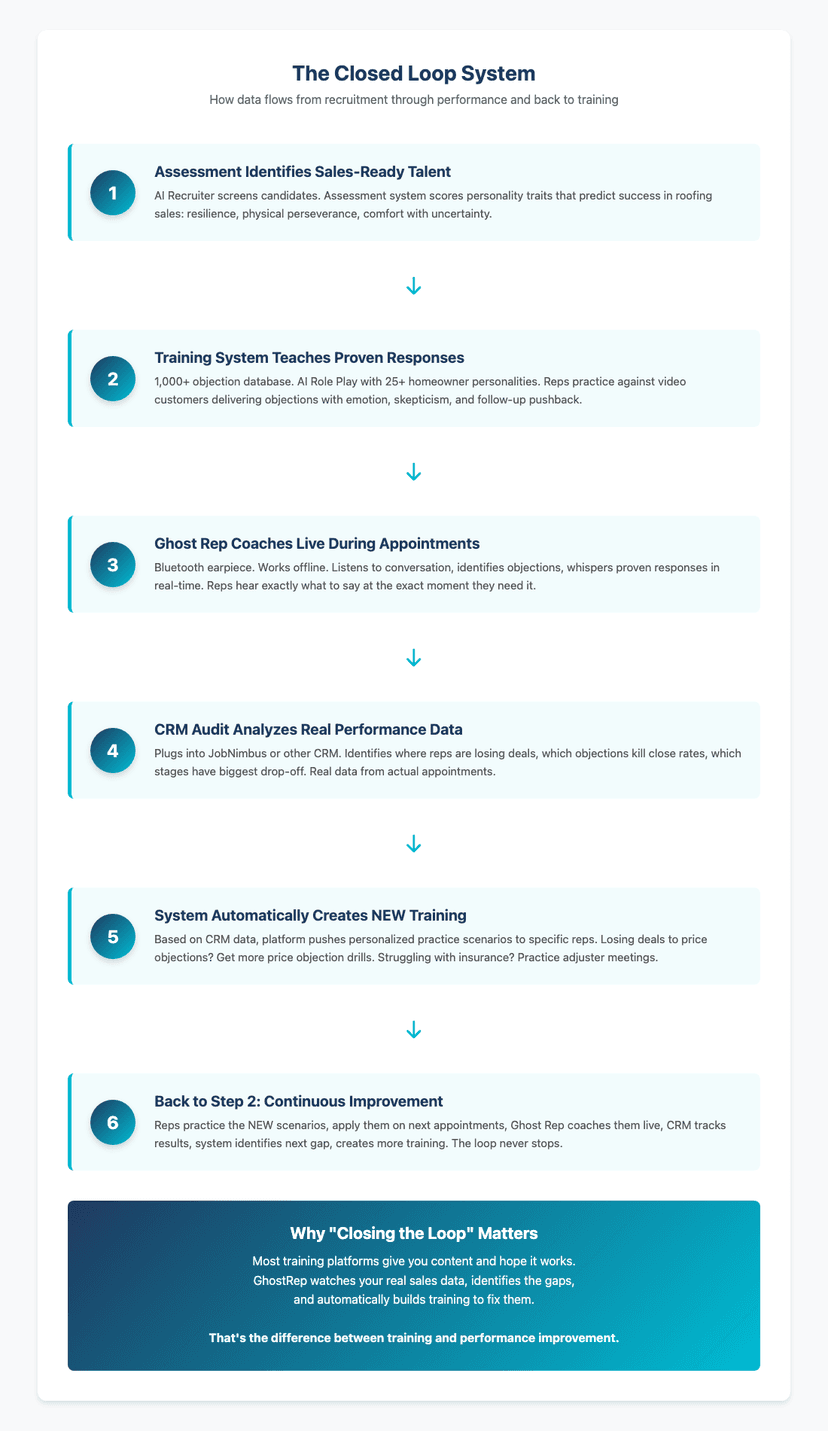
Here's the loop they described:
Step 1: Assessment identifies candidates with sales-ready personality traits
Step 2: Training system teaches them proven objection responses
Step 3: Ghost Rep coaches them live using those exact responses
Step 4: CRM Audit analyzes their real performance data
Step 5: System automatically creates NEW training based on their actual weak spots
Step 6: Back to Step 2 with personalized scenarios
The podcast correctly noted that most training platforms give you content and "hope it works." GhostRep watches your real sales data, identifies the gaps, and automatically builds training to fix them.
If your team keeps losing deals to price objections, the system detects it and pushes price objection scenarios to those specific reps. If someone struggles with insurance conversations, they get more adjuster meeting practice.
The AI hosts called this "tactical" and "comprehensive." They questioned what happens when knowledge becomes this integrated and immediate.
Good questions.
What This Reveals About Our AI
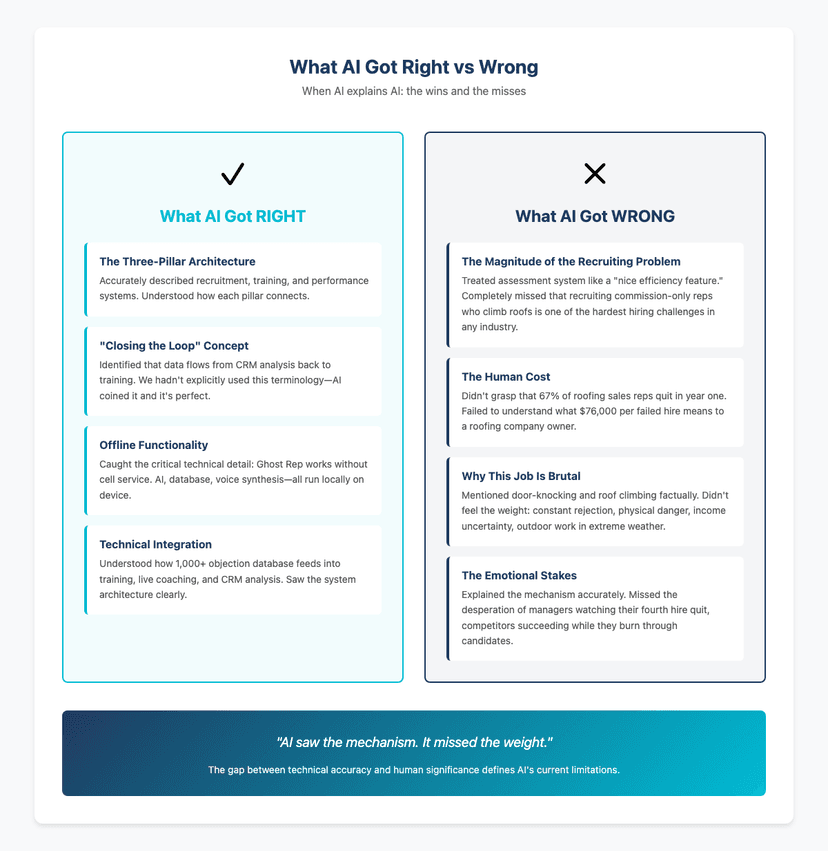
The experiment exposed our AI's current limitations—limitations we're actively working to close.
What our AI understands: System architecture, data flow, technical integration, abstract concepts like "closed loop systems."
What our AI misses: Human context, emotional magnitude, the difference between "technically correct" and "actually significant."
Our AI accurately described our recruitment tools but didn't grasp why recruiting commission-only reps who climb roofs represents an existential challenge for roofing companies.
It saw the mechanism. It missed the weight.
This gap—between technical accuracy and human significance—defines why we keep humans in the loop. Our AI processes information brilliantly. It needs humans to understand why humans care about solving specific problems.
The Meta-Lesson
We built GhostRep to solve problems AI couldn't fully grasp: the psychological resilience required for roofing sales, the muscle memory needed for objections under pressure, the integration between training and performance that changes outcomes.
Then we asked AI to explain what we built.
It got the architecture right. It understood the technical integration. It even coined useful terminology.
But it couldn't feel the weight of a manager who just lost their fourth rep in six months, each costing $76,000. It couldn't understand the desperation of watching competitors hire successfully while you burn through candidates.
That's the work AI can't do yet: understanding the magnitude of human problems.
Which is exactly why platforms like GhostRep exist—bridging the gap between what AI can process and what humans actually need.
The Bottom Line
Our AI explaining our platform creates powerful meta-content. It demonstrates technical sophistication and system comprehension.
But it can't replace human understanding of human problems.
Our AI Recruiter screens candidates with 87% accuracy not because we built a clever algorithm—we built it because we spent years watching roofing companies hemorrhage money on failed hires, understanding which personality traits predict success.
Our AI explained the tool.
We understand the problem.
That's why humans stay in the loop.
Free tools for roofing sales training
Turn this article into rep practice
Use the training library to turn ideas into drills, scripts, and coaching reps can actually use in the field.
Training tools
Browse objection, role-play, and scripting tools built for home improvement sales teams.
Browse training tools →All free tools
See the full tools hub across hiring, management, field sales, operations, and marketing.
Browse all tools →Role Play
Turn training concepts into live practice with AI homeowner scenarios that build muscle memory.
See Role Play →About the Author
Tim Nussbeck
Founder & CEO of GhostRep
Two decades in roofing—knocking doors, running teams, training 1,000+ reps. Built GhostRep to give every rep access to the coaching top teams get.
Training next step
Turn training ideas into drills your reps will actually run
Start with the free training tools if you need scripts, practice reps, or coaching prompts today. Book a walkthrough if you want GhostRep mapped to your onboarding process.
- ✓Best fit if reps need more repetition, not more theory.
- ✓Useful for onboarding, objection practice, and weekly coaching.
- ✓Demo shows how Role Play plugs into your current training process.
Start Here
Browse training tools
Free objection builders, role-play prompts, scripts, and rep-practice templates.
Browse training toolsNeed it mapped to your team?
Talk through your current workflow, traffic mix, and where GhostRep fits before you change anything.
Book a 15-minute walkthroughYou Might Also Like
Learn how roofing reps can practice objections without burning leads using AI role play, call review, and low-risk live reps.
Read article →Generic training fails because it does not know your pricing or products. Build AI sales training tuned to your specific roofing operation.
Read article →Compare AI sales training for roofing companies: role play, live coaching, call review, SalesAsk, Rilla, Siro, GhostRep, cost, and ROI.
Read article →