Your SPOTIO dashboard is green. Rep knocked 61 doors yesterday, made 22 contacts, set 1 appointment. He's done that all month. Four weeks in, your close rate is the same number it was when you brought him on.
You pull the activity log. He's working. GPS breadcrumbs show he's covering the territory. No gaps, no cheating the clock. By every metric SPOTIO tracks, this guy is doing the job.
So why isn't he closing?
That question is exactly what SPOTIO wasn't built to answer — and it's the one that actually matters when you're trying to move revenue. This isn't a knock on SPOTIO. It's a category distinction that a lot of managers figure out only after they've been staring at flat close rates for a few months wondering what they're missing.
What SPOTIO Is Actually Built For
Before going further, it's worth being straight about what SPOTIO does well, because it does genuinely solve a real problem.
SPOTIO's rep tracking gives managers GPS-verified proof of field activity. Every door knock logged, every visit timestamped, every route breadcrumbed from first stop to last. Territory management lets you assign reps to specific zones, track which addresses have been hit, prevent double-knocking, and see real-time rep positions from a map.
The Autoplays keep follow-up sequences running without the rep having to remember who they called last Tuesday.
For a roofing crew working a hail event with six reps in the same zip code, or a solar team canvassing a subdivision for the third time this month, that organizational layer is not optional — it's essential. SPOTIO is a field ops tool, and it's a good one.
The problem shows up when managers start expecting field ops data to tell them something it was never designed to capture: what happens inside the conversations.
What SPOTIO Logs vs. What Actually Happened at the Door
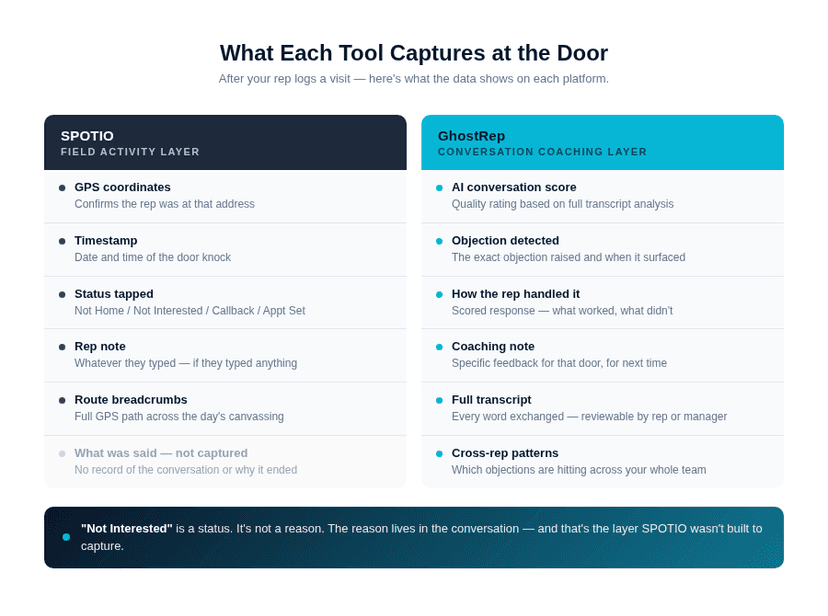
When your rep logs a visit in SPOTIO, here's what gets recorded: the GPS coordinates confirming they were at the address, the timestamp, and whichever status they tapped — "Not Home," "Not Interested," "Callback," "Appointment Set." If they typed a note, that's in there too.
What it doesn't capture: what the rep said when the door opened. What the homeowner said back. Whether the rep ran a clean opener or fumbled it trying to remember their pitch. Whether the homeowner's "not interested" was a genuine brush-off or a soft objection that a better rep would have turned into a 10-minute conversation.
You can look at a SPOTIO log and see that a rep had 22 contacts and set 1 appointment. That's useful information. It tells you his contact-to-appointment rate is about 4.5%.
What it doesn't tell you is whether contacts 2 through 21 all stalled on the same objection — "I already have someone coming out" — or whether he's opening with something weak that gets the door closed before he even gets to the pitch.
Those are two very different problems with two very different fixes. And you can't see which one it is from the activity log.
Key insight: "Not Interested" is a status. It's not a reason. The reason is in the conversation, and SPOTIO doesn't capture conversations.
Why You Can't Activity-Track Your Way to a Higher Close Rate
The natural response to flat close rates is to push for more doors. More doors means more contacts, more contacts means more appointments, and the math should eventually work out.
That logic holds only if your problem is volume. If your problem is conversion — what happens in the conversations you're already having — more doors just means you're failing faster.
Per SPOTIO's own canvassing data, a solid rep running 50-70 doors per day should land a 30-40% contact rate. At the low end, that's 15-20 real conversations per day. If your close rate per conversation is stuck, pushing from 60 doors to 80 doesn't change the math on those conversations.
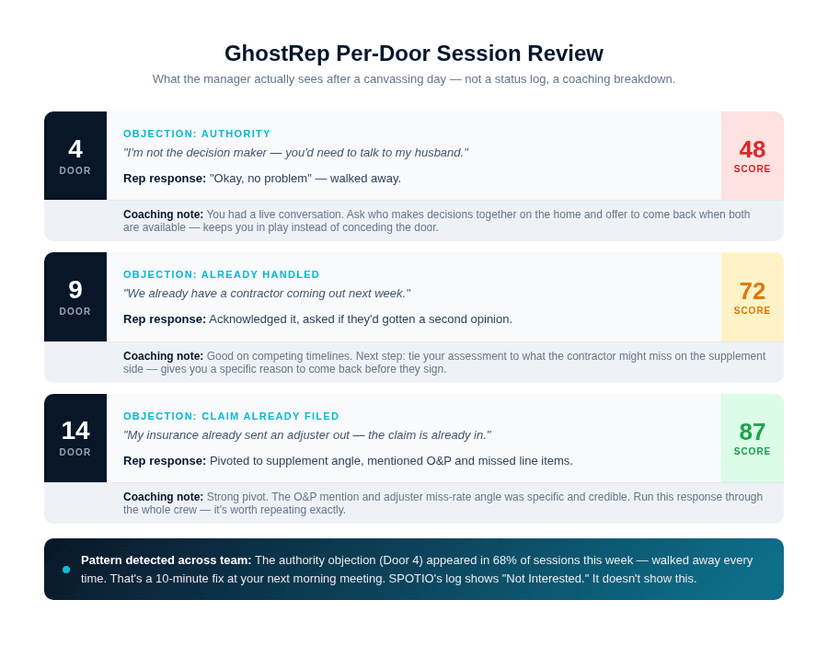
Here's what the actual math looks like. Take a 10-rep team. Each rep averages 18 conversations a day, 20 working days a month — 3,600 total conversations per month across the team.
At a 9% conversation-to-appointment rate, that's 324 appointments. At 50% close and a $12,500 average ticket, you're at $2.025M in monthly booked revenue.
Move that conversation rate from 9% to 12%. Same doors. Same reps. Same territory. Now you've got 432 appointments, 216 closes, $2.7M booked.
That's $675,000 a month from a 3-point improvement in how your reps handle conversations they're already having. Your numbers will vary by market and crew size. But the close rate lives in the conversation, not the door count.
SPOTIO tells you how many conversations happened. Moving from activity tracking to conversation quality is a different toolset — one that shows you what happened inside those conversations and whether your reps are handling objections or folding the moment a homeowner pushes back.
What Per-Door Coaching Actually Shows You
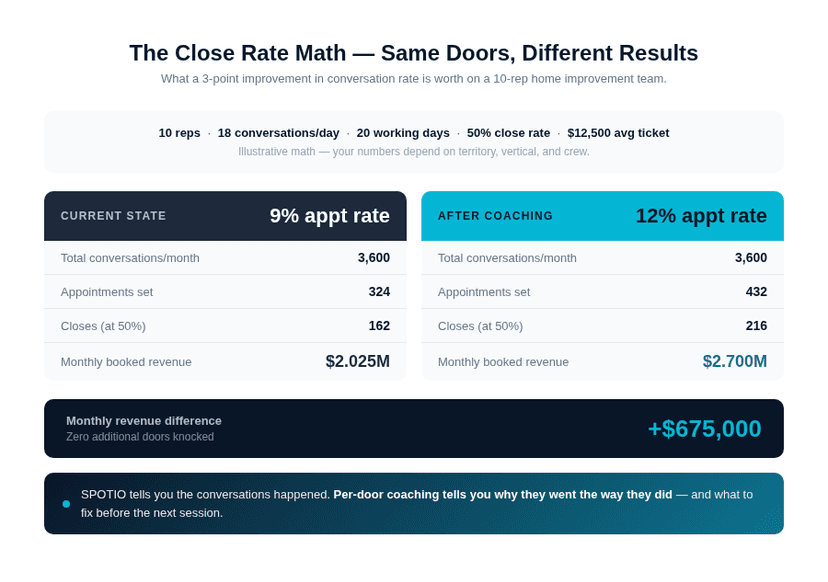
When a GhostRep-trained rep wraps a canvassing session, every conversation from that session gets reviewed by AI — not logged as a status, analyzed.
The rep and the manager see a breakdown for each door they had a real conversation at: a score, what went well, which objection surfaced, how the rep handled it, and a specific coaching note for next time.
It's granular in a way that changes what you actually do in your next team meeting.
Door 6: Homeowner said "I already have a contractor coming out." Rep said "Okay, no problem" and walked away. Score: 51. Coaching note: You had a live conversation. Ask when the contractor is coming and whether they've gotten a second opinion on the scope. That keeps you in play instead of conceding the door.
Door 14: Rep hit the insurance angle on a homeowner who mentioned they'd already filed a claim. Score: 84. Strength: Brought up O&P and the adjuster's tendency to miss line items. That pivot is worth practicing with the whole crew.
When you review a full session across your team and Door 6's "I already have a contractor" brush-off shows up in 70% of sessions — handled the same way, conceded every time — that's not a mystery anymore. That's a 15-minute fix at your next morning meeting.
Deliberate, scenario-specific objection practice is what actually moves the needle on conversation rates. You can't design that practice without knowing which objections are breaking your team.
SPOTIO's activity data can flag that a rep is struggling — their appointment rate is low, their contact rate is off — but it can't show you the pattern behind the numbers. That pattern is what coaching actually runs on.
Without it, you're guessing at what to work on in every meeting. With it, you're spending 15 minutes on the specific thing that's costing you appointments right now. See how other D2D teams practice objections without burning real leads.
Key insight: If the same objection is ending conversations for 7 out of 10 of your reps and you don't know it, you can't fix it. That's the data SPOTIO doesn't give you.
This Isn't Just a Roofing Problem
SPOTIO is used across home improvement — roofing, solar, HVAC, windows, siding. Every D2D vertical runs into the same issue: the field ops layer gets built out, and then the team stalls because activity visibility didn't solve the conversation problem.
In solar, the objection pattern usually centers on financing and payback period. In HVAC it's "my system is fine for now." In windows it's "we just got new windows a couple years ago." In roofing after a hail event, it's "I already have someone coming out."
The specific objections change by vertical. The gap between activity data and conversation coaching doesn't.
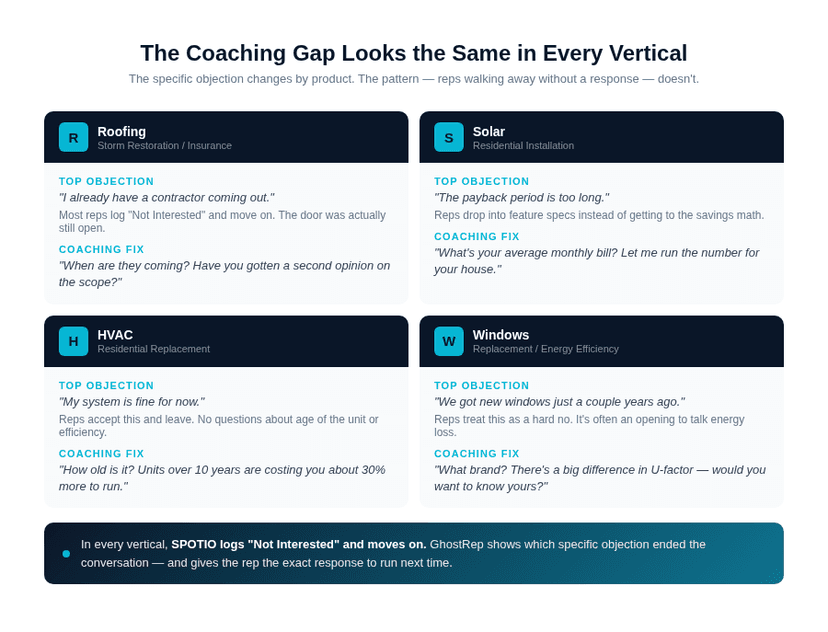
GhostRep is built for this across all of those verticals. Reps practice via voice roleplay before they hit the field — running the specific objections that actually come up in your territory, not generic sales scripts.
After a session, the per-door coaching review gives them and the manager something specific to work on. For canvassers whose CRM history shows a prior contact or filed claim, the pre-knock briefing gives them context before they ring the bell.
The field ops problem is real and SPOTIO solves it well. But if your SPOTIO dashboard looks fine and the revenue isn't moving, the next question isn't "are they in the field?" — it's "what's happening when they get there?" Those are different questions and they need different tools.
Check out the full breakdown in the best canvassing apps comparison to see how the whole category stacks up.
Key Takeaways
- SPOTIO solves the accountability problem — GPS verification, activity logging, territory management. It tells you your reps are in the field and what they logged. That's a real and important problem to solve.
- Activity data doesn't explain close rate — "Not Interested" is a status, not a reason. SPOTIO records what happened; it doesn't capture what was said or why the conversation ended the way it did.
- More doors won't fix a broken conversation — If your close rate per conversation is stuck, pushing volume scales the same failure. The fix is in the conversations, not the door count.
- Pattern detection is what coaching runs on — When the same objection is ending conversations for 70% of your reps, that's a fixable problem. You can't see that pattern in an activity log.
- These tools answer different questions — SPOTIO: "Are they working?" GhostRep: "Why aren't they closing?" Teams running both use SPOTIO for field ops and GhostRep for rep development. They're not competing for the same budget line.
Frequently Asked Questions
Does GhostRep replace SPOTIO?
No. GhostRep doesn't do GPS tracking, territory assignment, or route planning. If you need field ops software, that's a separate decision. GhostRep handles the conversation layer — practice before the field, per-door coaching after, and pre-knock briefings when CRM history exists.
What does GhostRep actually show after a canvassing session?
Each door with a real conversation gets an AI score, a strengths callout, the specific objection that surfaced, how the rep handled it, and a coaching note for next time. The full transcript is available if you want to dig into a specific door.
Does this work for home improvement verticals besides roofing?
Yes — solar, HVAC, windows, siding, home security. The conversation coaching and objection practice work the same way regardless of vertical. You load the objections specific to your product and territory, and the AI scores and coaches against those.
Can SPOTIO tell me why my close rate is dropping?
SPOTIO can show you the numbers — appointment rate, contact rate, doors per day. It can't show you the conversation patterns behind those numbers. That's what a conversation coaching tool is for.
How much does GhostRep cost?
GhostRep publishes transparent pricing at ghostrep.ai/pricing. Prepaid hour bundles start at $200 for 25 hours — no subscription, no contracts, no demo required.
Related Articles
- Best Canvassing Apps for Roofing Contractors
- GhostRep vs SalesRabbit: What Happens After the Door Opens
- GhostRep vs Knockio: Routing Doesn't Fix a Weak Pitch
- GhostRep vs BatchLeads: Finding Leads Isn't the Hard Part
- How to Practice Roofing Sales Objections Without Burning Leads
- Why Your Roofing Rep's Close Rate Is Dropping
Free tools for door-to-door reps
Give canvassers something they can use today
Pair the strategy in this article with free tools for scripts, door hangers, homeowner texts, and field follow-up.
Field sales tools
Generate homeowner texts, canvassing assets, inspection summaries, and follow-up language.
Browse field sales tools →Training tools
Build knock tracks, objection handlers, and practice scenarios before reps burn live doors.
Browse training tools →Echo
Support reps live in the field with in-ear coaching during real conversations.
See Echo →About the Author
Tim Nussbeck
Founder & CEO of GhostRep
20+ years in roofing and home improvement sales—knocking doors, running teams, and building practical coaching systems. Built GhostRep to give every rep access to the coaching top teams get.
Field next step
Give your reps something they can use before the next knock
Start with field and training tools if you need talk tracks, follow-up language, or canvassing assets now. Book a walkthrough if you want GhostRep mapped to live field coaching.
- ✓Best fit if reps need sharper first knocks and second visits.
- ✓Useful for follow-up language, inspection texts, and canvassing flow.
- ✓Demo shows how Echo and Role Play support real field conversations.
Start Here
Browse field sales tools
Create homeowner texts, canvassing assets, inspection summaries, and follow-up copy.
Browse field sales toolsNeed it mapped to your team?
Talk through your current workflow, traffic mix, and where GhostRep fits before you change anything.
Book a 15-minute walkthroughYou Might Also Like
Compare BatchLeads property and lead-data workflows with GhostRep conversation practice. See where each product fits and what neither replaces.
Read article →Knockio maps routes and rep activity. GhostRep trains the pitch, objection handling, follow-up, and pipeline discipline that turn doors into jobs.
Read article →Compare GhostRep and SalesRabbit by workflow, evidence, pricing questions, integrations, and a fair roofing evaluation—not by overlapping AI labels.
Read article →