If a sales manager cannot see which streets were worked, buying another coaching tool misses the problem. If the routes are clean but reps still mishandle price, spouse, timing, or insurance questions, another mapping layer misses it too.
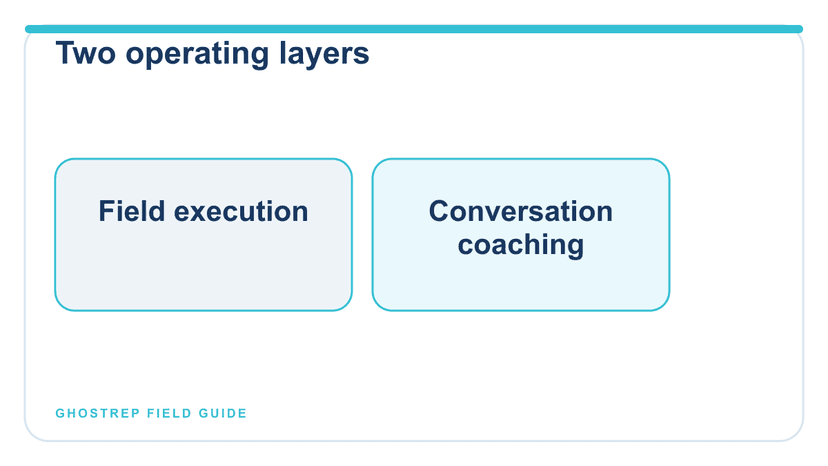
SalesRabbit and GhostRep sit on different parts of the roofing sales day. SalesRabbit organizes where field work happens and what was recorded. GhostRep helps reps practice conversations and helps managers coach what was said. A contractor may need either, both, or neither.
Disclosure: GhostRep publishes this comparison. Product pages and pricing were reviewed July 26, 2026. Verify current scope, implementation fees, minimums, contract terms, add-ons, and data handling with each vendor before buying. SalesRabbit’s official feature comparison and pricing page control its current public claims; GhostRep’s current offer is on the pricing page.
Quick answer
| If the contractor needs to… | Evaluate first | Material to inspect |
|---|---|---|
| Map territories and assign areas | SalesRabbit | Area ownership, route, mobile usability, history |
| Capture field leads and dispositions | SalesRabbit | Required fields, offline behavior, sync, duplicate handling |
| Practice objections before live appointments | GhostRep | Attempt, transcript, rubric evidence, successful retry |
| Turn repeated field misses into coaching | GhostRep | Manager review, assigned drill, observed field transfer |
| Manage the full customer pipeline | CRM or roofing operating system | Ownership, stage definitions, reporting, accounting handoff |
| Do both field execution and rep development | Potentially both | Clear system ownership and minimum necessary data exchange |
What SalesRabbit is built to do
SalesRabbit’s public materials describe a field-sales platform with lead mapping, lead status and notes, reminders, route planning, area management, rep location tracking, scheduling, analytics, gamification, forms, integrations, and paid capabilities such as DataGrid AI, digital contracts, weather, and mover leads depending on the plan.
That breadth matters when a contractor’s problem is operational visibility. If two canvassers work the same subdivision, dispositions disappear into text messages, or appointments lack owners, field software can create a consistent record. Test it in the conditions that actually break the workflow: weak connectivity, rapid door-to-door entry, rep reassignment, duplicate properties, setter-to-closer handoff, and export back to the company’s system of record.
As of the review date, SalesRabbit’s public pricing page lists a free Lite option, paid Team and Pro plans, Enterprise pricing by quote, and several separately priced capabilities. The same page says paid plans do not have a free trial, implementation packages are required, and contracts may run one to three years. Those terms can change; use the written quote and order form rather than this article for a purchasing decision.
What GhostRep is built to do
GhostRep begins after the company defines the behavior it wants. Reps practice doorstep, appointment, objection, follow-up, and other home-improvement conversations. Managers review what the rep said, score observable behavior, identify repeated misses, and assign targeted retries. Role Play provides the practice surface, while Echo supports live field conversations and evidence for coaching.
Use SalesRabbit and your CRM to organize territories, leads, and job records. Use GhostRep to practice the conversation, review field recordings, and prepare coaching. Your managers bring the product knowledge and team standards that make the feedback useful.
The door-to-door training guide defines the flexible conversation method. The role-play scenario generator turns a recurring field pattern into a controlled, fictionalized drill.
See the difference in one roofing workday
One field event, two different system jobs
Area assigned
- Field-execution record: Rep receives the correct subdivision and route
- Training record: No training action
Door outcome
- Field-execution record: Homeowner requests an inspection after 5 p.m.; rep records disposition and owner
- Training record: No customer record copied into practice
Pattern detected
- Field-execution record: Manager sees many “already have a roofer” dispositions
- Training record: Manager creates a fictionalized objection drill
Practice
- Field-execution record: No field-record change
- Training record: Rep practices acknowledging the existing relationship and offering a scope checklist without pressure
Coaching
- Field-execution record: Actual next actions remain in the field system or CRM
- Training record: Manager reviews evidence, requires a retry, then observes field transfer
The boundary protects data quality. Customer identity, address, appointment, and job status stay in the operational system. Training uses only the minimum facts needed to reproduce the skill challenge, preferably fictionalized or de-identified.
Run two separate evaluations if the needs are different
A fair evaluation does not ask “Which dashboard looks better?” It defines one operational constraint per tool and measures evidence tied to that job.
What the buying team must verify
Primary cohort
- SalesRabbit evaluation: Six canvassers in one defined territory
- GhostRep evaluation: Same six reps practicing two recurring objections
Baseline
- SalesRabbit evaluation: Required-record completion and duplicate rate
- GhostRep evaluation: First-attempt rubric pass and critical-error rate
Workflow test
- SalesRabbit evaluation: Assign, work, disposition, schedule, reassign, export
- GhostRep evaluation: Attempt, source-backed score, feedback, retry, field observation
Failure test
- SalesRabbit evaluation: Offline entry, duplicate address, sync conflict, former-rep ownership
- GhostRep evaluation: Unsupported claim, scenario variation, scorer disagreement, weak connectivity
What success produces
- SalesRabbit evaluation: Complete, timely, correctly owned field records
- GhostRep evaluation: Repeated behavior improvement verified by a manager
Do not infer
- SalesRabbit evaluation: More pins caused more sales
- GhostRep evaluation: Higher practice score caused more revenue
Freeze definitions before the evaluation. “Activity,” “worked property,” “appointment,” “qualified,” “attempt,” and “pass” must mean the same thing throughout. The remote roofing management guide provides a manager operating rhythm, and the roofing canvassing-app comparison covers field-software alternatives. If RepCard is the other field finalist, use the focused RepCard and GhostRep workflow comparison to keep field records and practice evidence separate.
Buying questions that expose the real fit
Questions for a SalesRabbit evaluation
- Which mapping, custom-field, attachment, scheduling, API, integration, analytics, coaching, and security capabilities are in the quoted plan?
- Which items are add-ons, and what implementation package, seat minimum, billing term, and contract length apply?
- How do offline records reconcile, and what happens when two reps edit the same lead?
- Can the contractor export complete lead, activity, attachment, and ownership history?
- How are location tracking, permissions, former users, data retention, and deletion handled?
Questions for a GhostRep evaluation
- Can the company use its own approved scenarios, facts, prohibited claims, and rubric?
- Can managers inspect the attempt evidence behind a score and record a disagreement?
- How are live guidance, recording, consent, privacy, access, retention, and deletion controlled?
- Can managers assign a narrow retry and verify the behavior during supervised work?
- What usage, implementation, support, and integration costs appear in the complete evaluation budget?
Three common architecture mistakes
- Using a training score as the CRM: a role-play result does not own the customer, appointment, scope, or forecast.
- Using field activity as proof of skill: doors, pins, and appointments do not show whether the rep listened, stayed accurate, or handled objections safely.
- Copying customer records into practice: build fictionalized scenarios from patterns instead of moving unnecessary personal data between systems.
If the team already has a reliable canvassing and CRM workflow, adding another field platform may create duplicate work. If field execution is organized but conversation quality is inconsistent, a practice system addresses the narrower constraint. If both layers are weak, sequence the rollout so managers can tell which change produced which operational effect.
Frequently asked questions
Does GhostRep replace SalesRabbit?
No. GhostRep does not replace territory, lead, route, or field-activity management. It addresses conversation practice and coaching.
Can a roofing company use both?
Yes. Keep SalesRabbit or the chosen field system responsible for customer and activity records, and keep GhostRep responsible for practice evidence. Define the minimum data exchange and an owner for each workflow.
Which is better for canvassing?
SalesRabbit is the relevant choice for mapping, territory, lead, and field execution. GhostRep may support the conversation skill used during canvassing, but it is not the canvassing system.
How should a contractor compare ROI?
Use separate cost and benefit models. Field software should first improve record completeness, ownership, routing, and follow-up. Training software should first improve observable behavior, coaching efficiency, and field transfer. Treat revenue impact as a matched, time-bounded sensitivity analysis.
Choose the missing operating layer
Choose SalesRabbit when the constraint is field execution. Choose GhostRep when the constraint is conversation practice and coaching. Use both only when the systems have distinct jobs, clear owners, and a privacy-safe handoff. The honest comparison is not feature count; it is whether each tool produces the evidence the manager needs to run that part of the operation.
Free tools for door-to-door reps
Give canvassers something they can use today
Pair the strategy in this article with free tools for scripts, door hangers, homeowner texts, and field follow-up.
Field sales tools
Generate homeowner texts, canvassing assets, inspection summaries, and follow-up language.
Browse field sales tools →Training tools
Build knock tracks, objection handlers, and practice scenarios before reps burn live doors.
Browse training tools →Echo
Support reps live in the field with in-ear coaching during real conversations.
See Echo →About the Author
Tim Nussbeck
Founder & CEO of GhostRep
20+ years in roofing and home improvement sales—knocking doors, running teams, and building practical coaching systems. Built GhostRep to give every rep access to the coaching top teams get.
Field next step
Give your reps something they can use before the next knock
Start with field and training tools if you need talk tracks, follow-up language, or canvassing assets now. Book a walkthrough if you want GhostRep mapped to live field coaching.
- ✓Best fit if reps need sharper first knocks and second visits.
- ✓Useful for follow-up language, inspection texts, and canvassing flow.
- ✓Demo shows how Echo and Role Play support real field conversations.
Start Here
Browse field sales tools
Create homeowner texts, canvassing assets, inspection summaries, and follow-up copy.
Browse field sales toolsNeed it mapped to your team?
Talk through your current workflow, traffic mix, and where GhostRep fits before you change anything.
Book a 15-minute walkthroughYou Might Also Like
Compare BatchLeads property and lead-data workflows with GhostRep conversation practice. See where each product fits and what neither replaces.
Read article →Knockio maps routes and rep activity. GhostRep trains the pitch, objection handling, follow-up, and pipeline discipline that turn doors into jobs.
Read article →SPOTIO tracks door activity. GhostRep trains the conversations that turn those doors into appointments, closed jobs, and better reps.
Read article →