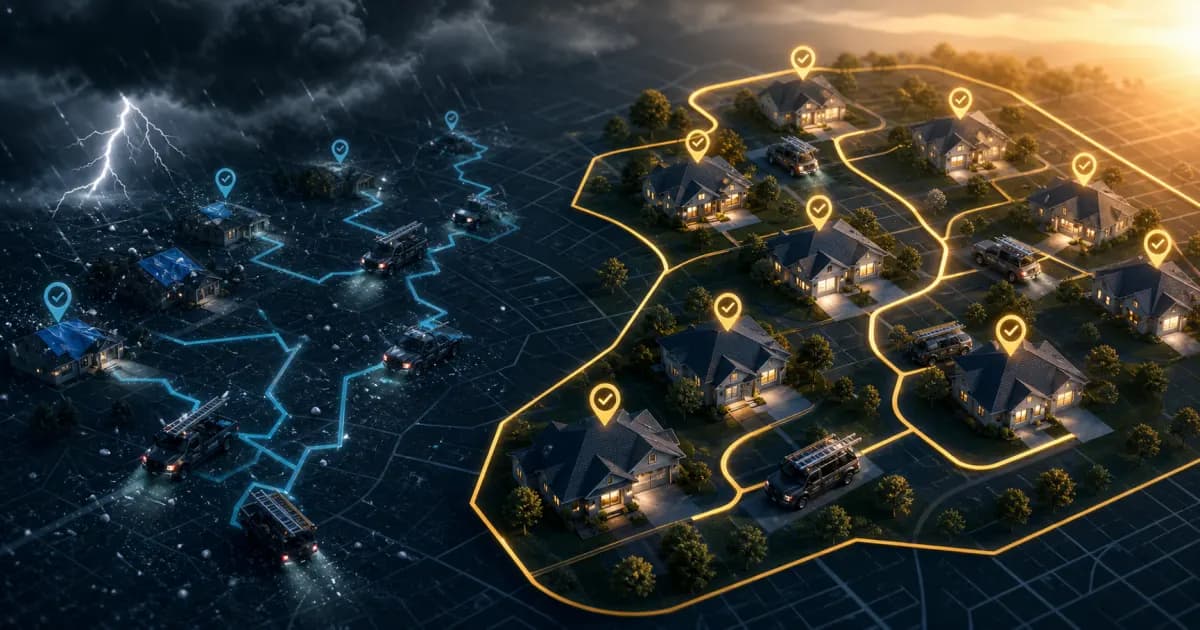
Storm chasing can produce more revenue quickly; a local roofing territory can produce more predictable contribution and repeatable demand. Neither model wins automatically. The better model is the one that leaves more cash after direct job costs, lead acquisition, commissions, travel, market setup, warranty exposure, and fixed operating overhead.
Use the calculator below with your own collected-job data. It compares annual revenue, gross profit, strategy-specific selling costs, contribution after those costs, and contribution margin. It does not pretend that a national “average storm ROI” can decide your market.
Short answer: choose storm deployment when you have verified demand, compliant market entry, production capacity, cash reserves, and a written service plan. Choose territory building when density, referrals, route efficiency, brand equity, and forecast stability matter more than one short surge. Many established roofers use a hybrid: serve storm demand inside a deliberately maintained territory.
Storm Chasing vs Local Territory ROI Calculator
Use one consistent 12-month period. Enter collected jobs—not signed contracts—and use gross margin after direct production cost. Put lead charges, canvassing cost, commissions, and sales-only software in acquisition and selling cost. Put hotels, fuel, licensing, temporary facilities, and launch marketing in travel and market setup.
Storm Chasing vs Local Roofing at a Glance
| Decision factor | Storm deployment | Local territory |
|---|---|---|
| Demand pattern | High-intent surge after verified damage | Year-round replacement, referral, service, and storm demand |
| Main financial risk | Market-entry cost and volume collapse before fixed costs are recovered | Slow density build and overspending before referral momentum exists |
| Operational constraint | Crew, lodging, materials, permitting, inspection, and warranty coverage | Consistent prospecting, local proof, route discipline, and customer follow-up |
| Attribution | Track by storm date, deployment, ZIP, campaign, and collected job | Track by neighborhood, source, referral chain, cohort, and collected job |
| Durable asset | A deployable operating playbook—if documented and serviceable | Local density, reviews, referral relationships, and service history |
The Seven Costs That Change Storm-Work Profitability
- Lead acquisition and selling labor. Separate purchased leads, canvassing labor, commissions, call-center cost, and launch marketing. The roofing lead cost calculator converts those costs into cost per collected job.
- Travel and temporary infrastructure. Include fuel, airfare, lodging, per diem, temporary offices, storage, vehicles, and market-specific software or phone numbers.
- Licensing and compliance. Registration, solicitation, contract, cancellation, insurance, permit, and advertising rules vary by state and locality. Verify them before deployment; do not treat this article as legal advice.
- Production surge premium. Model overtime, subcontractor pricing, material logistics, supervision, inspection delays, and the cost of jobs that cannot be installed when promised.
- Cash conversion. A signed contract is not cash. Measure deposit timing, insurance proceeds, mortgage-company endorsements, supplements, completion, final collection, and chargebacks.
- Warranty and service coverage. Reserve cash per installed cohort and price the trip or local partner required to resolve a callback.
- Exit cost. Count lease termination, crew demobilization, open permits, unresolved supplements, final payroll, and the service burden that remains after salespeople leave.
NOAA's disaster database confirms why storm opportunity can be material: U.S. severe-weather events can create widespread damage to homes and businesses. But the database measures large disaster losses—not contractor demand, addressable roofs, available crews, or your close rate. Use NOAA's Billion-Dollar Weather and Climate Disasters data as market context, never as a roofing revenue forecast.
How to Measure Storm vs Retail Roofing Without Bad Attribution
Google is already associating this page with “measuring marketing attribution for storm vs retail roofing leads.” The operational answer is to assign the source before the appointment and preserve it through collection.
For every opportunity, store:
- Original source: referral, canvass, LSA, paid search, purchased lead, organic, agent, property manager, or repeat customer.
- Demand trigger: named storm/date, age-based replacement, leak, inspection, repair, sale, or maintenance.
- Geography: permanent service area, deployment market, ZIP, neighborhood, and distance from service base.
- Cohort dates: lead, inspection, signed, installed, invoiced, and collected.
- Financial outcome: collected revenue, direct job cost, acquisition and commission cost, rework reserve, and contribution.
Do not overwrite original source because a rep later knocked the neighbor. Give the neighbor a new referral record and connect it to the installed-job cohort. A defined contractor sales pipeline template keeps storm, retail, and referral work visible without mixing their stale-date rules.
When Each Strategy Makes Sense
Storm deployment is a fit when
- damage and addressable demand have been verified with more than a weather-map screenshot;
- the company can fund setup and production before final collection;
- licenses, insurance, contracts, solicitation rules, and local permits are confirmed;
- production capacity and material access are reserved;
- every sold job has a named service owner after the deployment ends; and
- a stop-loss date defines when the company will stop acquiring work and demobilize.
Local territory building is a fit when
- the market has enough replacement volume to support the team without a single weather event;
- review density and neighbor referrals reduce the need to reacquire every job;
- short drive times improve inspections, production supervision, and warranty response;
- the company is willing to track neighborhoods and repeat touches for multiple seasons; and
- the owner values forecast stability and transferable local relationships.
A hybrid is usually stronger than a false either-or
A local roofer does not need to ignore storms. The durable hybrid is to serve storm damage inside or adjacent to a territory the company intends to maintain. Use storm demand to create project density, then keep the service promise, referral cadence, reviews, inspections, and local relationships alive after the surge.
FEMA consumer guidance tells homeowners to check contractors, seek local references, get written estimates and contracts, and verify insurance. That is a useful operating standard for the contractor too: build the proof and service system a cautious homeowner should demand. See FEMA's post-disaster contractor guidance.
The Weekly Owner Scorecard
Review both models on the same definitions:
- collected jobs and collected revenue;
- gross profit after direct production cost;
- acquisition and selling cost per collected job;
- contribution after strategy-specific setup and warranty reserve;
- days from lead to inspection, signed to installed, and installed to collected;
- open permits, supplements, punch items, callbacks, and warranty claims by cohort;
- referral and repeat share, reported separately from paid and canvassed work; and
- manager hours and production capacity required for the next 30 days.
Use the sales territory builder to define local ownership and the storm-season revenue calculator for capacity planning. Revenue belongs in the forecast only after the operating and cash assumptions are visible.
Frequently Asked Questions
Is storm chasing more profitable than local roofing?
It can be, but revenue volume alone does not prove it. Compare collected revenue and gross profit after acquisition, commissions, travel, market setup, production surge costs, warranty reserve, and overhead. Use your own cohort data because storm severity, regulations, job size, capacity, and cash timing differ by market.
What is the difference between a storm chaser and a local roofer?
A storm-deployment company moves selling and production resources into damage markets. A local roofer maintains a continuing service area and local operating presence. The labels do not determine quality or ethics; contracts, licensing, installation, communication, and long-term warranty service do.
How should roofers attribute storm leads?
Keep original source, demand trigger, storm/date, deployment, ZIP, rep, and cohort dates as separate fields. Preserve the original source through collection and create connected records for neighbor referrals instead of overwriting attribution.
What is the best ROI metric for storm work?
Start with contribution after direct job cost, acquisition and selling cost, travel and setup, and a warranty reserve. Then compare that contribution with the capital tied up and the time required to collect it. Booked revenue and signed-contract value are not ROI.
Is working storm damage unethical?
No. Ethical storm work means honest inspections, compliant solicitation and contracts, accurate scope, quality installation, clear communication, and service after the sale. Pressure, fabricated damage, misleading insurance claims, and disappearing after collection are unacceptable.
Methodology note: The calculator is deterministic owner-entered planning math. Default values are illustrative and are not industry averages, customer results, promises, or valuations. External disaster and consumer-protection sources were reviewed August 9, 2026. Verify current laws, permits, licensing, contracts, insurance requirements, and source data before acting.
Free storm sales resources
Make storm-season training usable in the field
Use free tools for inspection summaries, follow-up language, adjuster prep, and objection handling before the next appointment hits.
Field sales tools
Build inspection summaries, homeowner updates, and post-appointment follow-up assets.
Browse field sales tools →Training tools
Use training tools for claim scripts, rebuttals, canvassing language, and storm-specific prep.
Browse training tools →Echo
Coach reps live during door knocks, inspections, and follow-up conversations when storm volume spikes.
See Echo →About the Author
Tim Nussbeck
Founder & CEO of GhostRep
20+ years in roofing and home improvement sales—knocking doors, running teams, and building practical coaching systems. Built GhostRep to give every rep access to the coaching top teams get.
Storm-season next step
Turn storm-season advice into field execution
Use the field tools first if you need inspection summaries, homeowner updates, or follow-up language. Book a walkthrough if you want GhostRep mapped to storm-volume coaching.
- ✓Best fit if the issue is speed, consistency, and field execution.
- ✓Useful for inspection summaries, claim prep, and storm follow-up.
- ✓Demo shows how Echo supports reps when volume spikes and managers cannot be everywhere.
Start Here
Open storm-field tools
Build homeowner updates, inspection summaries, and follow-up assets for real appointments.
Open storm-field toolsNeed it mapped to your team?
Talk through your current workflow, traffic mix, and where GhostRep fits before you change anything.
Book a 15-minute walkthroughYou Might Also Like
Compare HailTrace storm data with GhostRep sales coaching. HailTrace shows where to knock; GhostRep helps reps win the conversation at the door.
Read article →Build an independent roofing estimate from field observations, scope, quantities, costs, assumptions, and review gates without crossing claim boundaries.
Read article →What retail roofers need to add storm restoration: claim boundaries, supplement documentation, cash-flow realities, and a responsible starting plan.
Read article →