Use-case answer: HailTrace helps roofing teams find storm-hit addresses. GhostRep helps the rep handle the conversation after they get there, especially when every competitor has the same storm map.
Compare next: Compare Echo live field coaching, Role Play, and the canvassing script generator if the door conversation is where storm leads break.
Quick Comparison: HailTrace vs GhostRep
| Question | HailTrace | GhostRep |
|---|---|---|
| Where did hail hit? | Strong fit | Not the core job |
| What should the rep say at the door? | Limited fit | Strong fit |
| Can reps practice storm objections? | No | Yes, through role play |
| Can managers review appointment quality? | No | Yes, through Echo feedback |
A week after the storm, the homeowner on your target block has already heard the pitch. Not once — three times, maybe four. The hail report isn't impressive. The free inspection offer isn't a differentiator.
Every rep who knocked that door had the same data you have: the same storm path, the same damage score, the same platform showing the same affected addresses.
That's not a knock on HailTrace. Their storm intelligence is genuinely good — 17 meteorologists producing real-time data, address-level damage scores, instant alerts when a property in your territory gets hit. It works. The problem isn't the data. The problem is that every serious roofing company in your market has the same subscription.
When the map is identical for everyone, the map stops being the advantage.
What HailTrace Is Actually Built For
HailTrace is a storm intelligence platform built specifically for roofing contractors and insurance restoration companies. After a hail event, it shows exactly where the storm hit, how large the hail was, which properties took the most impact, and which addresses have the highest probability of needing a new roof.
Built for the field, accessible from your phone mid-route. Here's what you get with a subscription:
- Real-time hail, wind, and storm tracking with meteorologist-verified data
- Address-level damage scores for every property in a storm zone
- Instant alerts when past customer properties take a hit
- Meteorologist-reviewed reports usable as documentation in adjuster meetings
- Integrations with field CRMs to push leads directly into your workflow
For a storm-driven operation, HailTrace does what it promises. You know where the opportunity is before your competition starts canvassing, and your reps show up with verified documentation instead of just a handshake. That's a real advantage — until everyone else gets the same one.
Key insight: HailTrace solves the targeting problem. It tells you where the hail hit, which addresses scored highest, and which properties to prioritize. It has no data on what your rep says when the door opens.
When Everyone Has the Same Map
Hail tracking apps have become standard equipment for serious roofing companies. The data quality has gone up, the cost has come down, and most established crews are running some version of storm intelligence on every event.
Which means that after a significant hail event, multiple roofing companies are converging on the same neighborhood at the same time with the same information.
Any rep who's worked a storm-hit block in the first week knows what that looks like: yard signs from three different companies, door hangers already on half the handles, homeowners who mention they've already had someone out.
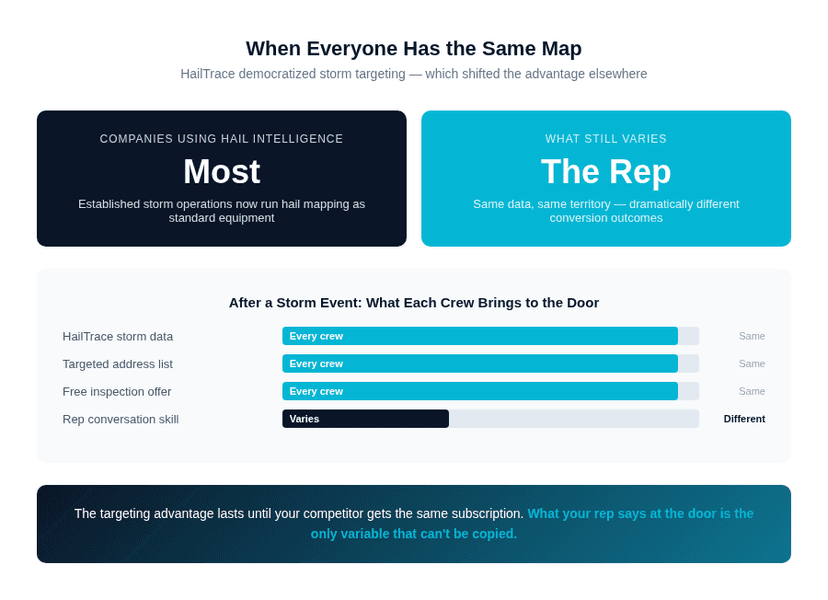
Multiple hail tracking tools now compete for the same roofing contractors, which has made storm targeting a commodity. HailTrace is excellent at what it does, and so are its competitors. The market figured out the targeting problem — and in doing so, created a new one.
The targeting advantage lasts until your competitor gets the same subscription. After that, the only variable is what your rep says when they're standing at the same door three other crews already knocked.
What the Fourth Knock Actually Looks Like
It's Wednesday. Your rep walks up to a house that's been knocked four times since Saturday. The homeowner opens the door. Here's what she already knows:
- It hailed. She's seen the news.
- Her roof might be damaged. Three different reps told her so.
- A free inspection is available. Every crew offered one.
- She doesn't have to decide today. She's in no hurry.
She's not evaluating data. She's evaluating the person at her door. The psychology of that fourth knock is completely different from the first — she's already processed the pitch, already formed objections, already decided she's skeptical of anyone who leads with a hail report.
Most reps don't adjust for this. They run the same opener they used on the first house of the day and wonder why it lands cold.
The objection isn't "I'm not sure if my roof was hit" — it's "I've already had three people out here telling me the same thing." That's a different conversation, and it requires a different first sentence.
A rep who hasn't drilled that scenario will fold. They'll recite the pitch she's heard three times and wonder why she's not interested. The hail data got them there. The conversation determines everything after.
The Skill Gap That Data Cannot Close
Two reps. Same storm event. Same HailTrace data. Same territory. At the end of a 40-door day, one set 5 appointments. The other set 2. Roofing close rate benchmarks show this kind of variance is standard — and it's not explained by territory or timing.
Consider what that gap means on a real storm event. A 10-rep crew, $13,500 average ticket. Half the crew setting appointments at 8%; the other half at 4%. On a 40-door day, that's the difference between 3.2 and 1.6 appointments per rep.
Across a 5-day event, the bottom half leaves 40 appointments on the table — every single one on a door HailTrace had already identified as high-priority. At a $13,500 average ticket and a 50% close rate, that's roughly $270,000 in revenue sitting on doors the data already pointed to.
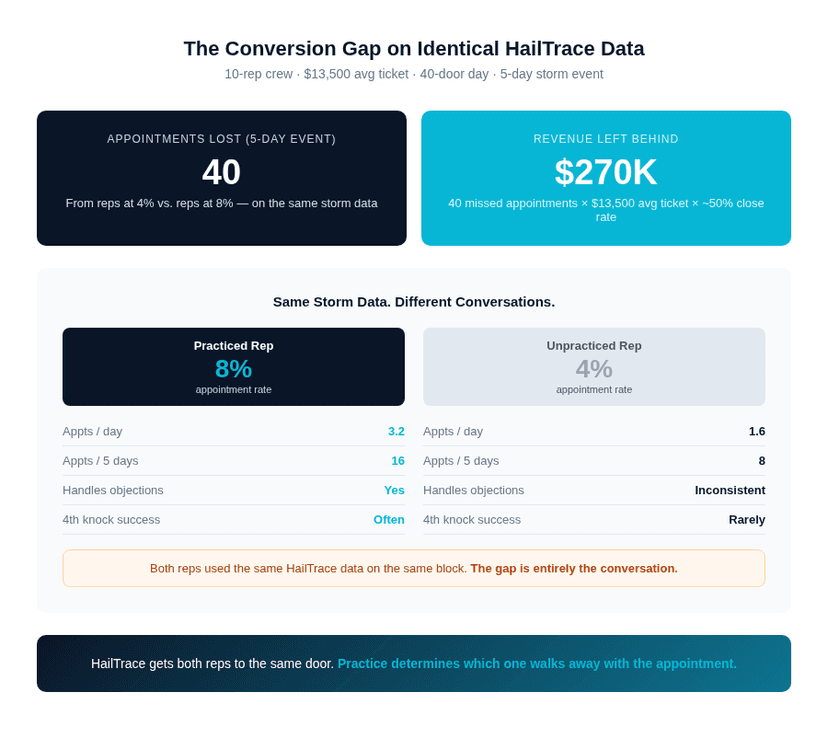
When close rates drop on a storm event, the data usually isn't the problem. The territory was good — HailTrace confirmed it. The issue is what reps say in the first 30 seconds and how they handle the objections that follow.
The fix is practice. Not shadowing a manager on two rides, but actual repetitions — drilling the skeptical homeowner, the "I already have someone coming out," the "my insurance company is handling it."
Practicing objection handling without burning real leads is exactly what GhostRep's AI roleplay is built for. A rep who's run that scenario 20 times before storm season has a different conversation than one running it live for the first time on a hot lead.
Key insight: HailTrace identifies the best doors in a territory. GhostRep trains what your rep says when they're standing in front of one. Both problems are real. They require different tools.
Where HailTrace and GhostRep Belong Together
These two platforms solve different parts of the same revenue problem:
- HailTrace — storm intelligence, address scoring, fast alerts. Gets your crew to the right door before the competition.
- GhostRep — conversation practice, objection drilling, rep skill development. Ensures the rep at that door is ready for what's waiting on the other side.
Storm-chasing operations live and die on conversion rates, not just on storm volume. A crew that gets to every event first but converts at 4% is leaving more money behind than one that arrives second and converts at 9%.
Training reps before storm season is the step most operations skip — because training is harder to measure than data and easier to defer when the calendar looks busy. The crews that don't skip it close more jobs from the same number of doors.
Your numbers will depend on crew size, territory, and how consistently your reps practice — but a 2-3 point conversion improvement on a storm event pays for both tools in the first week.
The goal isn't to choose between better targeting and better reps. A storm event rewards both. HailTrace makes sure you're knocking the right doors. GhostRep makes sure those doors don't close on the pitch they've already heard twice this week.
Most operations are already running the data side. The ones pulling ahead of their competition in the same storm event are the ones that also took the time to prepare their reps for what the data already found.
Key Takeaways
- HailTrace solves the targeting problem — meteorologist-verified storm data, address-level damage scores, and instant alerts get your crew to the right doors before the competition. It's excellent at what it's built for.
- Storm data has become table stakes — multiple roofing companies run hail intelligence on every event. When the map is the same for everyone, targeting is no longer the differentiator.
- The fourth knock is a different conversation — homeowners who've already heard three pitches aren't asking whether it hailed. They're deciding whether to trust your rep. That requires practiced skills, not more data.
- The skill gap explains conversion variance — two reps on identical HailTrace data in the same territory produce very different appointment rates. The variable is what they say at the door.
- Both tools belong in the same operation — HailTrace handles storm intelligence. GhostRep handles rep skill development. Neither one does the other's job.
Frequently Asked Questions
Does HailTrace include any sales training or coaching features?
No. HailTrace is a storm intelligence and lead targeting platform. It identifies damaged properties, verifies storm data, and integrates with CRMs — but it has no mechanism for training reps on what to say when they knock those doors.
Can better storm data improve a rep's conversion rate?
Better targeting puts reps on higher-probability properties, which can improve close rates at the margin. But a rep who can't handle a skeptical homeowner will lose a high-probability door just as fast as a low-probability one. The data improves lead quality; rep skill determines what happens with it.
Is GhostRep a replacement for storm intelligence tools?
No. GhostRep is a sales skill training platform — it doesn't track storm events, score properties, or alert your crew when a neighborhood gets hit. It trains the conversation skills that determine conversion once reps are in the field. A storm-driven operation needs both.
When should a roofing company add conversation training to their storm prep?
Before storm season starts. Reps who've drilled post-storm objections before the first event convert better on day one. Waiting until a crew is already in the field means the highest-value early doors in a storm event are training reps at full ticket price.
How much does GhostRep cost?
GhostRep publishes transparent pricing at ghostrep.ai/pricing. Prepaid hour bundles start at $200 for 25 hours — no subscription, no contracts, no demo required.
Related Articles
- Storm Chasing vs Territory Building: Where the ROI Actually Lives
- How to Train Roofing Sales Reps in 3 Weeks Before Storm Season
- How to Practice Roofing Sales Objections Without Burning Leads
- Door Knocking Psychology: What Actually Happens at the Door
- Roofing Rep Close Rate Drop: What the Data Actually Tells You
Free storm sales resources
Make storm-season training usable in the field
Use free tools for inspection summaries, follow-up language, adjuster prep, and objection handling before the next appointment hits.
Field sales tools
Build inspection summaries, homeowner updates, and post-appointment follow-up assets.
Browse field sales tools →Training tools
Use training tools for claim scripts, rebuttals, canvassing language, and storm-specific prep.
Browse training tools →Echo
Coach reps live during door knocks, inspections, and follow-up conversations when storm volume spikes.
See Echo →About the Author
Tim Nussbeck
Founder & CEO of GhostRep
20+ years in roofing and home improvement sales—knocking doors, running teams, and building practical coaching systems. Built GhostRep to give every rep access to the coaching top teams get.
Storm-season next step
Turn storm-season advice into field execution
Use the field tools first if you need inspection summaries, homeowner updates, or follow-up language. Book a walkthrough if you want GhostRep mapped to storm-volume coaching.
- ✓Best fit if the issue is speed, consistency, and field execution.
- ✓Useful for inspection summaries, claim prep, and storm follow-up.
- ✓Demo shows how Echo supports reps when volume spikes and managers cannot be everywhere.
Start Here
Open storm-field tools
Build homeowner updates, inspection summaries, and follow-up assets for real appointments.
Open storm-field toolsNeed it mapped to your team?
Talk through your current workflow, traffic mix, and where GhostRep fits before you change anything.
Book a 15-minute walkthroughYou Might Also Like
Build an independent roofing estimate from field observations, scope, quantities, costs, assumptions, and review gates without crossing claim boundaries.
Read article →What retail roofers need to add storm restoration: claim boundaries, supplement documentation, cash-flow realities, and a responsible starting plan.
Read article →Compare storm chasing and local territory roofing with your job volume, margin, acquisition, travel, warranty, and overhead costs.
Read article →