Contractor-only answer: Compare the offer, not the logo. Do not choose between Angi and HomeAdvisor by brand name. Angi Inc.'s current annual report says a basic Pro membership includes profiles on both Angi.com and HomeAdvisor.com, while its marketplace includes several lead and subscription structures. Compare the exact written offer, lead type, fees, credit rules, and your own cost per collected job.
This is not a homeowner guide. It is for roofing owners and marketing managers deciding whether to buy marketplace leads.
HomeAdvisor vs Angi: What Should a Roofer Choose?
Angi versus HomeAdvisor verdict for roofers: choose the written offer that produces acceptable collected-job economics in your market. There is no evidence-backed universal winner. Angi Inc.'s FY2025 Form 10-K places both brands in the same company and describes multiple lead and subscription structures. Two roofers can use the same brand while buying different products.
| Your decision | Evidence to request | What to do |
|---|---|---|
| Buy one program or both? | Legal seller, inventory source, duplicate and matching rules | Confirm whether a second program adds distinct opportunities before adding its budget. |
| Which quote costs less? | Lead fees, subscriptions, minimum spend, approved credits, and staff time | Compare all-in costs for the same completed cohort, not the advertised unit price. |
| Is the lead quality acceptable? | Valid contacts, held appointments, completed jobs, collections, and failure reasons | Separate poor fit from missed calls and slow follow-up before judging the source. |
| Can we stop a poor fit? | Renewal date, cancellation notice, budget controls, and credit deadlines | Record the written exit conditions before starting the pilot. |
The right question is narrower and more useful:
Does this exact offer, configured for our roofing services and ZIP codes, produce acceptable cost per collected job and collected gross-profit contribution after credits, invalid contacts, no-shows, cancellations, rep time, and travel?
This page shows how to answer that question without relying on an invented national lead price or close-rate benchmark. For a platform-specific review, use the separate guides to Angi roofing leads and HomeAdvisor roofing leads. For cross-channel economics, use the roofing lead cost benchmarks.
Review method: This comparison was rebuilt from Angi's current SEC disclosure, official Angi/HomeAdvisor Pro pages and terms, and Federal Trade Commission guidance. GhostRep does not receive affiliate compensation from Angi or HomeAdvisor, did not inspect your account, and is not claiming hands-on results from either offer. The SEC filing, targeted-lead page, published credit guidelines and legacy HomeAdvisor terms were rechecked September 7, 2026. No private account quote or contractor performance record was supplied.
What the Public Documents Actually Establish
Source check: September 7, 2026. A HomeAdvisor-branded URL can host Angi Leads material. Identify the product before treating two pages as competing offers. The public documents below are evidence for diligence; your current signed agreement determines your account obligations.
| Buying question | Published evidence | Decision for a roofing company |
|---|---|---|
| Are these two independent suppliers? | Angi’s FY2025 filing lists both brands and says basic annual Pro membership includes profiles on both. | Do not pay twice on the assumption that two logos guarantee distinct inventory. Require an overlap rule and compare unique lead IDs. |
| What sharing rule is disclosed? | The targeted-leads page describes Market Match and Exact Match with up to three other Pros. | This count applies to those described experiences; get the current rule for your product, including double opt-in or other offers. |
| What can a bad lead recover? | The published guidelines allow discretionary store credits requested within 30 days. They list six-month expiry and exclude nonresponse or losing the job by themselves. | Budget credits when approved, not when requested. Save evidence of wrong contact data, category or ZIP and reconcile the credit statement. |
| Can we rely on the old renewal or refund page? | The still-live HomeAdvisor terms explicitly say last updated October 1, 2018; they include automatic renewal and an 18-month credit period. | That age and the conflicting credit period make it unsuitable as proof of a new account’s exact terms. Obtain the dated agreement and cancellation instructions. |
| Which has the lower roofing fee? | The filing describes service-, product- and location-dependent lead revenue. It does not supply a nationwide roofing price list. | Compare the order forms. A universal dollar winner or a promised roofing close rate is not supported by these sources. |
Our Recommendation by Company Situation
- Owner answering between installations: resolve call coverage before buying a shared feed. A written low lead price does not cover the cost of missed connections.
- Staffed office, clear service area, spare production capacity: consider one capped, attributable offer after the terms are complete. Test the exact product against your current source using collected-job economics.
- Already paying for one Angi-family program: add another only when incremental, nonduplicate opportunities can be identified. Shared parentage does not prove all leads overlap, but neither does a second brand prove diversification.
- Need exclusive opportunities or predictable exit costs: decline any offer that cannot put those conditions in writing. A verbal exception does not establish the purchase you need.
These are operating recommendations from the documented purchase structure, not results from a GhostRep-managed Angi account. Without an actual offer and mature contractor cohort, a more precise winner would be invented.
Use the contractor offer audit on the sales call. Capture the product, fees, budget exceptions, sharing, credits, renewal and exit terms, then reconcile the first lead cohort against that record.
Download the printable PDF · Free, no email required.
Are Angi and HomeAdvisor Separate Contractor Lead Options?
They are distinct consumer-facing brands inside the same public company, but that does not prove every offer, lead, or account is identical. Angi Inc.'s FY2025 Form 10-K says the company operates Angi and HomeAdvisor, includes profiles on both sites with a basic annual Pro membership, and charges Pros for consumer matches. It also says one service request can create multiple leads.
The practical conclusion is not “they are exactly the same.” It is “do not assume they are independent.” Ask the salesperson to identify the legal seller, product, inventory source, matching rules, and account terms in writing. If two proposed programs draw from overlapping requests, buying both may add cost without adding the reach you expected.
Read the official evidence in four layers:
- Membership is not product identity. A basic Pro membership can place a profile on both Angi.com and HomeAdvisor.com. It does not prove that every account receives the same lead product. Require the exact product and every included surface in the order form.
- A product family is not a national price. Angi disclosed lead, subscription, and pre-priced structures in 2025. It did not publish one nationwide roofing price. Model the actual quote, fees, billing cadence, and service area.
- A request is not necessarily exclusive. One consumer request can produce multiple leads. The filing does not establish one recipient count for every product. Confirm the matching limit for this offer and market.
- A paid match is not a held appointment. Pros can pay for a consumer match even when they never perform the service. Track the connection through valid contact, held appointment, completed job, and collection.
Angi's official targeted-leads page gives a more specific example. It says a Market Match lead can be sent to the Pro and up to three other Pros, while an Exact Match consumer can select that Pro and up to three others. That is evidence for those published products—not permission to label every Angi or HomeAdvisor connection “shared with four contractors.” Verify the product in your own order.
Add the 2026 Platform Transition to Your Questions
There is also current roadmap risk to clarify. In its Q1 2026 shareholder letter, Angi said it would feature-freeze its legacy platform and redirect product, design, data, and engineering resources toward an AI-native revenue platform for Pros. That statement does not provide a release date or say that a specific contracted feature will disappear. It does mean a buyer should ask which platform the proposed account uses, which capabilities are still supported, what migration is planned, and how records and settings will move.
Get written answers for data export, integrations, reporting continuity, account history, lead-credit history, support ownership, pricing changes, and cancellation rights during any migration. A favorable pilot on one product should not be treated as a permanent operating assumption if the underlying product is changing.
What Does a Roofer Actually Buy?
Start with precise language. A marketplace lead is a connection, not a roof, inspection, appointment, or contract. The FY2025 filing says consumer-match revenue applies regardless of whether the Pro ultimately performs the requested service. Older but still-live HomeAdvisor Service Professional Terms also say the platform does not guarantee a specific number of leads, successful contact, hiring intent, ability to pay, or a completed job.
That distinction changes the economics. Cost per lead is only the invoice denominator. The operating denominators are:
- Received lead: a platform connection charged or delivered to the account.
- Valid contact: your team can reach the person and confirm that they submitted the roofing request in the service area and category you bought.
- Company fit: the request matches company-defined service, geography, job-size, and scheduling rules.
- Held appointment: the homeowner actually attends the scheduled conversation or inspection.
- Sold job: the customer accepts under your documented sold-stage definition.
- Completed job: production completes the work under your normal acceptance rule.
- Collected job: the company receives the money being counted.
A valid contact is not automatically qualified or ready to buy. Use the separate roofing lead fit-versus-readiness framework to keep those states distinct, then route each inquiry through a documented lead intake and appointment handoff. If your team changes the definition halfway through a pilot, the comparison becomes unreliable.
Segment the Roofing Work Before You Blame the Source
Do not blend repairs, retail replacements, insurance-related inquiries, commercial work, and storm response into one close rate. They can have different qualification rules, sales cycles, production constraints, collection timing, and gross margins. Segment the cohort by the service category selected in the account, then keep the original category visible even if the job later changes.
Find the first denominator that failed, then give the problem to the owner who can actually change it:
- Duplicate, wrong contact, wrong ZIP, or wrong service: inspect the original lead record, active account settings, and credit policy. The platform/account owner controls the response.
- A valid request waits unassigned: inspect received, assigned, first-attempt, and next-action timestamps. The routing manager owns the gap.
- A contacted lead never holds: inspect the fit decision, scheduling, confirmation, and disposition. Inside sales or the assigned rep owns the next test.
- Sold work cancels or never completes: inspect scope, expectations, financing, production capacity, and the cancellation reason. Sales and operations share the diagnosis.
- Completed work remains uncollected: inspect the invoice, payer, receivable status, and collection owner. Accounting or collections owns the recovery.
This prevents two opposite mistakes: blaming the marketplace for an unowned internal handoff, or blaming the rep for a wrong or unreachable connection that should have entered the credit process.
Verify the Exact Angi or HomeAdvisor Offer
Complete this worksheet from the signed order, account screens, and current policy pages before the first charge. A sales call is not the source of truth unless the promise appears in the agreement.
Build a proof packet before the first charge. It should answer all twelve questions below with the named artifact—not a salesperson's recollection:
- Legal seller and product: Which entity bills you, and what is the exact product name? Save the order form and first invoice.
- Consumer source: Did the request originate on Angi, HomeAdvisor, a retail partner, or another network source? Save the written product description and a sample lead record.
- Overlap: Can this inventory overlap another Angi/HomeAdvisor offer you buy? Require a written answer and run a duplicate audit.
- Lead type: Is it full-price, subscription-discounted, double-opt-in, pre-priced, booked, or another connection? Match the order form to the account label.
- Competition: How many Pros may receive or be selected for the connection? Require product-specific terms, not a verbal average.
- Fees: What one-time, recurring, per-lead, premium, administrative, or other fees can apply? Get the complete fee schedule.
- Budget control: What is the spend target, can it be exceeded, and which products sit outside it? Save the account settings and controlling contract clause.
- Service and ZIP controls: Which roof types, job types, and ZIP codes are active? Export or screenshot the configuration with a timestamp.
- Credits: Which facts qualify, what proof is required, and is the remedy cash or store credit? Save the current policy and every claim outcome.
- Term and renewal: When does the subscription renew, how is renewal canceled, and what stays nonrefundable? Save the signed term, renewal notice, and procedure.
- Authorized use: Who may contact the lead, and may personal data enter your CRM or other systems? Reconcile the agreement, privacy terms, and internal data rule.
- Pause and exit: What does pausing change, what keeps billing, and how do you export records? Test the written support answer before scaling.
Angi's published targeted-leads page says Pros can choose work types and areas, set a monthly budget, and change account preferences. Treat those as configuration controls, not proof that every delivered request will match perfectly. The credit policy itself anticipates wrong ZIP codes and job types.
Credits, Billing, and Renewal: Verify the Account Rule
The current Angi Leads credit guidelines say a credit request must be made within 30 days. Published potentially eligible cases include a duplicate request, a wrong ZIP outside the Pro's profile, a wrong job type outside the profile, a competitor testing the system, or entirely wrong or disconnected contact information. The page says a nonresponsive consumer, a consumer who already hired someone, a shopper, a changed mind, or a lost job is not enough by itself.
Approved credits are described as store credits, not cash refunds. There is also a public-document conflict: the current credit page says credits expire after six months, while the older live Service Professional Terms say 18 months. Do not build a financial forecast around either period until the current signed order and account policy resolve it for your business.
The older terms also describe recurring subscriptions, automatic renewal, prepaid lead bundles that may be nonrefundable, and premium lead programs that can sit outside a normal spend target. Product terms change, and an old public page may not control a new account. That is exactly why the worksheet requires current written evidence.
Credit control: Review disputed leads every business day, submit evidence before the published deadline, record requested versus approved credits, and reconcile the account statement. A credit you never request is still acquisition cost.
Run a Controlled 30-Day Pilot, Then Let the Cohort Mature
A 30-day pilot can test lead flow, account controls, valid-contact rate, routing, appointment behavior, credit administration, and the team's ability to follow up. It may not be long enough to observe completed and collected roofing jobs. Do not call a cohort profitable because it signed work that has not reached production and collection.
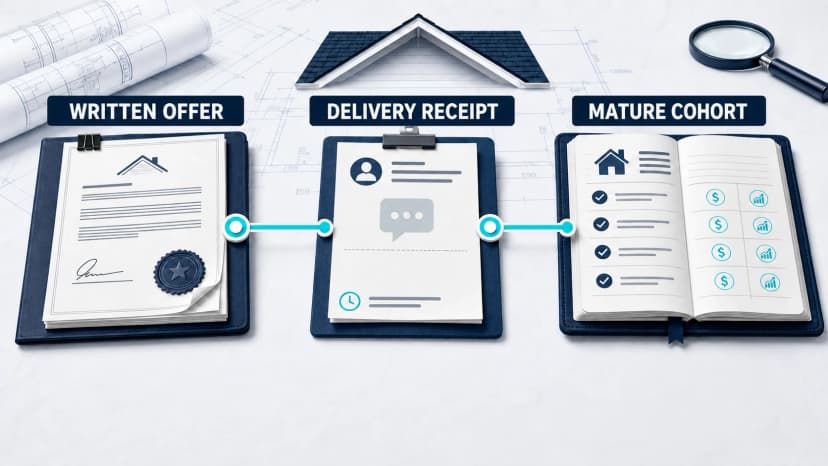
- Before day 1: Save the signed offer, define every funnel state, set the spend cap, assign the response owner, and document credit and opt-out procedures.
- Days 1–30: Give every received lead a cohort ID. Record source/product, charge, timestamps, fit, contact, appointment, credit, and disposition without overwriting history.
- Every week: Reconcile platform charges to the lead log, submit eligible credits, inspect out-of-area and wrong-service patterns, and review whether capacity is causing slow or incomplete follow-up.
- After day 30: Stop adding leads to the test cohort. Continue following its sold jobs through cancellation, completion, collection, direct job cost, and gross profit.
- At maturity: Compare the offer with your alternative channels using the same definitions. Continue, change, or scale only after the collected economics are visible.
The reusable roofing lead qualification checklist can help a manager standardize company-fit review. The complete roofing lead cost calculator owns the broader cost model; this article stays focused on comparing the marketplace offers.
The Scorecard That Chooses the Better Offer
| Metric | Formula | Why it matters |
|---|---|---|
| Net lead spend | Platform charges − approved credits | Uses reconciled cost, not the sales quote. |
| Total acquisition cost | Net lead spend + response labor + rep labor + travel/mileage + attributable tools | Counts the cost required to work the cohort. |
| Valid-contact rate | Valid contacts ÷ received leads | Separates reachable, confirmed requests from raw delivery. |
| Held rate | Held appointments ÷ valid contacts | Shows what survives contact, fit review, scheduling, and no-shows. |
| Cost per held appointment | Total acquisition cost ÷ held appointments | Measures the cost of a real sales opportunity. |
| Cost per collected job | Total acquisition cost ÷ collected jobs | Prevents signatures, cancellations, or receivables from overstating success. |
| Collected GP contribution | Collected revenue − direct job cost − total acquisition cost | Shows what the cohort contributed before general overhead. |
| Cohort ROI | Collected GP contribution ÷ total acquisition cost × 100 | Compares gross-profit return on the acquisition investment. |
When a denominator is zero, report the unit cost as N/A, not $0. A pilot with no held appointments did not produce free appointments.
Worked Example: The Cheaper Lead Loses
The values below are illustrative planning inputs, not current Angi or HomeAdvisor pricing, GhostRep customer results, or industry averages. Both example offers use a $12,000 collected job and 35% gross-margin assumption solely to make the calculation reproducible.
| Thirty-day cohort | Offer A | Offer B |
|---|---|---|
| Received leads | 20 | 30 |
| Gross lead charges | $2,100 | $1,750 |
| Approved credits | $100 | $100 |
| Net lead spend | $2,000 | $1,650 |
| Response, rep, and travel cost | $600 | $900 |
| Total acquisition cost | $2,600 | $2,550 |
| Invoice cost per received lead | $100 | $55 |
| Valid contacts | 14 | 12 |
| Held appointments | 8 | 5 |
| Sold / completed / collected jobs | 3 / 3 / 3 | 2 / 2 / 1 |
| Collected gross profit | $12,600 | $4,200 |
| Cost per collected job | $867 | $2,550 |
| Collected GP contribution | $10,000 | $1,650 |
| Cohort ROI | 384.6% | 64.7% |
Offer B appears cheaper at $55 per received lead versus $100. It loses after valid contact, appointment, and collection are counted. That does not prove expensive leads are better. It proves cost per lead cannot select the offer.
It also shows why the cohort must mature. If Offer B's second completed job is collected later, its cost per collected job and ROI change. Keep the original cohort ID and update outcomes; do not move a late collection into a newer month just to make that month's dashboard look better.
Contact, Privacy, and Neighborhood Canvassing Are Separate Controls
A homeowner's request through a marketplace is not blanket permission for any campaign, channel, or future use. Confirm who is authorized to contact the lead, which communication methods the request supports, what the platform agreement permits, and how your company records an opt-out. The FTC's Telemarketing Sales Rule guidance says sellers must maintain and honor entity-specific do-not-call requests and explains that live calls, automated calls, prerecorded messages, and prior inquiries do not all have the same rules. FCC, state, and local rules can add requirements.
The old version of this article told reps to automatically knock surrounding homes after a paid appointment. That advice improperly mixed two acquisition channels. Permission associated with one homeowner's request does not supply permission from a neighbor. If your company canvasses nearby homes, treat it as separate cold outreach:
- follow local permits, solicitation hours, no-soliciting notices, and company safety rules;
- do not reveal the purchased lead's name, project, insurance status, contact data, or inferred roof condition;
- track incremental labor and travel separately;
- set the attribution rule before the activity, not after a sale; and
- do not import purchased personal data into another system until the agreement, privacy terms, authorized-user rules, and data-processing controls allow it.
If a live human follow-up needs clearer company-approved wording, use the roofing follow-up generator only after your company has confirmed that the contact is allowed. A message generator cannot determine consent.
What the HomeAdvisor FTC Order Should Change in Your Diligence
In 2023, the FTC finalized a consent order settling allegations that HomeAdvisor had made false, misleading, or unsubstantiated claims about lead quality, source, and outcomes. The FTC's final-order announcement says the order provided up to $7.2 million in redress and prohibited specified misleading claims.
That history is material, but it does not prove every current lead is defective. The operator lesson is to reject outcome promises that are not written, defined, and substantiated. Ask:
- What exactly counts as a lead, match, appointment, or win?
- Does the conversion claim describe this trade, geography, offer, time period, and denominator?
- Is the source first-party, partner, or another network path?
- What happens when the request is outside the selected category or area?
- Can the claim and its conditions be attached to the order?
When to Test, Decline, Pause, or Scale
Test
Proceed only with a written offer, enforceable spend cap, clear categories and ZIPs, a defined owner, a working credit process, and enough response capacity. An unsaved verbal promise is not evidence.
Decline
Walk away when material fees, renewal, matching, source, data-use, or cancellation terms remain unclear after written follow-up. Urgency and projected jobs without a disclosed method do not close those gaps.
Pause or correct
Stop new cohort intake when charges do not reconcile, service or ZIP errors persist, or the team cannot work the cohort promptly and compliantly. Do not label an unowned routing failure “bad lead quality.”
Scale carefully
Scale only when more than one mature cohort produces acceptable cost per collected job and gross-profit contribution without breaking sales or production capacity. A low invoice CPL or one large win is not enough.
If neither offer passes, redirect the budget to channels your company can measure and own. The roofing lead-generation guide separates owned, earned, and purchased channels. Keep referral, canvassing, search, and marketplace cohorts separate instead of using one blended close rate.
Fix the measured sales handoff
A lead platform cannot repair an unowned follow-up process
GhostRep can help managers practice, review, and coach roofing sales conversations. It cannot make a platform lead valid, change the account contract, or replace compliant routing and attribution.
Frequently Asked Questions
Are Angi and HomeAdvisor the same company?
Angi Inc. operates both brands. Its FY2025 Form 10-K says a basic annual Pro membership includes profiles on both Angi.com and HomeAdvisor.com. That does not mean every product or connection is identical, so verify the exact seller, product, source, and terms in the offer.
Which is cheaper for roofing contractors: Angi or HomeAdvisor?
There is no public nationwide roofing price that can answer this honestly. Angi's filing says consumer-match revenue varies by service, product experience, and geography. Compare the complete current quote and then measure total acquisition cost per collected job—not just the fee per received lead.
Are Angi or HomeAdvisor leads exclusive?
Do not assume exclusivity. Angi reports that one service request can create multiple leads, and its targeted-leads page says certain Market Match and Exact Match connections can involve up to three other Pros. Other offer types exist, so the product-specific agreement controls.
How many contractors receive the same Angi or HomeAdvisor lead?
The published targeted-leads page says its specified Market Match and Exact Match experiences can include the selected Pro and up to three other Pros. That is not a universal count for every account, source, or offer. Ask for the rule that applies to the exact product you are buying.
Can contractors get refunds for bad Angi Leads?
The current public policy describes discretionary store credits, not cash refunds, for certain situations and requires requests within 30 days. Nonresponse, shopping, choosing someone else, or losing the job are listed as ineligible by themselves. Confirm the current account rule because public pages conflict on how long approved credits remain usable.
What is the average close rate for Angi or HomeAdvisor roofing leads?
No current public primary source provides one reliable roofing average across products, markets, services, teams, and definitions. Calculate sold jobs divided by received leads for your cohort, but also report valid-contact, held-appointment, completion, collection, and gross-profit results so one percentage does not hide the failure point.
Should roofers buy Angi or HomeAdvisor leads?
A capped test can be reasonable when the offer is documented, the company has response capacity, the account is attributable, and the expected gross-profit range can absorb the full acquisition cost. Decline or pause when terms are unclear, charges cannot be reconciled, or the team cannot follow up promptly and compliantly. Scale only after mature cohorts produce collected gross profit.
Methodology note: The original regulatory review was July 24, 2026. The four public product and contract sources in the new comparison table were rechecked September 7, 2026. The worked example is illustrative and uses no claimed platform benchmark or GhostRep customer result. Product pages and account terms can change; the signed order and current account policy control. This page is general operational information, not legal, privacy, accounting, or tax advice.
Free lead-generation resources
Turn traffic strategy into pipeline actions
Use free marketing and field tools to turn website, referral, and follow-up ideas into lead flow your reps can actually work.
Marketing tools
Generate ad copy, email sequences, company bios, and lead-conversion messaging for your market.
Browse marketing tools →Field sales tools
Create follow-up assets, texts, and homeowner-facing copy once a lead is already in motion.
Browse field sales tools →Job Intel
Give reps better customer context before the follow-up so lead quality is easier to convert.
See Job Intel →About the Author
Tim Nussbeck
Founder & CEO of GhostRep
20+ years in roofing and home improvement sales—knocking doors, running teams, and building practical coaching systems. Built GhostRep to give every rep access to the coaching top teams get.
Lead-gen next step
Run the paid-lead math before you buy another lead
Use the ROI calculator to see whether your team is multiplying or wasting bought leads. Book a walkthrough if you want GhostRep tied to lead handling, 6-packs, and follow-up execution.
- ✓Best fit if paid leads create activity but not enough extra pipeline.
- ✓Useful for measuring whether a rep workflow lowers effective acquisition cost.
- ✓Demo shows how GhostRep supports the field process after the lead is assigned.
Start Here
Run the lead-cost math
Model what extra appointments, better close rates, and faster follow-up do to lead economics.
Run the lead-cost mathNeed it mapped to your team?
Talk through your current workflow, traffic mix, and where GhostRep fits before you change anything.
Book a 15-minute walkthroughYou Might Also Like
Model your HomeAdvisor quote through contact, inspection, sale, completion and collection. Include labor and gross profit before buying more roofing leads.
Read article →Learn the 3-phase review system roofers use to turn happy customers into Google reviews, stronger local rankings, and more booked leads.
Read article →Compare roofing SEO and Google Ads using fully loaded spend, qualified leads, signed and completed jobs, gross profit, cost per job, and true ROI.
Read article →