Free roofing sales tool
Roofing Door Knocking Script Generator
Generate a word-for-word roofing door knocking script tuned to your market, pitch type, and the rep's experience level. It writes the canvassing opener, the value line, the inspection ask, responses to the first objections, and a callback plan for the doors that don't answer.
A great script does three jobs: it gives the homeowner a checkable reason you're on their street, it asks for exactly one thing, and it survives the first “not interested” without an argument. Below the generator you'll find four scripts you can steal today — storm, retail, referral, and the no-soliciting door — plus the lines that get reps thrown off porches.
Created by Tim Nussbeck — founder of GhostRep, 20+ years in home improvement sales.
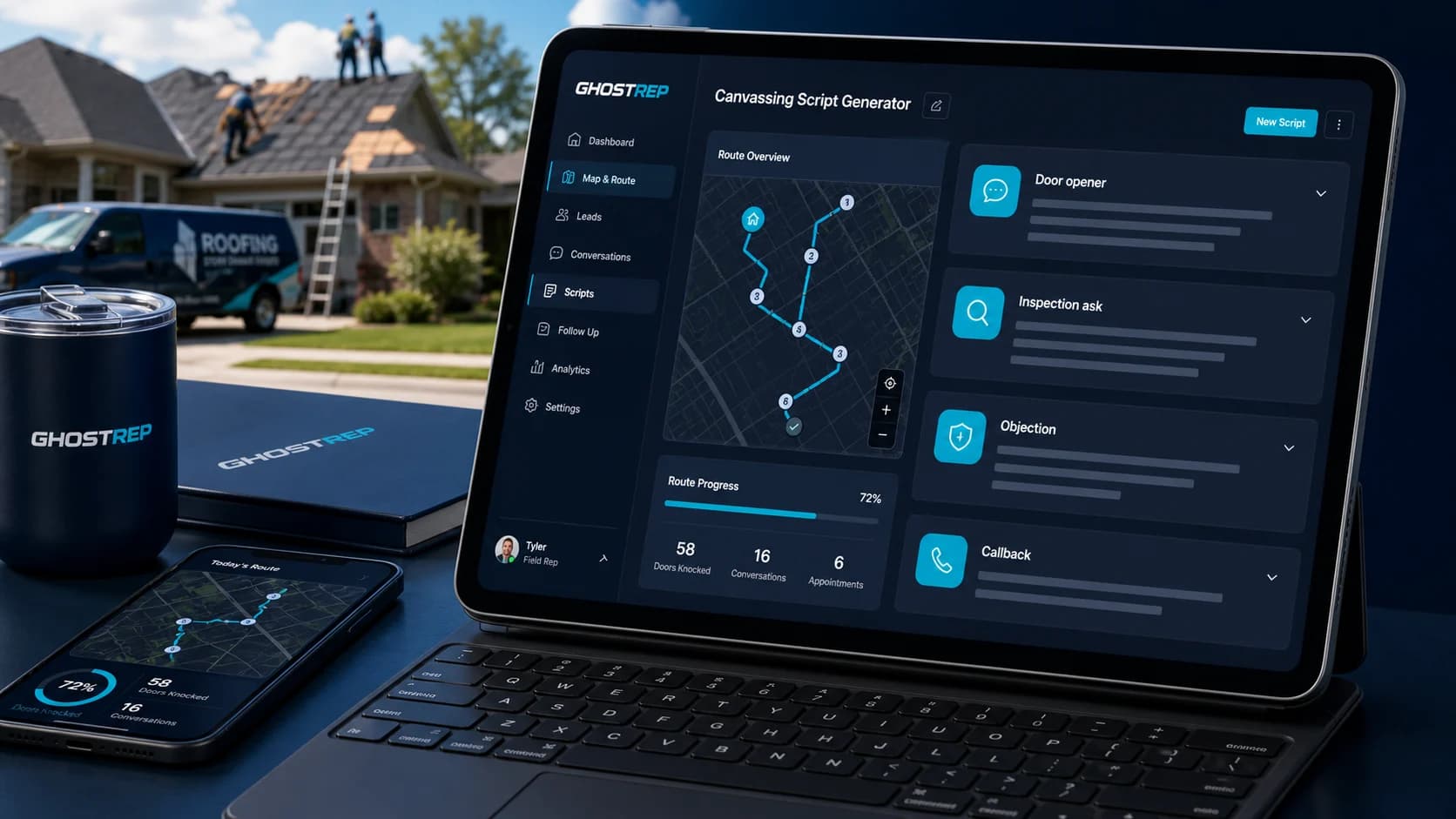
Each script includes
- Door opener. A first line tied to the street, storm, or roof age.
- Value line. One sentence on why a free look is worth ten minutes.
- Inspection ask. A single, low-pressure ask for the next step.
- Objections + callback. Responses to the first nos and a no-answer plan.
Selling solar at the door? Use the dedicated solar doorstep rehearsal for electricity-cost, roof-suitability, and utility-identity questions.
Enter your details
Free to use. Generated scripts are a starting point — review and adapt every line to your market before a rep takes it to the door.
Practice the approach as well as the words
Follow an annotated doorstep conversation, then rehearse five homeowner branches. The printable field card separates visible behavior from what an audio recording can establish.
Open the demonstration and printable observation cardFrom the script to the real conversation
Review the conversation after the route.
Scripted coaching example · Not a customer transcript
- Source moment
- 00:26 — The homeowner asks, “Are you with my insurance company?” The rep moves to the inspection ask without correcting the misunderstanding.
- One next behavior
- State the verified company identity and independent role. Answer the question before discussing an inspection.
- Owner and next check
- Rep: rehearse a clear identity answer. Manager: review the next comparable authorized conversation for that clarification.
Audio cannot establish where a rep stood, whether a sign was posted or what gestures they used. Keep in-person observations separate and follow the approved recording process.
Use the actual exchange when you coach. Echo connects authorized recording, live cues when enabled on a supported app, and post-appointment review. The manager checks the source and chooses the action.
What makes a great door knocking script
Three things, and everything else is decoration.
The reason has to be checkable. “We're in the neighborhood doing free inspections” is what every company says, and homeowners have heard it enough to close the door on reflex. A hail date, the crew two doors down, the age of the roofs on the block — the opener works when the homeowner can verify it from their own driveway.
The ask has to be one thing. Ten minutes on the roof, or a time on the calendar for it. A rep who goes for the inspection, the phone number, and an appointment in the same breath gets a no to all three.
The exit has to be practiced. When a homeowner says “Not interested,” acknowledge the decision and leave. A useful script prepares both a clear explanation for someone who wants to continue and a respectful ending for someone who does not. Record the actual outcome instead of treating every answer as an appointment.
The rest is calibration, and it's what the generator above handles: storm streets lead with the storm date, retail neighborhoods lead with roof age, referral streets lead with the neighbor's name. New hires get the full word-for-word version; veterans get the frame and the key lines. And since door-to-door carries real legal obligations — the FTC rules on identification and cooling-off periods, local permit ordinances — put the compliance in the script instead of trusting each rep's memory.
Roofing door knocking script examples
Four scripts, one for each street a canvasser actually walks. Steal the pattern, not the words — swap in your own street names, storm dates, and customer names so every line is verifiable by the person hearing it.
“Hey there — I'm Tyler with Peak Home Services. We just finished replacing your neighbor's roof at 4218 Elm; you might have seen our crew out here yesterday. Their insurance covered the whole thing after the hailstorm. From your driveway your shingles look like they took some hits too. Mind if I take a quick look? I can tell you in about ten minutes whether it's worth filing a claim — completely free, no strings attached.”
Why it works: Opens with verifiable neighborhood proof and ends on one ten-minute ask.
“Morning — I'm Dana with Summit Roofing. Most of the homes on this block went up around 2003, which puts a lot of these roofs right at the end of their lifespan. I'm doing free condition checks on the street today. Can I grab a ladder and give yours a quick once-over? Takes about ten minutes and I'll show you photos of whatever I find.”
Why it works: Leads with roof age the homeowner can relate to, then offers proof with photos.
“Hi — I'm Marcus with Ridgeline Roofing. We put the new roof on the Garcias' place at 412 Maple last spring, and we're back on the street this week for another job. Elena said it was fine to mention her name if I knocked on a few doors. Since we've already got the crew and equipment out here, I'm offering the same free inspection we did for them. Want me to take a look while we're on the block?”
Why it works: A name the homeowner knows converts better than any pitch — and the crew on the street makes the story checkable.
“I saw your sign, so I'll be quick — I'm not asking you to buy anything today. We're the crew working at 4218 Elm, and after Tuesday's hail we're documenting damage on this street for insurance claims. I wanted you to know why our trucks are out here. If you'd like, I can take ten minutes and tell you whether your roof took any hits — and if not, I'll leave you our info and get off your porch.”
Why it works: Acknowledges the sign, explains the trucks, and gives the homeowner an easy out — which is exactly what makes them listen.
One caveat on the no-soliciting door: in many municipalities a posted sign makes the knock itself an ordinance violation. Know your local rules — where the sign carries legal weight, skip the knock and leave a door hanger instead. And if you're working a street where you already have a customer, the cloverleaf script generator builds the referral version around a specific job address.
Want a version tuned to your exact pitch type, market, and rep level? Use the generator above.
What to say when knocking doors for roofing
The words matter, but so does everything around them. The homeowner reads the rep before the rep says a word: step back from the door after you knock, keep your hands visible, relax your posture. Script the body language as deliberately as you script the opener — the psychology of door-knocking does as much work as the line you deliver. Then keep it conversational — reps talk to homeowners, not at them.
“We’re checking roofs on this street after Tuesday’s hail — I noticed a few hits on yours from the driveway.”
Starts with the homeowner’s situation, not your company.
“Mind if I take ten minutes and tell you if it’s worth filing a claim?”
Makes one specific, time-boxed ask instead of an open-ended one.
“We just finished your neighbor’s roof at 4218 Elm — their insurance covered the whole thing.”
Uses verifiable proof the homeowner can check.
What reps should never say at the door
Some lines lose the deal. These lines lose the deal, the neighborhood, and in a couple of cases put your license at risk. Put them in the script explicitly as forbidden — don't assume a new rep knows.
“We’ll cover your deductible”. Waiving or absorbing an insurance deductible is illegal in a growing number of states — Texas law treats it as fraud with fines and jail on the table. One rep saying it at one door can cost you your reputation with every carrier in the market.
“You’ll get a free roof”. Nothing about an insurance claim is free — the homeowner pays a deductible and has been paying premiums for years. “Free roof” sets an expectation that blows up at the signing table and flags your company as a storm chaser.
“Your insurance will definitely cover this”. The rep doesn’t decide what the carrier covers, the adjuster does. Promise the process — a documented inspection and help with the claim — never the outcome. A broken coverage promise is how you end up with a hostile customer mid-build.
“I can see damage from here” (when you can’t). If the rep hasn’t actually seen hits from the driveway, inventing them is the fastest way to get caught lying — the adjuster will look at the same roof. Openers only work when every claim in them is checkable.
Trash-talking their current roofer. “Those guys cut corners” makes the homeowner defend a choice they already made. If they mention another company, compliment the diligence and offer a second set of eyes — a comparison inspection costs them nothing.
Anything after the second real no. The first no is a reflex; bridge it once. The second no is a decision; respect it, leave the door hanger, and move on. Reps who argue past two nos burn the street for every knock that comes after them.
Turn the door into an appointment, not a pitch dump
The goal at the door is not to sell a roof. It's to earn the inspection and set the appointment where the roof gets sold. Reps who unload the full pitch on the porch — warranty, financing, shingle brands — answer every question the homeowner would have needed the appointment to ask, and walk away with “we'll think about it” instead of a time on the calendar.
Script the transition from yes to appointment. If the rep can inspect on the spot, do it — then set the results appointment for a time when every decision-maker is home: “I'll have photos of everything I find. When are you and your husband both around — tomorrow evening, or Saturday morning?” Offering two concrete times beats “when works for you?” every time, and asking for both spouses up front kills the “I need to talk to my wife” objection before it exists — for the objections that survive anyway, the objection handler writes word-for-word responses. Get the phone number after the yes, framed as confirmation: “What's the best number to text you a reminder?”
Then protect the appointment. Same-day text confirmation, a reminder the morning of, and a scripted reschedule line for cancellations. Doors that said “maybe” or didn't answer go into a follow-up sequence, not a notebook — the roofing sales follow-up cadence covers the timing that keeps a knocked street producing for weeks after the knock.
How managers should train reps on the script
Rehearse the introduction, one genuine question and a respectful exit. Change the homeowner's answer so the rep must listen rather than memorize a finish. A firm “not interested” ends the approach; practice acknowledging it and leaving, not finding another bridge.
Structure the first week around exposure: two days of observation, then knocking alongside an experienced rep with feedback after each door, then solo with an end-of-day debrief. Debrief on conversations and appointments, not door counts — a rep who knocked 60 doors and set two inspections is ahead of one who knocked 120 and set none. As your team scales, the right canvassing apps for contractors track doors, conversations, and callbacks so coaching runs on data, not gut feel.
Review what happened on the route before rewriting the pitch. GhostRep Echo connects authorized recording to post-conversation review. Choose one exchange, verify the context and coach the next question. Live cues require organization enablement and a supported app. Use practice to prepare the correction; use field observation for behavior audio cannot show.
Frequently asked questions
What should I say when knocking on doors for roofing?
Open with a specific, verifiable fact about their situation — a recent storm, a neighbor’s roof you’re already working on down the street, or the age of homes in the neighborhood. Then ask for one thing in plain language: a quick look at the roof, or ten minutes on the calendar. Generic openers that lead with your company name get doors closed; specific openers that start with the homeowner’s situation keep them open.
How do I handle “not interested” at the door?
“Not interested” is a reflex, not a decision. Don’t argue — reframe the ask: “Totally fair. All I’m asking for is 10 minutes. If I don’t find anything, you’ll know your roof is solid and we’re done.” Say it once, with confidence, then respect a genuine second no. Pushing past two real nos wastes your time and poisons the neighborhood for the next rep.
What do I say at a house with a no-soliciting sign?
First, know your local ordinance — in many municipalities a posted sign makes the knock itself a violation, and the safe play is a door hanger instead of a knock. Where knocking is legal, acknowledge the sign immediately: name the job you’re working down the street, say you’re not asking them to buy anything today, and offer to leave information. Brevity and honesty are the only things that work at a skeptical door — a rep who argues with the sign confirms every suspicion behind it.
Is door-to-door roofing sales legal?
Yes in most areas, but soliciting rules vary by municipality and many cities require a permit. After declared disasters, several states enforce anti-solicitation windows. The FTC also sets cooling-off period rules for door-to-door sales that your contracts must comply with, and states like Texas make it illegal for a contractor to waive or absorb an insurance deductible. Check your local ordinances and state contractor laws before canvassing a new market.
How many doors should a roofing rep knock per day?
A full day is roughly 80 to 120 doors with 20 to 30 real conversations. Track conversations and appointments separately from raw door count — doors alone don’t tell you whether a rep is engaging homeowners or just sprinting through the street.
How do I train a new rep to use the canvassing script?
Two days of observation, then knock alongside an experienced rep with feedback after each door, then solo with an end-of-day debrief. Have reps rehearse the script out loud and role-play the first three objections before they ever touch a real door. Skipping the practice phase is how new reps develop habits nobody corrects.