In this article
A roofing sales call review should leave the rep with one change to try on the next conversation. Select the recording for a stated reason, listen to the exact moment and rehearse the correction. This guide also calculates the manager time needed to sustain that process.
The selection routine is a starting design, not a roofing benchmark. Two calls can reveal a coaching gap; they cannot estimate the rep’s overall quality. Keep targeted risk reviews separate from the developmental sample.
One reviewed moment, one correction, one next check
This fictional call excerpt demonstrates the review process. It is not a customer recording or a measured GhostRep result. The manager selected it from a rotating proposal-review sample, rather than because it ended in a sale.
07:42 — Homeowner: “Your warranty sounds longer, but what happens if there's a leak?”
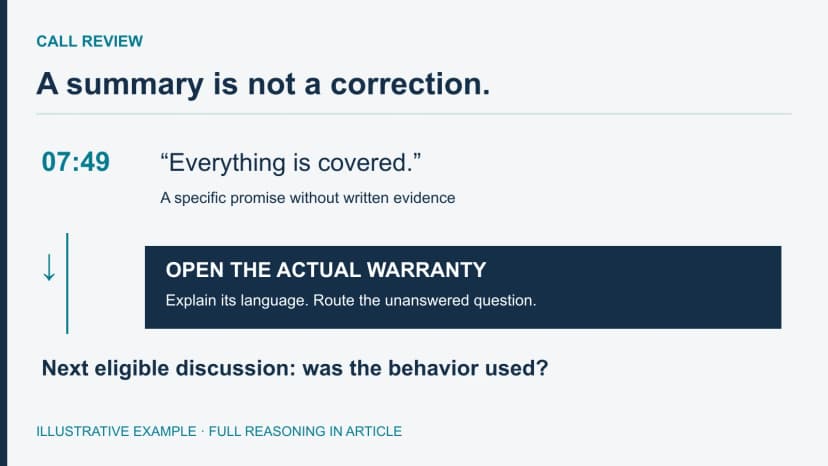
07:49 — Rep: “Everything is covered, so you won't have to worry.”
08:02 — Homeowner: “Even the labor?”
08:06 — Rep: “Yes, all of it.”
“Rep explained coverage” hides the problem. At 07:49 and 08:06, the rep promised unrestricted warranty coverage. A signed sale would not make that promise accurate.
Correction: Open the current written warranty, identify which question it answers and route anything it does not answer. Do not tell the rep merely to “build more value.” This review does not require a new total-score system; use the existing call-scoring guide for that job.
Practice homeowner: “So if it leaks, do I pay anything?”
Retry: “Let's separate the manufacturer's product warranty from our workmanship document. Here's what each says. I don't have enough information to promise how a future claim would be handled. Which cost are you concerned about?”
Practice homeowner: “Labor if you have to come back.”
Rep: “I'll show you the labor language and ask our warranty owner to clarify the remaining question before you decide.”
Next review record: Target behavior: reference the written warranty before describing coverage. Manager: Ellis. Practice outcome: demonstrated once; no field conclusion. Next evidence: the next eligible warranty discussion selected through the normal rotation. If none occurs, record “no opportunity observed” and assign a different scenario; a quiet review period is not proof of transfer.
If the promise recurs, check whether the rep can find and use the current warranty. Repair missing access before repeating the drill. An accurate explanation that loses the sale can still demonstrate the coached behavior.
Related guidance: roofing sales call scorecard, call-scoring manager guide, sales KPI scorecard, roofing sales follow-up cadence.
Roofing Sales Call Review Cadence at a Glance
| Cadence step | Manager action | Required output |
|---|---|---|
| Select | Lock one rotating manager-selected conversation and one rep-selected conversation before coaching begins. | A list showing rep, call type, date, and selection method. |
| Review | Listen, record timestamps, and evaluate observable behavior with the same scorecard used across the team. | One strength, one priority gap, and the exact moment that supports each observation. |
| Coach | Review the moment with the rep and agree on one behavior to change. | A specific next-call action, not a list of personality judgments. |
| Practice | Rehearse the same moment with a comparable roofing scenario. | A repeatable response or question the rep can use naturally. |
| Follow through | Check for that behavior in the next eligible conversation. | Evidence that the rep used it, modified it, or still needs support. |
| Calibrate | Periodically have two reviewers evaluate the same conversation and reconcile differences. | Shared interpretation of the standard before managers compare rep scores. |
Size the routine to call volume and manager capacity. A three-rep retail team and a 30-rep storm operation will not need the same review load.
Define Which Roofing Sales Conversations Count
Review recorded phone or approved field conversations with enough relevant behavior to coach. Exclude voicemail and scheduling exchanges unless those workflows are the target.
Define your eligible conversation types before selecting recordings:
- Lead qualification: the first substantive conversation used to understand the homeowner's need, timing, location, and next step.
- Inspection or job recap: the rep explains what was observed, separates fact from assumption, and prepares the homeowner for the next decision.
- Estimate presentation: the rep explains scope, options, price, timing, and decision criteria.
- Objection conversation: the homeowner raises price, trust, timing, competing bids, spouse approval, insurance, financing, or another real concern.
- Follow-up conversation: the rep reconnects after an estimate or unanswered next step. Use this article to review the conversation itself; use the follow-up cadence article to evaluate timing and channel sequence.
- Closed-won or closed-lost review: the conversation contains a decision or a clear reason the opportunity moved forward or stopped.
Tag each recording by conversation type and sales stage. Otherwise the manager may compare a five-minute qualification call with a 45-minute estimate presentation as though they were the same task.
Build a Balanced Coaching Sample Without Calling It Representative
A workable coaching sample has two lanes.
Lane 1: developmental sample. Select one eligible conversation from a rotating category without choosing by outcome. Let the rep submit another for feedback. Record which is which; the rep-selected call may expose a concern the manager would miss.
Lane 2: targeted exceptions. Add complaints, material misstatements, repeated misses or unfamiliar offers. Report these separately: a queue built to find risk will naturally contain more errors.
The GAO’s call-monitoring report distinguishes statistical performance sampling from local coaching reviews and notes that the smaller local sample could not estimate overall call-center performance. Its call counts are not roofing benchmarks.
To estimate overall quality, define a separate sample across call type, lead source, territory and rep tenure. The NIST sampling handbook explains precision, randomization and stratification; selecting interesting recordings is not a substitute.
For every reported average, show the count, date range, eligible population, and selection method. “Average score: 78” is weak evidence. “Average score: 78 across 24 randomly selected estimate presentations from June, excluding targeted complaint reviews” is interpretable.
Calculate Manager Call Review Workload
Capacity trap: Faster playback reduces listening time, not the rep’s coaching time. If reviews take the manager away from promised estimate approvals, reserve both jobs explicitly or reduce the review queue. A recording backlog is not a coaching program.
Use this workload formula before promising a cadence the manager cannot sustain:
Review hours = reps × conversations per rep × ((average conversation minutes ÷ playback speed) + scoring and note minutes) ÷ 60
Then add coaching, selection, calibration, and administration separately. Do not hide those hours inside the listening estimate.
Illustrative workload: An eight-rep team reviews two 20-minute conversations per rep. The manager listens at 1.5× playback and spends five minutes scoring and writing notes after each conversation.
8 × 2 × ((20 ÷ 1.5) + 5) ÷ 60 = about 4.9 review hours
If the manager also holds one 25-minute coaching session with each rep, coaching adds:
8 × 25 ÷ 60 = about 3.3 coaching hours
That is about 8.2 hours before selection, calibration, permissions, rescheduling, or follow-through. It is an illustrative capacity example, not a recommended staffing ratio. Longer field appointments, lower playback speed, deeper notes, or multiple managers will change it.
If the math does not fit, adjust deliberately. Reduce the baseline for stable reps, shorten the eligible call type, rotate deeper reviews across the team, or assign trained reviewers. Do not claim full coverage while managers quietly skip the work.
Prepare the Review Before You Press Play
A manager should know why a recording entered the review queue before hearing it. Capture:
- rep, territory, lead source, and conversation date;
- call type and sales stage;
- whether the selection was rotating, rep-selected, random, or targeted;
- the customer's stated objective and the next step at the time;
- the prior coaching behavior being checked, if one exists; and
- any known consent, access, or data-handling restriction.
Listen once for context, then return to the coaching timestamps. “At 11:42, the rep moved to scheduling without answering the scope question” gives the rep something to change. “Sounded weak” does not.
For teams using an approved recording workflow, Echo can surface the transcript and conversation moments that need manager attention. If recording is unavailable or inappropriate for the situation, use a sales ride-along evaluation and keep that field-observation evidence separate from audio-only call scoring.
Use one evaluation frame across managers. Research on behaviorally anchored feedback produced mixed results, while rater-training research found improved agreement in a competency-rating setting. Neither proves a roofing cadence; both help explain why reviewers need shared definitions.
Run a Focused Call Coaching Conversation
The coaching session should turn one recorded moment into one next-call behavior.
- Ask for the rep's read first. What were they trying to accomplish, and where did the conversation change?
- Play the exact moment. Use the timestamp rather than debating a manager's summary.
- Name the observable behavior. Describe what the rep said or did and what customer signal followed.
- Choose one priority. Do not turn one recording into a 12-item correction list.
- Rehearse the alternative. Have the rep try a better question, transition, explanation, or objection response in context.
- Define follow-through. State which next eligible conversation will show whether the behavior transferred.
Tell reps which recordings are reviewed, who can access them and how the evidence is used. Do not introduce disciplinary criteria through a coaching session.
The sales manager 1-on-1 script can provide the meeting structure. Keep the call evidence, one agreed behavior, and the follow-through date at the center of that conversation.
Change the Sample When Risk Changes
The baseline is not a ceiling. Increase review density temporarily when:
- a new rep begins taking live homeowner conversations;
- an experienced rep changes role, territory, offer, lead source, or sales motion;
- a homeowner complaint, consent issue, or material misstatement is reported;
- the same observable miss appears across multiple reviews;
- close rate, cancellation rate, or follow-up completion changes enough to justify diagnosis;
- a new script, financing program, promotion, or campaign creates unfamiliar questions; or
- a high-value or unusually complex opportunity warrants closer supervision.
Remove extra reviews when their cause is resolved, while retaining the developmental sample. Record the reason, affected conversations and reassessment point.
Separate Conversation Quality From Sales KPIs
A call review and a KPI report answer different questions.
| Management question | Best evidence |
|---|---|
| Did the rep confirm the homeowner's concern before presenting a recommendation? | Recorded conversation plus a consistent call scorecard. |
| Is the rep's close rate changing across the full opportunity set? | CRM and KPI data with a defined time period and denominator. |
| Why might price objections be ending conversations? | Targeted call review, followed by a broader sample if a general conclusion is needed. |
| Is one lead source producing weaker appointments? | Lead-source and funnel analysis across the eligible population. |
| Did the rep use last cycle's coaching behavior? | The next eligible recorded conversation. |
Score behavior before considering the sale. Existing customer relationships, service-area fit and price can affect the outcome. Use the team’s KPI view for full-population results.
Turn the Review Into the Next Practice Rep
Do not end with “be better at objections.” Convert the recorded moment into a narrow practice assignment.
If the rep introduced price before confirming scope, practice the transition from inspection findings to homeowner priorities. If the rep answered a three-bid objection with a discount, practice one version that clarifies decision criteria before discussing price. If the rep talked through the homeowner's pause, practice asking the next question and waiting.
Match the drill to the recorded moment. Use GhostRep Role Play and the feedback form to rehearse and document the change. AI Sales Coach can support that workflow; the next approved conversation supplies the field check.
Set Recording Consent, Access, and Retention Rules
Operational privacy check: Before reviewing or sharing recorded calls, confirm that the call was recorded under company-approved consent and disclosure procedures for the jurisdictions involved. Limit access to people with a legitimate coaching or quality role, retain recordings only as long as needed under company policy and applicable requirements, and verify that any recording or transcription provider protects the data. This is operational guidance, not legal advice.
The FTC’s Telemarketing Sales Rule guidance notes that recording-consent rules vary by state. Confirm the rules for the actual phone or field workflow with qualified counsel; the TSR does not cover every roofing conversation.
Document who may record, listen and share; where transcripts live; how requests are handled; and when data is deleted. Retention follows applicable requirements and business purpose, not an arbitrary day count.
The FTC's Start with Security guidance recommends keeping only information that is essential, restricting access on a need-to-know basis, securing sensitive information throughout its lifecycle, and disposing of data that is no longer needed. Apply those principles to audio, transcripts, summaries, customer details, and any vendor that processes them.
Weekly Call Review Process Checklist
- Define the eligible conversation types for this cycle.
- Select one rotating manager-choice conversation and receive one rep-choice conversation per rep.
- List targeted exception reviews separately and record why each was added.
- Confirm the recording is approved for review and access is limited appropriately.
- Calculate the listening and scoring workload before blocking manager time.
- Review with the same scorecard and capture exact timestamps.
- Write one strength, one priority gap, and one next-call behavior.
- Hold the coaching conversation and rehearse the relevant moment.
- Check the behavior in the next eligible conversation.
- Report sample count, period, and selection method beside any average score.
- Keep KPI trends in the KPI system instead of inferring them from a few recordings.
- Calibrate reviewers on a shared conversation often enough to catch interpretation drift.
The cadence is working when managers can sustain it, reps know what behavior they are practicing, and the next review closes the loop. If recordings accumulate without coaching or follow-through, the system is storage—not sales management.
Source Notes
Source review date: July 11, 2026. Sampling guidance comes from the NIST/SEMATECH e-Handbook of Statistical Methods. The coaching-versus-measurement distinction is illustrated by the GAO review of SSA call monitoring. Behavioral-observation and reviewer-calibration context comes from the linked performance-appraisal research. Recording and data-handling cautions use the FTC's Telemarketing Sales Rule and Start with Security guidance.
The research and government examples here come from broader performance-appraisal and contact-center settings. They support the operating principles, but they do not establish a scientifically optimal review cadence for roofing sales teams.
Frequently Asked Questions
How often should roofing sales managers review calls?
A weekly coaching cycle is a practical starting rhythm because it keeps the reviewed moment close to the rep's next opportunity to apply feedback. It is not a proven universal optimum. Adjust the rhythm for call volume, rep tenure, risk, manager capacity, and the amount of variation you observe.
How many roofing sales calls should a manager review per rep?
Start operationally with two completed conversations per rep: one manager-selected from a rotating category and one rep-selected for help. Treat that as a coaching sample, not a statistically representative measurement. Add clearly labeled targeted reviews for new hires, complaints, repeated misses, or other risk.
What sales calls should managers review?
Rotate across qualification, inspection recap, estimate presentation, objection handling, follow-up, and closed-won or closed-lost conversations. Do not review only wins, losses, longest calls, or complaints. Those are targeted selections and can be useful, but they do not show normal performance by themselves.
Should reps choose their own calls for coaching?
Let the rep choose one conversation where they felt uncertain or want feedback, but do not make rep-selected calls the whole sample. Pair the rep choice with a manager-selected conversation from a rotating call type so the cadence supports both self-diagnosis and broader coverage.
Can two call reviews measure a rep's overall performance?
No. Two conversations can reveal a coachable moment and support a next-call action. Estimating overall quality or comparing reps requires a defined population, defensible selection method, enough observations, and attention to factors such as call type, lead source, territory, and outcome.
How do you calculate manager call review workload?
Multiply reps by conversations per rep, then multiply by average listening time after playback speed plus scoring and note time. Divide by 60 for hours. Add coaching, selection, calibration, and administration separately so the calendar reflects the complete management load.
Should call review scores be used instead of sales KPIs?
No. Call review scores describe observable behavior in sampled conversations. KPIs describe activity and outcomes across a defined opportunity set. Use conversation review to diagnose and coach; use CRM and KPI data to measure funnel trends.
What consent is needed to record roofing sales calls?
Requirements vary by jurisdiction, channel, purpose, and circumstance. Use company-approved disclosure and consent procedures, confirm the applicable rules with qualified counsel, restrict access, and document retention and vendor-security practices. Do not assume one script, beep, or policy makes every phone or field recording lawful.
About the Author
Tim Nussbeck
Founder & CEO of GhostRep
20+ years in roofing and home improvement sales—knocking doors, running teams, and building practical coaching systems. Built GhostRep to give every rep access to the coaching top teams get.
Manager next step
Turn this into a manager workflow your team can repeat
Use the management tools if you need a practical coaching or accountability system first. Book a walkthrough if you want GhostRep tied to rep performance and live coaching.
- ✓Best fit if coaching is inconsistent across reps and managers.
- ✓Useful for 1-on-1s, scorecards, and weekly operating rhythms.
- ✓Demo shows how AI Sales Coach turns performance data into specific guidance.
Start Here
Browse management tools
Open scorecards, coaching docs, forecast templates, and manager workflows.
Browse management toolsNeed it mapped to your team?
Talk through your current workflow, traffic mix, and where GhostRep fits before you change anything.
Book a 15-minute walkthroughYou Might Also Like
Build a practical roofing manager workflow with conversation evidence, a sample weekly review, coaching actions and a checklist for AI sales software.
Read article →Use a 30-day roofing sales onboarding calendar with safety gates, field practice, role play, coaching evidence, and weekly manager decisions.
Read article →Train roofing sales reps remotely with a complete scope module, visible attempts, specific feedback, accessible delivery and supervised sign-off criteria.
Read article →