In this article
A useful roofing sales practice plan changes one observed behavior. If a rep answers a price concern before asking what the homeowner is comparing, the target is clarification—not “be more confident” or “close more.” Recreate the moment, give precise feedback and change the next scenario enough to require judgment.
Begin only when job-related evidence supports one specific gap. Use the stage-by-stage skills guide to identify it and the development matrix to maintain the wider record. Better practice performance does not guarantee a sale; the uncoached check and later field evidence are separate steps.
Confirm the Skill Gap With Evidence, Not Revenue Alone
A sales result can tell a manager where to investigate. It does not identify the behavior to rehearse. A lower close rate could reflect lead source, territory, pricing, homeowner timing, appointment mix, operational capacity, or a conversation problem. Even when a conversation contributed to the result, the manager still needs the specific moment.
Start with job-related evidence such as an approved call excerpt, an observed field interaction, a role-play moment, a CRM work sample, or a documented handoff. Describe what happened without guessing at personality or motivation.
| Observed moment | Weak diagnosis | Practiceable behavior |
|---|---|---|
| The homeowner says another proposal is cheaper, and the rep immediately defends the company's price. | “Needs confidence.” | Clarify what the homeowner is comparing before explaining a verified difference in scope, warranty, financing, or service. |
| The rep describes visible roof conditions, then implies what the insurance carrier will approve. | “Needs more insurance knowledge.” | Separate the contractor's observation from the carrier's coverage decision, use company-approved language, and escalate questions outside the rep's authority. |
| A canvasser delivers a long opening while the homeowner gives short answers and starts closing the door. | “Needs better energy.” | Ask permission to continue, state the reason for the visit briefly, and move to the first relevant question. |
| An estimate follow-up ends with “let me know” and no agreed action. | “Does not close hard enough.” | Confirm the unresolved issue and earn a specific, dated next step or a clear close-the-loop decision. |
| The rep lists product features without connecting them to anything the homeowner said. | “Needs more product training.” | Connect the relevant product or process detail to the homeowner's stated concern about warranty, leaks, financing, appearance, timing, or another verified priority. |
If the evidence comes from a real customer conversation, keep the review job separate from the practice job. The Roofing Sales Call Scorecard owns the evaluation form, and the guide on how to score a roofing sales call explains how to document an observable moment. This article starts when that review has produced one defensible coaching priority.
Rewrite the Gap as One Observable Behavior Target
The target should tell the rep what to do, when to do it, and what not to substitute for it. A practical sentence follows this logic:
When this customer signal appears, the rep will perform this observable behavior within their role authority, without the current unhelpful response.
For a price-defense gap, the customer signal is a comparison to another proposal. The observable behavior is asking what differs before responding. The unhelpful response is immediately defending price or attacking the competitor.
For an insurance-boundary gap, the signal is a homeowner asking whether a condition will be covered. The behavior is accurately separating what the contractor observed from what the carrier decides, then routing questions outside the rep's authority. The unhelpful response is implying a coverage outcome or making an unsupported promise.
Keep one target per practice cycle. Discovery, product explanation, objection diagnosis, next-step control, and CRM documentation may all need work, but combining them creates ambiguous feedback. If the rep improves, the manager will not know which practice mattered. If the rep struggles, the rep will not know which behavior to change first.
Match the Practice Scenario to the Selling Stage
A scenario should reproduce the decision the rep has to make, not merely reuse the topic. Match these elements to the evidence:
- Sales stage: door approach, qualification, inspection recap, estimate presentation, objection conversation, follow-up, or handoff.
- Customer objective: understand damage, compare proposals, manage cash flow, clarify timing, reduce uncertainty, or decide whether to proceed.
- Information available: what the rep knows, what remains unknown, and what must be verified before an answer is safe.
- Role authority: what the rep may explain, what requires an estimator, manager, production lead, financing provider, carrier, or another qualified person.
- Desired next step: permission to inspect, a scheduled proposal review, a documented follow-up, a verified escalation, or a complete handoff.
If the gap occurred during a retail estimate presentation, a generic door-knocking exercise will not test it. If the rep mishandled an insurance question, a simple “your price is too high” prompt may practice a different skill. The Sales Role-Play Scenario Generator can create stage-specific practice material, but the manager still has to confirm that the scenario reproduces the evidence-backed moment and respects company-approved boundaries.
Add Variations That Change the Decision, Not Just the Words
Repeating the same homeowner sentence can make a response sound smooth without showing that the rep recognizes when the response applies. Meaningful variations preserve the target behavior while changing the context around it.
For a price-comparison target, one homeowner may have two proposals with different ventilation and decking assumptions. Another may have comparable scope but care most about the monthly payment. A third may be missing a decision-maker. The target remains “clarify what is being compared before explaining the relevant difference,” but the correct follow-up question changes.
For a product-explanation target, vary the homeowner's stated priority. One is concerned about recurring leaks, another about warranty terms, another about financing, and another about whether the job can be completed before a planned event. The rep should connect only the relevant, verified information to the priority that was actually stated.
For an insurance-boundary target, vary what is known. In one scenario the rep has photos but no carrier documentation. In another the homeowner has an estimate but is asking the contractor to predict approval. In a third the question belongs with a designated company specialist. The rep must recognize the boundary and escalate when appropriate, not memorize one disclaimer and repeat it regardless of context.
Use an Attempt → Feedback → Retry Loop
Run the scenario once before coaching the answer. Observe whether the rep notices the cue and performs the target. Then give feedback tied to the exact moment, let the rep ask a clarifying question, and run a comparable version again.
Research on expert performance by Ericsson, Krampe, and Tesch-Römer described practice activities designed to improve a specific aspect of performance through effort, repetition, and informative feedback. That research did not validate a roofing-sales practice schedule or promise a revenue result. The useful design principle is narrower: practice the identified behavior, surface the error, provide information the learner can act on, and offer another opportunity to perform it.
Feedback should be specific enough to guide the next attempt:
You heard the lower-price comparison, but you explained our warranty before learning whether the scopes were comparable. On the retry, ask what the homeowner sees as different and summarize that answer before you explain anything.
That is more useful than “slow down” or “build value.” The Role-Play Feedback Form can capture the evidence from one practice session without turning the practice result into an overall employee rating. For repeatable scenarios and immediate coaching opportunities, GhostRep Role Play can provide practice volume while the manager keeps the behavior target fixed.
Space Practice and Change the Context Before You Call It Transfer
A smooth retry immediately after feedback shows that the rep can use the correction while the cue is fresh. It does not show that the behavior will return later or survive a different customer context.
Schmidt and Bjork's review of learning research distinguished immediate practice performance from longer-term retention and transfer, noting that conditions that make practice look easier are not always the conditions that produce stronger later performance. Their work spans learning paradigms outside roofing sales and does not prescribe an exact cadence here. It supports a practical caution: do not judge the plan only by how polished the final coached attempt sounds.
Return to the target after an interval set by the team, remove the coaching prompt, and change a meaningful feature of the scenario. Change the homeowner's priority, the sales stage, the information available, or the wording of the cue. Do not change every variable at once; the manager still needs to know whether the same target behavior is being tested.
A short initial sequence may help the rep understand the new behavior. Later attempts should require the rep to recognize when and how to use it. The stopping decision should be based on credible performance across relevant variations and an uncoached check, not a universal number of repetitions.
Use Retrieval Practice for Knowledge, Not as Proof of Selling Skill
Some apparent conversation gaps include a knowledge component. A rep may not recall the company's approved warranty explanation, financing workflow, inspection boundary, handoff requirement, or escalation contact. In that case, knowledge retrieval can support the practice plan before the rep applies the information in conversation.
Roediger and Karpicke found that retrieving learned material improved longer-term retention compared with repeated study in their experiments. Use that finding for product and process knowledge only. It does not show that a quiz improves roofing close rates or that recalling an approved explanation means the rep can use it appropriately with a homeowner.
A rep can first retrieve the correct company process without notes, check it against the current approved source, and then practice applying it in a realistic conversation. The knowledge check answers, “Can the rep recall the information?” The scenario answers, “Can the rep decide when and how to use it?” The later field observation answers, “Did the behavior appear in real work?”
Operating Example: Price Defense to Comparison Diagnosis
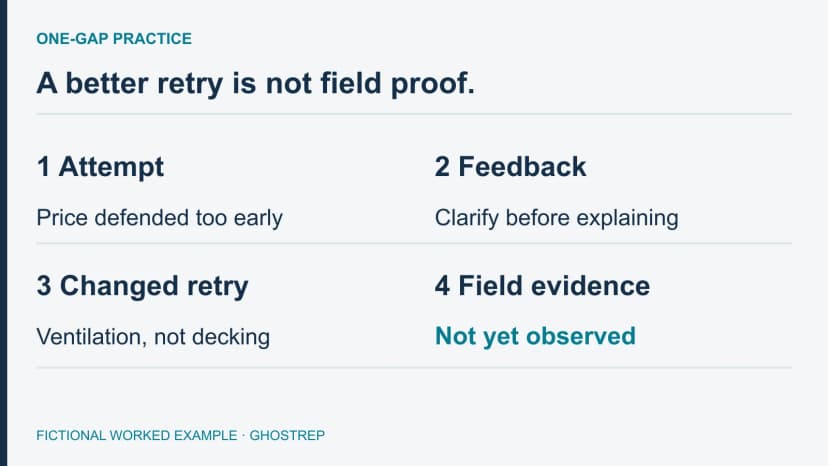
Operating example, not a benchmark: The exchanges below are fictional. They demonstrate the same skill gap with different customer cues. No live rep, recording, customer result or completed field-transfer check is represented.
- Observed gap
- Rep defended the total before learning which scope item the homeowner was comparing.
- Target behavior
- Ask a neutral comparison question, listen and confirm the specific unresolved item before explaining an offer.
- Source
- Current fictional scope reference S-22; no claim about a competing proposal unless that proposal is available and reviewed.
- Completion rule
- Demonstrate the behavior in a changed scenario without a coach supplying the first question. Keep unresolved technical questions for their source owner.
Homeowner, first attempt: “Your price is higher. The other contractor says decking is extra.”
Rep, first attempt: “Our roof is worth more because our crew does better work.”
Coach: “You defended value before asking what decking treatment the customer needs clarified. Ask about the written scope, then confirm the answer; do not judge the other crew.”
Rep, coached retry: “Which decking allowance is unclear in the proposals you are comparing?”
Homeowner: “I cannot tell what either price covers.”
Rep, coached retry: “You need the decking allowance in writing before comparing totals. Is that the question?”
The coached retry shows the requested behavior after a prompt. It is evidence of a successful retry, not independent transfer. For the next check, remove the coaching and change the unresolved item.
Homeowner, uncoached variation: “The other proposal says ridge vent is optional. Do I need your ventilation option?”
Rep: “What are you trying to compare about that option?”
Homeowner: “Whether it is required or just an upgrade.”
Rep: “You want to distinguish a requirement from an option. I need the reviewed design and scope source before answering that; I will route the question to the estimator.”
- First attempt
- Target missing: no clarification before price defense.
- Coached retry
- Target demonstrated after feedback; keep the coach prompt in the record.
- Uncoached variation
- Clarification and escalation demonstrated in this fictional exercise. No technical answer invented.
- Field evidence
- Not observed. The next eligible real interaction needs authorized review using the same behavior standard.
- Next assignment
- Check independent use in a suitable interaction; if the cue changes the behavior, return to a varied drill rather than repeating the same line.
For remote delivery, use the completed remote module and sign-off example. This practice plan does not prescribe a number of attempts, a number of days, or an expected sales lift. It does not substitute for the company’s formal performance process.
Run an Uncoached Transfer Check
Change the cue and remove the coach’s hints. Observe only the named target; do not turn one clarification check into a score for the entire presentation. If the rep needs a prompt, record it. A successful simulated check still leaves field transfer unverified.
Check the Next Eligible Real Interaction
Use a naturally occurring interaction where the behavior is relevant and the company permits observation. A CRM note can show a documented next step; it usually cannot establish how the rep clarified the concern. If the cue never appears, record “not observed” rather than assigning a pass or manufacturing pressure.
Keep the practice and later evidence connected in the approved coaching record. For product information, see AI Sales Coach; the manager owns the interpretation of the evidence.
Record the Evidence, Outcome, and Next Action Separately
Record source, date, exact behavior, whether it occurred without a prompt and one next assignment. Keep the sale outcome separate: a signature cannot erase an unsupported claim, and a declined proposal cannot erase accurate clarification. Choose maintain, vary the drill, repair a knowledge gap or reopen the diagnosis.
When Practice Improves but Field Behavior Does Not
Do not automatically assign more identical repetitions. A simulation-to-field gap is new diagnostic information. Compare the practice context with the real interaction:
- The scenario was too clean. The live homeowner combined price, timing, and trust concerns while practice isolated one obvious cue.
- The rep depended on feedback. Coached retries improved, but the rep did not recognize the cue without a manager prompt.
- The information differed. The rep could respond when scope was documented but guessed when the competing proposal was unclear.
- The knowledge was not retrievable. The rep understood the conversational move but could not recall the approved product, financing, warranty, or escalation information under pressure.
- The role boundary was unclear. The rep did not know when to stop explaining and involve a manager or specialist.
- An operating barrier intervened. Missing documents, unavailable pricing, scheduling uncertainty, or a broken handoff made the practiced behavior difficult to execute.
- The original gap was wrong. The observed miss may have been a symptom of a different capability or a one-off context rather than a repeatable development need.
Change the practice to reproduce the relevant context, reduce feedback dependence, repair the knowledge or process problem, or reopen the diagnosis. More practice is useful only when the activity still matches the behavior the rep needs in the field.
Keep Developmental Practice Separate From Formal Performance Action
A focused practice plan is a coaching intervention. It is not a formal performance review, promotion standard, disciplinary record, or employment decision. Managers should tell reps when a process is developmental and when a separate company policy applies.
Use the Sales Manager 1-on-1 Script when the practice target belongs inside a normal coaching conversation. When the issue involves sustained performance expectations, prior documented support, formal consequences, or another employment process, stop treating the practice note as the whole record. Follow company policy and involve qualified HR or legal professionals as appropriate. The Sales PIP Builder is a separate workflow for a formal improvement process; it should not be triggered by one practice miss or substituted for professional review.
Safety, licensing, customer-consent, insurance, financing, and employment requirements can vary. A practice scenario should use current company-approved information and clear escalation paths. This article provides an operating framework, not legal, HR, insurance, safety, or compliance advice.
Frequently Asked Questions
How long should a roofing sales practice plan last?
There is no universal duration. Keep the plan open long enough to observe the target across relevant variations, run an uncoached check, and inspect the next eligible real interaction. The skill's complexity, evidence quality, rep experience, risk, and opportunity frequency should determine the cadence—not a generic number of days.
How many role-play repetitions does a sales rep need?
No fixed count proves readiness. Repeating one script can produce fluency without recognition or transfer. Use enough attempts to understand the behavior, then vary the customer context and remove prompts. Judge the evidence from relevant variation and uncoached performance rather than a magic repetition target.
Can close rate be the practice target?
No. Close rate is an outcome across opportunities, not one behavior the rep can perform in a scenario. It can help a manager decide where to investigate. The practice target should name a controllable action such as clarifying a proposal comparison, connecting a product detail to a stated need, or earning a specific next step.
What if the gap is product or process knowledge?
Have the rep retrieve the current approved information, verify it against the source, and then apply it in a realistic customer conversation. A knowledge check can show recall. It cannot show whether the rep recognizes when the information is relevant, explains it accurately, or stays within role authority.
Does a strong role-play result prove field readiness?
No. It shows how the rep performed in that practice context. Run a new uncoached variation and then look for the same observable behavior in the next eligible real interaction. Preserve the practice result and field evidence separately.
The Operating Rule
One confirmed gap becomes one observable target. The target drives realistic scenarios. Feedback changes the next attempt. Variation tests judgment. An uncoached check tests whether the behavior can return without a prompt. The next eligible real interaction shows whether it appeared in the field.
If those steps stay separate, managers can see where development is breaking down instead of declaring that a rep “passed training.” That is the job of a roofing sales skill-gap practice plan: make one behavior easier to observe, practice, and verify without pretending one exercise explains the whole rep or guarantees the next sale.
About the Author
Tim Nussbeck
Founder & CEO of GhostRep
20+ years in roofing and home improvement sales—knocking doors, running teams, and building practical coaching systems. Built GhostRep to give every rep access to the coaching top teams get.
Training next step
Turn training ideas into drills your reps will actually run
Start with the free training tools if you need scripts, practice reps, or coaching prompts today. Book a walkthrough if you want GhostRep mapped to your onboarding process.
- ✓Best fit if reps need more repetition, not more theory.
- ✓Useful for onboarding, objection practice, and weekly coaching.
- ✓Demo shows how Role Play plugs into your current training process.
Start Here
Browse training tools
Free objection builders, role-play prompts, scripts, and rep-practice templates.
Browse training toolsNeed it mapped to your team?
Talk through your current workflow, traffic mix, and where GhostRep fits before you change anything.
Book a 15-minute walkthroughYou Might Also Like
Test a roofing sales script with verified claims, exact before-and-after wording, varied role play and a versioned approval record before release.
Read article →Define observable roofing sales skills by selling stage. Compare two discovery attempts and see how managers calibrate evidence before assigning practice.
Read article →Evaluate AI sales training for home improvement teams with roofing and HVAC practice examples, a manager trial scorecard and a clear measurement plan.
Read article →