In this article
A roofing sales skill is a behavior the rep can perform at a particular selling stage. “Confident” is an impression. “Clarified what the homeowner was comparing before responding to price” is something a manager can hear, judge and coach.
This guide follows that behavior chain from first contact to contract and handoff. It is not a downloadable competency matrix or a rating form. The skill matrix tool supplies the reusable development record; start here to define the work its ratings refer to.
What Counts as a Roofing Sales Skill?
A useful skill statement contains a situation, an action, and an observable result. It should be specific enough that two managers can examine the same work and discuss the same behavior.
Compare these descriptions:
- Too vague: builds trust.
- Observable: identifies the company and purpose of the visit, asks permission to continue, answers credibility questions with verifiable information, and avoids pressure or unsupported claims.
- Too vague: good at discovery.
- Observable: asks about the property, the homeowner's concern, timing, decision process, and previous steps before recommending a next action.
- Too vague: strong closer.
- Observable: summarizes the homeowner's stated priorities, confirms unresolved questions, asks for the appropriate commitment, and records a specific next step.
The U.S. Department of Labor-sponsored O*NET profile for a broad nontechnical sales-representative occupation identifies skills such as active listening, speaking, persuasion, negotiation, critical thinking, active learning, and monitoring. Those categories are useful background, but they are not a roofing-sales curriculum. A roofing company still has to translate a broad skill such as active listening into the moments its reps actually face: a skeptical door introduction, a retail replacement discovery conversation, a storm-related inspection recap, or a proposal comparison at the kitchen table.
A complete standard also includes company process and role boundaries. A rep can sound polished and still be unready if they skip required CRM fields, misstate a warranty, imply an insurance outcome, climb a roof outside company safety rules, or promise a production date they cannot verify.
Prepare for the Right Sale Before First Contact
Competent preparation means the rep knows why this customer is being contacted, which sales path applies, what information is already available, and what a legitimate next step would be. The rep should not discover halfway through the conversation that the address is outside the service area, the lead requested a repair the company does not perform, or the appointment requires another decision-maker who was never invited.
For a canvassing rep, preparation may include the assigned territory, the company's no-soliciting and weather rules, recent work the rep is authorized to reference, and the exact handoff required when a homeowner wants an inspection. For a retail appointment, it may include the lead source, reported leak or roof age, appointment participants, financing materials approved for use, and the estimator's scope. For storm restoration, it may include the date and type of reported event, the claim stage the homeowner described, and the boundary between documenting property conditions and making decisions reserved for an insurer or other licensed professional.
Evidence of preparation can come from a pre-appointment briefing, an accurate CRM record, or the rep's ability to explain the purpose and desired next step before a simulation. The roofing sales training library explains how to keep the company references, practice activities, and readiness evidence behind each stage current.
Earn the Next Conversation at First Contact
The first-contact skill is not delivering the longest or most energetic opener. It is creating enough clarity and relevance for the homeowner to choose the next small step.
At a door, observable competence includes identifying the rep and company, stating a truthful reason for stopping, reading whether the homeowner is willing to engage, and reaching a useful question without hiding the purpose of the conversation. On an inbound call, it includes acknowledging why the homeowner contacted the company, clarifying the immediate concern, and explaining what will happen next.
Consider a rep working a neighborhood after a hail event. An unready rep declares that the homeowner has damage or that insurance will buy a roof before anything has been inspected. A ready rep explains the company's role, asks what the homeowner has observed, and proposes the appropriate company-approved inspection or follow-up without predicting a coverage decision.
The first-contact target also changes by role. A setter may need to earn and confirm a qualified inspection. A closer responding to a referral may need to establish the agenda for a scheduled consultation. That is why onboarding should assign role-specific readiness work rather than asking every new hire to “master the pitch.” The Sales Onboarding Plan can organize those responsibilities into a schedule after the role standard is defined.
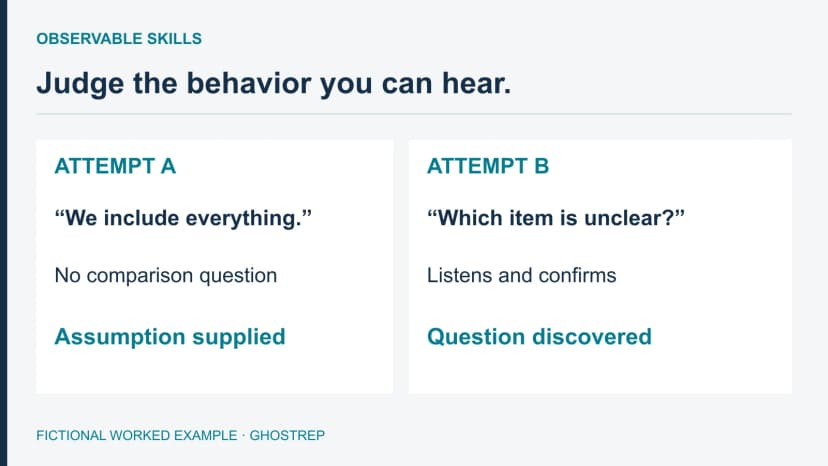
Discovery: Two Attempts Against One Observable Standard
Fictional standard: Before defending price, ask which written scope item the homeowner is comparing, listen to the answer and confirm it without inventing either proposal’s contents. This is one skill within discovery; it does not certify the rep’s complete ability.
Homeowner, attempt A: “Your price is higher than the other quote.”
Rep, attempt A: “That is because we use better materials and include everything.”
Manager review: “No comparison question; no source for “better” or “everything.” The response fails the stated clarification standard.”
Homeowner, attempt B: “Your price is higher than the other quote.”
Rep, attempt B: “Which part of the written scope is unclear when you compare them?”
Homeowner: “I cannot tell whether either price includes replacement decking.”
Rep, attempt B: “So the decking allowance is the item you need clarified before comparing totals. Have I understood that correctly?”
Homeowner: “Yes.”
- Reviewer A
- Marks attempt B as demonstrated: it asks, listens and confirms the specific comparison.
- Reviewer B
- Initially marks partial because the rep did not answer whether decking is included.
- Resolved disagreement
- The standard assesses discovery, not technical scope explanation. Attempt B demonstrates the targeted clarification. The unresolved allowance still requires its source owner.
- Boundary example
- “You are worried about the cheap contractor, right?” supplies the rep’s assumption. It does not demonstrate discovering the customer’s comparison.
- Practice assignment
- Attempt A needs one clarification drill. Assign the single-gap practice plan; use another uncoached example before expanding a readiness decision.
Choose the objective for the booked stage before judging the attempt. A proposal review may require clarification and source comparison; first contact may only require permission and a relevant next conversation. One standard cannot silently change after the outcome is known.
Coordinate Inspection and Explain Findings Accurately
Roofing sales often brings the conversation close to technical work, safety requirements, and regulated boundaries. Competence here starts with knowing what the rep is trained and authorized to do—and when to stop and bring in the right person.
Roof access is not a sales-bravado test. A rep should follow the company's training, equipment, weather, property-access, and fall-protection procedures. OSHA's official residential fall-protection standards and related resources show why the company safety owner must define the applicable requirements. This article does not determine which rule applies to a particular inspection or replace company safety training.
When communicating findings, a prepared rep distinguishes among what was observed, what a qualified person concluded, what the proposed scope includes, and what remains unknown. For example, the rep can walk a homeowner through dated photos of lifted shingles, flashing conditions, or an interior stain while avoiding an unsupported claim about cause, code, coverage, or final repair scope.
Observable competence includes using the company's approved terminology, showing the evidence clearly, checking the homeowner's understanding, and escalating a technical or coverage question instead of improvising. A sales ride-along evaluation is the better instrument when the manager needs to observe property conduct, inspection workflow, or nonverbal execution in the field.
Translate Scope, Options, and Value
Knowing product names is not the same as helping a homeowner make a decision. The rep must connect verified scope, material choices, warranty terms, schedule assumptions, financing information, and company process to the priorities discovered earlier.
Suppose a retail homeowner is comparing two proposals. One includes intake ventilation work and an allowance for damaged decking; the other appears less expensive but is unclear on both. A competent rep does not attack the competitor or announce that the higher proposal is automatically better. The rep helps the homeowner compare the written scopes, explains the verified differences using approved documents, identifies questions that remain unanswered, and lets the homeowner evaluate the tradeoffs.
Likewise, a rep discussing financing should use the approved offer and disclosures, explain what the contractor can and cannot determine, and avoid promising approval or a payment that has not been verified. A rep discussing a manufacturer warranty should use the current written terms rather than relying on memory or turning a limited warranty into a blanket promise.
Managers can test this skill with varied customer situations instead of one memorized presentation. The Sales Role Play Scenario Generator can create practice contexts, while GhostRep Role Play gives reps additional conversation practice. Neither should define the company's product, legal, financing, or warranty standard; management must supply the approved source material first.
Diagnose Concerns Before Answering
Objection handling is not a contest to produce the fastest rebuttal. The core skill is identifying what the homeowner means, confirming it, and responding only to the verified concern.
“We are getting three bids” could mean the homeowner has a firm purchasing process, does not yet trust the contractor, believes the scope is incomplete, expects a lower price, or is not ready to decide. A rep who immediately defends price may create a price argument that the homeowner never raised.
Observable competence looks like this:
- the rep lets the homeowner finish;
- the rep asks a relevant clarifying question;
- the rep summarizes the concern accurately;
- the response uses verified scope, process, or value information; and
- the rep checks whether the concern was resolved before moving on.
A manager reviewing a lawfully obtained customer conversation can use the Roofing Sales Call Scorecard to document evidence from that one call. The call scorecard should not become the rep's entire competency profile: it captures one conversation, while a role standard covers performance across stages and evidence sources.
Ask for the Right Commitment and Complete the Contract
Closing competence means recognizing when the decision has enough information, confirming what remains unresolved, asking for the appropriate commitment, and completing the company's approved agreement process accurately. It does not mean forcing every conversation toward a signature regardless of stage or customer readiness.
At a first door conversation, the right commitment may be a confirmed inspection with clear expectations. At the end of a retail presentation, it may be authorization to proceed under the written scope and terms. If another decision participant needs to review the proposal, competence may mean scheduling a specific follow-up that includes that person instead of ending with “let me know.”
Once a covered agreement is signed, required documents and disclosures are part of the job—not administrative cleanup. The FTC's Cooling-Off Rule applies to certain sales made at a home or other covered locations and includes disclosure and cancellation requirements, with definitions and exceptions that matter. State and local rules may add other obligations. The company should have qualified counsel define the approved process; this article is not legal advice.
Observable evidence at the close includes an accurate agreement, no unauthorized changes or promises, delivery of company-required documents, confirmation of the next step, and a CRM record that matches what the homeowner agreed to. The rep should be able to explain the customer's commitments and the contractor's commitments without rewriting either one.
Verify Skill With More Than One Kind of Evidence
No single observation proves that a rep has mastered an entire role. A familiar role-play can show that the rep remembers a preferred response. One successful call can show the behavior in one context. A signed agreement can happen despite a weak process. Use evidence that matches the skill and look for the behavior in a new situation.
Managers can draw from four evidence types:
- Simulation: a role-play that isolates a difficult moment without risking a customer relationship.
- Conversation review: evidence from a lawfully obtained call or approved recording process.
- Field observation: a ride-along or supervised appointment where the manager can see preparation, conduct, and execution.
- Work artifact: a proposal recap, inspection record, CRM note, contract package, or handoff another employee can inspect.
If the evidence exposes one specific weakness, do not assign the rep the entire training library again. Use the companion guide on turning a roofing sales skill gap into a practice plan to isolate the behavior, practice it, and check whether it transfers to a new context.
Keep broader employment decisions in their proper workflows. A periodic sales rep performance review can consider a wider body of work and business context. Advancement decisions belong with documented rep promotion criteria. Neither should be replaced by one conversation score or one manager's impression.
Common Questions About Roofing Sales Skills
Is a sales skill the same as a KPI?
No. A skill is an ability the rep demonstrates, such as clarifying a homeowner's decision criteria or explaining a written scope accurately. A KPI is a repeated measure such as appointments, inspections, close rate, average job value, or follow-up completion. KPIs can point managers toward a possible problem, but they do not identify the behavior causing it.
Do retail and storm-restoration reps need the same skills?
They share foundations such as listening, accurate explanation, objection diagnosis, and clear next steps. The application differs. Retail work may require deeper option, financing, and proposal-comparison skills. Storm restoration requires especially clear boundaries among contractor observations, policy questions, carrier decisions, and the customer's responsibilities. Define targets for the sales model and role rather than copying one universal standard.
Should this skill standard be used to screen candidates?
Not as written. This guide describes post-hire job performance. Candidate evaluation has different evidence limits and should use a structured, job-related hiring process. Do not treat a candidate's polished interview answer as proof that they can perform every field responsibility.
Should the top closer define what good looks like?
A top closer can provide useful examples, but results alone do not make every behavior a company standard. Management should compare top-performer practices with customer experience, company policy, accuracy, safety, legal review, and whether another trained rep can repeat the behavior. Preserve what is effective and approved; do not institutionalize shortcuts merely because they accompanied strong revenue.
How often should roofing sales skill standards change?
Review them whenever the underlying work changes: a new sales model, product line, financing offer, warranty, CRM workflow, territory strategy, safety procedure, contract, or legal requirement. Also review them when managers repeatedly disagree about what competent execution means. A standard that no longer matches the work trains and evaluates the wrong behavior.
Does a skill gap automatically mean a PIP or lost promotion?
No. A skill gap is a development finding, not an automatic employment decision. Managers should consider the quality and amount of evidence, role expectations, training provided, opportunity to demonstrate the skill, business context, and the company's approved performance process. Keep coaching evidence separate from unsupported conclusions about the person.
Define the Work Before You Rate the Rep
A useful roofing sales standard makes the job visible. It tells a canvasser what a trustworthy first contact looks like, tells a closer what complete discovery requires, tells a storm-restoration rep where claims and technical boundaries sit, and tells a manager what evidence can support the next coaching conversation.
Start with the real sales path your company runs. Write each capability as an observable action. Match the evidence to the behavior. Then use the Trade Sales Skill Matrix Generator to organize those company-approved expectations by role without confusing a skill profile with hiring, KPIs, call scoring, performance reviews, or promotion decisions.
About the Author
Tim Nussbeck
Founder & CEO of GhostRep
20+ years in roofing and home improvement sales—knocking doors, running teams, and building practical coaching systems. Built GhostRep to give every rep access to the coaching top teams get.
Training next step
Turn training ideas into drills your reps will actually run
Start with the free training tools if you need scripts, practice reps, or coaching prompts today. Book a walkthrough if you want GhostRep mapped to your onboarding process.
- ✓Best fit if reps need more repetition, not more theory.
- ✓Useful for onboarding, objection practice, and weekly coaching.
- ✓Demo shows how Role Play plugs into your current training process.
Start Here
Browse training tools
Free objection builders, role-play prompts, scripts, and rep-practice templates.
Browse training toolsNeed it mapped to your team?
Talk through your current workflow, traffic mix, and where GhostRep fits before you change anything.
Book a 15-minute walkthroughYou Might Also Like
Test a roofing sales script with verified claims, exact before-and-after wording, varied role play and a versioned approval record before release.
Read article →Use this 30-day roofing sales follow-up cadence with seven call, text, and email touches, adaptable templates, CRM steps, and clear stop rules.
Read article →Run a virtual roofing appointment using verified documents, a focused screen share and a clear next step. See a complete run of show and follow-up record.
Read article →